
Pest control marketing that works is built around two things: the first call and the recurring plan. Win the Google map pack for "pest control," "exterminator" and "termite inspection" in every town you serve, with a fully built Google Business Profile for each real office. Give every pest and every city its own page, so you rank for the searches people actually type, like "pest control Anaheim." Keep reviews coming in every week, run Local Services Ads and search ads in peak season, and answer every call fast. Then judge all of it by cost per new recurring customer, not cost per lead. Across seven of our pest control clients, Google Business Profiles produced more than 7,300 tracked calls in 2026.
Pest control client results
Every number below comes from our clients' Google Business Profile and map-ranking reports for 2026. Calls are calls made from the Google profile itself, not every call the business got. Ranks are averages across a map grid, where 1.0 means #1 on every point of the grid. Results are specific to each client and market, and they aren't a promise of the same outcome for anyone else.
Cura Termite & Pest Control
Owner: Seth Fenn
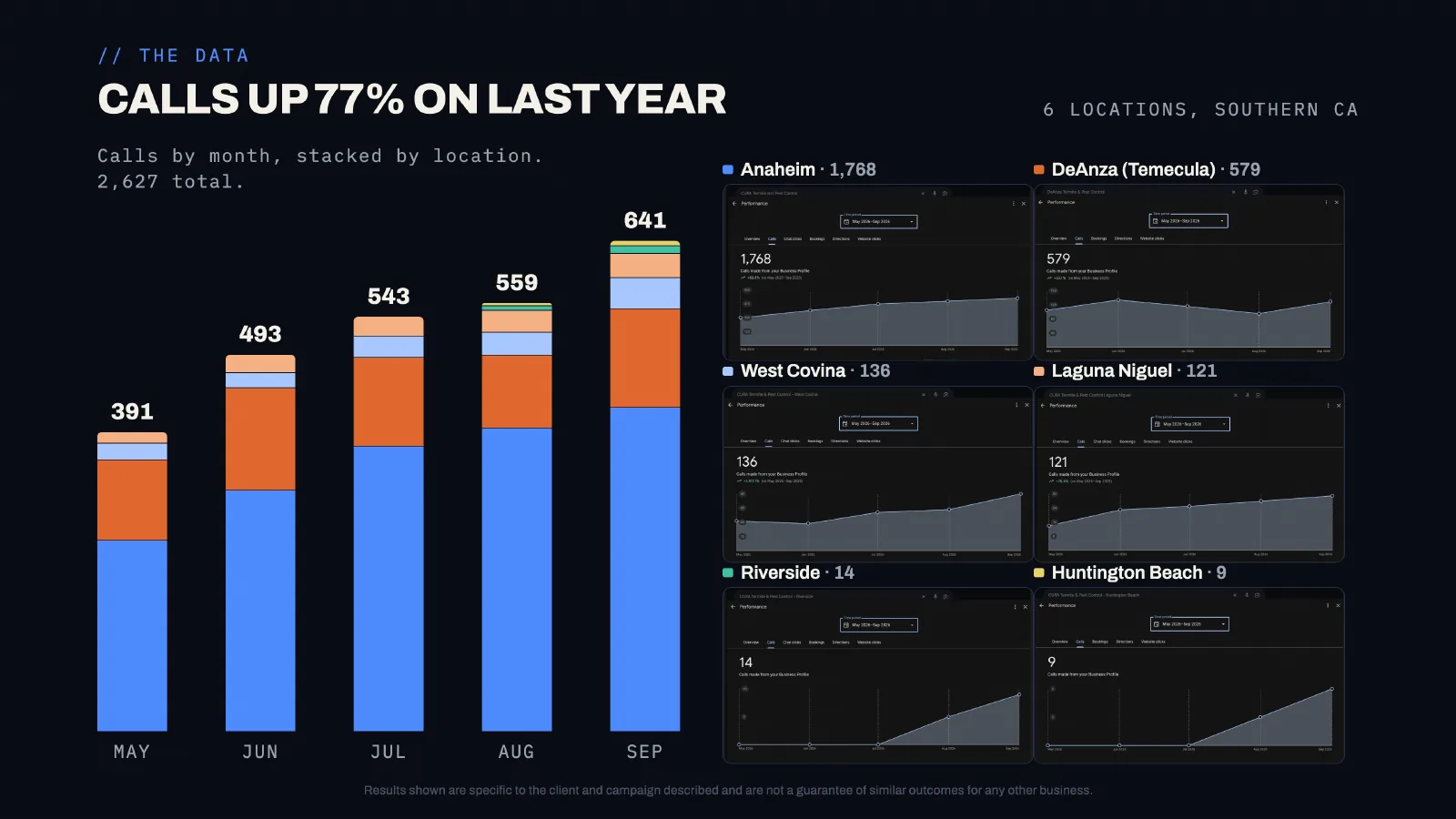
Anaheim 1,768, Temecula 579, West Covina 136, Laguna Niguel 121, plus two new profiles. Average map rank 1.09 in West Covina and 1.63 in Torrance. Calls rose every month, from 391 in May to 641 in September.
King Pest Solutions
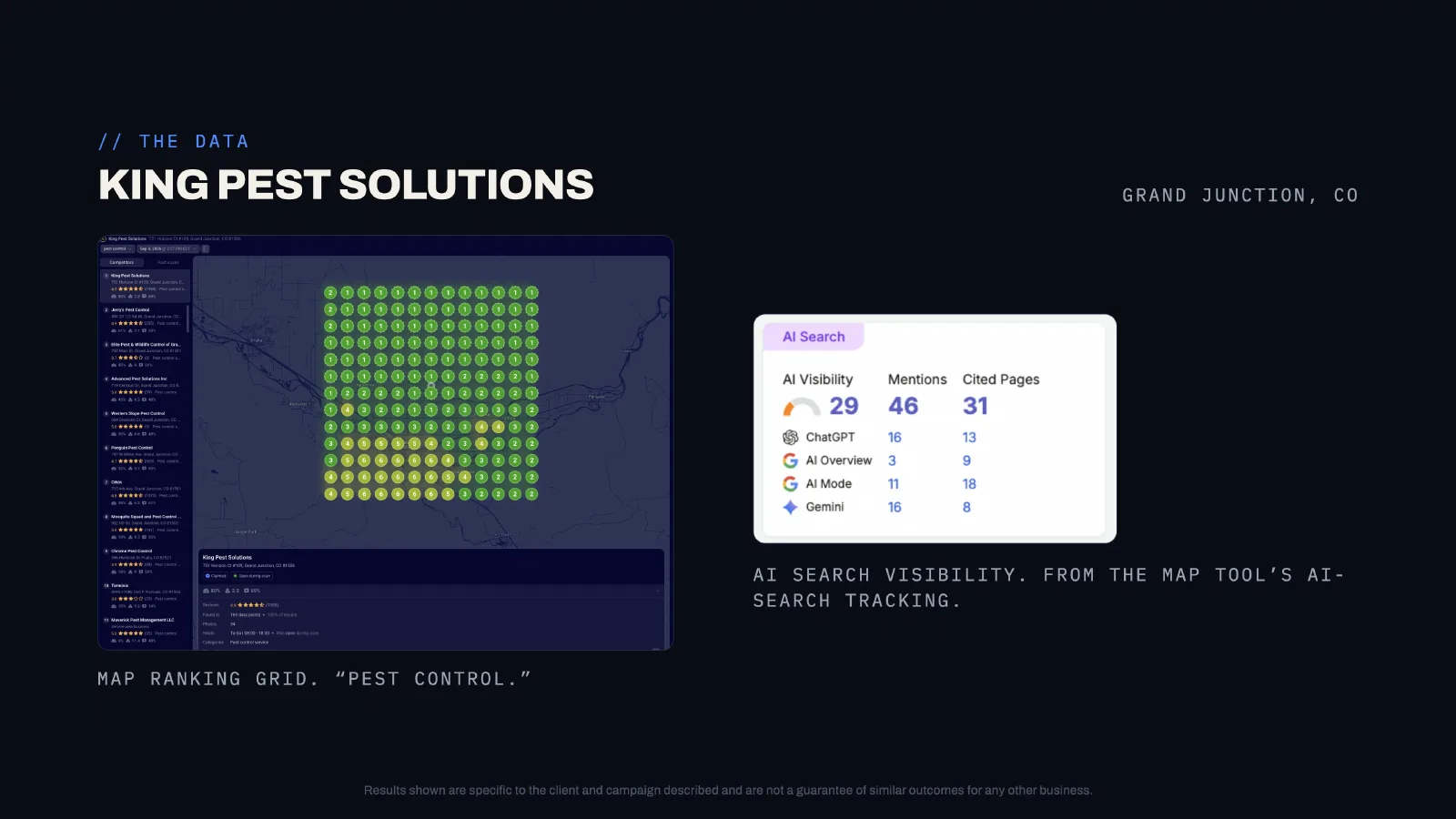
Grand Junction 1,026 and Colorado Springs 763. #1 on Google Maps for “pest control” in Grand Junction, ahead of 10 tracked competitors, with AI search visibility tracked alongside.
Scout Pest Control
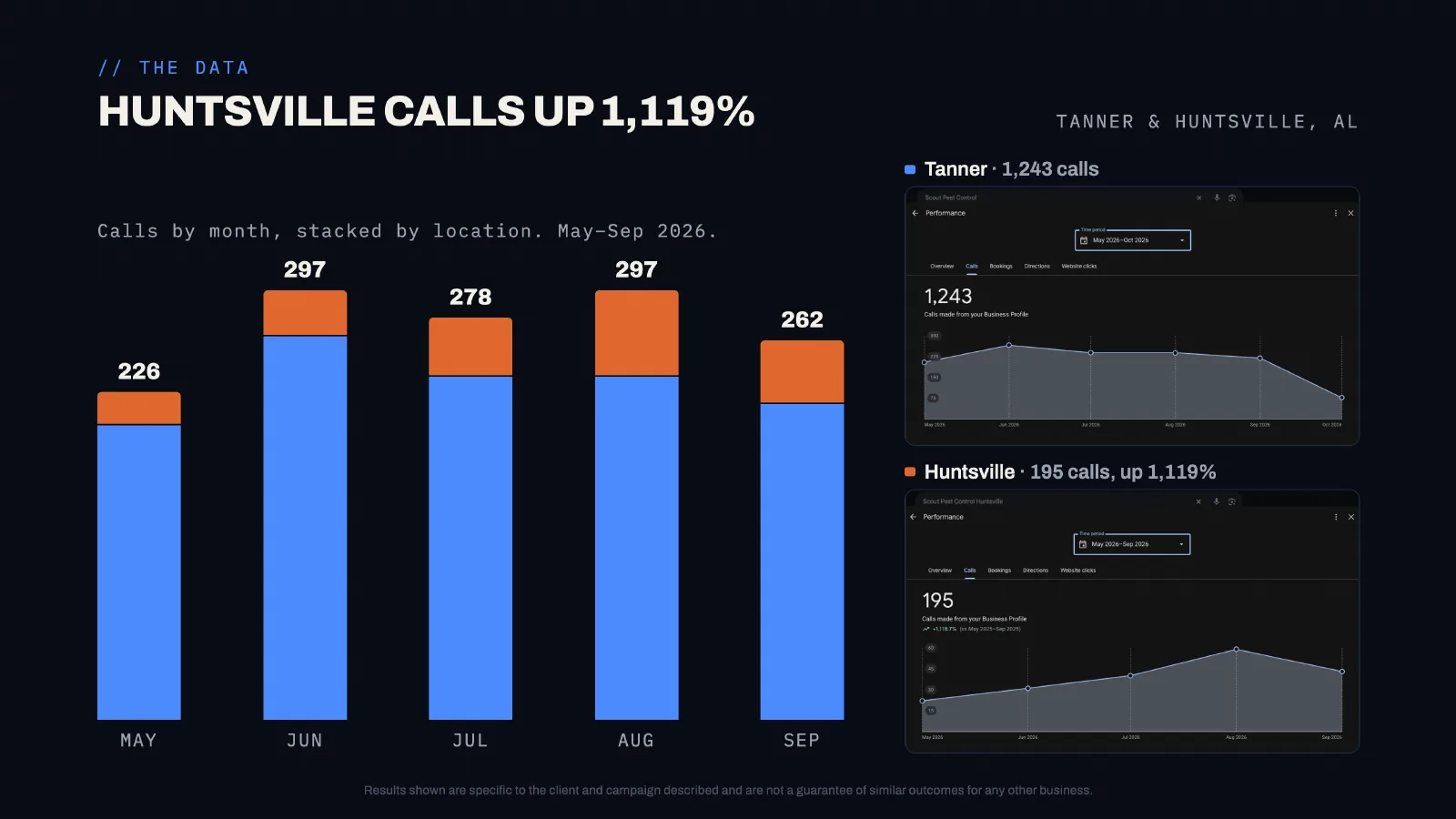
Tanner 1,243 and Huntsville 195, with Huntsville up 1,119% YoY. Average map rank 2.98 for “local pest control” and 2.95 for “exterminator near me” in Tanner.
MMPC Pest Solutions
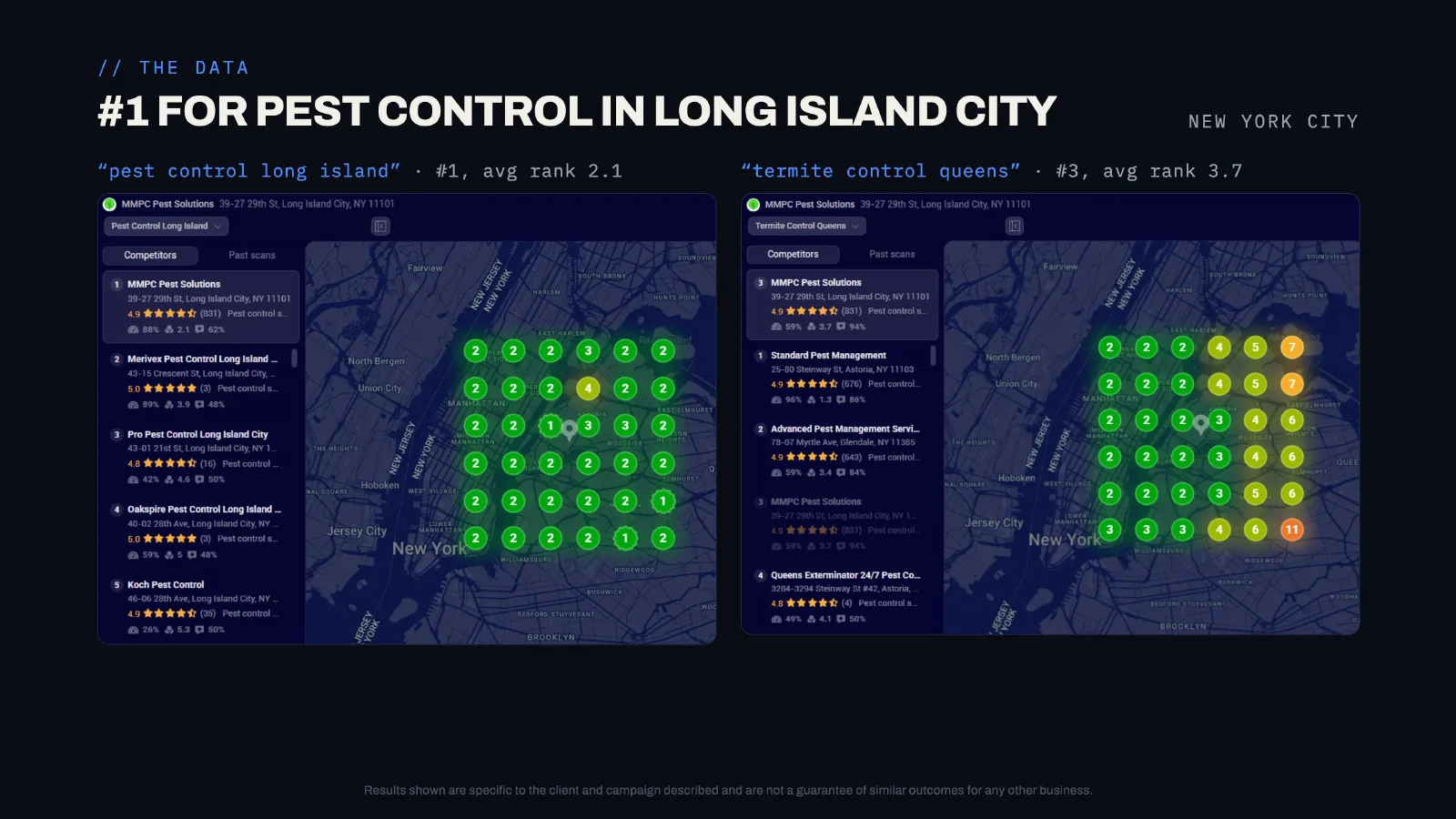
About 140 calls a month. #1 for pest control in Long Island City, with 88% of the map grid in the top 3, and #3 for “termite control queens.”
Surge Pest Control
Owner: Forrest Jensen
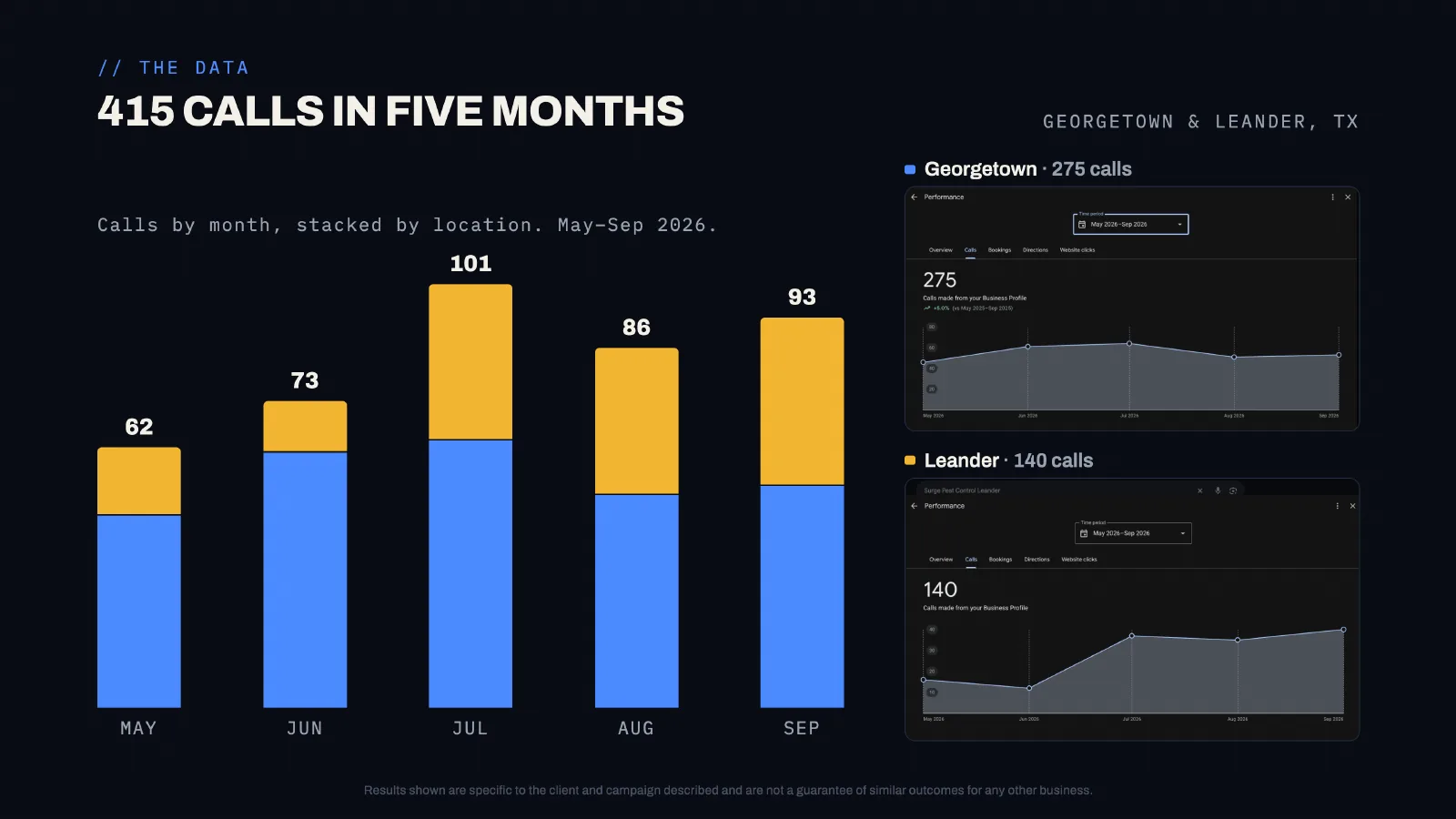
Georgetown 275 and Leander 140, from a second profile we recommended. Average map rank 2.89 for “exterminator” in Georgetown, with 72% of the grid top 3.
 Read the case study
State Termite & Pest Solutions
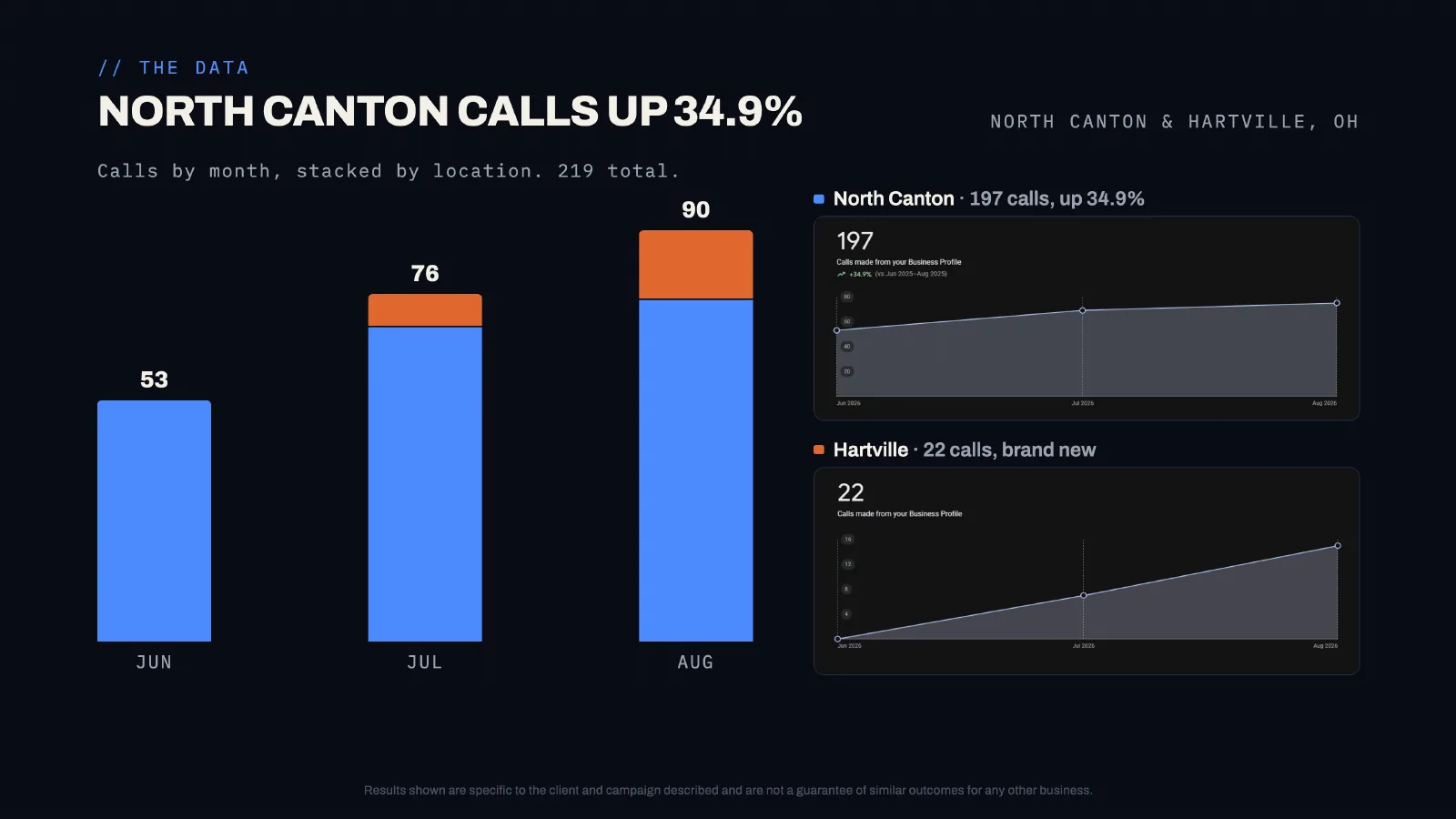
219 calls in three months: North Canton 197 and Hartville 22, from a brand-new profile. Average rank 2.38 for “termite control North Canton,” with 84% of the grid high.
Bad Termite
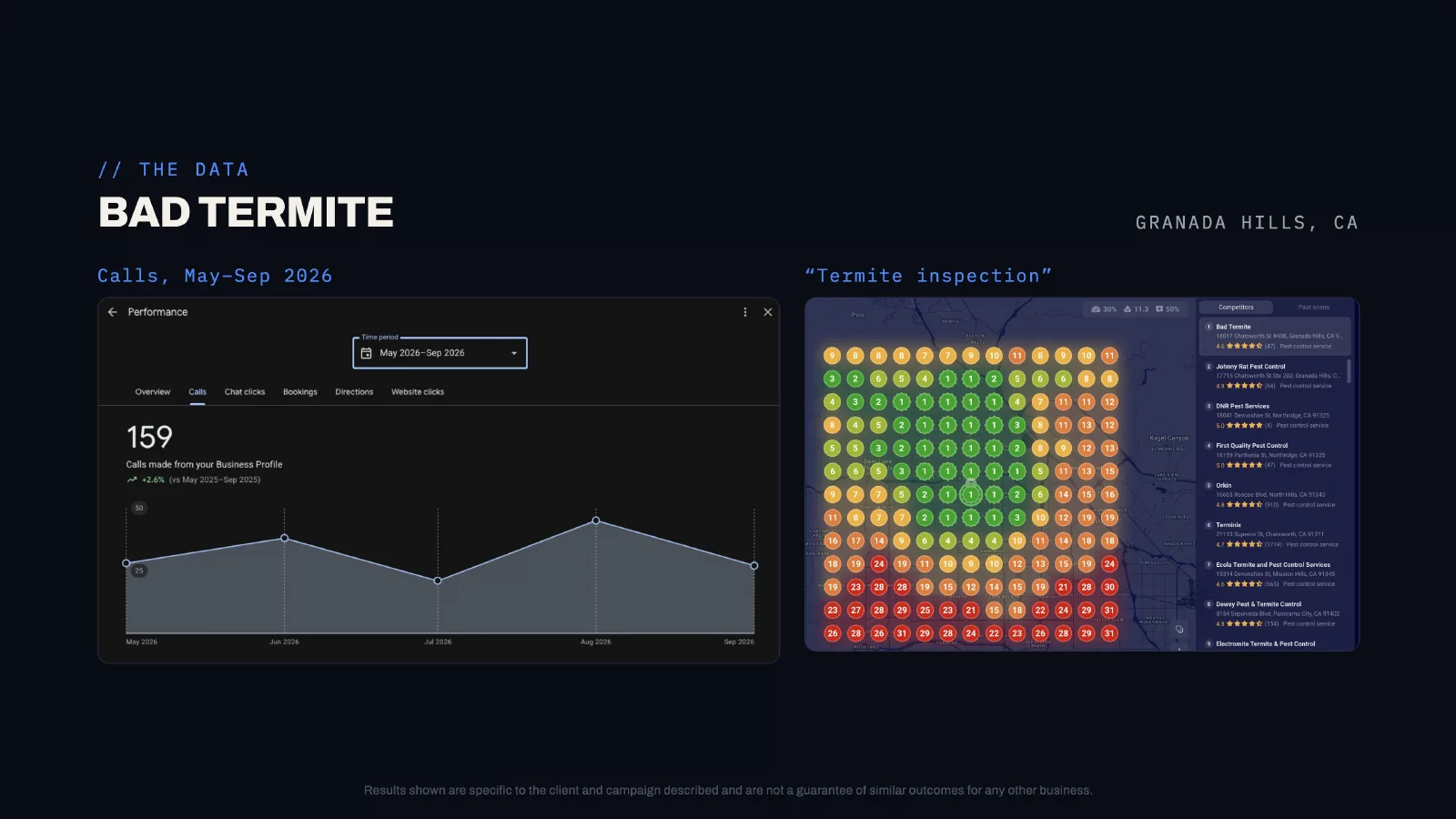
159 calls from Google Business Profile, May–Sep 2026, up on last year. #1 for “termite inspection” across the heart of Granada Hills.
Modern Pest Control
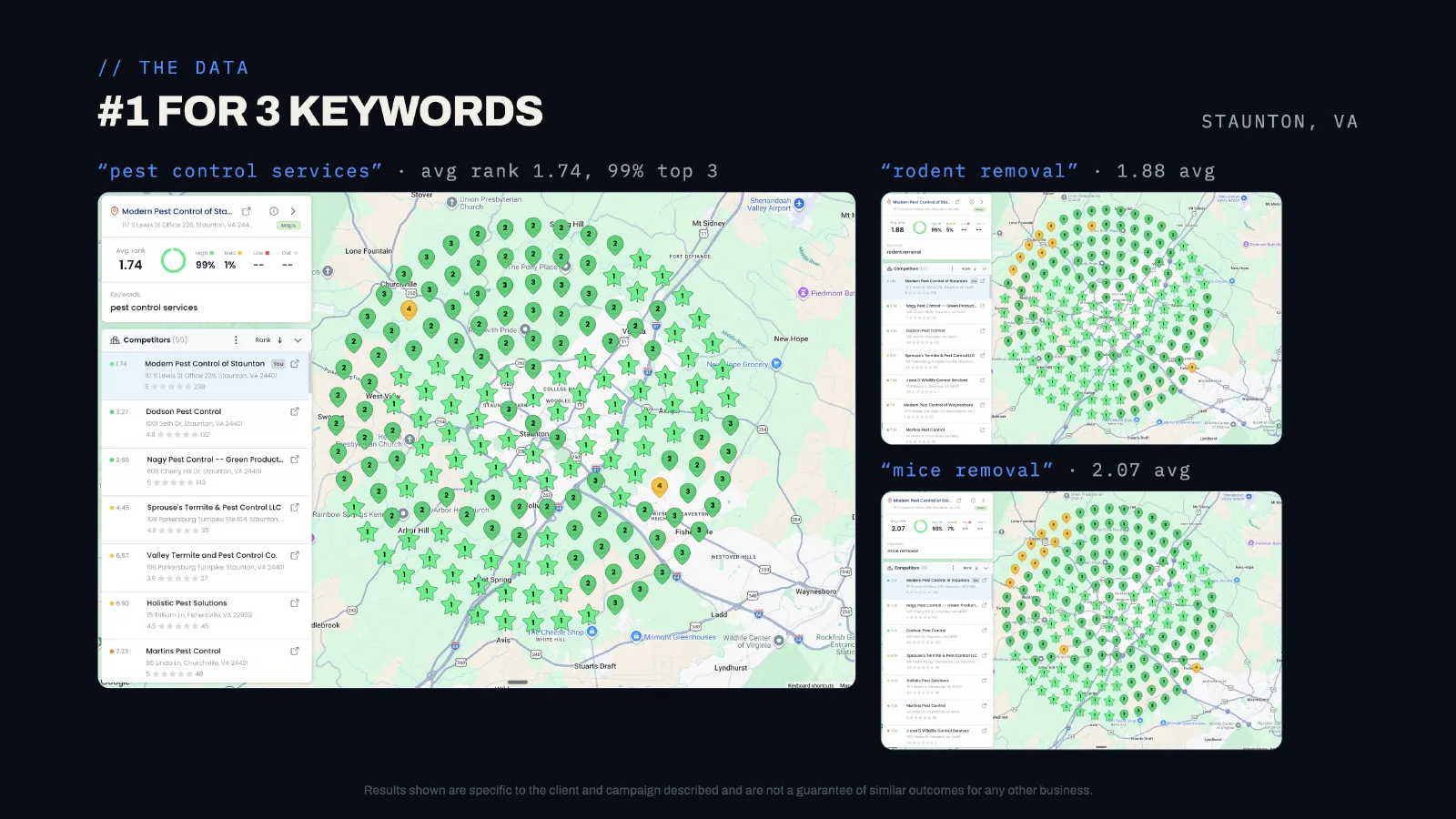
#1 on Google Maps for three keywords: “pest control services” (1.74 average rank), “rodent removal” (1.88) and “mice removal” (2.07).
| Client | Market | Calls from Google | Best tracked map result |
|---|---|---|---|
| Cura Termite & Pest Control | Orange County, Inland Empire and LA County, CA (6 locations) | 2,627 (May–Sep 2026), up 77% YoY | 1.09 avg rank, West Covina |
| King Pest Solutions | Grand Junction & Colorado Springs, CO | 1,789 (May–Sep 2026), up 47% YoY | #1 for "pest control," Grand Junction |
| Scout Pest Control | Tanner & Huntsville, AL | 1,438 (May–Sep 2026) | 2.95 avg for "exterminator near me," Tanner |
| MMPC Pest Solutions | Long Island City, Queens, NY | 744 (May–Sep 2026) | #1, 88% of the grid top 3 |
| Surge Pest Control | Georgetown & Leander, TX | 415 (May–Sep 2026) | 2.89 avg for "exterminator," Georgetown |
| State Termite & Pest Solutions | North Canton & Hartville, OH | 219 (Jun–Aug 2026), North Canton up 34.9% | 2.38 avg for "termite control North Canton" |
| Bad Termite | Granada Hills, CA | 159 (May–Sep 2026), up YoY | #1 for "termite inspection" |
| Modern Pest Control | Staunton, VA | Not reported | 1.74 avg, 99% of the grid top 3, "pest control services" |
Two patterns repeat across these accounts. The companies with the most calls run more than one real Google Business Profile: Cura has six locations, King, Scout, Surge and State Termite each have two. And the newest profiles start slow. Cura's Riverside and Huntington Beach profiles and Scout's Huntsville profile still rank well behind their main offices. A new profile takes months of reviews, pages and links before it pulls its weight.
How pest control marketing differs from other home services
Pest control is a recurring-revenue business sold one urgent problem at a time. Someone finds roaches in the kitchen or termite wings on a windowsill, searches, and calls the first company that looks credible. The money is in turning that one call into a quarterly or monthly plan. That changes what you should measure and where you should spend.
| Pest control | HVAC and plumbing | |
|---|---|---|
| What the first call is worth | Low on its own; the value is the plan it becomes | Often high on its own (installs, water heaters, repipes) |
| What to measure | Cost per new recurring customer, and how long they stay | Cost per booked job and average ticket |
| Searches that matter | Pest + city ("termite inspection Temecula"), "exterminator near me," specific pests | Emergency + service ("AC repair near me," "burst pipe") |
| Other strong channel | Door-to-door sales in peak season | Maintenance agreements and referrals |
| Route economics | Customer density per route decides margin | Less sensitive to density |
| Licensing | State licenses are required (BLS), and Local Services Ads checks business and owner licenses | Trade licenses |
Two of our owners say outright that door knocking is part of their engine. Forrest Jensen calls door-to-door sales the core of Surge Pest Control. Seth Fenn at Cura names his three best channels as "the SEO, our door knocking, and then obviously Yelp." Search marketing doesn't replace a strong sales team. It fills the routes that the sales team builds, and it brings in the urgent calls that door knocking can't reach.
Route density changes how you target, too. A new customer three streets from an existing route is worth more than one 40 minutes away. Build your city pages and Google profiles around the areas where your routes already run, then expand outward.
How do homeowners choose a pest control company?
They look for proof of a license, real reviews and clear answers about safety, then call whoever looks most credible and answers first. Government guidance tells them to check exactly those things. The EPA's tips for selecting a pest control service say cost "should not be the only factor," tell homeowners to get references and verify licenses, and warn them to check the credentials of companies that sell door to door. The National Pesticide Information Center's guide to selecting a company adds insurance, Integrated Pest Management, experience with the specific pest, and written estimates.
That shapes your marketing in three ways:
- Put your license number and service categories on every location page and in your Google profile description. Homeowners are told to check them.
- Answer the safety questions on your pest pages: kids, pets, the products you use and how to prepare. Those are the questions official guides tell homeowners to ask.
- If you sell door to door, make your online proof easy to find. A homeowner who looks you up after a knock should find a real Google profile with recent reviews, a working phone number and a site that shows your license.
The market keeps growing. The Bureau of Labor Statistics projects pest control jobs to grow 6% from 2025 to 2035, faster than average. It notes that while some people treat pests themselves, "many prefer to hire professional pest control services." More competitors each year means the visibility you build now gets harder for them to take.
Which marketing channels get pest control companies the most customers?
For most pest control companies, the Google Business Profile and map pack produce the most calls at the lowest long-run cost. Local Services Ads and search ads bring calls fastest. SEO pages compound over time, reviews decide who gets the call, and door-to-door fills routes in season. Here is how they compare.
| Channel | Speed to first calls | Cost model | Best for | Watch out for |
|---|---|---|---|---|
| Google Business Profile and map pack | Weeks to months | Your time or an agency; no per-click cost | "Pest control near me," "exterminator," pest + city | Suspensions from fake addresses; slow start for new profiles |
| Local Services Ads | Days, after verification | Pay per lead; costs vary by market, competition and bidding | Urgent calls in peak season | Junk leads you must dispute; license and background checks |
| Google search ads | Days | Pay per click | Termite, bed bug, rodent and wildlife searches | DIY and "how to" clicks unless you add negative keywords |
| SEO (pest and city pages) | Months, then compounds | Content and links | Every pest you treat, every town you serve | Thin pages that only swap the city name |
| Reviews | Ongoing | A system and a habit | Winning the click between three map results | Gating or scripting reviews, which breaks Google's rules |
| Door-to-door | Same day | Sales team pay | Filling routes in spring and summer | Local permit rules; quality of signed accounts |
| Email and texts to past customers | Same week | Your CRM list | Turning one-time jobs into plans before the season | Sending without a clear offer |
| Meta (Facebook and Instagram) ads | Days | Pay per impression or click | Seasonal prevention plans, retargeting site visitors | Weak for same-day emergencies |
| Commercial outreach | Months | Sales time | Restaurants, property managers, warehouses on recurring service | Long sales cycles |
| Yelp, Nextdoor, Angi | Varies by market | Free listing to paid leads | Markets where homeowners use them | Shared leads; inconsistent business details |
How to set up a Google Business Profile for a pest control company
A fully built Google Business Profile is where most of our pest control clients' calls come from, so it's the first thing we fix. For most companies the primary category is "Pest control service" (search the category list in your profile for the exact names available). Add secondary categories only for work you actually do. List every pest and service you treat, set real service areas around your routes, keep hours accurate in season, and add real photos of your trucks, technicians and jobs.
Pest control Google Business Profile checklist
- Primary category: "Pest control service." Test secondary categories one at a time, and only for services you offer.
- Business name: your real, legal business name. Adding "Best Exterminator Anaheim" to the name breaks Google's guidelines and invites a suspension.
- Services: every pest and treatment as its own service: termite inspection, termite treatment, fumigation, rodent removal, bed bugs, ants, roaches, mosquitoes, wildlife, and commercial service.
- Service areas: the cities and ZIP codes your routes actually cover.
- Website link: point each profile to the page for that location, not just your homepage.
- Photos: real trucks, uniforms, technicians and before-and-after photos, added every month.
- Hours: accurate, including seasonal changes and holidays.
- Reviews: ask after every service and reply to every review.
- Updates: post seasonal updates (termite swarms in spring, mosquitoes in summer, rodents in fall).
Google removed the Questions and Answers feature from Maps in December 2025, so put your answers on the profile's services and description and on your website instead. Our full pest control Google Business Profile guide walks through every setting.
When should a pest control company add a second Google Business Profile?
When you have a real, staffed location in another market. Each profile can only rank around its own address, so one office can't win the map in a city 30 miles away. That's why it's the most common growth move we recommend. In Bodhi's audit of a New Jersey pest company (video below), the advice was a profile in each county the company already served but had no office in. Surge's second profile, in Leander, produced 140 calls in its first five months of tracking. State Termite's new Hartville profile produced 22 calls in its first three months.
Only open a profile for an address that meets Google's guidelines: a real location where you're staffed or meet customers. Virtual offices and mailbox addresses get suspended. If that's already happened, here's how to get a suspended Google Business Profile back.

Read the full Google Business Profile and reviews guide
How pest control companies rank higher on Google Maps
Map rankings come down to three things: how relevant your profile and website are to the search, how close the searcher is to your address, and how prominent your business is, mostly from reviews, links and mentions. You can't move your address. You can make your profile and pages the most relevant in town, and you can out-review and out-link the companies around you.
Check rankings on a grid, not with one search from your office. A single search shows what one spot sees. A grid shows the whole service area. Modern Pest Control's grid for "pest control services" in Staunton, Virginia averages 1.74, with 99% of the points in the top 3. Scout's grid for "pest control near me" in Huntsville averages 7.95, with 29% of points high. Both are true at the same time, and only a grid shows you where to work next.
| Map ranking factor | What to do | Client example |
|---|---|---|
| Category and services | "Pest control service" primary; every pest listed as a service | Bad Termite ranks #1 for "termite inspection" across Granada Hills |
| Location page | Link each profile to a page about that city, with its pests and its jobs | State Termite: 2.38 avg for "termite control North Canton" |
| Reviews | A steady flow every week, at every location | Cura: about 1,500 reviews across its profiles, per the owner |
| Links and citations | Consistent name, address and phone everywhere; local links | Cura's domain authority went from 8 to 24, per the interview |
| Real locations | One profile per staffed office | Cura, King, Scout and Surge all rank from more than one office |
The map pack can move quickly when the basics get fixed. Cura's DeAnza Termite & Pest Control profile in Temecula went from an average rank of 7.08 to 5.09 for "termite inspection" in about a month.
Read the full Google Maps ranking guide
What pages does a pest control website need to rank?
One page for every pest you treat, one for every city you serve, and a page for each office location. Homeowners don't search "pest control services." They search "termite inspection Temecula," "bed bug treatment near me" or "pest control Anaheim." A page that matches the search ranks. A services list with a sentence per pest doesn't.
Cura shows what this looks like when it works. In Bodhi's audit video, Cura's site gets about 5,000 visitors a month from search, and its top keywords are city searches: "pest control Anaheim," "pest control Garden Grove," "Orange County pest control." "Pest control Anaheim" alone shows about 1,300 searches a month in Semrush, and Cura ranks #1 for it. Compare that with the audited New Jersey company, whose title targeted "New Jersey," a state it will never rank for statewide. The fix was to target the county it actually serves.
| Page type | Example | What it must include |
|---|---|---|
| Location page (one per profile) | /anaheim-pest-control | Address, the area served, local pests, real jobs and photos, reviews from that office |
| City page | /pest-control-garden-grove | What's different about pests there, neighborhoods, nearby jobs, how fast you can be there |
| Pest page | /termite-inspection | Signs, how the inspection or treatment works, visits needed, how to prepare, safety for kids and pets |
| Pest + city page (high-value only) | /termite-control-temecula | Only where search demand and margin justify it, with real local detail |
| Plans page | /pest-control-plans | What each plan covers, how often you visit, what happens if pests come back |
| Commercial page | /commercial-pest-control | Restaurants, property managers and warehouses; inspection logs and reporting |
Cura's own site is built this way. Each office has a location page, such as /locations/orange-county-ca/anaheim, with service pages under it, such as Anaheim pest extermination. That gives each Google Business Profile a matching page to link to and gives Google one clear page for each city and service.
Pest control SEO checklist
- Title tags name the service and the city or county you serve, such as "Pest Control in Bergen County, NJ," not just the state.
- One H1 per page that matches what people search.
- The answer comes first on every page: what you treat, where, how fast, and what it involves.
- No copies with only the city name swapped. Every city page needs real local detail.
- Pest pages link to the city pages where you treat that pest, and city pages link back.
- LocalBusiness schema on each location page, with the same name, address and phone as the profile.
- Fast load and a working layout on phones, where most of these searches happen.
- Earned links from local sites, suppliers, associations and local news, not bought link packages.
A blog alone isn't an SEO strategy. Seth Fenn paid his previous agency for "a couple years" of blog posts. "I don't think our domain authority, I don't think anything increased a substantial amount," he says. What moved Cura was service and city pages, links and reviews.
Want this built for your pest control company? Book a free growth call and we'll review your Google profiles, site and rankings.
Book a Growth CallRead the full Google Ads and LSA guide
Are Local Services Ads worth it for pest control?
Usually yes, for urgent calls in peak season. Local Services Ads show above the regular search ads with the Google Verified badge, and you pay per lead, not per click. Google's screening and verification for pest control can include state business and owner license checks and a verified Google Business Profile, and Google says it takes three to four weeks on average. Lead costs vary by market, competition and bidding, so set your ceiling from what a new recurring customer is worth to you, not from someone else's number.
Local Services Ads are also changing. Google began moving them into Google Ads as pay-per-lead campaigns in August 2026, with pest control in the first group: weekly budgets become daily budgets, manual bidding goes away, and old reports don't carry over. Our Google Ads and LSA guide for pest control covers the migration in detail.
- Pick only the job types you want, such as termites, rodents, bed bugs and general pest.
- Answer every LSA call live. Google says responsiveness is one of the factors in how LSA ranks.
- Give LSA its own fixed tracking number in your CRM records, because LSA calls never touch your website and won't show up in Google Analytics.
- Dispute leads that don't qualify, such as wrong services, spam and areas you don't cover.
- Ask LSA customers for Google reviews too. Reviews help both the ads and the map.
- Compare LSA's cost per new recurring customer with search ads and the map every month.
Google's money-back guarantee for LSA customers ended on December 7, 2025, and the badge is now called Google Verified. If your site or ads still use the old badge name, update them.
Read the full pest control lead generation guide
How to run Google Ads for a pest control company
Bid on the pests and cities you want, block searches from people who plan to do it themselves, and send each ad group to a page about that pest. The common mistakes in pest control ads are broad keywords that pull in "how to get rid of ants" clicks and ads that point to the homepage.
- Ad groups by pest: termites, bed bugs, rodents, wildlife, mosquitoes and general pest. Each has its own landing page.
- Negative keywords: DIY, "how to," spray, home remedy, jobs, salary, license and course.
- Location targeting: people in your service area, not people "interested in" it.
- Call tracking: a tracked number on ads and landing pages, so every call has a source.
- Seasonal budgets: raise them as your local season starts, and cut them back when it ends.
- Conversions: count booked inspections and signed plans, not just form fills.
Paid ads stop the day you stop paying. Most of our pest clients use ads and LSA to cover peak season while the map and SEO build calls that don't charge per click.
See how we run Google Ads for pest control
Pest control marketing by season
Pest searches follow the weather, and the timing shifts by region and species, so use your own call data from last year as the real calendar. As a general pattern, subterranean termites swarm on warm days after rain, mostly in spring. The UC Statewide IPM Program notes some species also fly in fall, and NC State Extension says North Carolina's native species swarm from late winter into September or October. Mice tend to move indoors as temperatures drop in fall. Get your pages, offers and budgets ready six to eight weeks before your local peak, not when the phone starts ringing.
| Season | What people search | What to do |
|---|---|---|
| Late winter | Few urgent searches; rodents still active | Build and refresh pest and city pages; prep seasonal profile updates; email past one-time customers about plans |
| Spring | Termite swarms (late winter in the South), termite inspection, ants | Raise ad and LSA budgets gradually; post termite updates; push reviews hard |
| Summer | Mosquitoes, wasps, roaches, bed bugs | Peak ads; door-to-door; answer every call; ask every new customer for a review |
| Fall | Mice, rats, spiders, stink bugs | Rodent pages and ads; convert summer one-time jobs to plans |
| Winter | Rodents, wildlife in attics, bed bugs | Lower ad budgets; build links and content; plan next season's locations |
How many Google reviews does a pest control company need?
More than the companies ranking above you, and a steady flow every week rather than a burst. Our best-performing clients get 25 new reviews/month. Reviews help you rank, and they decide which of the three map results gets the call.
- Ask after every service, by text, with a direct link to the right location's profile.
- Ask every customer, not only the happy ones. Google doesn't allow review gating.
- Never tell customers what to write. Just ask for an honest review.
- Reply to every review, and handle complaints directly before they become one-star reviews.
- Link your site's review section to your Google profile, not to an unverifiable testimonials page.
Seth Fenn says Cura has about 1,500 reviews across its profiles, with ratings of 4.9 and 5.0. What he values most in the review system is hearing about a low rating directly, so he can "reach out to the customer and handle that situation" right away. Bodhi made a related point in the New Jersey audit: a reviews section on your own site should link out to your Google profile, because "this page could be completely fake" to a visitor who can't check it.
Read the full pest control SEO guide
What makes a pest control website convert?
It tells the homeowner in seconds that you treat their pest, in their town, safely, and that they can book today. Put the phone number and booking button where they're easy to find, show real photos of your team, and link real reviews.
- The headline names the service and the area, such as "Pest control in Orange County."
- Real photos of your technicians and trucks, not stock families.
- A click-to-call number and online booking above the fold on mobile.
- A clear list of pests you treat, each linking to its own page.
- Answers to the safety questions about kids, pets, and what to expect before and after treatment.
- Plan details that are easy to compare.
- Licenses and service areas visible.
- Pages that load fast on a phone.
An old-looking site costs you calls even when its SEO is decent. In the audit, Bodhi's verdict on a site that "looks like it's from 2015" was that it didn't need to be rebuilt from scratch. It needed a modern front end and local targeting.
Read the full pest control website design guide
How do pest control companies get recommended by ChatGPT and AI search?
AI assistants such as ChatGPT, Gemini, Claude, Grok and Google's AI Overviews recommend local companies they can confirm from many sources. That means consistent listings everywhere, strong recent reviews that describe the work, clear answers on your own site about which pests you treat and where, and mentions on other sites. No one can guarantee a recommendation, but every one of those signals is something you can build.
- The same business name, address, phone and services on Google, Bing, Apple Maps, Yelp, the BBB and industry directories.
- Every pest and city page starts with a plain answer an AI tool can quote.
- FAQ and LocalBusiness schema on the right pages.
- A Bing Places profile. ChatGPT and Copilot lean on Bing's index.
- Mentions on local news, associations, podcasts and supplier sites.
- A monthly check of the prompts your customers would ask, such as "best termite company in Temecula."
King Pest Solutions is a working example. We track its AI search visibility alongside its map grid in Grand Junction, where it ranks #1 on the map for "pest control." Our guide to AI search for pest control companies covers the full method.
Read the full AI search guide for pest control
Why do fast answers matter so much in pest control?
Because someone with roaches in the kitchen calls the next company on the list if you don't pick up. Every channel above produces calls. Unanswered calls waste them. Answer live during business hours, have an answering service or after-hours line in peak season, call back missed calls within minutes, and track the answer rate by location.
Speed matters for LSA as well, because responsiveness is one of the factors Google lists for LSA ranking. A missed call costs you the customer and can lower your ad position.
What should a pest control company measure?
Cost per new recurring customer by channel, and how long those customers stay. Leads and clicks only tell you about activity. A channel that brings cheap one-time jobs can be worth less than an expensive one that brings plan customers who stay for years.
| Metric | Why it matters | Where it comes from |
|---|---|---|
| Calls and forms by source | Shows which channel produced the lead | Call tracking, Google profile insights, form tracking |
| Answer rate | A missed call is a lost customer | Phone system, call tracking |
| Booked rate | Shows whether your office is converting the calls | CRM (FieldRoutes, PestPac, ServiceTitan and others) |
| Cost per new recurring customer | The number every channel is judged on | Spend by channel ÷ new plan customers by channel |
| Retention | Decides what a customer is really worth | CRM cancellations and renewals |
| Map grid rank by location | Leading indicator for calls | Grid tracking tools |
| AI visibility | Whether assistants name you | Monthly prompt checks |
Three setup details decide whether these numbers can be trusted. Make the lead source field required in your CRM, so your office can't skip it on a busy morning. Use call tracking with different numbers for ads, organic search and LSA, so each call carries its source. And extend Google Analytics data retention from the default two months to the maximum, so you can compare this May with last May.
Compare each month with the same month last year, not the month before. Pest control is seasonal, and a quiet January isn't a failure. That's why the client numbers above are shown year over year.
How much should a pest control company spend on marketing?
Pest control companies spend about 6.6% of revenue on marketing and advertising on average, according to the 2025 NPMA and PCO Bookkeepers cost study of 246 firms. For a $1M company, that's about $5,500 a month. Growth-stage companies opening new locations often spend more. Seth Fenn's advice is to "reinvest everything back into marketing," and to put the most money into whichever channel gives the best return. Our pest control marketing budget guide breaks budgets down by revenue and season.
More pest control marketing ideas
A 90-day pest control marketing plan
The order matters. Fix what's broken and what's free first, then add paid ads, then build the pages and links that compound.
| When | What to do |
|---|---|
| Week 1–2 | Audit every Google Business Profile: categories, services, service areas, hours, photos and website links. Set up call tracking and a map grid for your core searches. |
| Week 2–4 | Start the review system at every location. Fix name, address and phone mismatches across directories. Set up or verify LSA. |
| Month 2 | Build or rebuild location pages and your top pest pages, starting with termites, rodents, bed bugs and general pest. Fix title tags to target real cities and counties. |
| Month 2–3 | Launch search ads by pest with strong negative keywords. Add city pages for the towns your routes already cover. |
| Month 3 | Review the grids, calls by source and cost per new recurring customer. Decide whether a second location and profile makes sense. |
How to choose a pest control marketing agency
How we work with pest control companies
We run Google Business Profiles, map rankings, SEO, website pages, Local Services Ads, Google Ads and AI search visibility for pest control companies across the US. Each client gets an account manager, a monthly report with calls by source and map grids, and a clear list of the pages we've added. Forrest Jensen calls that transparency "one of my favorite things about Stryker." When services were missing from Surge's new profile, "two days later it was done."
We're honest about what we drive. Surge's growth comes mostly from Forrest's door-to-door team. We run the SEO and the Google profiles, and we're one part of the growth, not the cause of it.
Client proof, in the owners' words

Cura Termite & Pest Control (Seth Fenn, Orange County, Los Angeles County and the Inland Empire, California). 2,627 calls from Google across six locations from May to September 2026, up 77% on the year before, with calls rising every month from 391 to 641. Average map rank is 1.09 in West Covina, 1.63 in Torrance and 2.88 in Anaheim. On what changed, Seth says: "we were on the second and third page. Now I'm in the map pack number one, and I'm on the first page." More in his full interview.

Surge Pest Control (Forrest Jensen, Georgetown, Texas). Started from zero at the end of 2023, did about $500K in year one, and is hitting about $2M in 2026 (owner-reported). On the second Google Business Profile, Bodhi said "it's now ripping," and Forrest answered, "I'm sure we'll get a third one." Read the Surge case study.
See all pest control case studies
Guides for pest control owners
- Pest control SEO: pest and city pages, title tags, links and reviews.
- Rank on Google Maps: how pest companies get into the map pack.
- Google Business Profile and reviews: setup, categories and a steady review flow.
- Google Ads and Local Services Ads: campaigns, LSA and what leads cost.
- Lead generation: where pest control leads come from and what they cost.
- Website design: sites that turn visits into calls.
- Marketing ideas: tactics that work by season.
- AI search: getting named by ChatGPT and AI Overviews.
- How to choose an agency: questions to ask and red flags.
- Case studies: eight pest control companies, real numbers.
- Marketing budget: how much to spend, by revenue and season.
- Surge Pest Control case study: from zero to about $2M, in the owner's words.
- Suspended Google Business Profile: how to get it back.
- All client videos: owners on camera.
- Plumbing marketing, roofing marketing and electrician marketing: the same system for other trades.
FAQ
How much does pest control marketing cost?
The industry average is 6.6% of revenue, from the 2025 NPMA and PCO Bookkeepers cost study, or about $5,500 a month for a $1M pest control company. Growth-stage companies opening new locations often spend more. Judge spend by cost per new recurring customer. See our pest control marketing budget guide.
What is the best marketing for a pest control company?
For most companies: a fully built Google Business Profile for each real office that ranks in the map pack, one website page per pest and per city, a steady flow of Google reviews, and Local Services Ads and search ads in peak season. Many of the strongest companies add door-to-door sales. The best channel in your market is the one with the lowest cost per new recurring customer.
How do I get more pest control leads?
Fix your Google Business Profile first (category, services, service areas, photos and reviews), build pages for the pests and cities you serve, and turn on Local Services Ads while SEO builds. Then answer every call quickly. Speed decides who gets the job.
Is SEO or Google Ads better for pest control?
Ads and Local Services Ads bring calls within days but stop when you stop paying. SEO and the map pack take months but keep producing calls. Most pest control companies run both: ads for peak season while SEO lowers the overall cost per customer over time.
How long does pest control SEO take?
Map rankings can move in weeks once the profile is fixed. Cura's Temecula profile went from 7.08 to 5.09 for "termite inspection" in about a month. City and pest page rankings usually take a few months. It depends on your competition and where you start.
Are Local Services Ads worth it for pest control?
Usually, for urgent calls in season. You pay per lead, get the Google Verified badge, and show above regular ads. Lead costs vary by market, competition and bidding. Dispute bad leads, answer every call and compare cost per new recurring customer with your other channels.
What Google Business Profile category should a pest control company use?
"Pest control service" as the primary category for most companies. Add secondary categories only for services you actually offer, and list every pest you treat as a service.
Should a pest control company have more than one Google Business Profile?
Yes, if you have a real, staffed location in each market. Each profile ranks around its own address. Cura runs six locations and Surge's second profile produced 140 calls in five months. Never use a virtual office or mailbox address, because those profiles get suspended.
Can you get my pest control company recommended by ChatGPT?
No one can guarantee it. AI assistants recommend companies with consistent listings, strong reviews that describe the work, clear answers on their own site and mentions on other sites. We build all four and check the prompts that matter in your market every month.
Do you work with termite and wildlife companies too?
Yes. Cura Termite & Pest Control, State Termite & Pest Solutions and Bad Termite are termite-focused, and Modern Pest Control ranks #1 for rodent removal in Staunton. We build pages, categories and campaigns for each service you offer.