
A common benchmark is to spend 7–8% of gross revenue on marketing, which the SBA suggests for businesses under $5M in revenue with 10–12% net margins. For an HVAC company doing $1M, that's about $70,000–$80,000 a year, or $5,800–$6,700 a month. Spend more when you're growing into new towns with spare capacity, less when the schedule is full, and judge every dollar by cost per booked job.
"How much should I spend on marketing?" is the wrong first question. The right one is "how much does a booked job cost me, and how many more can my team run?" This guide gives you the benchmark, the math by revenue size, real 2026 lead costs by channel, a sample split, a seasonal calendar and the five numbers to track. The benchmarks are industry figures with sources, not our pricing.
What percentage of revenue should an HVAC company spend on marketing?
Start at 7–8% of gross revenue. That's the SBA guideline for small businesses with healthy margins, as reported by Investopedia. Growing HVAC companies entering new markets often go higher for a period; established companies with full schedules and strong referrals often run lower. Count all marketing costs, not just ad spend.
The rule comes from SBA guidance for businesses under $5M with 10–12% net margins (Investopedia, citing the SBA). If your margins are thinner, fix pricing, close rate and membership sales before you add spend, because more leads won't fix a leaky bucket.
Count everything: ad spend (Local Services Ads, search, social, mail), agency and freelancer fees, software (call tracking, review tools, CRM marketing add-ons), print, vehicle wraps, sponsorships, and in-house marketing payroll. Leaving things out makes your percentage look better than it is.
How much should an HVAC company spend on marketing by revenue size?
At the 7–8% benchmark, a $500K HVAC company spends about $35,000–$40,000 a year, a $1M company $70,000–$80,000, a $2M company $140,000–$160,000 and a $5M company $350,000–$400,000. Divide by 12 for a monthly number, then shift it with the seasons.
| Annual revenue | 7% per year | 8% per year | Per month (average) |
|---|---|---|---|
| $500,000 | $35,000 | $40,000 | $2,917–$3,333 |
| $1,000,000 | $70,000 | $80,000 | $5,833–$6,667 |
| $2,000,000 | $140,000 | $160,000 | $11,667–$13,333 |
| $3,000,000 | $210,000 | $240,000 | $17,500–$20,000 |
| $5,000,000 | $350,000 | $400,000 | $29,167–$33,333 |
| $10,000,000 | $700,000 | $800,000 | $58,333–$66,667 |
This is arithmetic on the benchmark, not a promise of results. Companies above $5M are outside the SBA's range and usually spend a lower percentage on a bigger base.
How much should you spend at each stage of growth?
Use three modes. Grow: spend above the benchmark while building your profile, reviews and site. Hold: stay near 7–8% and improve the weakest channel. Protect: once the board stays full, spend less as a percentage and protect your rankings and repeat customers.
| Mode | When | Spend | Where it goes |
|---|---|---|---|
| Grow | New company, new market, or a clear capacity gap | Above 8% of revenue for a set period | Profile, reviews, service pages, plus paid ads to buy calls while organic builds |
| Hold | Steady flow, want more | About 7–8% | Keep what books jobs, fix the weakest channel |
| Protect | Board full most of the year | Below 7% | Map rankings, reviews, past-customer marketing, replacement campaigns |
Spending more can pay off. In the ACCA's Contractor of the Future study, the average contractor spent 6% of revenue on marketing and advertising, and contractors who invested at least 12% reported net profit of 9% versus 5%. That shows the two go together, not that spending caused the profit, so earn the higher spend with tracking.
When should an HVAC company spend more or less than 7–8%?
Spend more when you have spare tech capacity, a proven cost per booked job, and a new town or service line to grow into. Spend less when the schedule is booked out, your call-to-booking rate is poor, or you can't yet track which channel produced a job. Fix tracking and phones before adding budget.
| Spend more when | Spend less when |
|---|---|
| Techs have open slots most weeks | You're booked out two weeks ahead |
| You're entering new towns or adding heat pumps, ductless or IAQ | Calls are going unanswered or unbooked |
| Cost per booked job is proven and stable | You can't see which channel booked a job |
| You're new and have few reviews or referrals | Membership and referral work already fill the board |
Capacity comes first. Marketing that brings in more work than your techs and CSRs can run is wasted, and missed calls also hurt your Local Services Ads ranking.
What do HVAC leads cost by channel in 2026?
Public benchmarks put HVAC Local Services Ads leads around $50–$65 on average and Google search ad leads around $128–$129 for AC and heating campaigns. Organic map and website calls have no per-lead cost but take months to build. Prices vary by market, competition and season.
| Channel | Benchmark | Source |
|---|---|---|
| Local Services Ads (HVAC) | $51 average lead, 44% booked (Feb 2026) | SearchLight LSA benchmark |
| Local Services Ads (HVAC) | $59 median lead; most accounts $36–$85 (June 2026) | AdGenius |
| Search ads: AC installation and repair | $9.68 per click, $127.74 per lead, 6.56% conversion rate | LocaliQ 2025 home services benchmarks |
| Search ads: heating and furnaces | $9.30 per click, $129.02 per lead, 7.48% conversion rate | LocaliQ 2025 home services benchmarks |
| Google Business Profile and SEO | No per-lead fee; cost is the work to build and maintain it | Your own tracking |
The LocaliQ figures are medians from 3,211 US search campaigns between April 2024 and March 2025. Lead costs are where you start; what matters is what a lead becomes. At a 44% booking rate, a $51 LSA lead is roughly a $116 booked job.
How do you build an HVAC marketing budget from the jobs you need?
Work backwards. Start with the extra revenue you want, divide by your average ticket to get jobs, divide jobs by your booking rate to get leads, then multiply leads by cost per lead for each channel. That gives a budget tied to your goal, which you can check against the percent-of-revenue benchmark.
We call this the jobs-back budget. Here's an example with made-up but realistic numbers. Swap in your own.
| Step | Example |
|---|---|
| 1. Extra revenue you want this year | $300,000 |
| 2. Average ticket (mix of repair and replacement) | $1,500 |
| 3. Jobs needed (1 ÷ 2) | 200 jobs |
| 4. Booking rate on paid leads | 44% (SearchLight's LSA booking rate) |
| 5. Leads needed (3 ÷ 4) | 455 leads |
| 6. Cost per lead | $51 (LSA) to $128 (search ads) |
| 7. Paid media budget (5 × 6) | $23,000 to $58,000 a year |
Then check it: $58,000 is about 19% of the $300,000 it's meant to bring in. If that's more than your margins allow, raise the booking rate or shift budget toward cheaper channels before you add spend.
What is the most you can pay for a booked HVAC job?
Your ceiling is the gross profit on the job times the share of it you're willing to spend on marketing. Work it out separately for repairs, maintenance and replacements. A replacement can carry a cost per booked job that would lose money on a repair call.
Max cost per booked job = average ticket × gross margin × share you'll spend on marketing.
| Job type (example) | Ticket | Gross margin | Share for marketing | Ceiling |
|---|---|---|---|---|
| Repair | $450 | 50% | 25% | $56 |
| Maintenance plan | $250 a year | 60% | 30% | $45 (more over its life) |
| System replacement | $10,000 | 40% | 10% | $400 |
At a $128 cost per lead and a 44% booking rate, a search-ad booked job costs about $290. That clears the replacement ceiling easily and fails on repair calls. That's why we split budgets by job type instead of setting one number for "Google".
How should an HVAC company split its marketing budget?
There's no single right split, but a sound starting point puts most of the budget on demand capture (a fully built Google Business Profile, SEO, Local Services Ads and search ads), a smaller share on retention (mail, memberships, email), and a test budget for new ideas. Then move money monthly toward the lowest cost per booked job.
| Bucket | What's in it | Why |
|---|---|---|
| Foundation (always on) | Google Business Profile, reviews, SEO and service pages, tracking | Compounds; lowers the cost of every other channel |
| Paid demand capture | Local Services Ads, Google search ads | Calls within days; scale up before peaks |
| Retention and referral | Mail to past customers, maintenance plans, stickers and thermostat plates, property-manager relationships | Cheapest jobs you'll ever book |
| Brand | Video, social, local Facebook ads with an offer | Makes people recognize you when they search |
| Test (small) | One new offer or channel a quarter | Finds the next winner without risking the base |
A worked example for a $1M company at 7.5% ($6,250 a month on average): keep the foundation running every month, put paid demand capture on a seasonal curve, keep retention steady, and hold back a small test budget. The exact numbers depend on your market and what your tracking says. For ideas to fill each bucket, see our HVAC marketing ideas.
How should an HVAC marketing budget change by season?
Raise paid spend two to three weeks before your first heat wave and first cold snap, hold it high through the peaks, and pull back in the shoulder seasons while shifting to tune-ups, maintenance plans and replacement financing. Keep the foundation (profile, reviews, SEO) steady all year.
| Period | Paid spend | Focus |
|---|---|---|
| Late winter to spring | Rising | AC tune-ups, plan sign-ups, replacement financing |
| Summer peak | Highest | AC repair, same-day service, replacements |
| Early fall | Lower | Furnace checks, heat pumps, plan renewals |
| Winter peak | High | No-heat calls, furnace replacement |
Remember Local Services Ads can spend above your weekly average in a busy week, up to a monthly max, so set budgets with peaks in mind. Details are in our LSA bidding section.
Should an HVAC company spend on ads or SEO?
Both, in a sequence. Ads and Local Services Ads bring calls in days but stop when the budget stops. A Google Business Profile and SEO take months but keep producing calls without a per-lead fee. Most HVAC companies should fund both from day one and let SEO carry a bigger share as it matures.
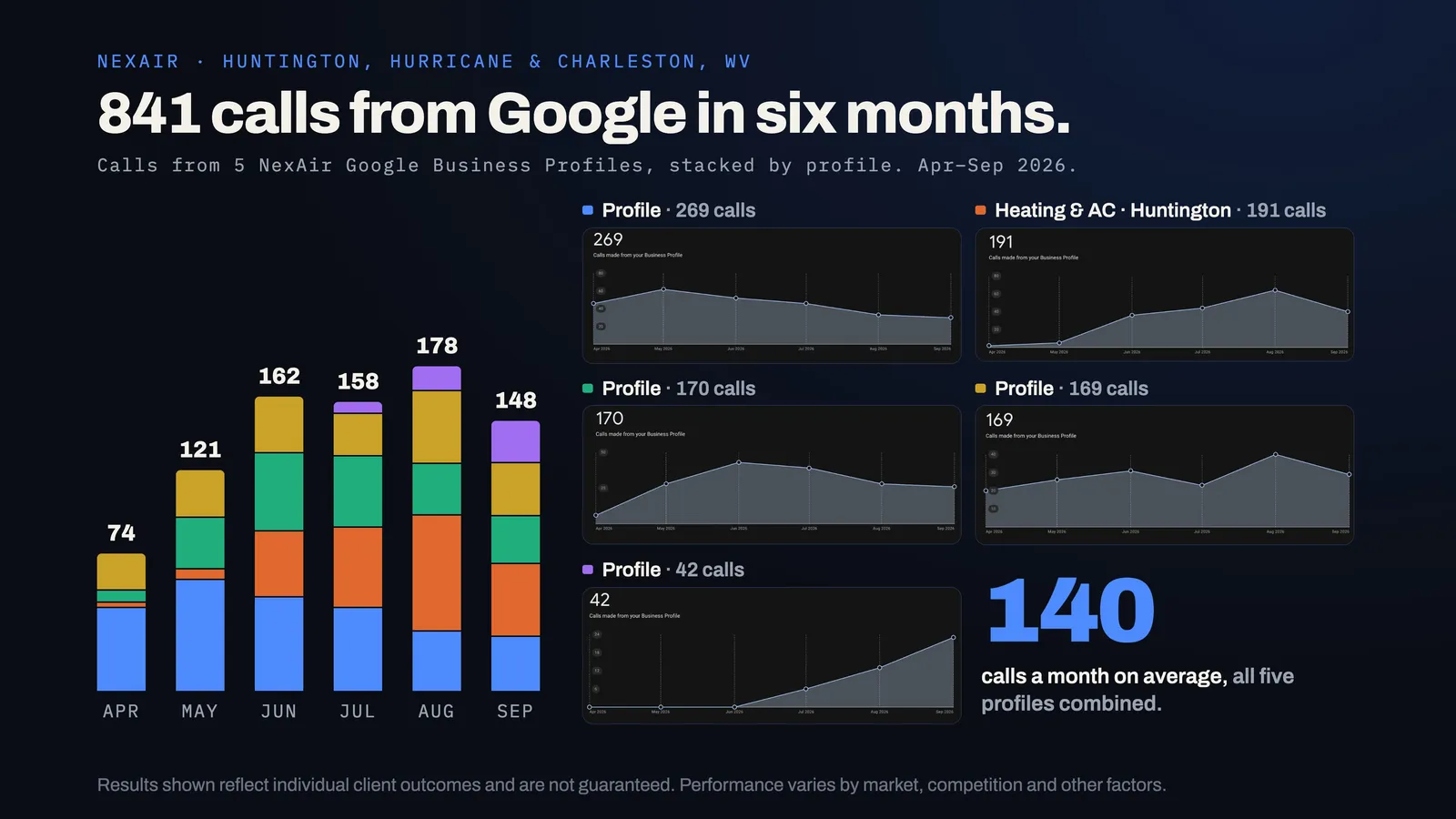
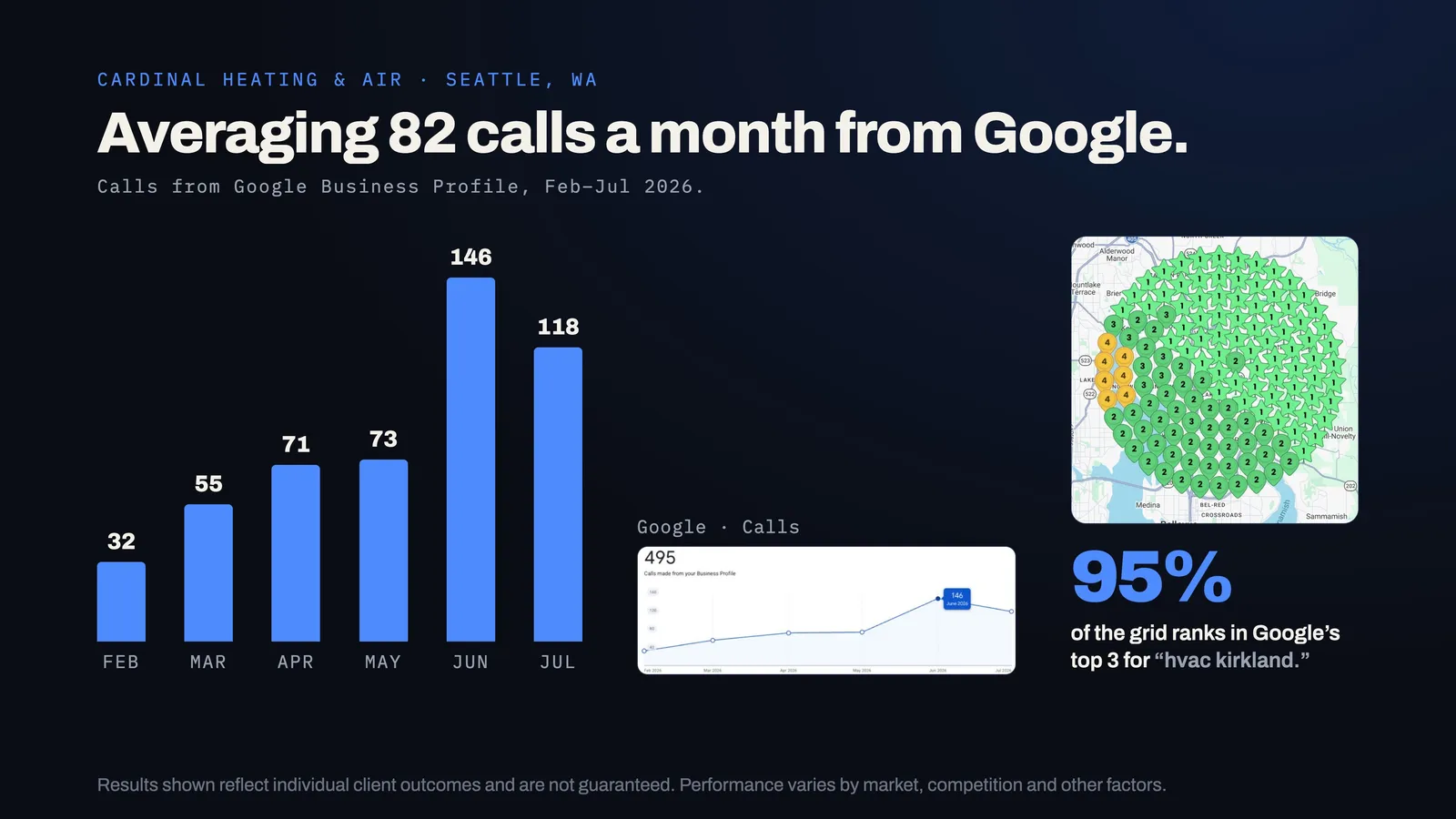
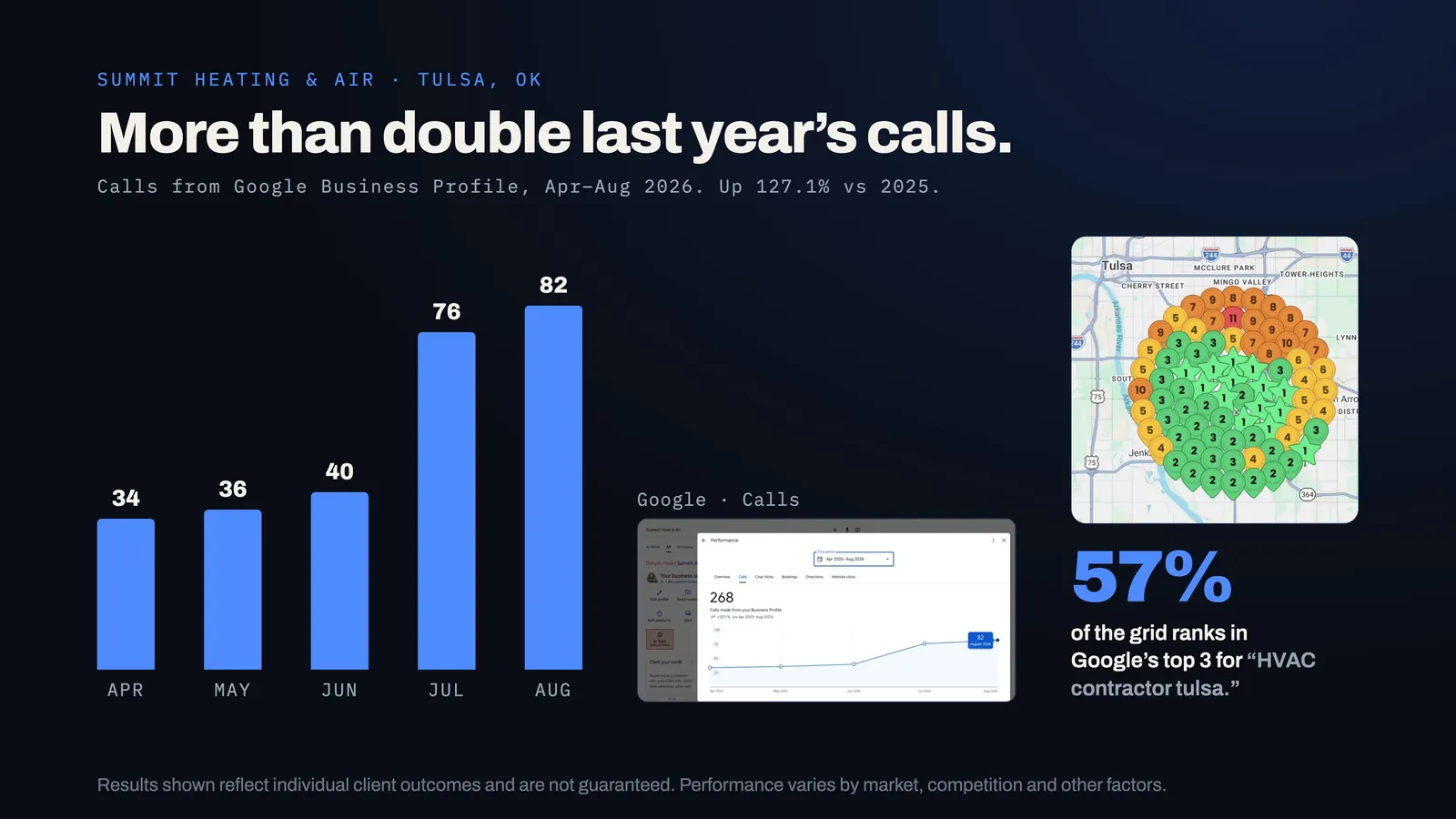
Jeremy's view after a few years of both: "I'm focused more on demand capture" (13:11), and getting the profiles and reviews right is "the king when it comes to demand capture" (10:06). NexAir grew from $1M to $4M in yearly revenue working with us, with five Google Business Profiles producing 841 calls from Google in six months. Cardinal Heating & Air in Seattle averages 82 calls a month from Google, and Summit Heat & Air's Google calls are up 127.1% on last year. Those calls carry no per-lead fee.

Compare the two paid options in Local Service Ads vs Google Ads, and see how the organic side works in our ranking on Google Maps and HVAC SEO guides.
Which numbers should an HVAC company track to manage its marketing budget?
Track five numbers by channel every month: cost per lead, lead-to-booked rate, cost per booked job, average ticket, and marketing spend as a percent of revenue. Budget against cost per booked job, and track replacements separately from repairs.
| Metric | Formula | What it tells you |
|---|---|---|
| Cost per lead | Spend ÷ leads | What each inquiry costs, by channel |
| Lead-to-booked rate | Booked jobs ÷ leads | Whether phones and follow-up convert |
| Cost per booked job | Spend ÷ booked jobs | The number to budget against |
| Average ticket | Revenue ÷ jobs | What a booked job is worth |
| Marketing % of revenue | Total marketing cost ÷ revenue | How you compare with the 7–8% benchmark |
One system replacement can cover a lot of ad spend, so measure cost per booked replacement on its own.
How do you set an HVAC marketing budget step by step?
Start from revenue goals and capacity, not a guess: work out how many extra jobs your team can run, what a booked job costs by channel, and what that adds up to. Check it against the 7–8% benchmark, then set a seasonal monthly plan and review it monthly.
- Set the revenue goal for the year and the extra revenue you need from marketing.
- Divide by your average ticket to get the number of extra jobs needed.
- Check capacity: confirm your techs and CSRs can run those jobs.
- Multiply jobs by cost per booked job for each channel, using your own data or the benchmarks above.
- Compare to 7–8% of revenue and adjust for margins and growth plans.
- Spread it across the year on a seasonal curve, keeping the foundation steady.
- Review monthly and move money toward the channels with the lowest cost per booked job.
How should you review the budget each month?
Once a month, put each channel's spend, calls, booked jobs and revenue side by side. Keep channels under your cost-per-booked-job ceiling, fix the ones within about 20% of it (usually call handling or landing pages), and cut or pause the rest. Move the money to what's working.
| Result | Action |
|---|---|
| Under the ceiling, room to grow | Keep, and raise spend in the next peak |
| Near the ceiling | Fix booking rate, landing page, targeting |
| Well over the ceiling for two months | Pause and move the money |
| Can't tell | Fix tracking before spending more |
What are the most common HVAC marketing budget mistakes?
Spending the same every month, judging channels on cost per lead instead of cost per booked job, leaving costs out of the total, scaling spend past capacity, and putting everything into rented channels with nothing that compounds.
- Flat monthly budgets that miss the peaks.
- Cost per lead as the scorecard. Cheap leads that don't book aren't cheap.
- Hidden costs left out of the total.
- More leads than the team can run.
- 100% rented visibility. When ads stop, the calls stop.
- Paying for work you can't see. Jeremy says his first SEO company took him "for a ride for $36,000" (10:25).
What do HVAC clients get from Google when the budget is spent well?
For our HVAC clients, steady investment in the Google Business Profile, reviews and SEO shows up as calls with no per-lead fee. These are Google Business Profile results from our client results report, 2026. Individual outcomes, not guaranteed.
NexAir Home Services
Owner: Jeremy Payne
Grew from $1M to $4M in yearly revenue. Across 5 Google Business Profiles, about 140 a month. Top 3 on Google Maps in every market tracked.
 Read the case study
Cardinal Heating & Air
Owner: Aashish Chenna
A $10M+ a year HVAC company. 146 in June alone. 95% of the ranking grid is in Google's top 3 for “hvac kirkland.”
Summit Heat & Air
Owner: Logan Haskett
The fastest-growing HVAC company in Tulsa. 268 calls from Google Business Profile, Apr–Aug 2026. 57% of the grid is top 3 for “HVAC contractor tulsa.”
 Read the case study
ECI Comfort
Owner: Chase Musser
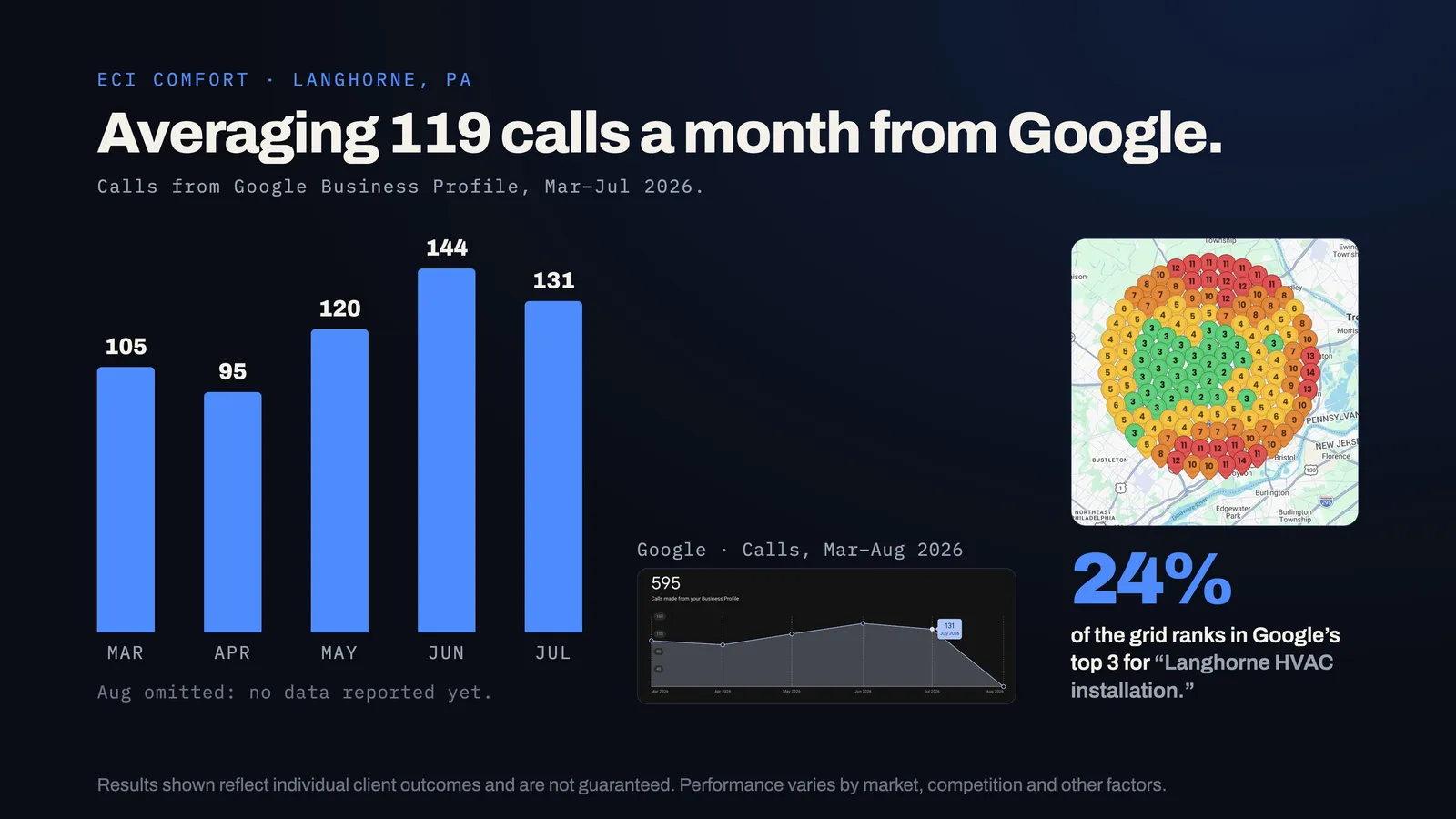
About 119 a month, with 131 in July 2026.
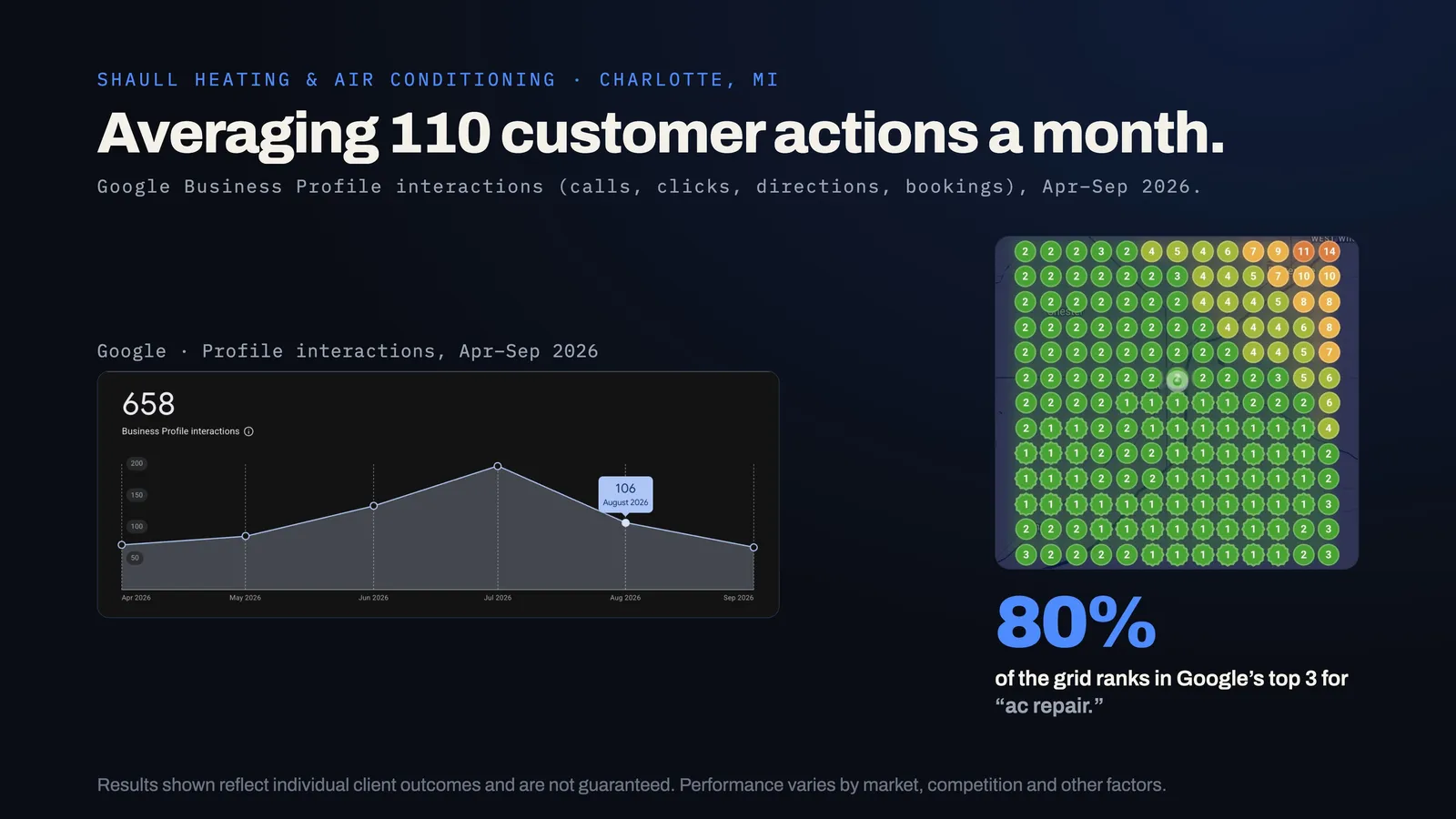
Shaull Heating & Air Conditioning
Owner: Tyler Shaull
About 110 a month. #2 local ranking for “ac repair” (Sep 17, 2026); 80% of the grid is top 3.
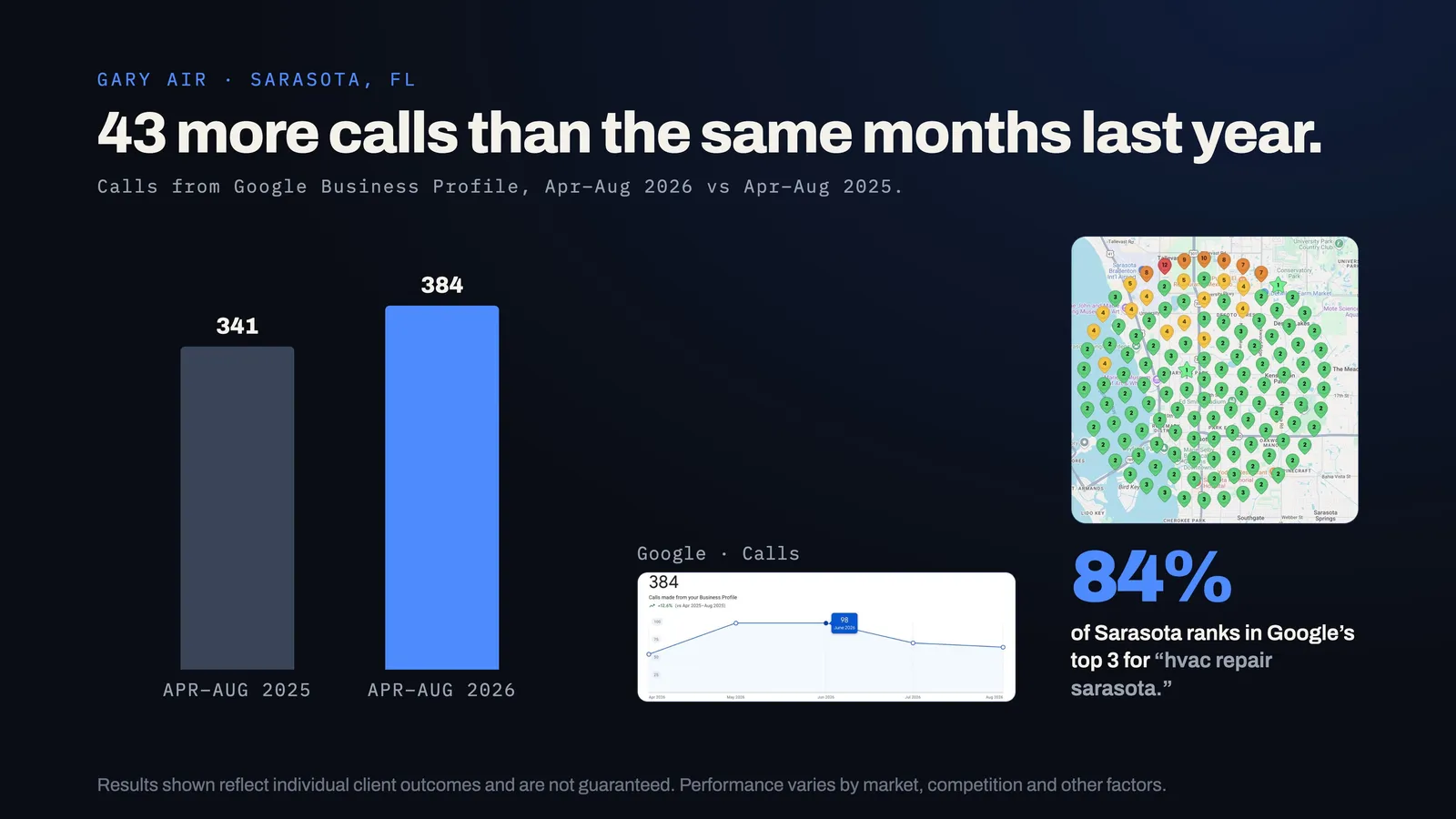
Gary Air
Owner: Rob Brooks
384 calls from Google Business Profile Apr–Aug 2026, up from 341. 84% of Sarasota is top 3 for “hvac repair sarasota.”
HVAC marketing budget FAQ
What percentage of revenue should an HVAC company spend on marketing?
A common benchmark is 7–8% of gross revenue, the SBA guideline for businesses under $5M with 10–12% net margins. Growing companies often spend more for a time; mature companies with full schedules often spend less.
How much should a $1M HVAC company spend on marketing?
At 7–8%, about $70,000–$80,000 a year, or roughly $5,800–$6,700 a month on average, shifted toward the summer and winter peaks.
How much do HVAC leads cost?
Public benchmarks put HVAC Local Services Ads leads around $50–$65 on average and Google search ad leads around $128–$129 for AC and heating campaigns. Costs vary by market, competition and season.
Should HVAC companies spend more on ads or SEO?
Fund both. Ads and Local Services Ads bring calls in days but stop when spending stops; a Google Business Profile and SEO take months but keep producing calls without a per-lead fee.
What should be included in an HVAC marketing budget?
Ad spend, agency and freelancer fees, marketing software such as call tracking and review tools, print and mail, vehicle wraps, sponsorships and in-house marketing payroll.
How should an HVAC marketing budget change by season?
Raise paid spend two to three weeks before the first heat wave and cold snap, keep it high through the peaks, and pull back in shoulder seasons while promoting tune-ups, plans and replacement financing.
How do I build an HVAC marketing budget from my goals?
Divide the extra revenue you want by your average ticket to get jobs, divide by your booking rate to get leads, and multiply by each channel's cost per lead. Then compare the result with your margins and the 7–8% benchmark.
Does spending more on marketing make HVAC companies more profitable?
In ACCA's Contractor of the Future study, contractors spending at least 12% of revenue on marketing reported 9% net profit versus 5%. That's a correlation, so tie any increase to tracked cost per booked job.
What is a good cost per booked job for HVAC?
It depends on your average ticket and margins. Track spend divided by booked jobs for each channel and compare it with what those jobs are worth, separating replacements from repairs.