
HVAC Google Maps SEO, the core of HVAC local SEO, is how a heating and cooling company ranks in the map pack. Google ranks local results on relevance, distance (proximity) and prominence. You can't move your shop, so you win with relevance (a complete profile, services and city pages that match the search) and prominence (steady new reviews, citations, links and brand). Measure it with ranking grids across your service area, not a single search from your office, and judge it by calls and booked jobs.
This HVAC local SEO guide is about rankings: how the map pack decides who shows up and how HVAC companies climb it. Setting up and running the profile itself (categories, services, photos, posts, review scripts, citations, suspensions) is in our companion guide: HVAC Google Business Profile optimization: the complete guide.
Why does the Google Maps 3-pack matter so much for HVAC?
HVAC demand is urgent and local. When a system fails, people search, look at the three map results and call one of them, often without visiting a website. Most homeowners don't remember an HVAC company's name between breakdowns, so the companies in the map pack on the first hot or cold day take most of the calls.
For an HVAC company, the three businesses in the map pack get most of the calls for "AC repair near me" and "furnace repair [city]." The searcher is in a hurry, the map is at the top of the screen, and the call button is one tap away. In my own family's service business, the Google Business Profile "is where 80 to 90% of our business is actually coming from" (4:02).
Being on the map at your shop isn't enough. What matters is how much of your service area sees you in the top three, for the searches that turn into jobs. That's what this page is about.
Emergency searches vs. planned searches
HVAC searches come in two kinds, and the map treats them differently. Emergency searches ("ac repair near me," "no heat," "furnace not working") are urgent and phone-first. Distance and recent reviews matter most, and the person calls one of the first businesses they see. Planned searches ("ac installation [city]," "heat pump replacement [city]," "new furnace [city]") are bigger jobs where people compare. Your website, your reviews' detail and your overall reputation carry more weight. A good HVAC local SEO plan targets both.
The HVAC keyword map
| Keyword group | Examples | How to win it |
|---|---|---|
| Broad "near me" | hvac near me, hvac company near me, heating and air near me | Primary category, proximity, review strength |
| Emergency repair | ac repair near me, furnace repair near me, emergency ac repair [city], no heat repair | Accurate "open" hours, recent reviews, service products linked to repair pages |
| Replacement and install | ac installation [city], furnace replacement [city], new hvac system [city] | Strong service pages, detailed reviews, financing and brand info |
| Long-tail, high-ticket | ductless mini-split installation [city], heat pump replacement [city], dual fuel system [city] | Dedicated pages and products; competition is often thin |
| Maintenance | ac tune-up [city], furnace maintenance, hvac maintenance plan | Seasonal posts, a maintenance plan page, products |
Track a few from each group, not only the biggest one. The long-tail group is where smaller HVAC companies most often beat national brands and private-equity-backed competitors with far bigger budgets.
What map pack results have HVAC companies seen with Stryker?
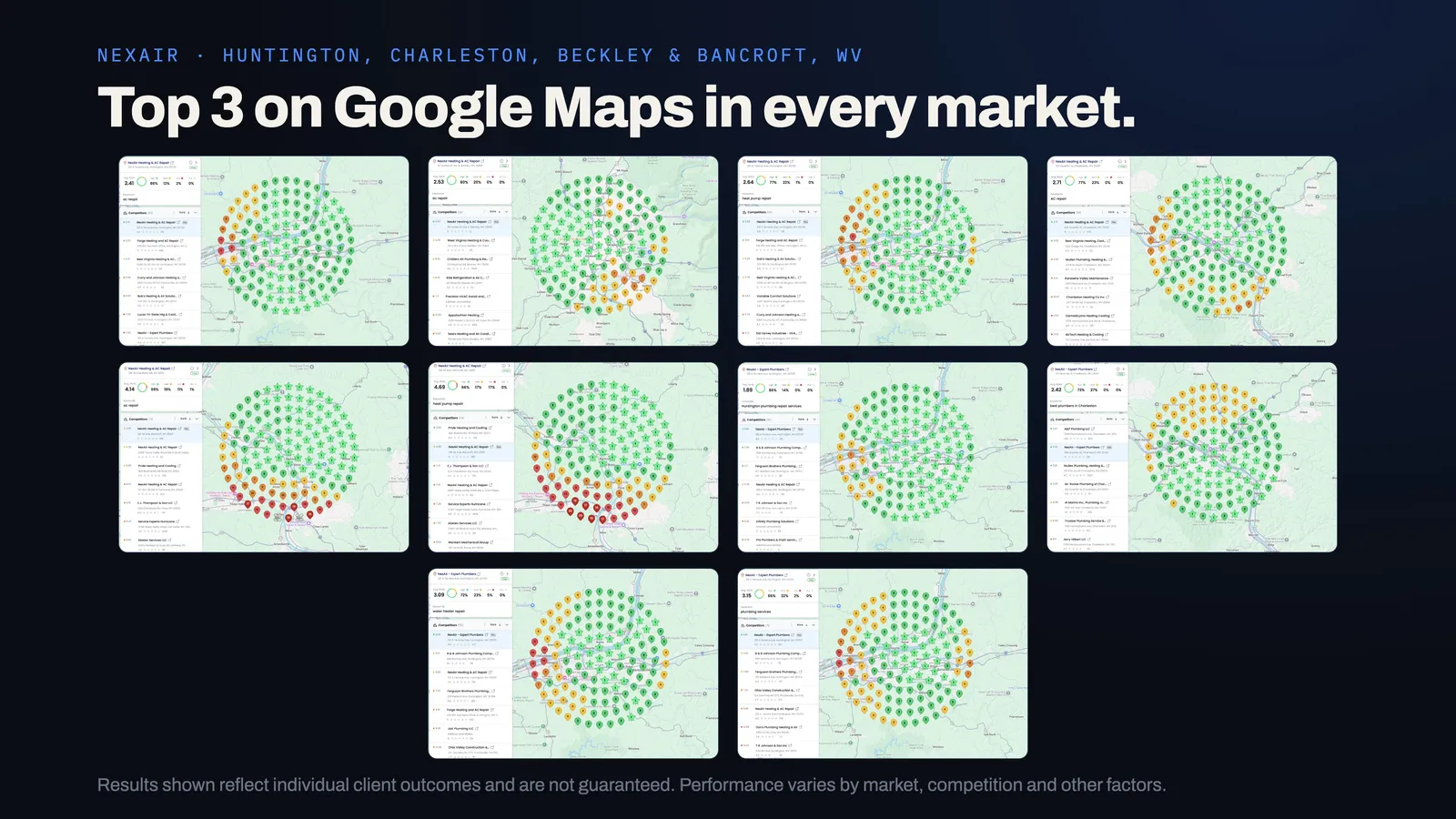
From our 2026 client grids: Cardinal Heating & Air holds 95% of its grid in the top 3 for "hvac kirkland," Gary Air 84% of Sarasota for "hvac repair sarasota," Shaull 80% with a #2 for "ac repair," Summit 57% of Tulsa, and NexAir is top 3 in every market it tracks.
Every one of these comes from our HVAC clients' own ranking grids and Business Profile Insights.
| Client | Market | Map pack result |
|---|---|---|
| NexAir Home Services | Huntington & Charleston, WV | Top 3 on Google Maps in every market tracked; 841 calls from Google across 5 profiles, Apr–Sep 2026 (about 140 a month combined; the busiest profile alone took 269); grew from $1M to $4M in yearly revenue |
| Cardinal Heating & Air | Seattle, WA | 95% of the grid top 3 for "hvac kirkland"; 495 calls from the profile, Feb–Jul 2026, averaging 82 a month and climbing from 32 in February to 146 in June; a $10M+ a year company |
| Gary Air | Sarasota, FL | 84% of Sarasota top 3 for "hvac repair sarasota"; 384 calls Apr–Aug 2026, 43 more than the same months of 2025 (up 12.6%) |
| Shaull Heating & Air Conditioning | Charlotte, MI | 80% of the grid top 3; #2 for "ac repair" (Sep 17, 2026); 658 profile interactions (calls, clicks, directions, bookings), Apr–Sep 2026, about 110 a month |
| Summit Heat & Air | Tulsa, OK | The fastest-growing HVAC company in Tulsa; 57% of the grid top 3 for "HVAC contractor tulsa"; calls up 127.1% year over year |
| ECI Comfort | Langhorne, PA | 595 calls from the profile in 2026, averaging 119 a month; 131 in July. Still building: 24% of the grid top 3 for "Langhorne HVAC installation," which shows calls can grow on repair searches while install keywords catch up |
Results shown reflect individual client outcomes and are not guaranteed. Performance varies by market, competition and other factors. Source: Stryker Digital client reporting, 2026. Full cards with charts: HVAC client results.
How does Google rank HVAC companies in local search?
Google ranks local results on relevance, distance and prominence. Relevance is how well your profile and site match the search. Distance is how close your verified location is to the searcher. Prominence is your reputation: reviews, links, mentions and brand searches. You can't move your shop, so you win on the other two.
Google says local results are ranked on three things. Here's what each one means for an HVAC company, and what you can actually control.
| Factor | What it means | What moves it for HVAC |
|---|---|---|
| Relevance | How well your business matches the search | Primary and secondary categories, services and products, city and service pages, review text and replies that name the job and the town |
| Proximity (distance) | How far your business is from the searcher or the place in the search | Your verified location. You can't fake it; you can only add real locations |
| Prominence | How well known and trusted you are | Review count, velocity and rating, citations, links from local sites, brand searches, press and community mentions |
Relevance: say exactly what you do and where
Relevance is the factor you control most, and the one most HVAC companies leave on the table. "Tell Google what you do, where you do it, and what you actually offer. The algorithm is so smart that if you do that enough times, it'll actually rank you on Google Maps, on ChatGPT itself" (7:16). The profile, the website and the reviews should all repeat the same pairing: the service (AC repair, furnace replacement, heat pump install) and the place. The step-by-step for the profile side is in the profile checklist.
Proximity: the factor you can't fake
A profile ranks strongest around its verified location and fades with distance. That's why the honest answer to "can you rank me across the whole metro from one shop" is "it depends on the metro." Distance is also why shortcuts like virtual offices are tempting, and why they get profiles suspended. The legitimate answer is in the next section.
Prominence: be the company people talk about
Prominence is reputation, measured online: reviews, mentions, links and how often people search your name. I told Jeremy Payne on camera, "the better your brand is the easier SEO is" (8:26). Trucks on the road, sponsorships, local press and great service all show up here eventually.
Behavior: what people do with your listing
Google can see how searchers react to your listing: whether they tap it, call, request directions, visit your website, or bounce back and choose someone else. A profile that earns more of those actions for a search is a profile that matches it. You can't fake that, but you can earn it: a strong rating, recent photos, an accurate "open" status, a clear description, and a website that loads fast and makes calling easy. Every improvement on the profile and the website feeds this loop.
What is an HVAC Google Maps ranking grid and how do you read it?
A ranking grid checks your map position for one keyword from many points across your service area. Green points are top 3. Read the share of green points for coverage, the shape for proximity versus relevance problems, and the change against your own past grids, using the same keyword, size and spacing every month.
Searching your own name from the office tells you almost nothing. Map results change with the searcher's location, so you can be #1 at your shop and invisible five miles away.
A ranking grid fixes that. The tool lays a grid of points over your service area, often 7×7 or larger, and checks where your profile ranks for one keyword from every point. Each point shows your position. Green points are top 3, which means you're in the map pack there. The share of green points is how much of your market you own for that search.
How to read a grid
- Look at the share of top-3 points first. That's your coverage.
- Look at the shape. Green clustered around your shop and red at the edges is a proximity problem. Red right next to your shop is a relevance or profile problem.
- Look at the keyword. "hvac [city]" and "ac repair" behave differently. Track a few money keywords, not just one.
- Compare with your own past grids, same keyword and same grid, not with another company in another city.
How to set up an HVAC ranking grid
- Center it on your verified location, then make sure it covers the area your trucks actually drive, not just the office neighborhood.
- Choose the size and spacing to match your market. A 7×7 or 9×9 grid with points a mile or two apart suits most suburban HVAC companies; dense cities need tighter spacing, rural areas wider.
- Track three to five money keywords: one broad ("hvac [city]" or "hvac contractor"), one emergency ("ac repair" or "furnace repair"), one replacement ("ac installation") and one long-tail ("ductless mini-split installation").
- Run it on a fixed schedule: monthly most of the year, weekly before and during peak season so you know you hold your spots when the phones should ring.
- Save every scan. The trend over months is the real report.
Real HVAC grids
| Client | Keyword | Top-3 coverage | What it tells you |
|---|---|---|---|
| Cardinal Heating & Air | "hvac kirkland" | 95% | Near-total coverage of its target city, inside the competitive Seattle area |
| Gary Air | "hvac repair sarasota" | 84% | Most of Sarasota sees Gary Air in the pack for a high-intent repair search |
| Shaull Heating & Air Conditioning | "ac repair" | 80%; #2 locally (Sep 17, 2026) | A smaller-market company can dominate its town on the money keyword |
| Summit Heat & Air | "HVAC contractor tulsa" | 57% | More than half of a large metro from one company; Summit is the fastest-growing HVAC company in Tulsa |
| NexAir Home Services | Multiple, 5 profiles | Top 3 in every market tracked | Multi-market coverage comes from real profiles in each market |
Notice that 57% in Tulsa and 95% in Kirkland are both strong. A big metro is harder to cover than a tight market. That's why the grid should be judged against your own starting point.
Grids also show change over time. My family's business was invisible on the map on February 14th, and by July 24th it was "ranking pretty much number one in our service area all around the map for Generac oil change which is the top search keyword in our market" (11:53). For "generator repair near me," it went from invisible on May 14th to "top three on the map pack" by July 24th (11:53).
How do HVAC companies rank in towns beyond their shop?
Own your home base first, then push into nearby towns with city pages, local reviews, posts and local links. A single profile only ranks strongly within a limited radius of its address, so for distant parts of a metro you need a real, staffed location with its own profile. Ads cover the gaps meanwhile.
Most HVAC companies serve far more area than one profile can rank in. Here's how to think about it:
- Own your home base first. Get the grid around your shop green for your money keywords before chasing the edges.
- Push into nearby towns with relevance and prominence: a city page for each town, reviews from customers there, posts about jobs there, and local links.
- Open real locations in markets you truly serve. In an audit I gave this advice to an owner covering several counties: "I would get a second Google business profile in one of those other markets that you're in" (7:45). Only where you have a real, verifiable, staffed location. NexAir runs five profiles this way.
- Target the right size of market in your titles and pages. Name your county or city, not your whole state. In one audit I told an owner, "you'll never rank number one in all of New Jersey for pest control" (0:53). "HVAC contractor Tulsa" can win; "HVAC company Oklahoma" can't.
- Fill gaps with ads. For towns your profile can't reach yet, Local Services Ads or Google Ads cover the calls while rankings build. See the HVAC Local Services Ads guide and HVAC Google Ads management.
How far can one profile rank?
There's no fixed radius. In a dense metro full of HVAC companies, one profile may rank strongly only a few miles around its address. In a small town with few competitors, the same profile can cover a whole county. Your grid will tell you: where green turns red is the edge of your profile's reach for that keyword today. Relevance and prominence push that edge out; they rarely erase it.
The multi-location playbook
Many of the strongest HVAC companies in big metros run several profiles, each tied to a real location. When it's time to expand:
- Rank your main location first. A second profile won't fix a weak first one.
- Pick the gap your grids show, a part of your service area where you get calls and win jobs but your map coverage is red.
- Open a real, staffed location there: an office or warehouse with signage, a lease and someone who works there. No virtual offices or mailbox stores; they're one of the most common reasons an HVAC profile gets suspended.
- Build the new profile completely with its own local phone number, its own city page as the website link, and products linked to that location's pages. Follow the profile checklist.
- Feed it reviews from jobs in that area, and run grids for it separately.
That's the path NexAir Home Services followed: five profiles in real West Virginia markets, top 3 in every market tracked, and 841 calls from Google in six months.
What HVAC local SEO pages help you rank on Google Maps?
A strong service page for every core service and a genuinely local page for each main town you serve, linked together and linked from your profile. A handful of well-built city pages with real local proof beats hundreds of thin pages with only the town name swapped, which Google tends to ignore or suppress.
Your website is the proof behind your profile. "When listing your services, you need to build out service pages for all the service that you actually offer" (2:24). And "We build out service area pages for every single service and place we offer" (3:29).
- Service pages: AC repair, AC installation, furnace repair, furnace replacement, heat pumps, ductless mini-splits, maintenance plans, emergency service.
- City pages: one per real town you serve, such as "AC repair Kirkland," with jobs you've done there, reviews from customers there and how fast you get there.
- H1s that name the service and the place: "The number one thing you should do when building a website for a home service business is talk about what service you offer and where you offer it" (0:32).
- Links both ways: profile products and posts link to these pages; the pages link to each other and back to your main service pages.
Quality beats quantity on city pages
It's now easy to generate hundreds of city pages in an afternoon. Don't. Pages that are the same template with the town name swapped add nothing, and Google tends to ignore them or hold the whole site back. Eight to twelve genuinely useful pages for the towns that matter most will outperform a hundred thin ones. Add more only when you can make each one real.
What a city page that ranks includes
- A title, H1 and opening paragraph that name the service and the town, like "AC Repair in Kirkland, WA."
- Local proof: jobs you've done there, photos from those jobs, and reviews from customers in that town.
- Local detail only a real local company would write: the neighborhoods you cover, typical housing stock and systems, how the climate affects equipment, how quickly you reach that area.
- Your services in that town, each linking to its service page, and a clear way to call or book.
- Five to ten frequently asked questions specific to that town or service, with FAQ schema.
Local content beyond city pages
A few genuinely local posts a year earn links, shares and relevance that template pages never will: a heat-wave guide with your county's cooling centers, a winter checklist for older homes common in your area, a write-up of a community project your team did. Write about what's really happening where you work, link to the matching service and city pages, and share it with local groups and news outlets. One useful local piece beats ten generic "5 signs your AC needs repair" posts.
Build an internal-link web
Your service pages should link to each other, every city page should link to the main services, and the main services should link back to the cities. A clean web of links helps Google crawl the site and understand that you offer every service in every town, without needing a separate page for every combination.
Look at what your traffic is made of. Of one client's site I said: "that's what you want your SEMrush to look like. You want your top keywords on your website to be what people are searching for" (6:38). For HVAC that means "AC repair [city]" and "HVAC contractor [city]." The page-building side is covered in depth in our HVAC SEO guide.
Want to see your HVAC company's ranking grid? Book a free growth call and we'll show you where you rank across your service area.
Book a Growth CallHow many reviews does an HVAC company need to rank in the map pack?
There's no fixed number. Google weighs recent reviews alongside total count, so a steady monthly flow can beat a competitor with a bigger but stale total. Aim to keep a comparable total to the top three and out-pace them every month. Our best-performing clients are getting 25 new reviews per month.
"Reviews are probably one of the most important ranking factors when it comes to ranking a Google Business Profile" (5:53). For rankings, four things about reviews matter:
- Velocity: how many new reviews you get each month. Our best-performing clients are getting 25 new reviews per month. A company with 300 old reviews and none this quarter looks less active than one adding reviews every week.
- Recency: fresh reviews tell Google and customers you're busy now.
- Rating: customers filter by it, and fewer people tap a low-rated listing.
- Content: reviews and your replies that name the service and the town add relevance. Replying with the service and the area is "something so small" that helps Google "show your business more" (6:26).
Measure your velocity against the top three in your market, not against a national number. If they add 10 a month and you add 25, you'll pass them. The scripts and reply templates we use are in the profile guide's reviews section.
Reviews don't work alone. Jeremy Payne's NexAir was "nowhere to be found on maps after 12 months, even though we had been smoking reviews" (10:43), because the profile wasn't fully set up. Fix the profile, then let reviews multiply it.
Do backlinks and citations help HVAC Google Maps rankings?
Yes. Consistent citations confirm you're real and where you are; relevant links add prominence. For HVAC, the best links are manufacturer and distributor dealer locators, local news, your chamber and local sponsorships. Bulk directories, paid link packages and press-release spam add little and can hurt your site's reputation.
Citations (listings with your name, address and phone) confirm you're a real business in a real place. Links from other websites to yours add prominence. For map rankings, local and industry relevance matters more than raw volume.
- Citations: the major platforms and HVAC-specific directories, all matching your profile exactly. The step-by-step clean-up is in the profile guide.
- Local links: your chamber of commerce, local sponsorships (youth sports, schools, charity events), local news coverage of your company, and community organizations you support.
- Industry links: manufacturer dealer pages, distributor and supplier pages, trade associations.
- Partner links: builders, property managers, realtors and other trades you work with.
Skip paid link packages and bulk directory blasts. They don't build real prominence and can do harm.
The HVAC link most companies never claim
The equipment brands you install, such as Carrier, Trane, Lennox, Bryant, Goodman, Rheem, Daikin and Mitsubishi Electric, run dealer and contractor locators on their own websites. Those sites carry huge authority and are about as relevant to an HVAC company as a link can get. If you're an authorized dealer or contractor, make sure you're listed with your exact name, address, phone and website. Ask your distributor rep how to get added if you're not. It's often a form and a phone call, and it's one of the strongest links an HVAC company can have.
How to earn local links without buying them
- Give local news a real story: a new location, a big hire, a free furnace for a family in need, a heat-wave safety message. A link from your local paper or TV station tells Google a trusted local source vouches for you.
- Sponsor things that publish a sponsor page: youth leagues, school events, charity runs.
- Join and get listed: chamber of commerce, trade associations (ACCA and your state contractor associations), local business groups.
- Ask partners: builders, property managers, realtors and home inspectors who send you work often have a "trusted pros" page.
What to avoid: generic offshore directories, private blog networks, content-farm articles and anyone selling links in bulk. A few hundred dollars of junk links can do more harm than good.
How do I find out why competitors outrank me on Google Maps?
Run grids for your money keywords, note who wins most points, then compare their categories, services, photos, review totals and last-90-day velocity, website pages, links and distance. Check for spam. Write the gaps down and fix them in order of impact: profile first, then reviews, then pages, then links.
The fastest way to find what's holding you back is to compare yourself with the three companies above you on the map, keyword by keyword. Here's the process:
- Pick three to five money keywords, such as "ac repair [city]," "hvac contractor [city]" and "furnace repair [city]."
- Run a grid for each and note who holds the top three across most of the grid.
- Compare profiles: primary and secondary categories, number of services and products, photo count and freshness, posting frequency.
- Compare reviews: total count, new reviews in the last 90 days, rating, and whether reviews mention services and towns.
- Compare websites: do they have pages for each service and city you don't? What does their H1 and title say? Which keywords bring them traffic?
- Compare distance: are they physically closer to the parts of the grid they win? If so, that's proximity, not something you can out-optimize from one location.
- Check for spam: keyword-stuffed names, fake addresses or duplicate listings. Report real violations with Google's tools; cleaning up a spammy map can move you up without changing anything else.
- Write the gap list and work it in order of impact: profile gaps first, then reviews, then pages, then links.
Competitor gap worksheet
| Check | You | Competitor #1 | What to do if you're behind |
|---|---|---|---|
| Primary category | — | — | Match the winner's primary if it fits your revenue |
| Secondary categories | — | — | Add the ones you genuinely do |
| Services and products listed | — | — | Fill every service, add products with links |
| Total reviews / rating | — | — | Get within a comparable range |
| New reviews, last 90 days | — | — | Out-pace them every month |
| Photos added, last 30 days | — | — | Weekly uploads from every job |
| Service and city pages | — | — | Build the missing pages, properly |
| Manufacturer and local links | — | — | Claim dealer locators, earn local press |
| Distance to the grid points they win | — | — | If it's proximity, plan a real location or use ads |
Copy the table, fill it in for each of the top three, and the plan writes itself. A competitor with thousands of reviews who stopped getting new ones months ago is far more beatable than the total suggests.

How long does HVAC Google Maps SEO take?
It depends on your market and starting point. Fixing a broken profile can move rankings within weeks. In competitive metros, expect foundations in the first quarter, steady grid movement in months four to six, and broad top-3 coverage later in the year, followed by expansion to new locations. Start before your busy season.
It depends on your market, competition and starting point. A broken or half-built profile can move quickly once it's fixed. My family's business was verified around February 2026; real SEO started around April; and by late July it was at the top of the map for its top keyword (11:37). Calls went from 3 in May to 14 and then about 20 a month (8:39).
Here's a realistic shape for a competitive market, as general guidance rather than a promise:
| Phase | Work | What you usually see |
|---|---|---|
| Months 1–3 | Rebuild the profile, fix NAP and citations, restructure service and city pages, start the review process, claim manufacturer listings | Quick wins near your address if the profile was broken; more calls from branded searches |
| Months 4–6 | Steady photos, posts and reviews; new pages each month; local link building | Grids improve keyword by keyword; more green further out |
| Months 7–12 | Keep velocity up; strengthen city pages; plan new locations from grid gaps | Top 3 across most of the core service area; expansion to new profiles |
Big metros and crowded markets take longer than small towns, and new locations take longer than established ones. Plan around the season: work done in spring and fall pays off in the peaks. Logan Haskett, who owns Summit Heat & Air, said it in a winter interview: "I don't really care about getting leads from SEO right now. It's the winter. It's slow time … But come the summertime and we're ranked how we're ranked right now, … we're going to have a massive summer" (4:18). Summit's calls from Google that spring and summer were up 127.1% on the year before.
What should HVAC companies track for Google Maps SEO?
Track ranking grids for three to five money keywords, calls and interactions from each profile, year-over-year change for the same months, review velocity against the top three competitors, calls and booked jobs by landing page, and a fixed set of AI prompts. Rankings are a leading indicator; booked jobs are the result.
- Ranking grids for three to five money keywords, same grid every month (Cardinal 95%, Gary Air 84%, Shaull 80%, Summit 57%).
- Calls from the profile by month (NexAir 841 in six months, ECI Comfort 595 Mar–Jul).
- Year-over-year change for the same months (Summit +127.1%, Gary Air +12.6%).
- Review velocity versus the top three competitors.
- Booked jobs and revenue traced back to map calls.
- AI visibility: a fixed set of prompts, such as "best HVAC company in [city]," checked monthly.
"Calls start going up, and you can actually track that graph and see the difference" (8:39).
The monthly map pack review
- Run the grids and compare with last month and the same month last year.
- Pull calls, website clicks and direction requests for each profile.
- Count new reviews for you and the top three competitors.
- Check which pages got profile traffic (from your UTM-tagged links) and which calls became jobs.
- Pick the two weakest keywords or grid areas and assign specific work: a better city page, more reviews from that area, a missing product, a local link.
How do ChatGPT and Google AI Mode choose which HVAC company to recommend?
They draw on the same local data as the map: business profiles, reviews, consistent listings, manufacturer and local press mentions, and websites that answer questions directly. Companies that already win the map pack with consistent details and recent reviews tend to show up most, but no one can guarantee an AI recommendation.
Homeowners now ask ChatGPT, Gemini and Google's AI Overviews "who's the best HVAC company near me." Those answers lean on the same local data the map uses: business listings and profiles, reviews, and the websites they link to. Companies that rank well in the map pack and have consistent listings and lots of recent reviews give AI tools the most to work with.
I've seen it with my own family's business. When I asked ChatGPT for a generator company in Rockland County, "The only company that shows up is Rockland County Generac maintenance, my family's company. And if I click right there it goes right to the homepage from ChatGPT itself" (12:11). We're "capturing leads on Google, we're capturing leads on Google Maps, and we're capturing leads on AI, on ChatGPT, on Claude, on Google Gemini" (12:26).
To improve your odds:
- Win the map pack in your core market first. AI answers for local services lean heavily on the same local data.
- Keep your name, city and services consistent everywhere: profile, website, directories, manufacturer listings.
- Add five to ten real customer questions to every service and city page, answered in two or three plain sentences, with FAQ and LocalBusiness schema.
- Get mentioned in local news and community sites for real reasons. AI tools read those mentions.
- Join local conversations honestly. If people in a local forum or neighborhood group ask for an HVAC recommendation, answer as yourself, clearly identified as the owner. Never pose as a customer.
- Skip generic AI-written blog posts about "the importance of HVAC maintenance." They don't rank and AI tools don't cite them.
Win the map, keep details identical, earn detailed reviews, and answer questions plainly. Nobody can guarantee an AI recommendation, so track prompts over time. More in getting named by ChatGPT and AI Overviews.
HVAC Google Maps SEO and local SEO FAQ
Quick answers to the map pack questions HVAC owners ask most: ranking factors, grids, service areas, city pages, reviews, links, competitors, timelines and AI search. For profile setup questions such as categories, photos, posts and suspensions, see our HVAC Google Business Profile optimization guide, which covers every field.
What is HVAC local SEO?
HVAC local SEO is the work that ranks a heating and cooling company in Google Maps and local search results for its service area. Map-pack rankings are the core of it: relevance, proximity and prominence, measured with ranking grids and judged by calls and booked jobs.
What is HVAC Google Maps SEO?
The work that gets a heating and cooling company into the Google Maps 3-pack across its service area: improving relevance (profile, categories, city and service pages), prominence (reviews, citations, links, brand) and adding real locations where proximity limits you.
How does Google rank HVAC companies in the map pack?
On relevance, distance (proximity) and prominence. Relevance is how well your profile and site match the search, distance is how close your location is to the searcher, and prominence is your reputation: reviews, citations, links and brand.
What is a Google Maps ranking grid?
A grid checks where your profile ranks for one keyword from many points across your service area. Green points are top 3. Cardinal Heating & Air has 95% of its grid in the top 3 for "hvac kirkland"; Summit Heat & Air has 57% for "HVAC contractor tulsa."
Can I rank on Google Maps in cities where I don't have an office?
Partly. Your profile ranks strongest near its verified location. City pages, local reviews and posts help nearby towns, but to rank well in another market you need a real, verifiable location there and its own profile. NexAir runs five profiles that way.
Are reviews a ranking factor for HVAC companies on Google Maps?
Yes. Review count, velocity, recency, rating and content all matter. Our best-performing clients are getting 25 new reviews per month. Compare your pace with the top three companies in your market.
Do backlinks help HVAC map rankings?
Links from relevant local and industry sites add prominence: chambers of commerce, local sponsorships, local news, manufacturer and distributor pages, trade associations and partner businesses. Skip paid link packages.
How do I find out why competitors outrank me on Google Maps?
Run ranking grids for your money keywords, then compare the top three on categories, services, photos, posts, review count and velocity, website pages, distance to the searcher and any spam. Work the gaps in order of impact.
How long does it take to rank in the HVAC map pack?
It depends on your market, competition and starting point. A broken profile can move quickly once fixed; Bodhi's family business went from invisible on Google Maps in February 2026 to the top of the map by late July. Big metros take longer.
What should I track for HVAC Google Maps SEO?
Ranking grids for three to five money keywords, calls from the profile by month, year-over-year change for the same months, review velocity against competitors, booked jobs and a fixed set of AI prompts.
Do Google Maps rankings affect ChatGPT and AI Overviews?
AI assistants lean on the same local data as the map: listings, profiles, reviews and linked websites. Strong map rankings and consistent details give them more to work with, but no one can guarantee an AI recommendation.
Why is my HVAC business not showing up on Google Maps?
Usually one of five things: the profile isn't verified or is suspended, the primary category doesn't match the search, the searcher is far from your location, competitors have far more recent reviews, or duplicate listings are splitting your signals. Run a ranking grid to see where you show and where you don't.
How many service areas should an HVAC company list?
Google allows up to 20, within about a one-and-a-half to two-hour drive. List the towns and counties your trucks really cover. Service areas alone won't make you rank far from your address; city pages, local reviews and, eventually, real locations do.
Do manufacturer dealer locators help HVAC local SEO?
Yes. Dealer and contractor locators on Carrier, Trane, Lennox, Bryant, Goodman, Rheem, Daikin and other brand sites are highly relevant, authoritative links. Make sure your listing uses your exact name, address, phone and website.
Ready to win the map pack in your market? Book a free growth call.
Book a Growth Call