
HVAC SEO means ranking your company in the Google Maps pack, organic results and AI answers for searches like "AC repair near me". Fix and fully build your Google Business Profile first, get reviews after every job, build a page for every service and city you serve, keep the site fast and clean, and measure calls and booked jobs, not just rankings.
What HVAC SEO actually is
HVAC SEO is the work that gets your company found when a homeowner searches for heating and cooling help in your area: the Google Maps results (the "map pack"), the regular organic results under them, and now the answers that AI assistants such as ChatGPT, Gemini and Google's AI Overviews give. It is not one task. It is your Google Business Profile, your reviews, your website's service and city pages, the technical health of that site, and the signals that tell Google you are a real company that does this work in this place.
I run SEO for home service companies, and before that I ran one. The simplest way I can put local SEO is the line I use in every video: "tell Google what you do, where you do it, and what you actually offer. The algorithm is so smart that if you do that enough times, it'll actually rank you on Google Maps, on ChatGPT itself" (7:16). Everything on this page is a way of doing that more clearly and more often than the HVAC companies around you.
For HVAC specifically, the stakes are high because demand is local, urgent and seasonal. Somebody with no heat in January or no AC in a July heat wave is not reading ten websites. They search, look at the map, check reviews, and call. In my own family's service business, the Google Business Profile "is where 80 to 90% of our business is actually coming from" (4:02). That is why HVAC SEO starts with the map pack and works outward.

Results from our HVAC SEO clients
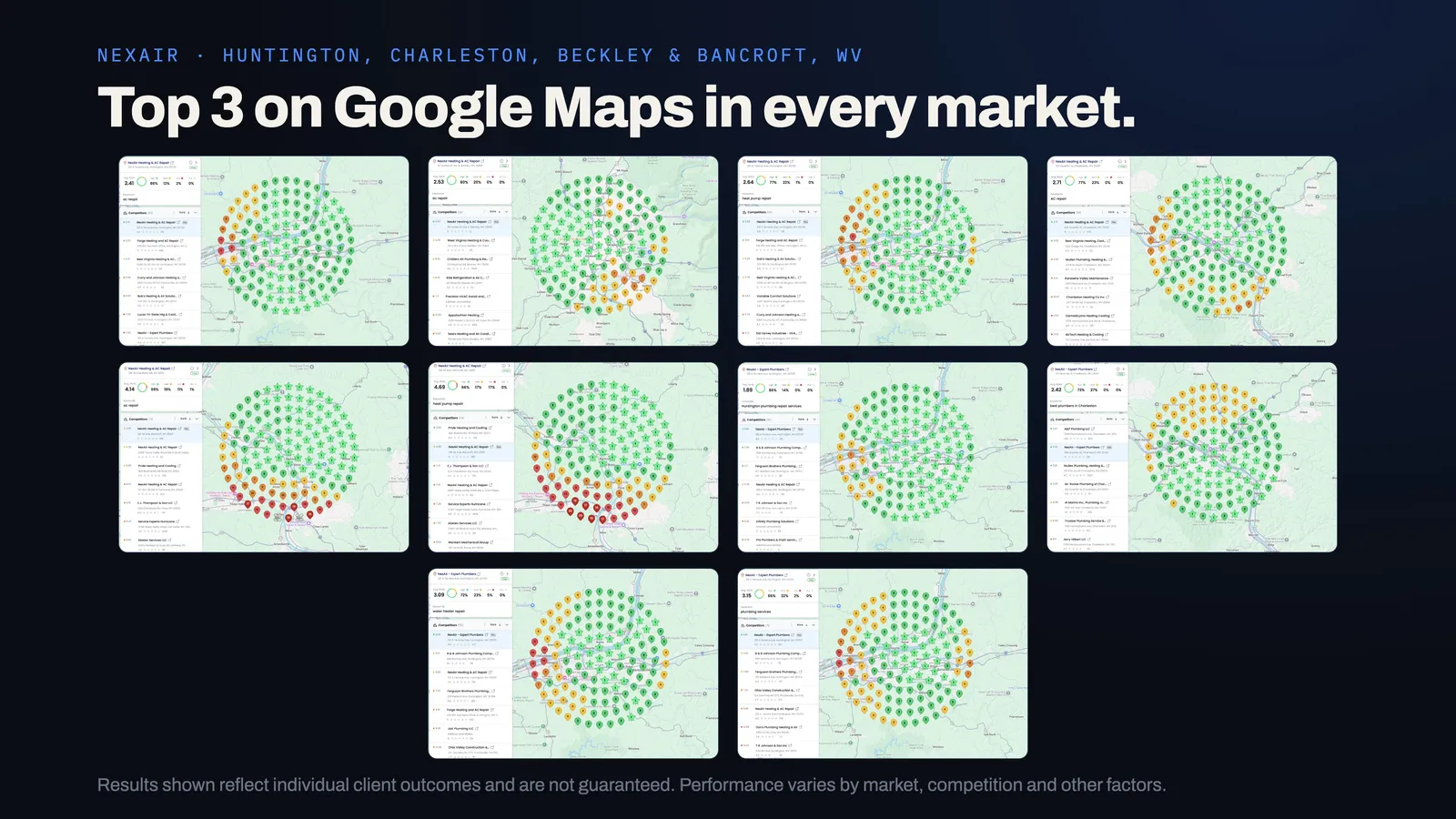
Here is what that work looks like in real HVAC numbers, taken from our clients' own Google Business Profile Insights and map-ranking grids. A grid checks where you rank from dozens of points across your service area; "top 3" means you show in the map pack at that point.
| Client | Market | Result |
|---|---|---|
| NexAir Home Services | Huntington & Charleston, WV | 841 calls from Google across 5 profiles, Apr–Sep 2026; top 3 on Maps in every market tracked; grew from $1M to $4M in yearly revenue |
| Cardinal Heating & Air | Seattle, WA | 495 calls from Google Business Profile, Feb–Jul 2026 (146 in June); 95% of the grid top 3 for "hvac kirkland" |
| Summit Heat & Air | Tulsa, OK | The fastest-growing HVAC company in Tulsa; calls up 127.1% vs. the same months of 2025 (268, Apr–Aug 2026); 57% of the grid top 3 for "HVAC contractor tulsa" |
| ECI Comfort | Langhorne, PA | 595 calls from Google Business Profile, Mar–Jul 2026; 131 in July |
| Shaull Heating & Air Conditioning | Charlotte, MI | 658 profile interactions, Apr–Sep 2026; #2 for "ac repair" (Sep 17, 2026); 80% of the grid top 3 |
| Gary Air | Sarasota, FL | 384 calls Apr–Aug 2026, up 12.6% from 341; 84% of Sarasota top 3 for "hvac repair sarasota" |
| Anderson Plumbing Heat & Air | Bethany, OK | 2,944 profile interactions Apr–Aug 2026, up 210.9%; 100% of the grid top 3 for "plumbers Bethany" |
Results shown reflect individual client outcomes and are not guaranteed. Performance varies by market, competition and other factors. Source: Stryker Digital client reporting, 2026. Full cards with charts: HVAC client results.
The spread is the point. Cardinal is a $10M+ a year company in a big, competitive metro. Shaull is in a small Michigan town. Gary Air was already getting calls and grew them 12.6%. The same playbook applies; what changes is how long it takes and how many profiles and pages the market needs.
Start with the Google Business Profile
If you do one thing from this page, do this. Jeremy Payne, who owns NexAir, paid a previous SEO company for a year before we met. In his words: "I was taken for a ride for $36,000 and … 12 months after the fact … my Google Business Profile was not completely … not only was it not optimized, it wasn't even fully set up. You know, we were nowhere to be found on maps after 12 months, even though we had been smoking reviews" (10:25). Reviews alone did not save him. The profile itself was broken.
Here is how I set up and run a profile, in the order I do it:
- Categories. Pick the primary category that matches most of your revenue, usually "HVAC contractor", then add secondary categories only for work you actually do, such as "Air conditioning contractor", "Heating contractor" or "Furnace repair service".
- Products and services with your market in the name. On my family's profile every product names the county: "Generac inspections Rockland County, emergency Generac service, Generac battery replacement, Generac oil change Rockland County" (4:34). For HVAC that means entries like "AC repair [your county]" and "furnace replacement [your city]". I write descriptions of "about 1,000 characters" and link each product to the matching page on the website (5:05), because that "increases your click-through rate and gets people to book a job with you quicker" (5:38).
- Posts with links. Every post names a service and links to that service page on your site; "this is another thing that communicates with the algorithm" (7:32).
- Real photos, regularly. "If you're at 500k plus in revenue, I highly recommend posting your employees, posting yourself, your family, whoever you can, products about once or twice a week to just get this profile looking more real to your target customer" (10:15). Your trucks, techs, installs and equipment. Never stock photos.
- Fill out everything. "Just fill out this profile as much as you possibly can" (10:33). Hours, service area, attributes, products, booking link.
The full section-by-section walkthrough, including review scripts and suspension recovery, is in our HVAC Google Business Profile optimization guide.
The proof that this works from a cold start is my family's business. I verified the profile around February 2026; it was invisible on Google Maps on February 14th, and by July 24th it was "ranking pretty much number one in our service area all around the map" for its top keyword (11:37). Calls went from 3 in May to 14 and then about 20 a month (8:39).
Map-pack ranking factors for HVAC
Google says local rankings come down to relevance, distance and prominence. In practice, here is what I see move HVAC companies up the map, in rough order of impact:
- Relevance of the profile and site to the search. Your primary category, your services list and the pages they link to all need to say "HVAC" plus the specific job (AC repair, furnace install, heat pump) plus the place.
- Where your business is, and how many profiles you have. One profile mostly ranks around its address. That is why multi-county HVAC companies add a second location. My advice in a recent audit applies to HVAC too: "I would get a second Google business profile in one of those other markets that you're in" (7:45). Only do it where you have a real, verifiable location. NexAir now runs five profiles, which is how it reached 841 calls in six months.
- Reviews. "Reviews are probably one of the most important ranking factors when it comes to ranking a Google Business Profile" (5:53). Count, recency, rating and what the reviews say all matter.
- Your website's local signals. Pages that name the service and city, a title tag that names your real market, and consistent name and address details everywhere.
- Brand. Searches for your company name, mentions, social and local press. I told Jeremy on camera, "the better your brand is the easier SEO is" (8:26).
For ranking grids from our clients, service-area strategy and a competitor gap process, see HVAC Google Maps SEO: how to rank in the map pack.
Distance is the one you can't fake, which is why the honest answer to "can you rank me across the whole metro" depends on where you have real locations.
Want this done for your HVAC company? Book a free growth call and we'll review your Google profile, site and rankings.
Book a Growth CallReviews: the engine behind the map pack
Our best-performing clients are getting 25 new reviews per month. That doesn't happen by hoping. It happens because every completed job triggers a review request while the tech is still in the driveway or the customer just paid.
Then reply to every review, and use the reply. My standard: "Thank you, Fred, for the five-star review. We appreciate you choosing Rockland County Generac Maintenance for dependable Generac generator service in Rockland County" (6:09). The service and the place are in the reply. For an HVAC company that reads like "thanks for choosing us for your AC repair in Kirkland". Google reads that "signal and it will talk to the algorithm and it will show your business more by something so small like that" (6:26).
One more review tip from my audits: if your website has a reviews section, link it out to your Google reviews. A reviews page on your own site with stock photos "just looks cheap" and "doesn't really help your conversion rate" (1:40).
Service and city pages
Your website has to back up what your profile claims. "When listing your services, you need to build out service pages for all the service that you actually offer" (2:24). And then: "We build out service area pages for every single service and place we offer" (3:29).
For an HVAC company, a solid starting set looks like this:
| Page type | Examples | Why it matters |
|---|---|---|
| Core service pages | AC repair, AC installation, furnace repair, furnace replacement, heat pumps, ductless mini-splits, maintenance plans | Each matches a search and a profile service you link to |
| Emergency pages | Emergency AC repair, no heat repair | Highest-intent searches; customers call fast |
| City and county pages | "AC repair [city]" for each town you serve | Ranks you beyond the address on your profile |
| Commercial pages | Commercial HVAC, rooftop units | Only if you do the work; different buyer |
Every page should be genuinely useful to that local customer, not a copy with the town name swapped. Show real jobs in that area, the equipment you install, how fast you can get there and real reviews from customers there.
Look at where your competitors' traffic comes from. In one audit I pulled up a client of ours whose top keywords were all "money keywords", searches like "pest control Anaheim" and "Orange County pest control"; "that's what you want your SEMrush to look like. You want your top keywords on your website to be what people are searching for" (6:38). For HVAC that means "AC repair [city]" and "HVAC contractor [city]", not your brand name or a blog post nobody books from.
On-page SEO for HVAC sites
On-page SEO is how each page tells Google and the customer what it is about. The two places I always start:
- The H1. "The number one thing you should do when building a website for a home service business is talk about what service you offer and where you offer it" (0:32). My family's site leads with "the number one top-rated Generac maintenance company in Rockland County, New York" (0:47). For HVAC that's the service plus the real market you serve.
- The title tag. Name your county or city, not your whole state. In an audit I told an owner targeting all of New Jersey: "you'll never rank number one in all of New Jersey for pest control" (0:53). Same for HVAC: "HVAC contractor Tulsa" can win; "HVAC company Oklahoma" can't.
Then the basics on every page: a meta description that sells the click, headings that follow the questions customers ask, internal links between service and city pages, a clear way to book. I like two ways to convert on every screen: "people are able to book on your website in two different options at all times when scrolling" (2:55). A booking form asking for name and phone beats email: "people don't answer emails, but with phone numbers, you can text them and call them" (1:19).

Turning HVAC website visitors into calls
Rankings only pay when the visitor calls or books. Most HVAC sites lose people in the first screen. What I check on every site:
- The first screen answers three questions: who you are, where you work and what you do, with a clear call or booking button. If a homeowner with no heat has to scroll to find out whether you serve their town, they hit back.
- Trust right under it: your star rating and review count, years in business, licensing, brands you install and financing if you offer it.
- Reviews high on the page, ideally the third section, not buried at the bottom.
- A sticky call or book button on mobile, so the action is always one tap away.
- Navigation that mirrors your services: heating, cooling, indoor air quality, maintenance plans, service areas. It helps visitors and tells Google how the site fits together.
- Speed you measure: run PageSpeed Insights on your key pages. As a general rule of thumb, aim for a mobile score in the 80s or higher and desktop in the 90s.
The same visitor behavior that converts on the website feeds the map too. See how Google ranks HVAC companies in the map pack.
Technical SEO basics
Most HVAC sites don't need exotic technical work. They need the fundamentals done right, because a slow or broken site wastes everything above:
- Speed and mobile. Most emergency searches happen on a phone. Pages should load fast on mobile data, with images compressed and nothing heavy above the fold.
- Indexing. Every service and city page should be in your XML sitemap, crawlable, and not blocked or duplicated. Check Google Search Console's page indexing report.
- Schema markup. LocalBusiness (or HVACBusiness) schema with your name, address, service area and hours; FAQ and review markup where it reflects real content.
- Consistent business details. The same name, address and website on your profile, site and major directories.
- Clean structure. Short, readable URLs (/ac-repair/tulsa), one topic per page, and internal links so no page is orphaned.
- Freshness. An outdated site holds you back even when the SEO basics are there. Of one audit I said the "website's pretty SEOed out. It's just a little old" (8:32).
HVAC SEO and AI search
AI assistants now answer "who's the best HVAC company near me" directly. The same signals that win the map pack feed those answers: a strong profile, consistent details, real reviews, and pages that answer questions plainly. My family's business shows this. When I asked ChatGPT for a generator company in Rockland County, "the only company that shows up is Rockland County Generac maintenance, my family's company" (12:11). We're "capturing leads on Google, … on Google Maps, and … on AI, on ChatGPT, on Claude, on Google Gemini" (12:26).
To give AI tools something to cite: answer the common questions on your own site in short, direct paragraphs (how fast you respond, what areas you serve, which brands you install); keep your name, address and service list identical everywhere; and earn mentions and reviews that describe the specific services you want to be recommended for. No one can guarantee an AI recommendation, so we track a set of prompts for your market each month and report what changes. More on this in getting named by ChatGPT and AI Overviews.
How long HVAC SEO takes
Honest answer: it depends on your market, competition and starting point. A profile that's broken (like Jeremy's) can move fast once it's fixed. My family's business went from invisible on Maps in February to top of the map by late July, with real SEO work starting around April (11:37). City pages and organic rankings take longer and compound.
Plan around the season. SEO built in spring and fall pays off in the peaks. Logan Haskett at Summit said it best in a winter interview: "I don't really care about getting leads from SEO right now. It's the winter. It's slow time … But come the summertime and we're ranked how we're ranked right now, … we're going to have a massive summer" (4:18). Summit's calls from Google that spring and summer were up 127.1% on the year before.
If you need calls this week, pair SEO with Local Services Ads or Google Ads while rankings build; see HVAC Google Ads management.
What to measure
Rankings are a leading indicator. Booked jobs are the result. This is what we report to HVAC clients, and what you should ask any HVAC SEO company for:
- Calls from the Google Business Profile by month. This is the number in most of the results above (841 for NexAir, 495 for Cardinal, 595 for ECI).
- Profile interactions: calls, website clicks, direction requests and bookings together (658 for Shaull, 2,944 for Anderson).
- Map-ranking grids for your money keywords, run on the same grid each month so changes are real.
- Year-over-year comparison for the same months, because HVAC is seasonal (Summit +127.1%, Gary Air +12.6%).
- Organic traffic to service and city pages and the keywords that bring it, from Search Console.
- Booked jobs and revenue traced back to calls and forms, so you know what SEO is actually worth.
In my own business I watch the same graph: "you can really see what happens when you start ranking on Google Maps … Calls start going up, and you can actually track that graph" (8:39).
Choosing an HVAC SEO company
Jeremy's advice after losing a year: vet the company properly. His biggest marketing mistake was "not properly vetting a quality SEO company from the beginning" (9:02). Ask any HVAC SEO company:
- Can you show HVAC clients by name, with call numbers and ranking grids from their own profiles?
- What will you change on my Google Business Profile in the first 30 days?
- Which service and city pages will you build, and how will each one be different?
- How do you get reviews, and how will you track calls back to booked jobs?
- Who owns the website, the profile and the data if we stop working together?
Our answers to all of those are on the HVAC marketing page, and in the NexAir and Summit case studies.
FAQ
What is HVAC SEO?
HVAC SEO is the work that gets a heating and cooling company found in Google Maps, organic search and AI assistants for searches like "AC repair near me": Google Business Profile optimization, reviews, service and city pages, on-page and technical SEO.
What does an HVAC SEO company do?
It sets up and runs your Google Business Profile, builds service and city pages, fixes on-page and technical issues, runs a review process, and reports calls, rankings and booked jobs every month.
What is HVAC local SEO?
HVAC local SEO focuses on ranking in the Google Maps pack and local results for your service area. It relies most on your Google Business Profile, reviews, and pages that name your services and the cities you serve.
How long does HVAC SEO take to work?
It depends on your market, competition and starting point. A broken profile can improve quickly once fixed; Bodhi's family business went from invisible on Google Maps in February to the top of the map by late July 2026. City pages and organic rankings take longer.
Are reviews a ranking factor for HVAC companies?
Yes. Reviews are one of the most important factors for ranking a Google Business Profile. Our best-performing clients are getting 25 new reviews per month, and we reply to every review naming the service and the area.
Should an HVAC company have more than one Google Business Profile?
Only if it has a real, verifiable location in each market. A second profile in another market you genuinely serve can add calls there; NexAir runs five profiles and got 841 calls from Google in six months.
Do I need a new website for HVAC SEO?
Not always. Many sites need service and city pages, better titles and headings, and speed fixes more than a rebuild. An outdated design can still hold back conversions.
How do HVAC companies show up in ChatGPT and AI Overviews?
AI assistants draw on the same signals as local search: a complete Google Business Profile, consistent business details, real reviews and pages that answer questions directly. No one can guarantee an AI recommendation, so track prompts for your market over time.
What should I measure to know HVAC SEO is working?
Calls and interactions from your Google Business Profile, map-ranking grids for your main keywords, year-over-year comparisons for the same months, organic traffic to service pages, and booked jobs traced back to those calls.
What results have Stryker Digital's HVAC SEO clients seen?
Examples from 2026 client reporting: NexAir Home Services got 841 calls from Google in six months, Cardinal Heating & Air got 495 calls Feb–Jul, Summit Heat & Air's calls rose 127.1% year over year and ECI Comfort got 595 calls Mar–Jul. Results vary by market.
Ready to rank your HVAC company? Book a free growth call.
Book a Growth Call