
Plumbing lead generation works best when you own the sources: a Google Business Profile that ranks in the map pack, Local Services Ads and Google Ads for emergency calls, one website page per service and town, steady Google reviews and a system that answers every call in seconds. Bought leads can fill gaps, but they cost more per booked job and stop the day you stop paying. Track every lead to a booked, paid job, then keep only the sources that win on cost per booked job.
What is plumbing lead generation?
Plumbing lead generation is everything that makes a homeowner, landlord or property manager call, text, book or fill out a form asking you to fix something. A lead is a person with a problem, a phone number and an address in your service area. It is not a click, a page view or a "like."
That definition matters because most plumbing marketing reports count the wrong thing. A clogged-drain call from a renter outside your area, a vendor pitch and a wrong number all show up as "leads" in an ad dashboard. None of them pays a technician. The number that pays is a booked job, and the cost that matters is the cost per booked job: what you spent on a source divided by the jobs it put on the board.
Plumbing has two kinds of demand, and they behave differently:
| Demand type | Examples | How fast they hire | What wins the lead |
|---|---|---|---|
| Emergency | Burst pipe, sewer backup, no hot water, gas or water leak, overflowing toilet | Minutes; first plumber who answers usually gets it | Map pack, Local Services Ads, call ads, a phone answered live |
| Urgent but not an emergency | Slow drain, running toilet, dripping water heater, low water pressure | Same day to a few days | Map pack, reviews, service pages, online booking |
| Planned and high-ticket | Water heater or tankless replacement, repipe, sewer line replacement, water treatment | Days to weeks, often with several quotes | Service pages, reviews, financing, estimate follow-up |
| Commercial and property management | Restaurants, multifamily, offices, preventive maintenance | Weeks; relationship-driven | Direct outreach, referrals, a commercial page, fast response |
A lead generation plan that treats all four the same wastes money. Emergency leads need speed and visibility at the top of Google. High-ticket leads need trust and follow-up. The rest of this guide is organized around that difference.
Where do plumbing companies lose leads before they become jobs?
Most plumbing companies lose more leads after the phone rings than before it. Before buying more leads, check the five places where the ones you already pay for leak out.
| Leak | How to spot it | Typical fix |
|---|---|---|
| Missed calls | Call-tracking report by hour; most shops find gaps at lunch, after 5 p.m. and on weekends | Overflow answering service that can book, plus a missed-call text-back within a minute |
| Slow form and message replies | Time between form fill and first reply in your CRM | Route forms and Google messages to the dispatcher's phone; target a reply within 5 minutes |
| Weak call handling | Listen to 10 recorded calls a week; count how many end with a booked time | A short booking script; offer two time windows before discussing price |
| Unsold estimates | Open estimates older than 7 days in your field-service software | A written follow-up sequence (see below) |
| No source tracking | You cannot say which channel produced last month's jobs | Separate tracking numbers per channel and a "lead source" field on every job |
Speed is the biggest of these. A widely cited Harvard Business Review study of more than 2,200 companies found that firms that contacted online leads within an hour were nearly seven times as likely to qualify the lead as those that waited even an hour longer. That study was not about plumbing, but emergency plumbing is more time-sensitive than almost any business in it: a homeowner with water on the floor calls the next plumber on the list within minutes.
Anderson Plumbing's owner put the cost of a weak funnel in plain numbers: he was paying about $440 per lead on pay-per-click and closing "if you're lucky, 20% of those." That works out to roughly $2,200 per closed job. Raise the close rate and the same spend buys twice the jobs.
What are the best plumbing lead generation strategies?
The best plumbing lead sources are the ones you own or control: your Google Business Profile, your website, your reviews and your past customers, backed by paid Google ads for emergency volume. The table ranks the 12 sources we see most often by what they usually cost per booked job and how much you control them.
| Lead source | Speed to first leads | Cost structure | Who controls it | Best for |
|---|---|---|---|---|
| Google Business Profile and Google Maps | Weeks to months | Work, not clicks | You | Emergency and "near me" calls |
| Local Services Ads | Days, once verified | Pay per lead | Google sets the rules | Emergency and common repair calls |
| Google Ads (search) | Days | Pay per click | You | Emergency, water heaters, sewer, high-ticket work |
| Website SEO (service and city pages) | Months | Work, not clicks | You | High-ticket and planned work |
| Google reviews | Ongoing | Time | You | Every channel; raises conversion and rankings |
| Past customers (text and email) | Immediate | Very low | You | Repeat work, water heater flushes, maintenance plans |
| Referrals | Ongoing | Low | You | Planned work, trust |
| AI search (ChatGPT, Gemini, AI Overviews) | Months | Work, not clicks | Partly you | Research-stage and "best plumber" questions |
| Bought leads (shared marketplaces, pay-per-call) | Immediate | Pay per lead or call | The vendor | Filling gaps in a new area |
| Meta (Facebook and Instagram) ads | Days | Pay per impression or click | You | Promotions, water heater and maintenance offers |
| Direct mail and door hangers | Weeks | Per piece | You | Neighborhoods around active jobs |
| Partnerships (realtors, property managers, other trades) | Months | Time | You | Inspections, commercial and recurring work |
Most plumbing companies need two kinds of sources running at once. Rented sources (Local Services Ads, Google Ads, bought leads) produce calls this week and stop when you stop paying. Owned sources (the profile, the website, reviews and the customer list) take longer to build but keep producing calls after the work is done, so they lower your blended cost per booked job over time. The question is not which kind to choose. It is how to shift the mix toward owned sources as fast as your cash flow allows.
Should plumbers buy leads or generate their own?
Generate your own wherever you can, and buy leads only to fill specific gaps. Bought leads are useful when you are entering a new town, have spare technician capacity this week or need volume while SEO builds. They are a poor foundation for a plumbing business.
| Question | Bought leads | Leads you generate |
|---|---|---|
| Who else gets the lead? | Shared leads may go to several plumbers at once; you race to call first | Only you |
| Cost over time | Flat or rising; you pay for every lead forever | Falls as rankings and reviews build |
| Lead quality | Varies; you often pay for wrong-service and out-of-area leads unless the vendor credits them | You control the services, areas and hours |
| Brand | The customer may remember the marketplace, not you | The customer finds and remembers your name |
| What you keep if you stop | Nothing | The profile, pages, reviews and customer list |
For reference, one lead-generation vendor, PeakIntent, puts 2026 shared plumbing leads at roughly $20–$80 each and pay-per-call at about $35–$95, with commercial, water heater and repipe leads higher. Those are a seller's ranges, not audited data, but they are a useful check: if a shared lead costs $50 and you close one in five because three other plumbers called the same person, you are paying $250 per job before the technician leaves the shop.
If you do buy leads, treat each vendor like an ad campaign. Give it its own tracking number or tag, record the outcome of every lead, ask for credits on bad ones and cut vendors whose cost per booked job is higher than your other sources after 60 to 90 days.
How do you get more plumbing leads from Google Business Profile and Maps?
A fully built Google Business Profile that ranks in the map pack is the largest source of plumbing calls for most of our clients. Customers searching "plumber near me" or "emergency plumber" see three map results before any website, and they tap to call straight from the listing.
Google says local results are based mainly on relevance, distance and prominence, and that you cannot pay for a better local ranking. In practice, the plumbing profiles that win share the same setup:
- Primary category "Plumber," with secondary categories only for work you actually do, such as "Drainage service," "Water heater installation service" or "Septic system service."
- Every service listed, with short descriptions in plain words customers use.
- Accurate hours; if you truly take calls 24/7, set the profile to 24 hours and answer that way.
- Real job photos added every month.
- A steady flow of reviews and a reply to every one.
- A matching website with a page for each service and town.
Our Google Business Profile guide for plumbers covers every field, and the Google Maps ranking guide covers categories, ranking grids and multiple locations.
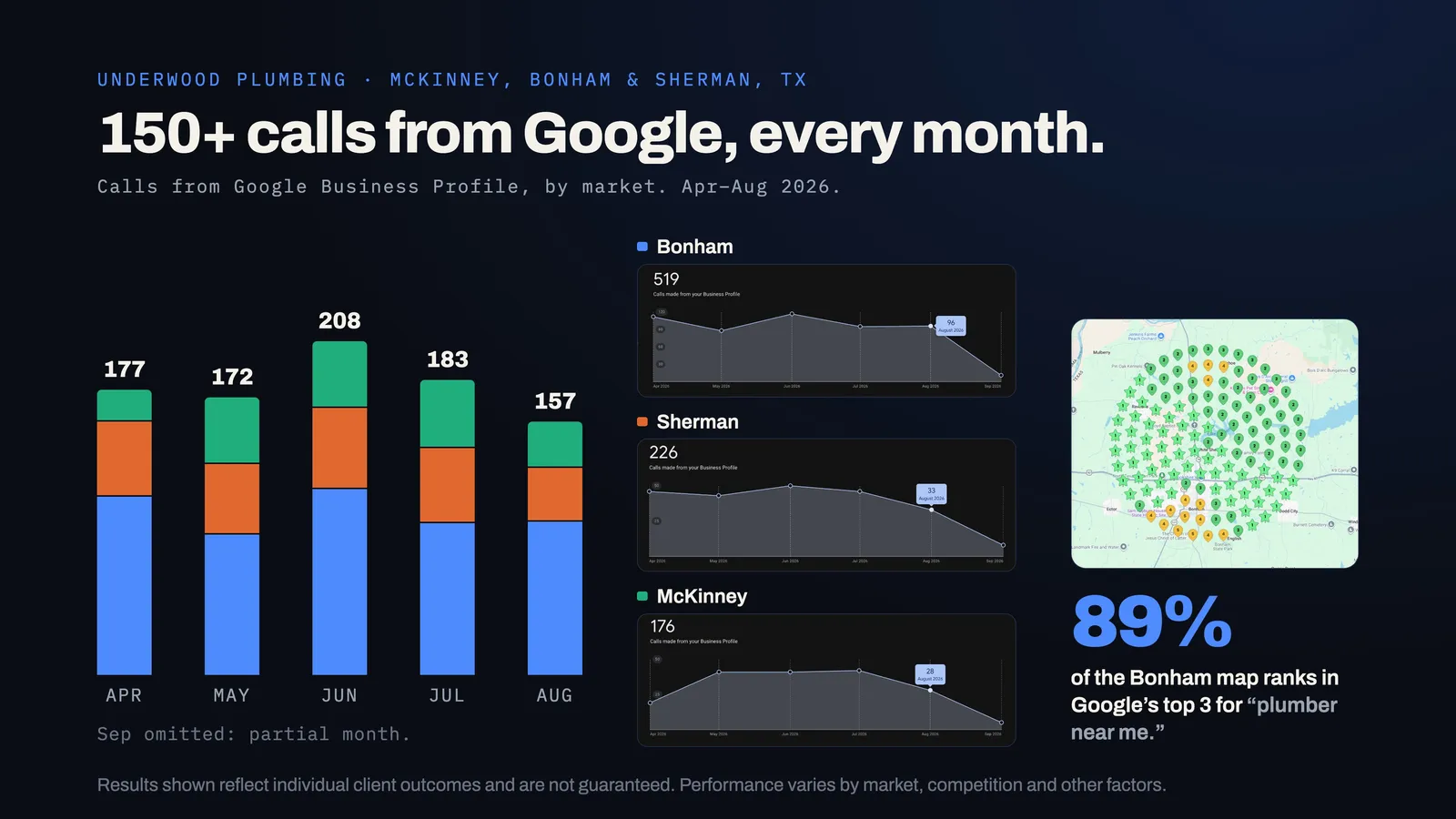
Underwood Plumbing in McKinney, Bonham and Sherman, TX got 897 calls from three Google Business Profiles from April to August 2026, about 179 a month, with an average map rank of 1.92 for "plumber near me" in Bonham and 89% of the Bonham grid in the top 3. Joe Cole Plumbing in Davie, FL got 410 calls from its profile over the same months, up 22% on 2025. (Client Google Business Profile reporting.)
How does SEO generate plumbing leads?
SEO generates plumbing leads by putting a page from your website in front of people searching for a specific job in a specific town, such as "water heater replacement Plano" or "sewer line repair Davie." These buyers are often comparing options, so the page has to answer their questions and make it easy to call.
Three kinds of pages do most of the work:
- Service pages, one per high-value service: drain cleaning, water heater repair and replacement, tankless water heaters, sewer line repair, leak detection, repiping, water treatment and so on. Each should explain the problem, the fix, how long it takes, what affects the price and why customers choose you.
- City pages, one for every town you want calls from, with real local detail: common pipe materials in older neighborhoods, hard water, slab leaks, clay sewer laterals and jobs your crew has done there. Pages that only swap the city name rarely rank.
- Problem pages that answer the questions people type before they call: "water heater leaking from the bottom," "why does my drain smell," "sewer smell in basement."
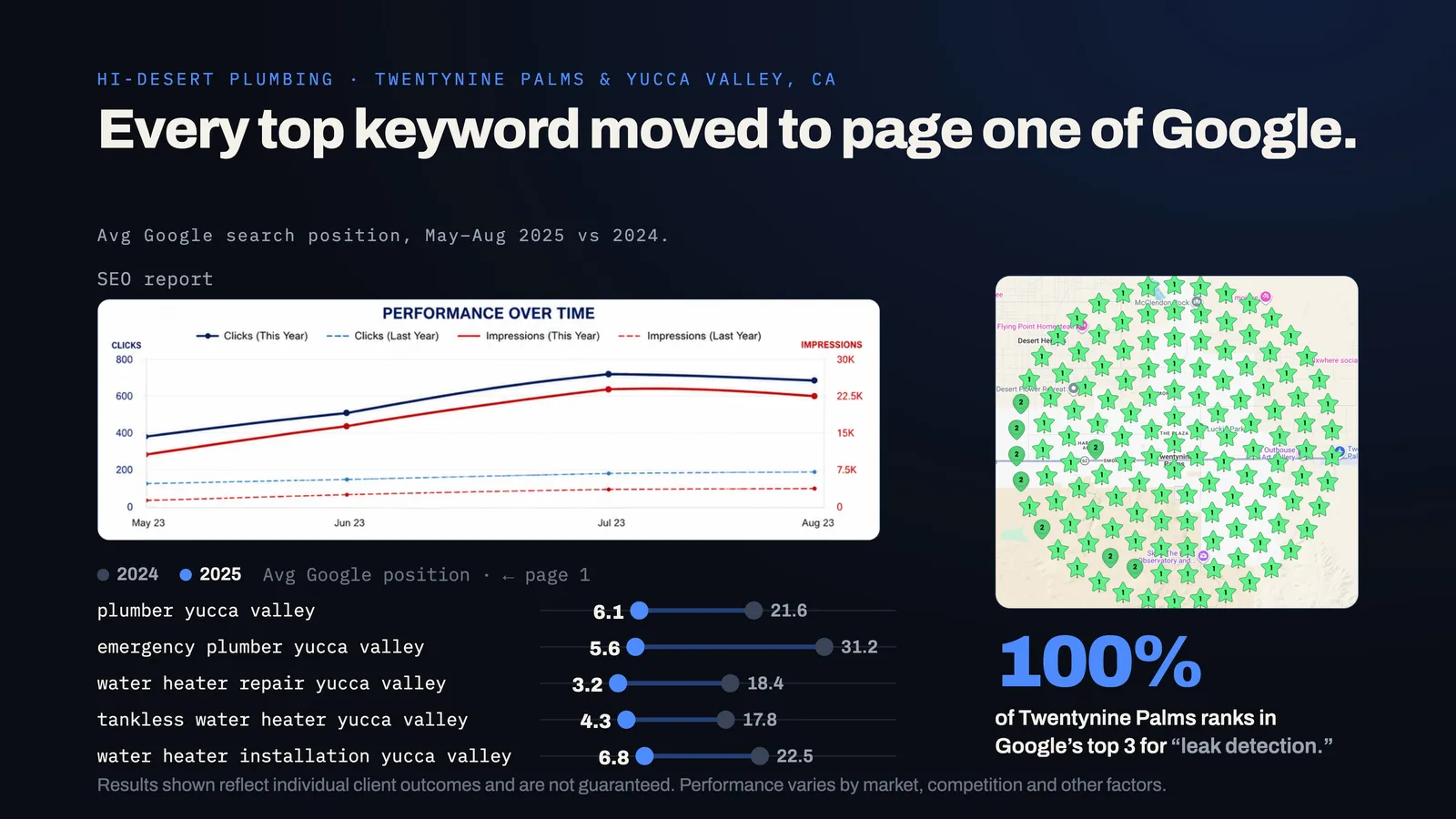
Service pages are how Hi-Desert Plumbing in Twentynine Palms and Yucca Valley, CA moved every tracked keyword to page one. "Emergency plumber yucca valley" went from an average position of 31.2 to 5.6, and website clicks from Google search rose 445%, to 2,460 from May to August 2026 (from 453 the year before). The full playbook is in our plumbing SEO guide.
Not sure which of your lead sources actually books jobs? Book a free growth call and we'll review your Google profile, website and call tracking with you.
Book a Growth CallHow do reviews generate more plumbing leads?
Reviews generate leads twice: they help your profile rank, and they decide which of the three map results a customer taps. In BrightLocal's 2026 Local Consumer Review Survey of 1,002 US adults, 47% said they would not use a business with fewer than 20 reviews, 74% cared only about reviews from the last three months, and 31% would only use a business rated 4.5 stars or higher, up from 17% a year earlier.
The same survey found that 83% of people asked for a review in the past year went on to leave one. Asking works. The plumbing companies that win build the ask into the job:
- The technician asks in person when the problem is fixed and the customer is relieved.
- The office texts a direct review link the same day, ideally within the hour.
- Someone replies to every review within a few days, by name and in a few specific words.
- Unhappy customers get a call from the owner or manager, not a template.
Never offer a discount, gift or entry into a drawing for a review, and do not ask only happy customers; Google prohibits both, and the FTC's 2024 rule on fake reviews makes buying or faking them illegal. Our best-performing clients get 25 new reviews per month.
When should plumbers use Local Services Ads and Google Ads for leads?
Use paid Google ads when you need emergency calls now, when you are entering a new area, or while your profile and website are still building. They are the fastest plumbing lead sources there are, and they stop when you stop paying.
| Local Services Ads | Google Ads (search) | |
|---|---|---|
| Where they show | Top of Google, above everything else, with the Google Verified badge | Above and below the regular results, marked "Sponsored" |
| How you pay | Per lead (a call or message), not per click | Per click |
| Typical cost | SearchLight's February 2026 data puts the average plumbing lead at about $57, varying widely by market | LocalIQ's plumbing benchmarks show about $10.49 a click and a 7.63% conversion rate |
| Control | Little: job types, areas, hours, budget | Full: keywords, ads, landing pages, bids, schedule |
| Setup time | Weeks, because of Google Verified screening | Days, if tracking is ready |
Costs in your market can be far above or below those averages, so judge both by cost per booked job, not cost per lead. Our guides to Local Services Ads for plumbers and Google Ads for plumbers cover setup, budgets and the settings that waste the most money.
How fast should you respond to a plumbing lead?
Answer calls live and reply to texts, Google messages and forms within five minutes. Emergency customers hire whoever answers first, and Google uses responsiveness in how it ranks Local Services Ads.
| Lead type | Target response | If you miss it |
|---|---|---|
| Phone call | Answered live, ideally within 3 rings | Automatic text-back within 1 minute, then a call-back within 5 |
| Google Business Profile or LSA message | Under 5 minutes during open hours | Reply first thing; slow replies can hurt your LSA ranking |
| Website form | Under 5 minutes | Call, then text with two time windows |
| Online booking request | Confirm within 15 minutes | Call to confirm before the slot |
| After-hours emergency | Answered by on-call tech or answering service that can dispatch | A live call-back before the customer finds someone else |
How should plumbers handle missed and after-hours calls?
Treat every missed call as a lost job and fix the gap with people, not voicemail. Plumbing emergencies do not keep office hours: frozen pipes break overnight, sewer lines back up on holiday weekends, and water heaters fail on Sunday morning.
- Measure the gap first. Pull missed calls by hour and day from your call-tracking or phone system for the last 90 days. Most shops find their biggest losses at lunch, after 5 p.m. and on weekends.
- Decide what you will do after hours. If you dispatch at night, route calls to an on-call tech or an answering service that can book and dispatch. If you don't, say so in your profile hours and ad schedule, and take a callback time.
- Turn on missed-call text-back. A text within a minute ("Sorry we missed you, this is [Company]. What's going on? We can have someone out today.") saves many calls that would otherwise go to the next plumber.
- Match your ads to your capacity. Running ads at 2 a.m. with nobody answering is the most expensive mistake in plumbing paid search.
How do you turn more plumbing calls into booked jobs?
Use a simple booking script, offer two specific time windows before talking price, and listen to recorded calls every week. The gap between "lead" and "booked job" is usually in how the phone is answered.
- Answer with the company name and your name. "Thanks for calling Smith Plumbing, this is Dana. How can I help?"
- Get the problem and the address. Confirm they are in your service area before anything else.
- Check for an emergency. Ask whether water is still running and tell them where the main shut-off usually is if it is.
- Offer two time windows. "We can have a plumber there between 1 and 3 today, or 8 to 10 tomorrow. Which works?"
- Explain the visit fee or diagnostic plainly. If you charge a trip or diagnostic fee, say what it covers.
- Confirm by text. Send the time window, the tech's name and photo if your software supports it.
- Tag the outcome. Mark the call booked, not booked and why, so you can see which sources send real jobs.
Then listen to ten recorded calls a week with the person who answers them. Most shops find a few repeat problems, such as quoting prices before offering a time or letting the caller hang up "to think about it," that are easy to fix and worth more than any new lead source.
What counts as a qualified plumbing lead?
A qualified plumbing lead is a real customer, in your service area, asking for a service you offer, at a time you can do it. Write that definition down and use it in every report, so a vendor's "lead" and your "lead" mean the same thing.
| Lead status | Counts as qualified? | What to do |
|---|---|---|
| New customer, in area, service you offer | Yes | Book it |
| Existing customer calling about a new job | Yes, but track separately | Book it; do not credit it to a new-customer channel |
| Out of your service area | No | Refer out; ask for an LSA credit or add a negative location in Google Ads |
| Service you do not offer (for example, well pumps) | No | Refer out; remove the job type or add negative keywords |
| Price shopper who will not book | Partly | Follow up once; review your offer and visit-fee explanation |
| Spam, sales pitch, wrong number | No | Exclude from reports; ask for credits where available |
How should plumbers follow up on unsold estimates?
Follow up on every estimate over a set amount with a fixed sequence: same day, two days later, a week later and a month later. Water heater replacements, repipes, sewer line replacements and water treatment systems are the jobs where follow-up pays most, because customers often get two or three quotes.
| When | How | What to say |
|---|---|---|
| Same day | Text from the tech or office | Thank them, attach the estimate, offer to answer questions |
| Day 2 | Phone call | Ask what questions they have; mention financing if you offer it |
| Day 7 | Text or email | A short review from a similar job, and the next open install date |
| Day 30 | Check in; for failing equipment, a reminder of the risk of waiting | |
| Day 90 | Seasonal reminder; then move to your past-customer list |
Track the percentage of estimates that close by technician and job type. Even a small rise in that close rate is worth more than most new lead sources, because the cost of the lead is already paid.
How do you generate more water heater, repipe and sewer leads?
High-ticket plumbing leads come from searchers who research before they buy, so they need dedicated pages, reviews that mention the job, clear financing and quick, professional estimates.
- Build one page per high-ticket service: tank water heater replacement, tankless installation, whole-home repipe, sewer line replacement and trenchless repair, slab leak repair and water treatment. Explain the signs that it is time, the options, what affects the price and how long the job takes.
- Run separate Google Ads campaigns for water heaters and sewer work, with their own budgets and landing pages, so cheaper drain clicks do not eat the budget.
- Turn repair calls into replacement leads. Train techs to note the age and condition of water heaters and pipes on every visit, and follow up on aging equipment.
- Use camera inspections on sewer calls and share the video with the customer; it makes the replacement decision easier.
- Show financing on the page and in the estimate if you offer it.
How do you get more plumbing leads from past customers?
Your customer list is the cheapest lead source you have. People who already hired you trust you, and they need a plumber again sooner or later.
- Send seasonal reminders: freeze prep before the first hard freeze, water heater flush once a year, sump pump checks before the spring rains and outdoor faucet shut-off in the fall.
- Offer a plumbing maintenance plan with an annual inspection, water heater flush and drain check. Members call you first and give you a reason to visit every year.
- Text past customers before busy holidays. ServiceTitan's data from more than 350 plumbing businesses found the Mondays around Thanksgiving are among the busiest days of the year (ServiceTitan); a reminder about what not to put down the disposal keeps your name in front of them.
- Keep the list clean: phone, email, address, equipment age and last service date in your field-service software.
How do you build a plumbing referral program that produces leads?
Referral programs work when the ask is specific and the reward is real but modest. "Tell your friends" does little; "If a neighbor needs a plumber, give them this card, and we'll send you a $50 gift card when we do the job" works better.
- Customer referrals: a thank-you for referring a paying customer (not for a review; never reward reviews).
- Realtors and home inspectors: fast turnaround on pre-sale inspections, sewer camera reports and repair quotes.
- Property managers and landlords: a dedicated line, clear pricing for common repairs and reliable photos and invoices.
- Other trades: HVAC, electricians, remodelers, restoration companies and water treatment dealers who need a plumber they can trust.
Track referral sources in the same "lead source" field as everything else so you can see which partners actually send work.
How do you generate plumbing leads in the slow season?
Plumbing demand is steadier than HVAC, but it still swings with weather and holidays. Plan your lead generation by season instead of reacting to a quiet week.
| Season | What breaks | What to push |
|---|---|---|
| Winter | Frozen and burst pipes, water heaters working hardest | Emergency ads, freeze-prep reminders, water heater replacement |
| Spring | Sump pumps, sewer backups from heavy rain, outdoor spigots | Sump pump checks, sewer camera inspections, backflow testing |
| Summer | Outdoor plumbing, irrigation, more people home | Water treatment, repipes, remodel plumbing, maintenance plans |
| Fall | Outdoor shut-offs, holiday guests, disposals | Pre-holiday drain cleaning, water heater flushes, winterization |
| Holidays | Kitchen drains and disposals around Thanksgiving | Extended hours, staffing and ads on the busiest days |
In slower weeks, shift effort to the owned sources: send a past-customer campaign, follow up on old estimates, ask for reviews from recent jobs and publish the service pages you have been putting off. That work keeps paying in the busy weeks.
Do Facebook ads, direct mail and partnerships work for plumbing leads?
They can, as supporting channels. They rarely beat Google for emergency calls, because people with a leak search rather than scroll.
- Meta ads work best for offers people can plan around: water heater replacement, water treatment, maintenance plans and seasonal specials. Target homeowners in your service area and send them to a page with the offer.
- Direct mail and door hangers work around active jobs. When you replace a sewer line on a street of 1950s homes, the neighbors have the same pipes.
- Truck wraps and yard signs are cheap visibility in the neighborhoods you serve; include the website and a short, memorable phone number.
- Nextdoor and local groups produce referrals when real customers recommend you; answer questions there helpfully rather than posting ads.
Measure each with its own tracking number or offer code. If you cannot measure it, you cannot tell whether it is worth renewing.
How do you track plumbing lead generation?
Track every lead from first contact to paid invoice, and report by source. Without that, every decision about where to spend is a guess.
- Use a separate tracking number for each channel: Google Business Profile, Google Ads, Local Services Ads (Google provides its own), direct mail and trucks. On the website, use dynamic number insertion so the number changes by visitor source while your main number stays on the profile.
- Record calls (with the disclosure your state requires) and tag each one as booked, not booked or not a lead.
- Send form fills and online bookings into your CRM with the source attached.
- Add a lead source field to every job in your field-service software, such as ServiceTitan, Housecall Pro or Jobber, and make it required.
- Report monthly on leads, booked jobs, revenue and cost per booked job by source.
| Metric | How to calculate it | What it tells you |
|---|---|---|
| Leads | Calls, texts, forms and bookings from new customers | Volume; not enough on its own |
| Booking rate | Booked jobs ÷ qualified leads | How well the phone is answered |
| Cost per booked job | Channel spend ÷ booked jobs from that channel | The main number for comparing sources |
| Revenue per lead | Revenue from channel ÷ leads from channel | Whether a source sends small or large jobs |
| Return on spend | Revenue (or gross profit) ÷ spend | Whether to scale the channel |
How do you decide which plumbing lead sources to keep?
Score every source every quarter on cost per booked job, average ticket and how much of it you control, then move money from the worst to the best. A source that looks cheap per lead can be the most expensive per job.
| Source | Leads | Booked jobs | Spend | Cost per booked job | Average ticket | Decision |
|---|---|---|---|---|---|---|
| Google Business Profile | 120 | 78 | (SEO cost) | Lowest | $480 | Keep investing |
| Local Services Ads | 40 | 24 | $2,280 | $95 | $520 | Keep; raise budget in peak weeks |
| Google Ads | 55 | 25 | $4,000 | $160 | $900 | Keep high-ticket campaigns; cut low-value keywords |
| Shared leads | 30 | 6 | $1,500 | $250 | $350 | Cut or renegotiate |
The numbers above are an illustration, not client data. Plug in your own from your call tracking and field-service software. The pattern is common, though: owned channels become the cheapest per job, paid search is worth it for larger tickets, and shared leads often lose once you count the jobs instead of the leads.
What plumbing lead generation mix fits your company size?
The right mix depends on how many trucks you run and how much cash you can put into sources that take months to pay back.
| Company stage | Focus first | Add next | Hold off on |
|---|---|---|---|
| Owner-operator, 1–2 trucks | Google Business Profile, reviews, Local Services Ads | Service pages for your top 3 services | Broad Google Ads, Meta ads, bought leads |
| Growing, 3–10 trucks | Profile and SEO for every town, LSA, Google Ads for emergencies and water heaters | Call center process, follow-up, maintenance plan | Channels you cannot track |
| Established, 10+ trucks or multiple locations | A profile per real location, city pages, full paid search | AI search, commercial outreach, partnerships | Spreading thin across too many vendors |
How does commercial plumbing lead generation differ from residential?
Commercial plumbing leads come from relationships and reliability more than from emergency searches. Restaurant owners, facility managers and property management companies hire plumbers they trust to show up, document the work and invoice cleanly.
- Build a commercial plumbing page that lists the property types you serve, your response times, licensing and insurance, and preventive maintenance options such as grease trap and backflow work.
- Run a separate Google Ads campaign for commercial keywords such as "commercial plumber" and "restaurant plumber," with its own landing page.
- Reach out directly to property managers and facility teams with a short, specific offer, and follow up for months, not days.
- Track commercial leads separately, because their sales cycle and value are completely different.
Killeen Plumbing Company in Westlake, OH grew organic traffic 62.9%, from 1,370 visits a month in February to 2,233 in September 2026, with an average map rank of 2 and 90% of the ranking grid in the top 3 for "commercial plumber." (Client analytics and grid reporting.)
Do AI tools like ChatGPT generate plumbing leads?
Yes, increasingly. BrightLocal's 2026 survey found 45% of consumers now use ChatGPT or other AI tools for local business recommendations, up from 6% the year before. AI tools usually name specific businesses when asked for a plumber, and they draw on the same signals that drive Google: a complete profile, reviews, consistent listings and a website that clearly states services, areas, licensing and hours.
AI leads are hard to track directly, because many arrive as a phone call or a branded search. Ask "How did you hear about us?" on every call and add "AI assistant" as an answer. Our AI search guide for plumbers covers what to do.
What results can owned plumbing lead generation produce?
Owned lead generation compounds. The profile, pages and reviews keep producing calls month after month, without a charge for each one. These are real 2026 results from plumbing companies we work with:
| Company | Market | Result |
|---|---|---|
| NexAir Home Services | Huntington & Charleston, WV | 841 calls from 5 Google Business Profiles, Apr–Sep 2026; revenue from about $1M to $4M |
| Underwood Plumbing | McKinney, Bonham & Sherman, TX | 897 calls from 3 profiles, Apr–Aug 2026 |
| Anderson Plumbing, Heating & Air | Bethany, OK | 2,944 profile interactions, Apr–Aug 2026, up 210.9% |
| Joe Cole Plumbing | Davie, FL | 410 calls, Apr–Aug 2026, up 22% |
| VeriTech Plumbing | Costa Mesa, CA | 7× the profile calls of a year earlier, Jan–Apr 2026 |
| Hi-Desert Plumbing | Twentynine Palms & Yucca Valley, CA | Website clicks from search up 445% |
See every company, with sources and timeframes, in our plumbing marketing case studies.

Anderson Plumbing, Heating & Air (Geoff Goodwill, Bethany, OK) moved away from paying about $440 per pay-per-click lead. The owner says "we've added probably 7 or 800 new customers since we started with you guys." (Owner's estimate, not audited.) Read the Anderson Plumbing case study.
What is a 90-day plumbing lead generation plan?
Fix the leaks first, turn on fast paid sources second, and start the owned sources that compound right away. This is the order we use with new plumbing clients.
| Weeks | Do this | Goal |
|---|---|---|
| 1–2 | Set up call tracking and recording, a lead source field in your software, and missed-call text-back; listen to 20 recent calls | Know where leads come from and where they leak |
| 2–4 | Rebuild the Google Business Profile: categories, services, hours, photos; start a same-day review ask | More map-pack calls; more reviews |
| 3–6 | Start or fix Local Services Ads and emergency Google Ads with tight areas and hours | Emergency calls this month |
| 4–8 | Publish service pages for your top high-ticket services and your main towns | Rankings that start to build |
| 6–10 | Launch estimate follow-up and a past-customer campaign | More jobs from leads you already have |
| 10–13 | Review cost per booked job by source; move budget toward the winners | A mix that gets cheaper over time |
Want a 90-day plan built for your plumbing company and towns? Book a free growth call and we'll map it out with you.
Book a Growth CallShould you hire a plumbing lead generation company?
Hire help if you lack the time or skills to run the profile, website, ads and tracking well, but make sure you own everything and are measured on booked jobs. There are two very different kinds of "lead generation company":
- Lead sellers sell you leads they generate on their own sites and listings. You pay per lead, own nothing and lose everything when you stop.
- Marketing agencies build your profile, website, ads and reviews in your name, so the work keeps producing after you stop paying them.
Before hiring either, ask who owns the accounts and phone numbers, how leads are defined and credited, and whether they report on booked jobs. Our guide on how to choose a plumbing marketing agency lists the questions to ask and the red flags, and our plumbing marketing budget guide shows how much to spend.
Related plumbing guides: plumbing website design, AI search for plumbers, 30 plumbing marketing ideas, how to choose a plumbing marketing agency and our plumbing case studies.
Plumbing lead generation FAQ
What is the best lead generation for plumbers?
For most plumbing companies, a fully built Google Business Profile that ranks in the map pack, backed by Local Services Ads and Google Ads for emergency calls, service and city pages on the website, and a steady flow of reviews. The best source in your market is the one with the lowest cost per booked job.
How much do plumbing leads cost?
It depends on the source and market. SearchLight's February 2026 data puts the average plumbing Local Services Ads lead at about $57; LocalIQ's benchmarks show Google Ads clicks around $10.49 with a 7.63% conversion rate. Leads in expensive metros can cost far more. Compare sources by cost per booked job.
Should plumbers buy leads?
Only to fill specific gaps, such as a new town or spare capacity. Shared leads may go to several plumbers, quality varies, and you keep nothing when you stop. Track bought leads by outcome and cut vendors whose cost per booked job is higher than your other sources.
How can a plumber get leads without paying for ads?
Build your Google Business Profile, ask every customer for a review, publish a page for each service and town, follow up on estimates, and stay in touch with past customers. These cost time rather than per-lead fees and keep working after the effort is done.
How fast should a plumber respond to a lead?
Answer calls live and reply to texts, messages and forms within five minutes. Emergency customers usually hire the first plumber who answers, and a missed call should get an automatic text-back within a minute.
How do I know which marketing brings in plumbing jobs?
Use a separate tracking number for each channel, record and tag calls, send forms into your CRM with the source attached and require a lead source on every job. Then report cost per booked job by source each month.
What is a good booking rate for plumbing calls?
There is no universal benchmark, because it depends on your lead mix. Track your own booking rate by source and by the person answering, and work on the lowest ones. Listening to recorded calls weekly is the fastest way to raise it.
Do plumbing referral programs work?
Yes, when the ask is specific and the reward is real: a thank-you for referring a paying customer, plus relationships with realtors, inspectors, property managers and other trades. Never reward customers for reviews.
How long does it take to generate leads from SEO?
Map-pack gains often show in weeks to a few months, followed by organic rankings for service and city pages. Anderson Plumbing's owner said phones were ringing more within about three months. It depends on competition and your starting point.
Can ChatGPT send leads to my plumbing company?
Yes. Many consumers now ask AI tools for local recommendations. AI answers draw on your Google profile, reviews, listings and website, so the same work that wins the map pack helps. Ask callers how they found you to measure it.