
Roofing marketing that works wins the searches homeowners make when they need a roof looked at now: "roofer near me," "roof repair" and "roofing company" plus their town. That means a fully built Google Business Profile for every real office, ranking in the map pack; one page per service and per city on your website; a steady flow of Google reviews; and Google Ads or Local Services Ads to cover the gaps while SEO builds. Then someone has to answer the phone. Judge all of it by signed jobs and revenue, not clicks, because one roof replacement pays for months of marketing.
This guide is written for owners of residential roofing companies, from one-truck repair shops to multi-location replacement companies. It covers what we do for our roofing clients, what the results look like in real accounts, and what we'd tell you to do first if you were doing it yourself. Every client number on this page comes from our 2026 roofing results deck: Google Business Profile call reports and map-ranking scans. Each section answers its question in the first paragraph, so you can skim.
Start with this video. Andy Walker, our founder, walks through the exact SEO system we use for roofing companies, from keyword research to the Google Business Profile, reviews, backlinks and citations. Most of what follows on this page expands on it.

Roofing client results
These are ten of the eighteen roofing companies in our 2026 results deck. Calls are calls made from the Google Business Profile itself, so they undercount total calls from Google. Ranks are grid averages: 1.0 would mean first place at every point. Each roofer's market, storm year and crew size differ, so treat these as examples, not a forecast.
Garabar Roofing
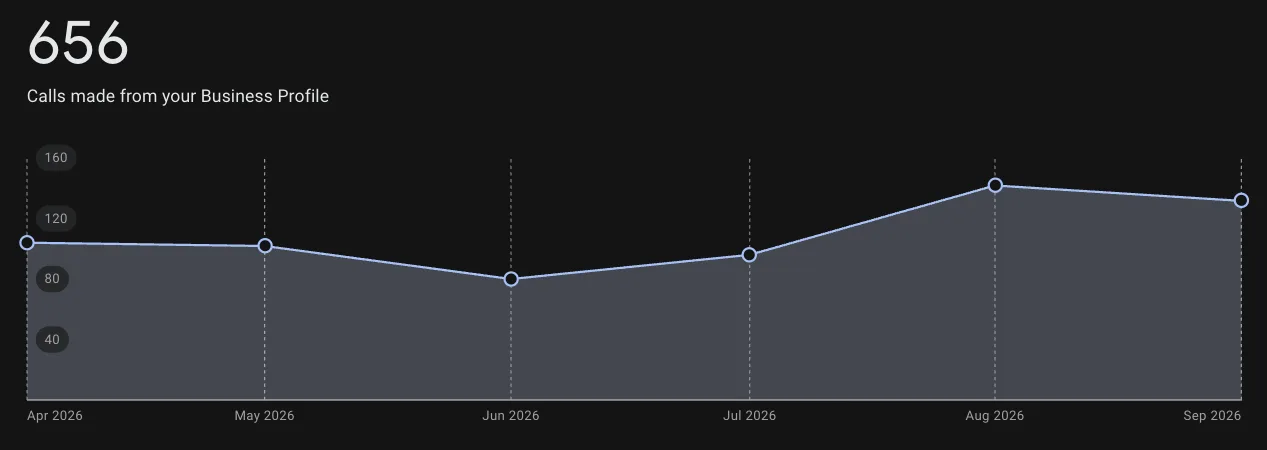
About 110 calls a month, peaking around 142 in August. 1.13 average rank for “roofer lake worth” (#1 of 41) and 1.66 for “roof repair lake worth” (#1 of 43).
Neal Roofing & Waterproofing
Owner: Sam Allsop
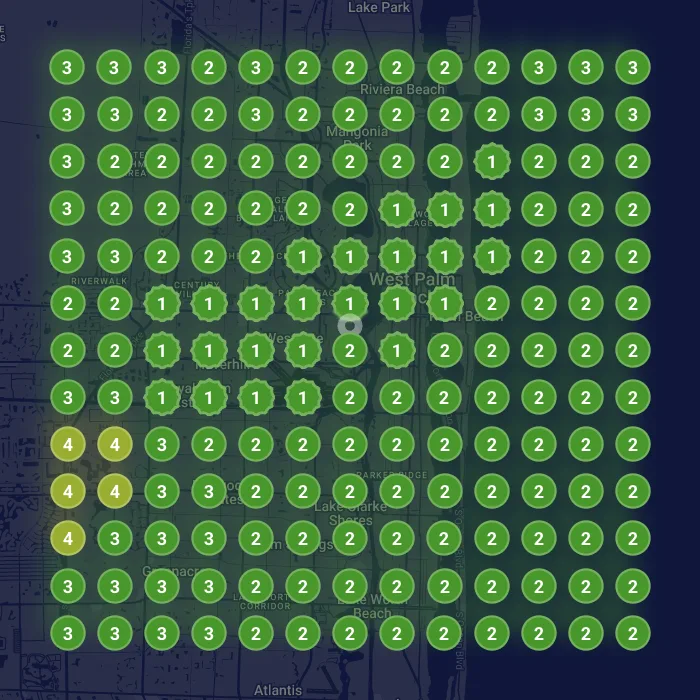
97% of the map grid in the top 3 for “roofing company west palm beach.” A landing page we built in May 2025 grew to about 3,100 organic visits a month.
Original Roofing Co.
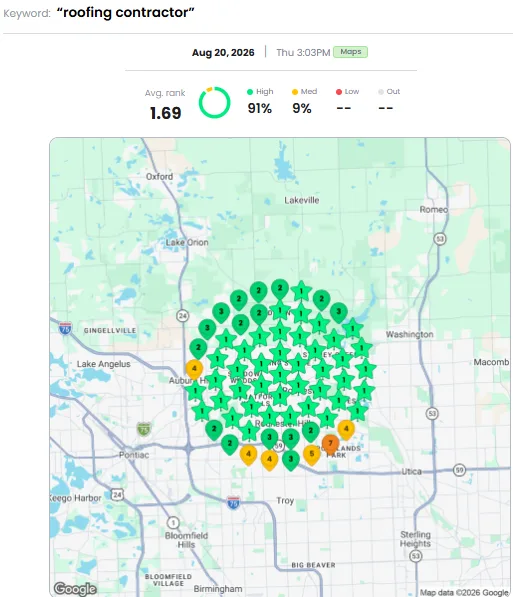
Rochester Hills 167 (up 68.7%), Grand Rapids 72 (up 24.1%) and a new Inverness, IL profile with 10. 1.69 average rank for “roofing contractor” in Rochester Hills.
Dave Adams Roofing & Siding
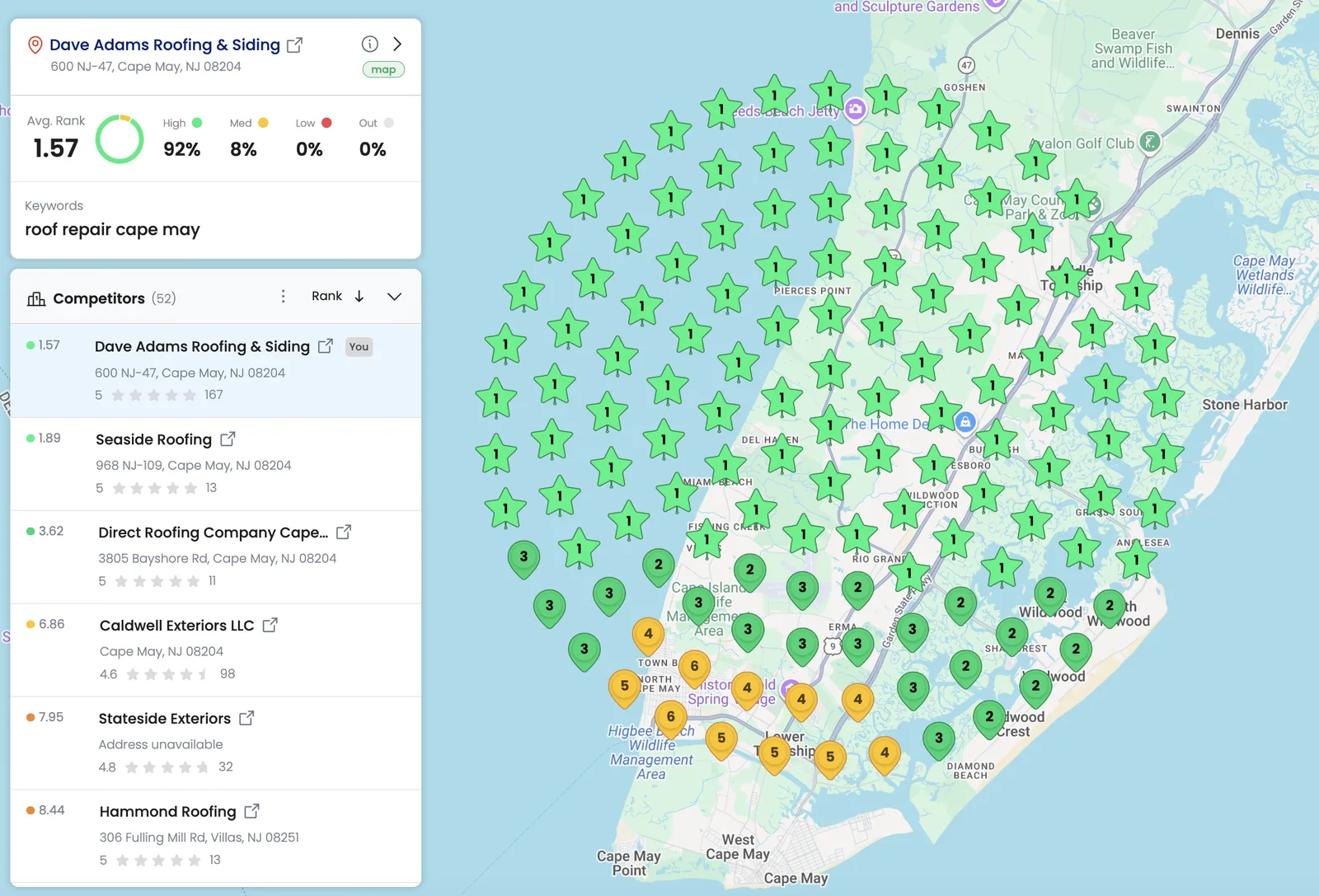
1.57 average rank with 92% of the grid in the top 3. 258 calls from Google, May–Sep 2026, up 12.2% on last year.
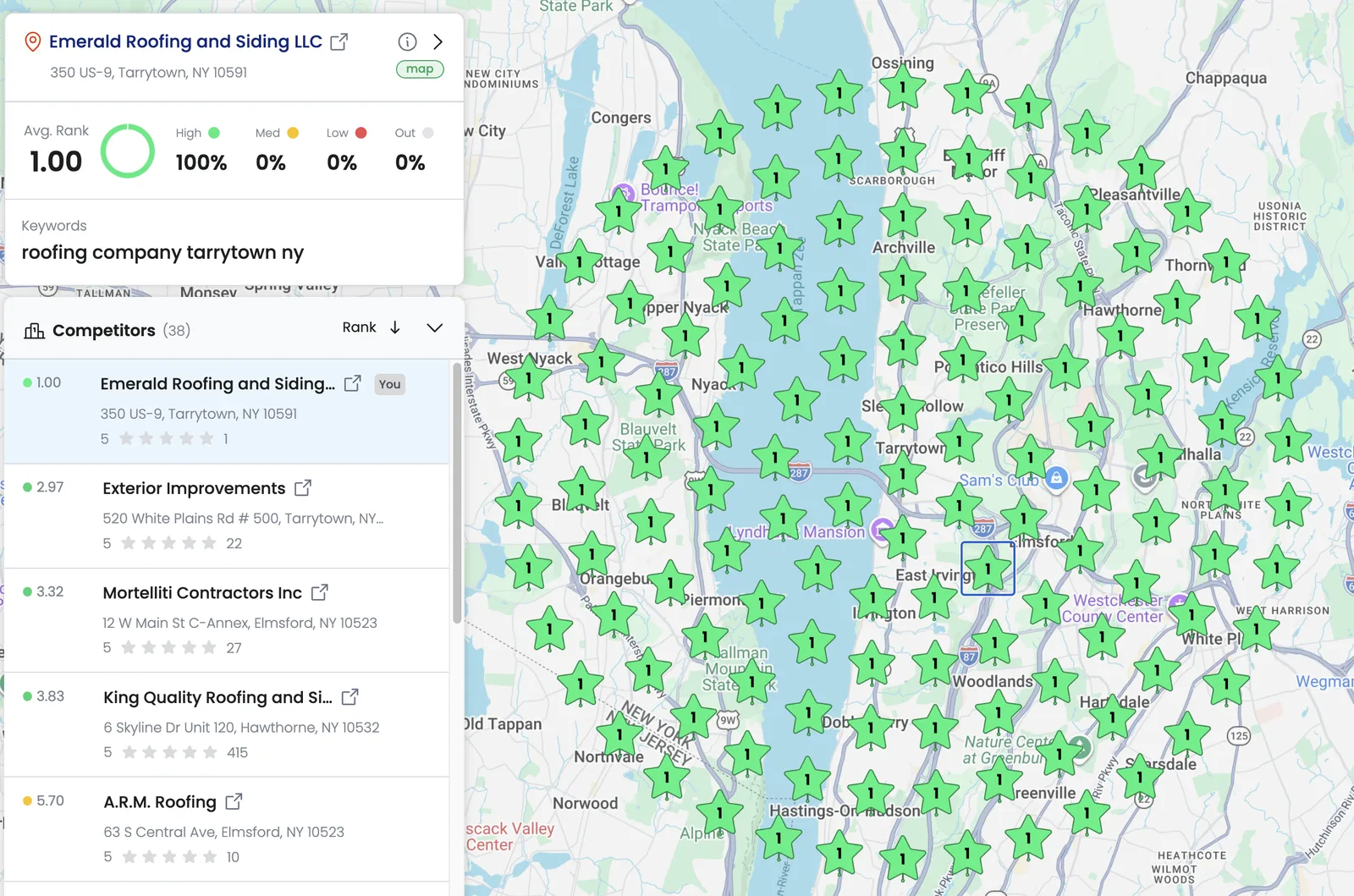
Emerald Roofing & Siding
#1 on every point of the Tarrytown grid, ahead of 38 competitors, and 2.41 in Rockland County with 93% in the top 3. 228 calls, Apr–Aug 2026, up 16.3%.
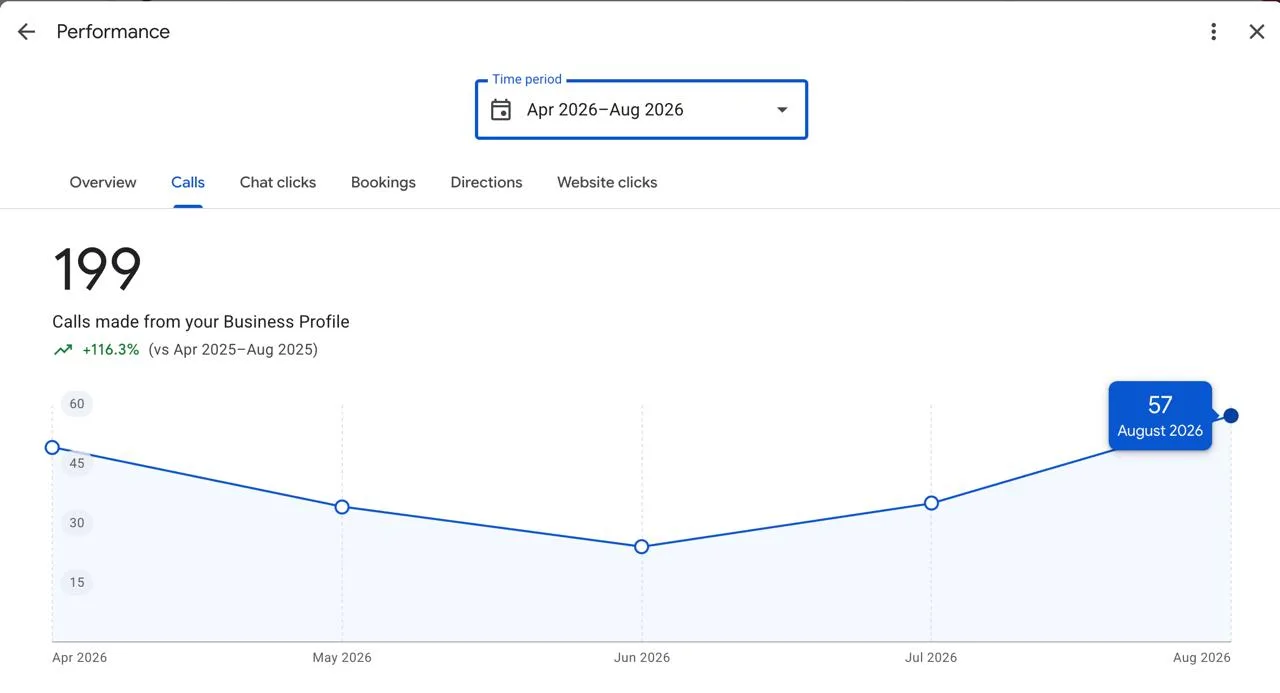
Real Roofing
199 calls in five months. 2.35 average rank for “roofing company chandler,” with 90% of the grid in the top 3, #1 of 63 tracked competitors.
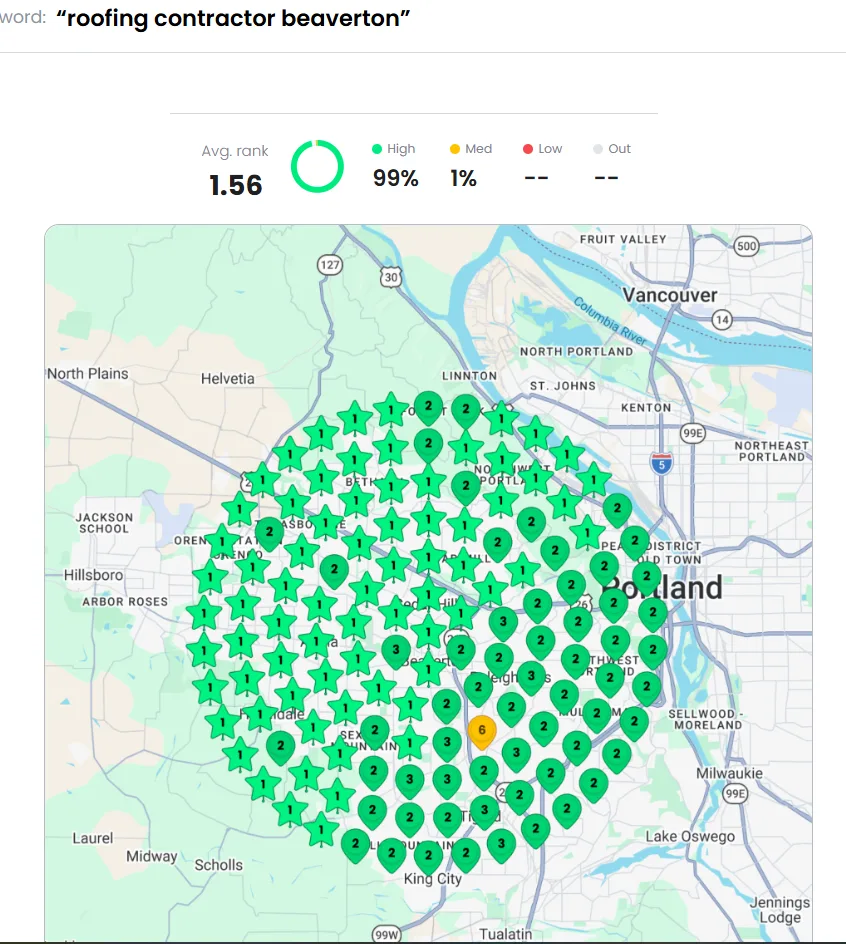
Raven Roofing
1.56 average rank for “roofing contractor beaverton.” 106 calls from Google, May–Sep 2026, and organic traffic up 84% to about 2,300 visits a month.
Gikas Roofing
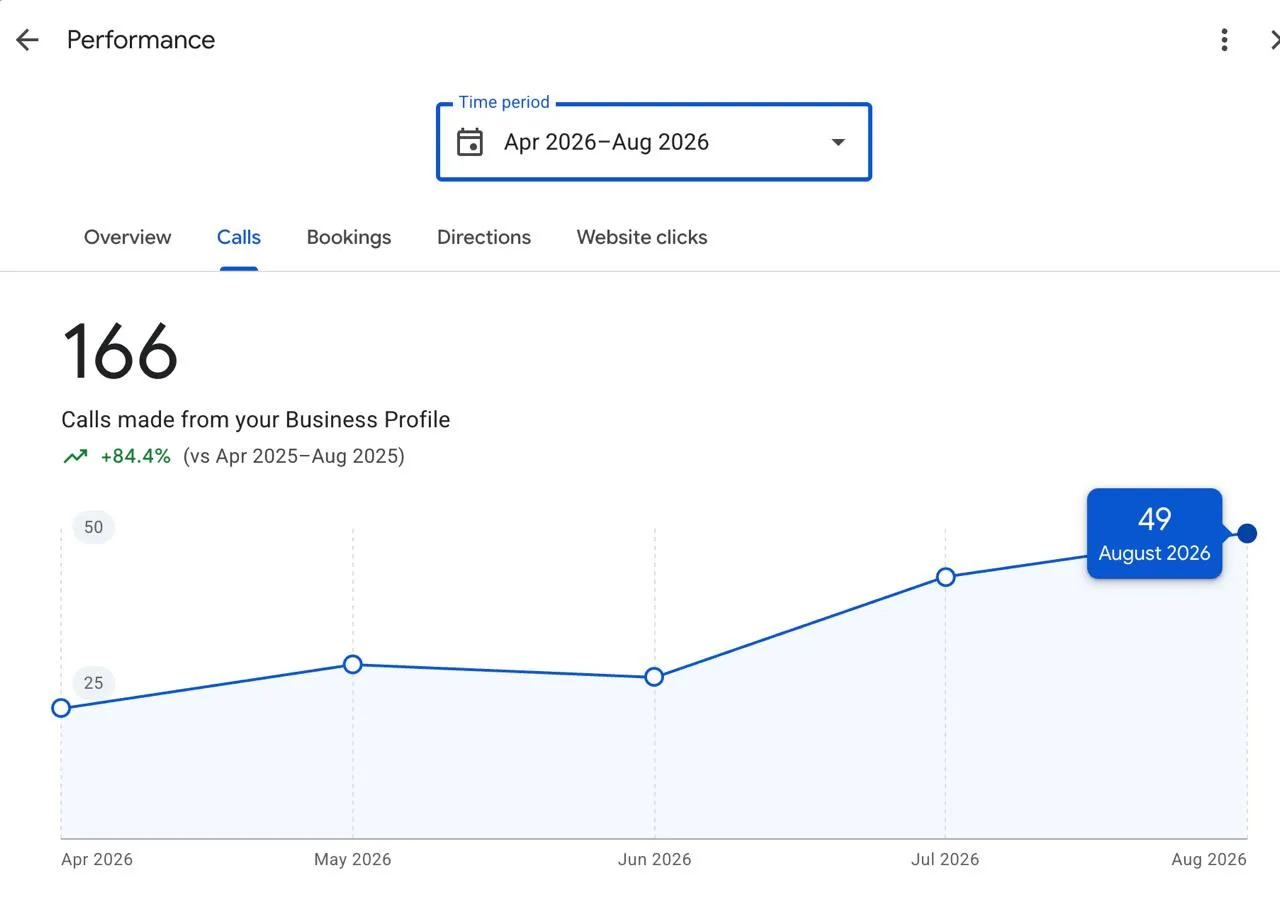
166 calls in five months, with 49 in August alone. 2.72 average rank for “roofing company rockland county,” 72% of the grid high, #2 in the market.
Mighty Dog Roofing
Owner: Vish Mazumder
#1 among tracked competitors for “roofing contractor near me” and “roof repair” across a wide grid north of Boston, with 6.49 and 7.12 average ranks.
All-Side Roofing & Restoration
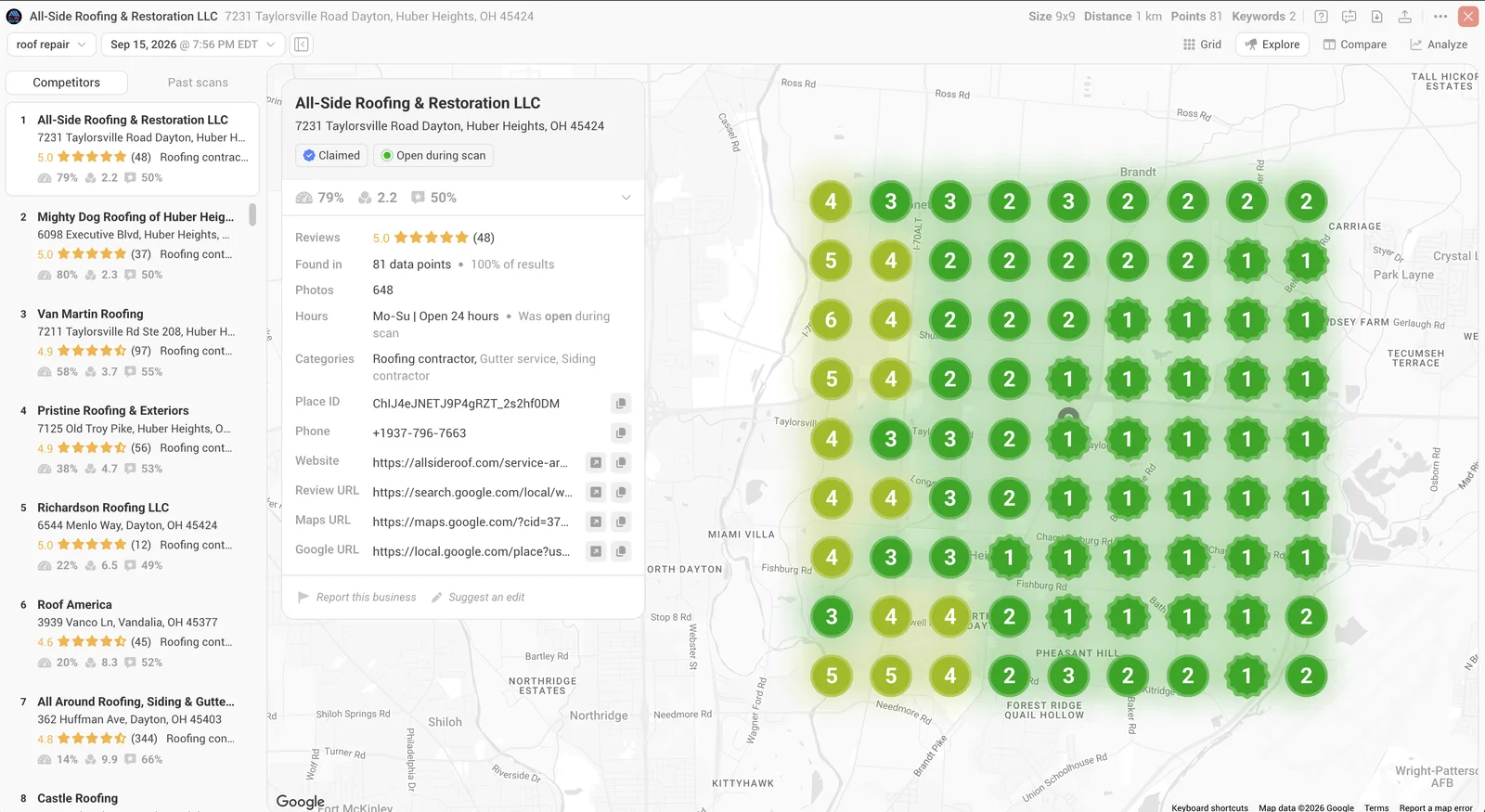
Dayton 141 (up 23.7%), Huber Heights 30 and a new Middletown profile. #1 for “roof repair” in Huber Heights and #2 in Dayton.
| Client | Market | Calls from Google profile | Best tracked map result |
|---|---|---|---|
| Garabar Roofing | Lake Worth Beach, FL | 656 (Apr–Sep 2026) | 1.13 avg for "roofer lake worth," #1 of 41 |
| Neal Roofing & Waterproofing | West Palm Beach, FL | 661 (Apr–Sep 2026) | 97% of the grid top 3 for "roofing company west palm beach" |
| Original Roofing Co. | Rochester Hills & Grand Rapids, MI; Inverness, IL | 249 (Jun–Sep 2026); Rochester Hills up 68.7% | 1.69 avg for "roofing contractor," Rochester Hills |
| Dave Adams Roofing & Siding | Cape May, NJ | 258 (May–Sep 2026), up 12.2% | 1.57 avg for "roof repair cape may," #1 of 52 |
| Emerald Roofing & Siding | Tarrytown & Rockland County, NY | 228 (Apr–Aug 2026), up 16.3% | 1.00 avg in Tarrytown, #1 of 38 |
| Real Roofing | Chandler, AZ | 199 (Apr–Aug 2026), up 116.3% | 2.35 avg for "roofing company chandler," #1 of 63 |
| Ridge Runner Roofing | Western North Carolina (3 profiles) | 182 (Apr–Sep 2026) | Monthly calls up from 20 to 46 |
| All-Side Roofing & Restoration | Dayton, Huber Heights & Middletown, OH | 173 (May–Sep 2026); Dayton up 23.7% | #1 for "roof repair," Huber Heights |
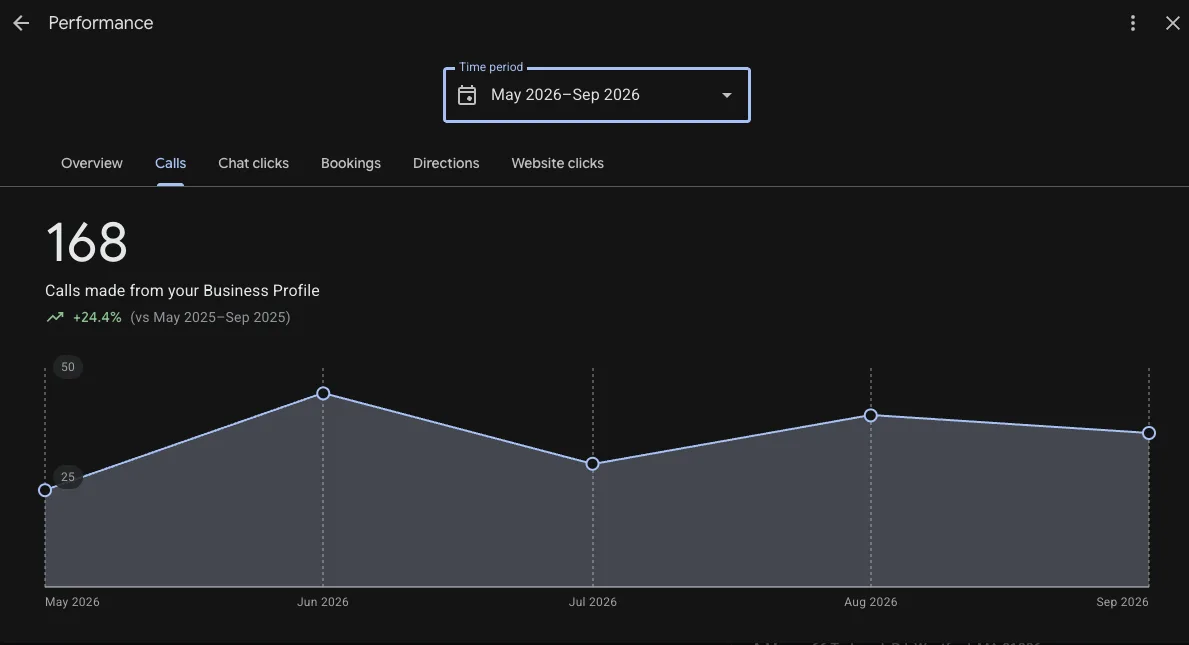
| Mighty Dog Roofing | Westford, MA | 168 (May–Sep 2026), up 24.4% | #1 of the tracked competitors for "roofing contractor near me" |
| Gikas Roofing | Pearl River, NY (Rockland County) | 166 (Apr–Aug 2026), up 84.4% | 2.72 avg for "roofing company rockland county," #2 |
Three patterns repeat. First, the companies with the most calls have one market they own outright on the map, like Garabar in Lake Worth Beach and Neal in West Palm Beach. Neal grew from $1M to $50M in revenue in 5 years; co-founder Sam Allsopp discusses it on Buyers & Builders. Second, multi-location roofers grow by adding real, staffed offices with their own profiles: Original Roofing, Ridge Runner, All-Side, Surge Exteriors and Raven Roofing all run two or three. Third, new profiles start slow. Original's Inverness profile produced 10 calls in its first four months and All-Side's Middletown profile produced 2. A new profile usually takes months to earn its rank.
Not every account is a win, and we'd rather show you that than hide it. Charleston Roofs + Windows averages 5.43 for "roofing company charleston," with 41% of the grid in the top 3. That's a hard, crowded market and it's still a work in progress. Bumble Roofing of Greater Kansas City had 38 profile calls from June to September 2026, and the trend was down. You'll find the full picture, including the weak spots, on our roofing case studies page.
How is roofing marketing different from other home services?
Roofing jobs are big, infrequent and often triggered by weather, so you're marketing to people who buy a roof once or twice in their lives and who compare several companies before they sign. That changes what you measure, how fast you need to answer, and how much proof you need to show.
| Roofing | HVAC, plumbing and pest control | |
|---|---|---|
| What one job is worth | High. A single replacement can pay for months of marketing | Smaller tickets, more repeat visits and service plans |
| How often the customer buys | Once every couple of decades for a replacement | Yearly maintenance, recurring plans |
| What triggers demand | Leaks, storms, hail, wind, an inspection for a home sale or an insurance claim | Breakdowns, seasons, recurring pests |
| How customers decide | Several estimates, reviews, photos of past roofs, warranty and financing | Often the first credible company that answers |
| What to measure | Cost per inspection, close rate and revenue per signed job | Cost per booked call and average ticket |
| Legal risks in the marketing itself | Insurance-claim advertising rules in some states, door-to-door rules | Fewer trade-specific rules |
Two things follow. Because the customer compares, your Google profile, reviews and website do most of the selling before you ever speak to them. And because one job is worth so much, a slow callback is expensive. Tony Munoz of Martin Home Exteriors in Jacksonville built his business on the opposite habit: he promises customers a call back within the hour. In his words, "the quickness in responding" is what customers notice.
Roofing also splits into two businesses that market differently. Retail work (repairs and replacements paid for by the homeowner) runs on search, reviews and financing. Insurance and storm work runs on speed after an event, inspections and documentation, and it comes with legal limits on what you can say. Most companies do both, and your website and ads should treat them as separate offers.
How do homeowners pick a roofer for a repair or a new roof?
They check reviews, look for a license and insurance, get more than one written estimate, and avoid anyone who pressures them. That isn't a guess. It's what the Federal Trade Commission tells them to do. The FTC's guide on how to avoid a home improvement scam says to consider "only contractors who are licensed and insured," to "get multiple estimates," to read reviews "with a critical eye," and lists contractors who knock "because they are 'in the area'" as a warning sign.
So the roofer who wins is the one who makes those checks easy:
- Show your license and insurance on every location page and in your Google profile description, with the license number written out.
- Show real roofs you've done, with the town named. Photos from the job site beat stock images every time.
- Explain your estimate: what's included, the materials, the timeline and the warranty. Itemized estimates are something Tony Munoz uses to stand out.
- Make it easy to get the inspection: a phone number that gets answered, a short form, and clear hours.
- Don't pressure. High-pressure tactics are exactly what homeowners are warned about.
Which marketing channels get roofing companies the most jobs?
For most residential roofers, Google drives the most profitable jobs: the map pack first, then organic search, then Google Ads and Local Services Ads. Referrals, yard signs, door knocking and bought leads fill in around that. The right mix depends on whether you sell retail repairs and replacements, storm and insurance work, or both.
| Channel | Speed | What it's good for | Watch out for |
|---|---|---|---|
| Google Business Profile and the map pack | Weeks to months | "Roofer near me," "roof repair [city]" and emergency calls | Ranks only near your real address; needs reviews |
| Website SEO (service and city pages) | Months | Replacement, material and city searches; feeds the map pack | Thin copy-paste city pages, which Google treats as doorway pages |
| Local Services Ads | Weeks (verification first) | Pay-per-lead calls with the Google Verified badge | Lead quality varies; disputes take work |
| Google Search ads | Days | Filling gaps, new markets, storm surges | Expensive clicks; needs tight keywords and negatives |
| Bought leads | Immediate | Volume in a new market | Often shared with other roofers; low close rates |
| Referrals, signs and neighbors | Ongoing | Cheap, high-trust jobs | Hard to scale on their own |
| Door knocking after storms | Immediate | Inspections in hit neighborhoods | Permit rules, cancellation rights and homeowner distrust |
We focus on the first four, because they compound. A page that ranks keeps producing calls next year without a per-click cost, and reviews you earn this month help your map rank, your ads and your close rate at once. Read the full comparison in our roofing lead generation guide.
How should a roofing company set up its Google Business Profile?
Use your real business name, "Roofing contractor" as the primary category, your real address, every roofing service you offer listed as a service, and a steady stream of job photos and reviews. Then link the profile to the matching page on your site. The profile is the single biggest lever for map rankings, and most roofers leave half of it empty.
- Name: your real-world business name, exactly as it appears on your signs and paperwork. Adding keywords that aren't part of your legal or brand name breaks Google's guidelines for representing your business and risks suspension. If you want "Roofing" and the city in your name, it has to be your real name. Andy covers this in the video above.
- Categories: "Roofing contractor" as primary. Add secondary categories only for work you really do, like gutter, siding or skylight services.
- Services: every one, written out: roof repair, roof replacement, roof inspection, storm damage repair, metal roofing, flat roofs, gutters. Link each to its page on your site where you can.
- Service areas: the towns you really cover. Google's guidelines say a service area shouldn't extend farther than about two hours' drive from where you're based.
- Photos: real crews, trucks and finished roofs, added every week or two.
- Description: lead with what you do and where, then your license, warranty and years in business. Write it for people, not for keywords.
- Posts and offers: recent jobs, financing, inspection availability. Bodhi points out in his Omaha audit that the market leader there posts every week.
If you have more than one real office, each one gets its own profile. A profile only ranks well around its own address, which is why our multi-location roofers grow by adding real locations, never virtual offices or mailboxes. Those get suspended. The full setup is in our roofing SEO guide, which covers the profile and reviews in detail.
How do roofing companies rank higher on Google Maps?
Google ranks local results on three things: relevance, distance and prominence. That's in Google's own help page on how local ranking works. You can't move your office closer to every searcher, so you win on relevance (a complete profile and strong service and city pages) and prominence (reviews, links and mentions across the web).
In practice, the roofers who rank #1 across their grid do the same handful of things well:
- A complete profile with the right category, every service listed and fresh photos.
- A strong, specific page on their site for the city the profile sits in, linked from the profile.
- More recent reviews than the competition, arriving every week, with owner replies.
- Consistent name, address and phone number across directories.
- Local links and mentions: suppliers, manufacturers' contractor directories, local news and community sites.
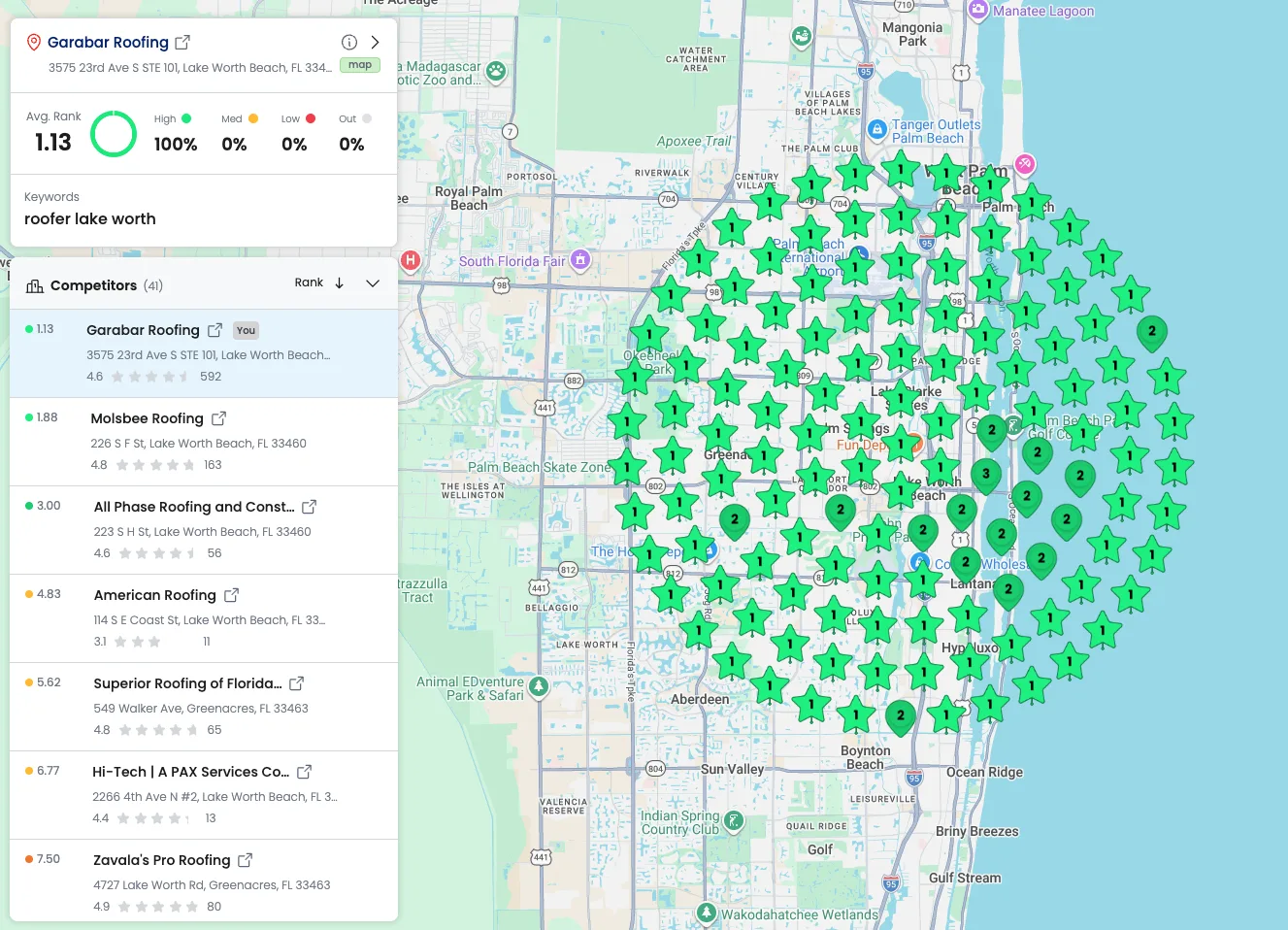
Distance still matters, and it explains most of the "why do I rank in one town and not the next one" questions. Emerald Roofing & Siding ranks 1.00 across Tarrytown but 2.41 in Rockland County. Original Roofing ranks 1.69 for "roofing contractor" around Rochester Hills, 5.30 around Grand Rapids and 7.91 around Inverness, where the profile is new. Same company, same work, different distance and age. See our guide to ranking a roofing company on Google Maps for how we read a grid and what to fix first.
Which pages does a roofer's site need for repair, replacement and storm searches?
One page per service and one page per city you serve, each written for that searcher, plus a homepage that says exactly what you do and where. A single "Services" page with a bullet list can't rank for "roof repair," "roof replacement" and "metal roofing" at the same time, and it can't rank in five towns.
| Page type | Examples | What it needs |
|---|---|---|
| Homepage | Roofing company in [main city] | Main city in the title and H1, services, proof, phone, license, reviews |
| Service pages | Roof repair, roof replacement, roof inspection, storm damage, metal roofing, flat roofing, gutters | How the job works, materials, timeline, warranty, photos, FAQs, call to action |
| Location pages | Roofing in [city], one for each town or county you really serve | Local proof: jobs in that town, local codes or weather, reviews from local customers |
| Location + service pages | Roof repair in [city] | Only where demand is real and you can write something different |
| Proof pages | Project gallery, reviews, warranty, financing | Real photos and named towns |
Andy's structure in the video nests these: county page, then city pages under it, then the city-and-service pages under those, all linked to each other and from the homepage. The trap is writing the same page 40 times with the city name swapped. Google's spam policies call those doorway pages, and they don't rank for long. Every city page needs something specific to that city.
The payoff can be big. In his live audit, Bodhi shows a landing page we built for Neal Roofing & Waterproofing in May 2025 that went from zero to about 3,100 organic visits a month. Giant Roofing & Exteriors in Ada, Michigan went from almost no organic traffic to 363 visits a month, and Raven Roofing's site reached about 2,300 a month, up 84%. Those traffic numbers come from SEO-tool estimates, so treat them as direction rather than an exact count. Read more in our roofing SEO guide and roofing website design guide.
Get ahead of the next storm season. On a free growth call we check where you rank for “roofer near me,” how your site sells inspections, and where calls slip through.
Book a Growth CallShould a roofing company run Local Services Ads and Google Ads?
Usually yes, while your map and organic rankings build, and in any market where you don't rank yet. Local Services Ads charge per lead, show at the top of local searches with the Google Verified badge, and suit roofers with strong reviews and someone answering every call. Search ads charge per click and give you more control, but roofing clicks are expensive, so they need tight keywords and a page built to convert.
Two things changed recently. Google replaced its older LSA badges with Google Verified in late 2025. And Google is moving Local Services Ads into Google Ads as Performance Max campaigns with pay-per-lead goals. According to Google's migration page, roofing is in the first group of US home service advertisers, starting in August 2026. You still pay per lead and the ads show in the same places on Search and Maps, but weekly budgets become daily averages, manual bidding goes away and old performance reports don't carry over, so save them first.
Two rules keep ad spend honest for roofers:
- Separate repair from replacement. They have different values and different searchers. Give each its own campaign or ad group and its own landing page.
- Track to signed jobs. A roofing lead isn't worth anything until it becomes an inspection, then an estimate, then a signed job. Connect your call tracking and CRM so you can see cost per signed job by campaign.
Our guide to Google Ads and Local Services Ads for roofers covers setup, negative keywords, budgets and how to dispute bad leads.
How many Google reviews does a roofer need to compete?
More recent reviews than the companies ranking above you, arriving every week rather than in bursts. There's no fixed number. Our best-performing clients get 25 new reviews/month. Reviews affect your map rank, your ad performance and, most of all, whether a homeowner calls you or the next roofer.
Tony Munoz went from about 60 Google reviews to about 160 in his first eight months with us, and he's now in the top three on the map in Jacksonville. That came from asking every customer, every time, at the right moment: when the roof is done and the crew has cleaned up. Andy's video recommends an automated text right after the job, followed by an email, so no one slips through.
What not to do: don't buy reviews, don't offer discounts or gifts for them, don't only ask the customers you know are happy, and don't write them yourself. Google's review policies ban fake engagement, and the FTC's rule on fake reviews lets it seek civil penalties. Ask every customer, make it easy with a direct link, and let them say whatever they want to say. Then reply to every review, good and bad.
How should roofers market storm and insurance work?
Be fast, be useful and stay inside your state's rules. After a hail or wind event, homeowners search for inspections and storm repair, and the roofer with an updated profile, a storm-damage page and someone answering the phone gets the calls. What you can say about insurance claims is limited by law in some states, so check before you advertise.
Florida is the clearest example. Florida Statute 489.147 treats any written or electronic communication that encourages a homeowner to contact a contractor to make a roof damage claim as a "prohibited advertisement" unless it carries specific disclaimers about deductibles and insurance fraud. It explicitly covers door hangers, business cards, magnets, flyers and emails. It also bans offering gifts or deductible waivers for an inspection or a claim, and bans contractors from interpreting policies or adjusting claims unless they hold a public adjuster license. Fines can reach $10,000 per violation. Other states have their own rules, so talk to a lawyer who knows contracting in yours.
The safe, effective approach:
- A storm damage page that explains what to look for, how an inspection works and what happens next, without promising insurance outcomes.
- Profile updates after an event: a post about inspection availability, updated hours if you extend them, and fresh photos.
- Search ads by area for the neighborhoods that were hit, turned on and off with the weather.
- Door knocking done right: permits where your town requires them, honest scripts and the cancellation notice the FTC's Cooling-Off Rule requires for most sales made at the customer's home.
What makes a roofing website turn visits into inspections?
A clear offer above the fold, a phone number and an estimate button that are always visible, proof that you're licensed and trusted, and real photos of roofs you've done. It has to load fast on a phone, because that's where most local searches happen. The rest is removing reasons to leave.
Bodhi's Omaha audit is a good checklist of what goes wrong. The homepage had a single call to action where it needed several, a footer cluttered with links, and a broken link to the company's YouTube channel. Compare that with the Neal landing page he shows in the same video: a sticky header with the license number and an estimate button, a short quiz that qualifies the lead, and video testimonials from real customers.
- Headline that says what you do and where: "Roof repair and replacement in [city]."
- Call and "Get an estimate" buttons in the header, after the first section and at the end.
- License number, insurance, manufacturer certifications and warranty.
- Financing, if you offer it, explained in plain words.
- Project photos with towns named, and reviews pulled from Google.
- A short form: name, phone, address, what's wrong.
See the full checklist in our roofing website design guide.
Why do ChatGPT and Google's AI answers name some roofers and not others?
By being easy for AI tools to verify: consistent business details everywhere, lots of recent reviews that describe the work, clear answers on your own site, and mentions on other trusted sites. No one can guarantee a recommendation, but those four things move it. AI search doesn't have enough search volume to need its own guide for roofers yet, so here's what we do.
Pineapple Roofing in Lewisville, Texas is the clearest example in our deck. Its AI visibility score in our tracking went from 0 to 20 in one month, December 2025, and the number of tracked ChatGPT prompts that mentioned it went from 0 to 3. That's small, early and worth watching, not a trend yet. In the Omaha audit, Bodhi checked whether ChatGPT named the company for its main searches, and it didn't. The company it named was the one with the most content and mentions.
- Same name, address, phone and hours on Google, Bing, Apple Business Connect, Yelp, the BBB and manufacturer directories.
- Service pages that answer real questions directly: cost factors, timelines, materials, warranties.
- Schema markup that matches what's on the page, including the RoofingContractor business type.
- Mentions in local news, supplier sites and community pages.
For the full method, read our AI search guide for home service companies. It applies to roofers the same way.
Why does answering fast matter so much for roofers?
Because homeowners call more than one roofer, and the first one to get back to them with a clear next step usually gets the inspection. Every other part of your marketing is wasted if the phone goes to voicemail. It's also a ranking factor for Local Services Ads, which can charge for missed calls during your business hours.
The fix is simple and boring: a person picks up every call during the hours you list, missed calls get a text back within minutes, form leads get a call within the hour, and you listen to a sample of recorded calls every week. Tony Munoz's one-hour callback promise is part of why his reviews mention how responsive his team is.
How should a local roofer compete with storm chasers?
By being obviously local and verifiable before the trucks with out-of-state plates arrive. After a big hail or wind event, crews follow the storm, knock doors, and leave when the claims are paid. Homeowners have learned to be wary, and that wariness is an opening for an established company.
- Show your address and history. A real office on your Google profile, years in business, and reviews that span several seasons, not just one storm.
- Show credentials a chaser can't borrow. Your state license number where your state issues one, proof of insurance, and any manufacturer certification you actually hold. Shingle makers such as GAF, Owens Corning and CertainTeed run contractor programs with their own requirements, and certified contractors can often offer stronger manufacturer warranties. Only claim the ones you hold and keep current.
- Stay within the rules. Several states regulate post-storm solicitation and contractor involvement in insurance claims, Florida among them. Know your state's rules before you canvass or advertise help with deductibles.
Which numbers tell a roofer its marketing is working?
Revenue and signed jobs by source, then the steps that lead there: calls and forms, inspections set, estimates given and close rate. Clicks and impressions tell you whether something is working early on. They don't tell you whether it's paying.
| Metric | Why it matters | Where it comes from |
|---|---|---|
| Calls from each Google profile | The main map-pack signal | Google Business Profile performance |
| Map grid average rank | Shows rank across your whole area, not just your office | A grid tracking tool, run monthly |
| Organic traffic and leads | Shows the website pages are working | Google Search Console, analytics |
| Cost per lead, by channel | Compares ads, LSA and bought leads | Ad accounts plus call tracking |
| Inspection-to-signed close rate | Tells you if leads are good or sales needs work | Your CRM |
| Revenue per signed job, by source | The number that decides your budget | Your CRM and invoices |
Vish Mazumder at Mighty Dog Roofing put attribution plainly in his interview: if you can't tell where your jobs came from, that's "a you problem." He means the tracking is the owner's job to set up, not the agency's to guess at.
What's a sensible marketing budget for a roofing company?
Enough to hit your revenue target at a cost per signed job you can live with. Start with your average job value and close rate, work back to how many leads you need, then fund the channels that produce those leads cheapest. There's no reliable industry percentage we'd stake your business on, so build the budget from your own numbers.
- Pick a revenue target for the next 12 months.
- Divide by your average job value to get the number of signed jobs you need.
- Divide by your close rate to get the number of inspections or estimates you need.
- Divide by your lead-to-inspection rate to get the leads you need.
- Price those leads by channel using your own history, then spread the budget across channels, weighting toward the ones with the lowest cost per signed job.
Plan around the seasons, too. In most of the country, spring and summer bring more searches and better weather to work in. After a storm, demand jumps for a few weeks. Put more into ads in peak season and steady SEO investment all year, because SEO built in the slow months is what pays in the busy ones.
What roofing marketing can you do for free?
More than most owners think. The highest-return free work is the Google Business Profile, a steady review habit and asking for referrals, and none of it costs anything but time. Paid channels work better on top of that foundation, not instead of it.
- Google Business Profile. Pick the right primary category, list every service, add real job photos every week and answer every review. It's free and it drives map rank. See how roofers rank on Google Maps.
- Reviews. Ask every customer the day the job is finished, with a direct link. Our best-performing clients get 25 new reviews/month, and that comes from a habit, not a campaign.
- Yard signs and the neighbors. A sign in the yard during the job, with permission, and a short note to the houses around it. Neighbors who watched a roof go on are some of the warmest leads you'll get.
- Bing Places and Apple Business Connect. Both are free, take an afternoon and send a share of calls Google doesn't.
- Old estimates. Call or text every estimate from the last year that didn't sign. Some chose nobody, and some are still waiting for a reason to call back.
- Short videos. A phone video walking a finished roof or explaining a common leak works on your profile, your site and social media.
Free marketing has one real cost: someone has to do it every week. The owners who get the most from it make it part of the job close-out, not a project for slow weeks.
A 90-day roofing marketing plan
Fix the free things first, then add ads, then build the pages and links that compound.
- Audit your Google Business Profiles (weeks 1–2). Name, category, services, service areas, hours, photos and website links. Set up call tracking and a map grid for "roofer," "roof repair" and "roofing company" in each market.
- Start the review system (weeks 2–4). Ask every finished job, by text then email. Reply to every review. Correct any listing where your roofing company's name, address or phone differs.
- Apply for Local Services Ads (weeks 2–4). Get your license, insurance and business name matching, then allow a few weeks for verification.
- Rebuild the core pages (month 2). Homepage, roof repair, roof replacement, inspection and storm damage pages, and a location page for each office's city.
- Launch search ads (months 2–3). Separate repair and replacement, add negative keywords for jobs, DIY and materials shopping, and send each ad group to a matching page.
- Review and expand (month 3). Check grids, calls by source and cost per signed job. Add city pages for the next ring of towns, and decide whether a second real location makes sense.
More roofing marketing ideas, by season
What Stryker Digital does for roofers
We run Google Business Profiles, map rankings, SEO, website pages, Local Services Ads, Google Ads and AI search visibility for roofing companies across the US, from single-office repair companies to multi-location replacement companies. Each client gets an account manager and a monthly report with calls by source, map grids and the pages we've added. Our roofing clients range from Garabar Roofing, a $50M-a-year company in Lake Worth Beach, to newer companies like Raven Roofing in Oregon that are building their second location.
Vish Mazumder, who grew his Mighty Dog Roofing franchise north of Boston to $5M in three years, described working with us simply: "Striker's been amazing." He's also clear that marketing is only one part of growth. His rule is to make sure that every job is set correctly, sold correctly and installed correctly. Leads you can't sell or install well hurt you. We'd rather grow you at a pace your crews can handle.
Roofing owners on camera

Mighty Dog Roofing (Vish Mazumder, Westford, Massachusetts). 168 calls from Google from May to September 2026, up 24.4% on the year before. #1 among the tracked competitors for "roofing contractor near me," with a 6.49 average rank across a wide grid. Vish calls our team "great team, super responsive."

Martin Home Exteriors (Tony Munoz, Jacksonville, Florida). Before working with us, Tony had never spent money on marketing. About eight months in, his Google reviews had gone from about 60 to about 160 and he was in the top three on the map. "I had agency fatigue," he says. This is now the "longest I've been with any agency."
Guides for roofing company owners
- Roofing SEO: service and city pages, the Google Business Profile and reviews.
- Rank on Google Maps: how roofers get into the map pack, and how to read a grid.
- Roofing ads: LSA and Search: campaigns, Google Verified and lead costs.
- Lead generation: every roofing lead source compared.
- Website design: sites that turn visits into inspections.
- Marketing ideas: tactics that work, by season and storm.
- Picking a roofing agency: what to ask before you sign.
- Case studies: eighteen roofing companies, real numbers.
- Suspended Google Business Profile: reinstatement steps (HVAC guide, same process for roofers).
- All client videos: owners on camera.
Run other trades too? See our plumbing marketing, pest control marketing and HVAC marketing and electrician marketing guides, or all the industries we work with.
FAQ
Which marketing brings a roofing company the most signed roofs?
For most residential roofers: a fully built Google Business Profile for each real office that ranks in the map pack, a website with one page per service and per city, a steady flow of Google reviews, and Google Ads or Local Services Ads while SEO builds. Judge every channel by cost per signed job, not cost per lead.
How can a roofer get more inspection requests?
Fix your Google Business Profile first (name, category, services, service areas, photos and reviews), build pages for each service and town you serve, and turn on Local Services Ads while your rankings grow. Then answer every call fast, because homeowners call more than one roofer.
Should a roofer put money into SEO or ads before storm season?
Ads bring calls within days but stop when you stop paying. SEO and map rankings take months but keep producing calls. Most roofing companies run both: ads for peak season, storms and new markets, and SEO to lower the overall cost per signed job over time.
When do roofing SEO changes start bringing calls?
Map rankings can move within weeks once the profile is fixed, but city and service page rankings usually take a few months. New profiles take longest: Original Roofing's new Inverness profile produced 10 calls in its first four months while its established Rochester Hills profile produced 167.
Are Local Services Ads worth it for roofing companies?
Often, if your reviews are strong and someone answers every call. You pay per lead, show above regular ads, and get the Google Verified badge. Dispute invalid leads, track each one to a signed job, and compare that cost with your other channels.
Which primary category should a roofer pick on Google?
"Roofing contractor" as the primary category for most companies. Add secondary categories only for work you really do, such as gutters or siding, and list every roofing service separately.
Can I advertise insurance claims for roof damage?
It depends on your state. Florida Statute 489.147, for example, bans ads that encourage homeowners to contact a contractor to make a roof damage claim unless they carry specific disclaimers, and bans gifts or deductible waivers for inspections or claims. Check your state's rules with a lawyer before you run storm or insurance ads.
When does a roofer need a second Google Business Profile?
Yes, if you have a real, staffed office in each market. A profile's map reach centers on its own office. Never use a virtual office or mailbox, because those profiles get suspended.
Can an agency make ChatGPT name my roofing company?
No one can promise it. AI assistants tend to name companies with consistent listings, strong reviews that describe the work, clear answers on their own site and mentions on other sites. We build all four and track the prompts that matter in your market.
Do you work with roofers who also do siding, gutters or windows?
Yes. Several of our clients, including Emerald Roofing & Siding, Dave Adams Roofing & Siding, Charleston Roofs + Windows and Martin Home Exteriors, sell more than roofs. Each service gets its own page, profile service listing and campaign.