
A good plumbing website gets a stressed visitor on a phone to call, text or book in under a minute, and gives Google and AI tools a clear page for every service and town you want calls from. That means a tap-to-call number and text option on every screen, one page per service and per city with real local detail, visible licensing and reviews, a short form, fast mobile load times, plumbing schema, and call tracking so you can see which pages produce booked jobs.
What makes a good plumbing website?
A good plumbing website does two jobs: it converts visitors into calls and bookings, and it ranks for the searches that bring those visitors in. Design that looks nice but hides the phone number fails the first job. A one-page site with no service or city pages fails the second.
Most plumbing visitors arrive in one of two states. Some have water on the floor and want a plumber now. Others are researching a water heater, repipe or sewer line and want to know whether you can be trusted with a big job. A good site serves both without making either one hunt.
| Job of the site | What it needs | How you can tell it works |
|---|---|---|
| Get the call | Tap-to-call and text on every screen, hours, service area | Calls and texts from the site, by page |
| Win the click on Google | A page for each service and town, written for how people search | Rankings and clicks in Search Console |
| Build trust | License, insurance, reviews, real photos of your team and trucks | Booking rate on high-ticket pages |
| Feed Google and AI tools | Clear text about services, areas, hours and credentials; schema that matches | Impressions, AI mentions, map rankings |
| Prove ROI | Call tracking, form tracking, lead source in your software | Cost per booked job from organic search |
What pages should a plumbing website have?
A plumbing website needs a homepage, one page for each service you want to sell, one page for each town you want calls from, an emergency page, an about page, a reviews page, a financing page if you offer it and a contact or booking page. Most underperforming plumbing sites are simply missing pages: one "Services" page listing 20 services cannot rank for any of them.
| Page | The question it answers | Must include |
|---|---|---|
| Homepage | Who are you, where do you work and how do I reach you? | Tap-to-call, text, service area, top services, license line, reviews |
| Emergency plumbing | Can someone come now? | Hours, how dispatch works, what to do before the plumber arrives (shut-off valve) |
| Service pages (drain cleaning, water heaters, tankless, sewer line, leak detection, repiping, water treatment, gas lines, toilets and fixtures) | Can you fix my problem? | Signs of the problem, options, what affects price, how long it takes, photos of real jobs, FAQs |
| City pages | Do you come to my town? | Real local detail, jobs completed there, neighborhoods, common local plumbing issues |
| Commercial plumbing | Do you handle my building? | Property types, response times, maintenance programs, insurance |
| About and licensing | Can I trust you in my home? | Owner and team, license numbers, insurance, years in business |
| Reviews | What do customers say? | Recent Google reviews, with the job type and town |
| Financing | Can I afford a big job? | Lender, terms in plain words, how to apply |
| Contact or book | How do I book? | Phone, text, a short form, online booking, hours, service area |
Every row is a question a customer asks. Google's AI features and tools like ChatGPT break a search such as "emergency plumber near me that does tankless" into the same smaller questions and look for pages that answer each one in plain text. If your answers live in images, PDFs or sliders, those tools cannot use them.
How should a plumbing homepage be laid out?
Lead with who you are, where you work and how to reach you, then let the visitor choose emergency or planned work. On a phone, the first screen should show the business name, a tap-to-call button, a text option and a one-line statement of services and area.
- Header. Logo, a tap-to-call number and a "Book online" or "Text us" button. On mobile, keep the call button in a bar that stays on screen.
- Headline. One plain sentence: "Licensed plumbers for drains, water heaters and leaks across Davie, Plantation and Weston. Open 24/7."
- Trust line. Google rating and review count, license number and "insured," in text, near the top.
- Two paths. "Plumbing emergency? Call now" and "Planning a water heater, repipe or sewer job? Get an estimate."
- Core services. Six to eight services, each linking to its own page.
- Recent reviews. Three or four short Google reviews with the job and town.
- Service area. Towns listed as links to their city pages.
- About the team. A real photo of the owner and techs, years in business, what customers can expect.
- Short form and booking. Name, phone, town and a one-line description; online booking if you use it.
Skip the full-screen video of a truck, rotating sliders and stock photos of smiling models. They slow the page down, push the phone number off the first screen and look like every other plumbing site.
How should a plumbing website serve emergency and planned buyers?
Give emergency visitors a phone number and reassurance within seconds, and give planned buyers the detail and proof they need to choose you for a large job.
| Emergency visitor | Planned-work visitor | |
|---|---|---|
| Typical searches | "emergency plumber near me," "burst pipe," "sewer backup" | "tankless water heater installation cost," "repipe house," "best plumber in [town]" |
| Device | Almost always a phone | Phone first, often a computer later |
| What they need first | A phone number, hours and proof you come to their area | Options, price factors, financing and reviews |
| Best call to action | Tap to call; text if they cannot talk | Request an estimate; book online; call |
| What loses them | A slow page, a buried number, a long form | Thin pages, no prices or price factors, no reviews on the page |
How should plumbing service pages be designed?
Each service page should answer one service completely: the problem, the signs, the fix, the options, what affects the price, how long it takes and why customers choose you, with a call button at the top and after each major section. These pages do double duty as SEO pages and as landing pages for Google Ads.
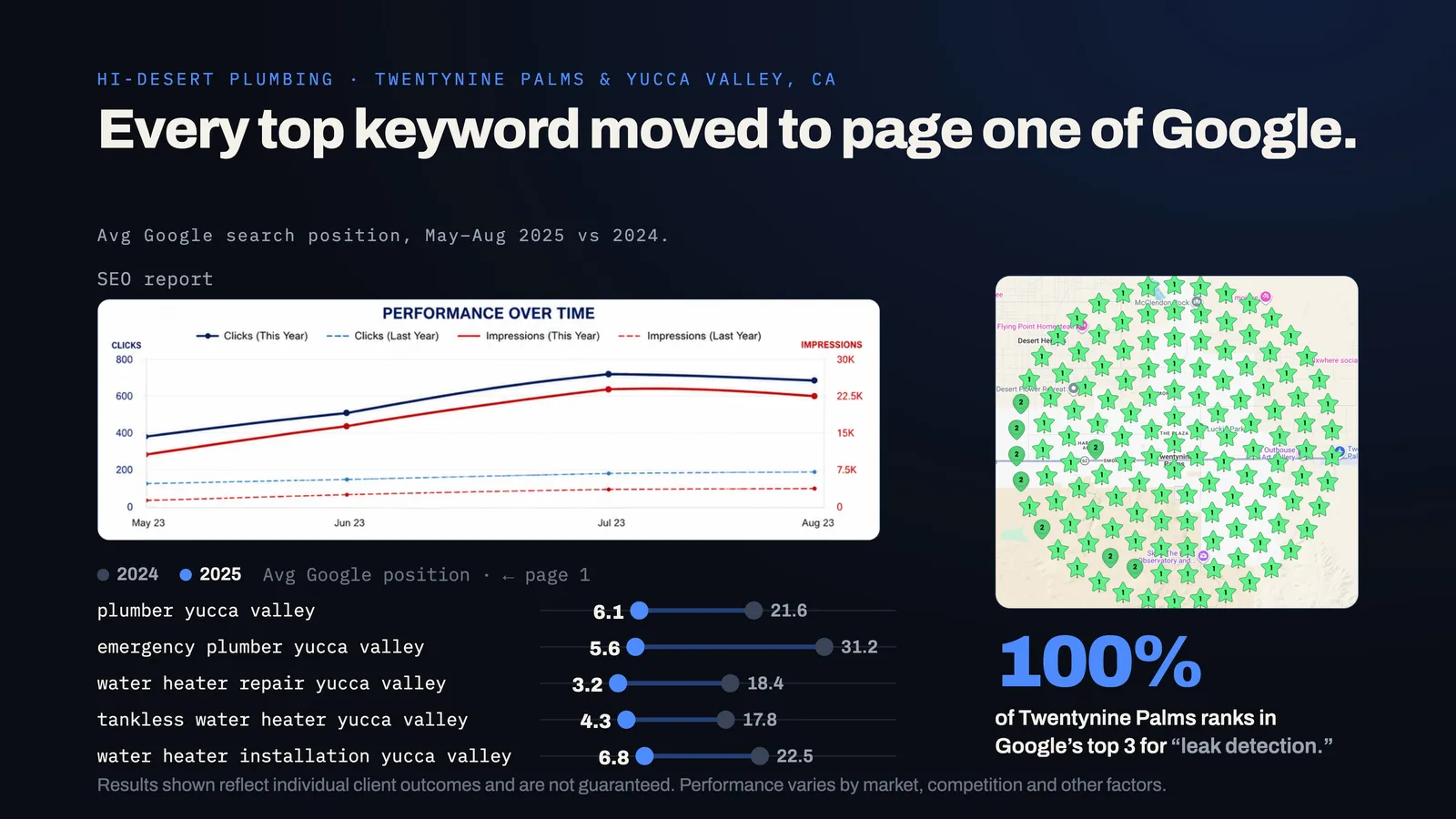
Hi-Desert Plumbing's service pages are a good example of what this does. After they were built out, "water heater repair yucca valley" moved from an average position of 18.4 to 3.2 and "emergency plumber yucca valley" from 31.2 to 5.6 (May–Aug 2026 vs. 2025, Search Console).
What should every plumbing service page include?
Use the same checklist for every service page so none of them ends up thin.
| Section | What to write | Example for water heater replacement |
|---|---|---|
| Answer-first intro | What you do, where, and how to book, in two or three sentences | "We replace tank and tankless water heaters across Plano and Frisco, usually same or next day." |
| Signs you need it | The symptoms customers notice | Rusty water, popping sounds, leaks at the base, a unit over 10 years old |
| Options | The choices and trade-offs | Tank vs. tankless, gas vs. electric, sizing for your household |
| What affects the price | Honest price factors, or a range if you are comfortable publishing one | Fuel type, venting changes, code upgrades, access, permits |
| How the job works | Step by step, with timing | Quote, permit, removal, install, test, haul away |
| Proof | Reviews and photos from this service | A review mentioning a water heater job in a named town |
| FAQs | Five to eight real questions from calls | "How long does a water heater last?" |
| Call to action | Call, text, book, estimate | Repeated after the intro, the price section and the FAQs |
How should plumbing city and service area pages be built?
Build a page for each town you want calls from, and make each one genuinely about that town. Pages that copy the same text with the city name swapped rarely rank and can drag down the rest of the site.
- Local plumbing issues. Hard water, older galvanized or cast-iron pipes in certain neighborhoods, slab foundations, clay or Orangeburg sewer laterals, freezing risk, septic vs. sewer.
- Neighborhoods and landmarks you actually serve.
- Recent jobs there, with photos and a sentence on what you fixed.
- Reviews from customers in that town.
- Local rules such as permits for water heaters or backflow testing requirements, if you know them.
- Links to your main service pages and to nearby city pages.
Start with the towns where you most want work and where you can actually get a truck quickly. Ten strong city pages beat fifty thin ones.
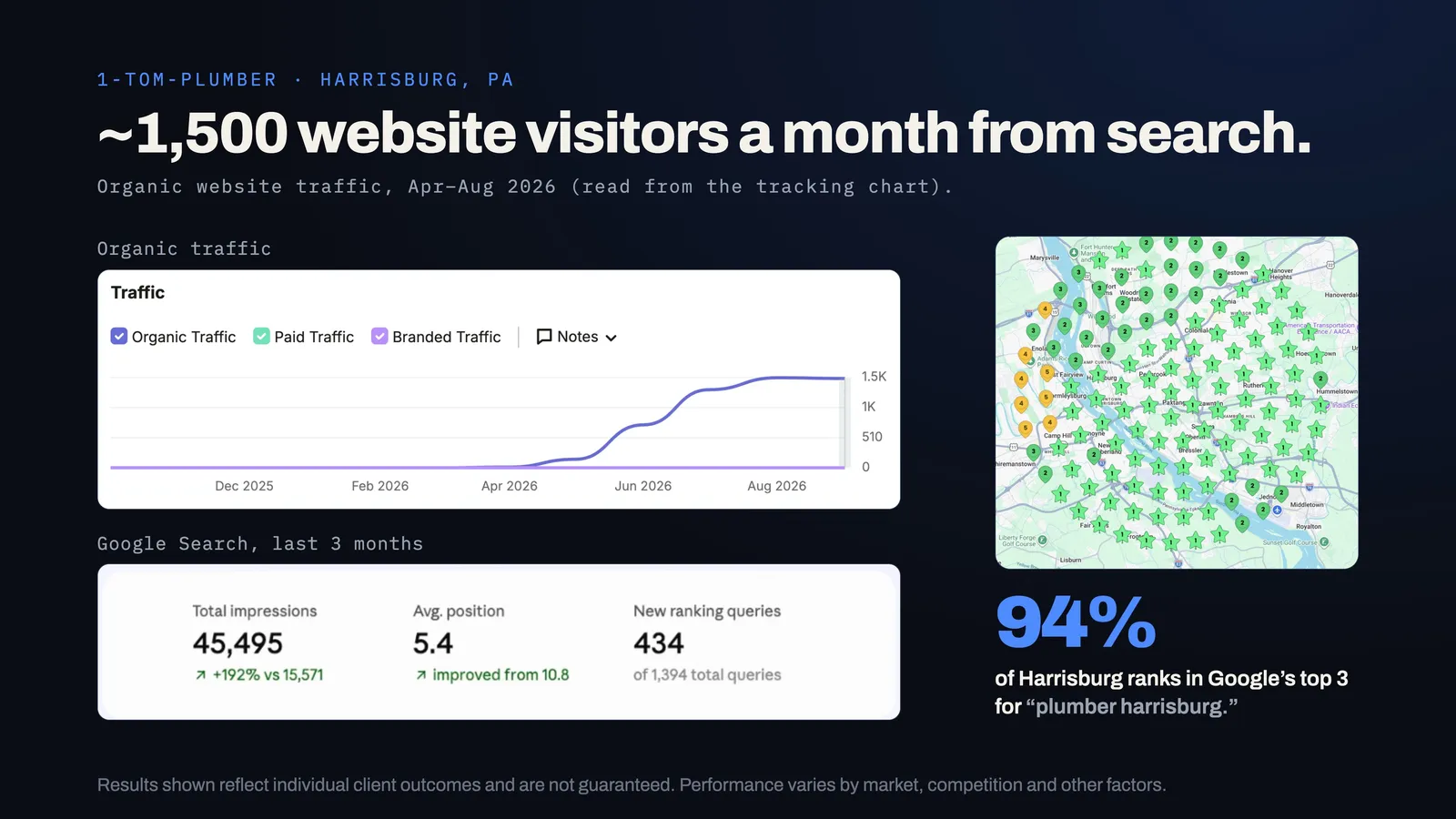
Maroon Plumbing in College Station, TX grew organic traffic 205.1%, to 955 visits a month (Jan–Apr 2026 vs. 2025), with 75% of its ranking grid in the top 3 for "plumber near me." 1-Tom-Plumber Harrisburg grew Google search impressions 192%, to 45,495 in three months, and improved average position from 10.8 to 5.4. (Client analytics and Search Console reporting.)
What makes a plumbing website convert more visitors into calls?
Plumbing sites convert when contacting you takes one tap and the visitor trusts you enough to do it. These are the changes that move the number most often:
- Tap-to-call on every screen. Use a real
tel:link, not an image of a number. Keep it in a sticky bar on mobile. - Text as an option. Many people cannot talk at work or would rather text. In one home services survey, 43% of plumbing businesses said direct messages were their best-performing call to action, well above the 32% average across home services (Scorpion).
- Short forms. Name, phone, town and a one-line description. Ask for photos and details after the first contact.
- Online booking for non-emergency jobs, connected to your field-service software, with time windows you can actually keep.
- Specific calls to action. "Get a plumber today" or "Get a water heater quote" beats "Contact us."
- Reviews next to the button. A star rating and a short quote right beside the call to action.
Should a plumbing website show prices and financing?
Show what you are comfortable showing. Many plumbers publish a service call or diagnostic fee and price factors rather than flat prices, because the same "water heater replacement" can vary a lot with venting, code upgrades and access. If you offer flat-rate pricing for common jobs, saying so builds trust.
For high-ticket work, show financing clearly: the lender, how to apply and a plain explanation of terms. Visitors researching a repipe or sewer line replacement often decide based on whether they can spread the cost.
How should plumbing website copy be written?
Write like a good dispatcher talks: plain words, short sentences, the answer first. Customers search "water heater leaking from the bottom," not "residential hot water system failure."
- Start each page and section with a direct answer, then explain.
- Use the words customers use on the phone, and include the town.
- Be specific: "most drain calls are fixed in one visit" beats "fast, reliable service."
- Avoid filler such as "quality service you can trust." Every plumber says it.
- Write each page yourself or with someone who knows plumbing. AI-written pages that say nothing specific rarely rank and do not convert.
What trust signals should a plumbing website show?
Show the proof a homeowner needs before letting a stranger into their house: license numbers, insurance, real team photos, reviews and how you work. Put the most important ones near the top of every page, in text.
| Trust signal | Where to show it |
|---|---|
| State license number(s) | Header or footer, about page, every service page |
| Insurance | Near the license line |
| Google rating and review count | Homepage, next to calls to action, service pages |
| Real photos of owner, techs and trucks | Homepage, about page, city pages |
| Background checks or drug testing, if you do them | About page and emergency page |
| Warranties and guarantees you actually offer | Service pages, in plain terms |
| Manufacturer certifications (for example, for tankless or water treatment brands) | Relevant service pages |
| Google Verified badge, if you run Local Services Ads | Describe it accurately; the old Google Guaranteed money-back program ended in December 2025 |
BrightLocal's 2026 survey found that 54% of consumers visit a business's website after reading positive reviews, so the site needs to confirm what the reviews promised.
How should a plumbing website be designed for mobile?
Design for the phone first. Most plumbing visitors arrive on a phone, often in a hurry, and Google uses the mobile version of your site for indexing and ranking (Google).
- A sticky call bar with "Call" and "Text" buttons.
- Buttons big enough for a thumb, with space between them.
- Body text at least 16 pixels so nobody has to zoom.
- No pop-ups that cover the page on load.
- Menus that list services clearly, not just "Services."
- Nothing wider than the screen; check every page at narrow phone widths.
How fast should a plumbing website load?
Fast enough that the phone number and headline appear almost immediately on a phone with a weak signal. Google's Core Web Vitals give concrete targets, measured at the 75th percentile of real visits (web.dev):
| Metric | What it measures | Good |
|---|---|---|
| Largest Contentful Paint (LCP) | How fast the main content appears | 2.5 seconds or less |
| Interaction to Next Paint (INP) | How quickly taps and clicks respond | 200 milliseconds or less |
| Cumulative Layout Shift (CLS) | How much the page jumps while loading | 0.1 or less |
The usual culprits on plumbing sites are large hero videos and images, booking and chat widgets loading on every page, old tracking scripts left by previous vendors, and coupon banners that push the call button down as the page loads. Compress images to WebP at the size they display, load widgets only when needed, remove scripts nobody uses and test with PageSpeed Insights.
Does a plumbing website need to be accessible?
Yes. Accessible sites are easier for everyone to use, and the Department of Justice says businesses open to the public must make their services, including websites, accessible to people with disabilities (ADA.gov). The DOJ does not set one technical standard for private businesses, but the WCAG guidelines are the common reference.
- Enough contrast between text and background.
- Alt text on job photos that describes what they show.
- Forms with labels, not just placeholder text.
- Everything usable with a keyboard.
- Phone numbers as text, never only in an image.
How do you build SEO into a plumbing website design?
Plan the pages around searches before designing anything, then give each page a clear title, heading and text that match one service or town. SEO added after launch is always harder.
- Keyword map. Assign each service + town combination to one page, so pages do not compete with each other.
- Titles and headings. "Water Heater Replacement in Plano, TX | Smith Plumbing" beats "Services."
- Internal links from the homepage to services, from services to cities and back.
- Clean URLs such as /water-heater-replacement and /plano-plumber.
- Name, address and phone that match your Google Business Profile exactly.
- Schema markup (below).
Our plumbing SEO guide covers keyword maps, on-page SEO and links in depth.
What schema markup should a plumbing website use?
Use structured data that describes your business and pages, and make sure it matches what the page actually says. Google documents local business structured data, and schema.org has a specific Plumber type.
| Schema type | Where | What it describes |
|---|---|---|
| Plumber (a LocalBusiness type) | Homepage or contact page | Name, address or service area, phone, hours, logo, reviews link |
| Service | Each service page | The service, area served, provider |
| FAQPage | Pages with visible FAQs | Questions and answers shown on the page |
| BreadcrumbList | Every page | Where the page sits in the site |
| Organization and WebSite | Site-wide | Your brand, logo and social profiles |
Schema does not rank a weak page on its own. It helps Google and AI tools read a good page correctly.
How do you make a plumbing website show up in AI answers?
Write clear, specific answers in text, keep your facts consistent everywhere and let AI crawlers read the site. AI tools quote pages that state services, areas, licensing, hours and prices plainly.
- Start pages and sections with a direct answer.
- State your service area, hours, license and specialties in text, on more than one page.
- Keep the same name, address, phone and hours on the site, the Google profile, Bing Places, Apple Business Connect and major directories.
- Do not block search and AI crawlers you want to be found by in robots.txt or your firewall.
More in our AI search guide for plumbers.
Want to know what your plumbing website is losing? Book a free growth call and we'll review your site, profile and tracking with you.
Book a Growth CallHow do you redesign a plumbing website without losing rankings?
Keep the pages that rank, redirect every old URL to its closest new page and check Search Console for errors after launch. Most rankings lost in a redesign are lost because pages or URLs disappeared without redirects.
- Export what ranks. From Search Console, list every page with clicks or impressions in the last 12 months.
- Map old URLs to new ones. Every old page gets a new home; nothing that earned traffic is deleted without a replacement.
- Keep the content that works. Improve it, but do not cut the text from pages that rank.
- Set up 301 redirects from every old URL to its new match, following Google's site move guidance.
- Move tracking. Analytics, call tracking, conversion tags and form tracking on the new site before launch.
- Launch, then check. Submit the new sitemap, test redirects, and watch Search Console coverage and rankings for four to six weeks.
Should a plumber use WordPress, a website builder or a template?
Use a platform that you own, that loads fast, that lets you add as many service and city pages as you need, and that you can take with you if you change vendors.
| Option | Good for | Watch for |
|---|---|---|
| WordPress | Flexible sites with many pages; most agencies and freelancers can work on it | Plugin bloat, slow themes, updates and security |
| Website builders (Wix, Squarespace and similar) | Small sites you edit yourself | Limits on speed, page structure and moving away |
| Field-service software sites | Quick setup tied to booking | Few pages, little control over SEO, hard to move |
| Custom-built sites | Speed and full control | Make sure you own the code and can edit content |
Whatever the platform, make sure the domain is registered in your company's name and that you have the login.
What content and photos should a plumbing website have?
Real ones. Photos of your actual team, trucks and finished jobs build more trust than any stock image, and they make your site look different from every competitor using the same smiling plumber.
- Before-and-after photos of drains, water heaters, repipes and sewer jobs.
- The owner and technicians, in uniform, with names.
- Branded trucks in recognizable local spots.
- Short videos: a sewer camera clip, a tankless install, an owner introduction.
- Problem guides answering what customers ask on calls.
How do you track leads from a plumbing website?
Track calls, texts, forms and bookings separately, and tie them to booked jobs. A website that "gets traffic" but cannot show calls is impossible to judge.
- Call tracking with dynamic number insertion, so calls from organic search, ads and other sources show up separately, while the number on your Google profile stays your main number.
- Google Analytics and Search Console connected, with key events for calls, texts, forms and bookings.
- Form submissions sent to your CRM with the page and source attached.
- A lead source field on every job in your field-service software.
How should plumbing website forms and online booking work?
Keep forms short, answer them within minutes and only offer online booking for jobs and times you can keep. A form that gets a reply tomorrow loses to the plumber who called back in five minutes.
- Four fields: name, phone, town or ZIP and "What's going on?"
- Send each submission to the dispatcher's phone, not a shared inbox.
- Confirm with an on-screen message and a text: "Thanks, we'll call you within 10 minutes."
- For online booking, offer real windows, exclude emergencies and confirm by phone or text.
What are good plumbing website design ideas?
The best ideas make it easier to call, easier to trust you or easier to find the right page:
- A "What to do right now" box on the emergency page (shut off the main valve, turn off the water heater).
- A water heater age checker that explains how to read the serial number.
- A service-area map with clickable towns.
- Job galleries filtered by service and town.
- A "Meet your plumber" section with photos.
- Before-and-after sliders for sewer and remodel work.
- A clear maintenance plan page with what members get.
What does a website built for leads do for a plumbing company?
A site built around service and city pages, with clear calls to action and tracking, grows organic traffic and calls month after month. Results from plumbing clients in 2026:
| Company | Market | Website result |
|---|---|---|
| Hi-Desert Plumbing | Twentynine Palms & Yucca Valley, CA | Website clicks from Google up 445% (2,460 May–Aug 2026, from 453) |
| 1-Tom-Plumber | Harrisburg, PA | Impressions up 192%; average position 10.8 → 5.4; about 1,500 visitors a month from search |
| Maroon Plumbing | College Station, TX | Organic traffic up 205.1%, to 955 visits a month |
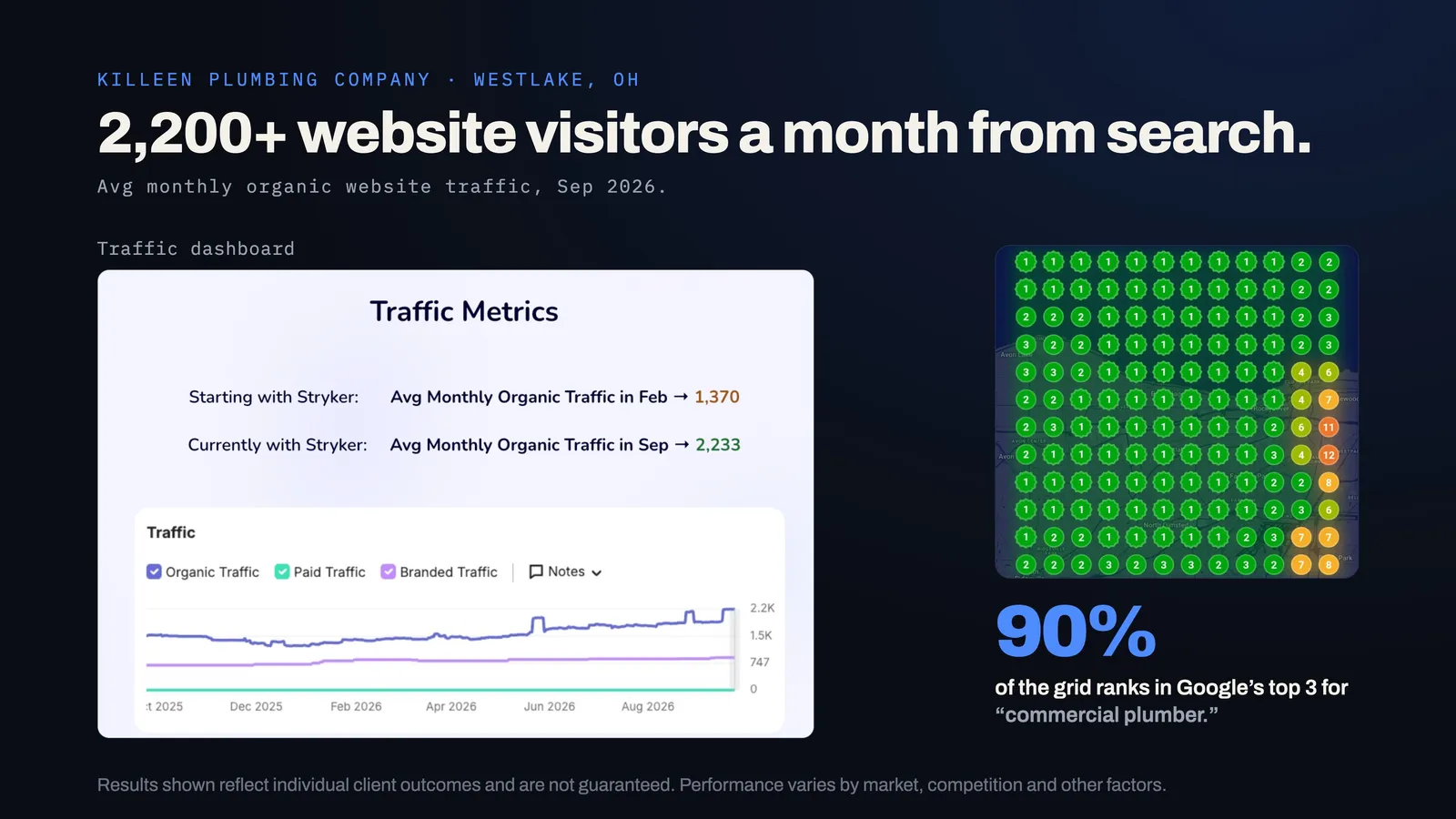
| Killeen Plumbing Company | Westlake, OH | Organic traffic up 62.9%, to 2,233 a month |
| Anne the Plumber | Smithfield, RI | Ranking for 100+ searches; 379 website clicks Feb–Jun 2026, up 9.2% |

NexAir Home Services (Huntington and Charleston, WV) runs plumbing and HVAC from one site with separate service pages for each trade, backed by five Google Business Profiles. Those profiles produced 841 calls from April to September 2026, and the owner says yearly revenue grew from about $1M to $4M. (Client reporting and owner's figures.)
What are the most common plumbing website mistakes?
The same handful of problems costs plumbing companies the most calls. Most are cheap to fix.
| Mistake | Why it costs calls | Fix |
|---|---|---|
| Phone number only in the header image | Cannot be tapped; Google and AI tools cannot read it | A text tel: link in a sticky mobile bar |
| One "Services" page for everything | Ranks for nothing specific | A page per service with its own title and FAQs |
| City pages with only the town name changed | Rarely rank and can hurt the whole site | Real local detail, jobs and reviews for each town |
| Long contact forms | Emergency visitors give up | Four fields; collect details after first contact |
| Stock photos | Looks like every competitor; builds no trust | Real team, truck and job photos |
| No license or insurance in text | Homeowners and AI tools look for it | License numbers near the top and in the footer |
| Slow hero video and widget scripts | Phone number appears late on mobile | Compress images, delay widgets, remove unused scripts |
| Different phone numbers everywhere | Confuses customers and listings | One main number on the profile; tracking numbers via dynamic insertion |
| No tracking | Cannot tell which pages produce jobs | Call tracking, analytics events and lead source in your software |
How should a plumbing website work with Google Ads and Local Services Ads?
Send paid clicks to the service page that matches the search, not the homepage. Someone who searched "water heater replacement" should land on the water heater page with a call button at the top; someone who searched "sewer line repair" should land on the sewer page.
- Match the page to the ad group. Each Google Ads campaign or ad group points to its matching service page.
- Keep the call to action consistent with the ad: if the ad promises same-day service, the page should say so above the fold.
- Use the same tracking so you can compare paid and organic visitors on the same page.
- Local Services Ads do not send clicks to your site, but many customers check your website before calling, so the site still affects how many LSA leads you win.
Our Google Ads guide for plumbers covers landing pages and conversion tracking in more depth.
What affects what a plumbing website costs?
Website pricing varies widely, from cheap templates to fully custom builds, so compare what is included rather than the headline number. These are the factors that drive the cost and the value:
| Factor | Why it matters |
|---|---|
| Number of service and city pages | Each one is a chance to rank; thin sites cost less but bring fewer calls |
| Who writes the content | Specific, local writing ranks and converts; generic text does not |
| Photography | Real job and team photos cost time but outperform stock |
| Speed and technical setup | Fast, clean code avoids paying for a rebuild later |
| Tracking and integrations | Call tracking and booking connected to your software make the site measurable |
| Ownership | Make sure you own the domain, content and files if you leave |
| Ongoing updates | New pages, photos and fixes keep rankings growing |
What should you check before launching a plumbing website?
Run this checklist on a phone, not just a desktop.
- Tap-to-call works on every page; texting works.
- Every service and city page has a unique title, heading and meta description.
- Name, address and phone match the Google Business Profile.
- License and insurance appear in text.
- Forms send to the right person and show a confirmation.
- Call tracking and analytics events fire.
- Old URLs redirect to new ones.
- Schema validates in Google's Rich Results Test.
- Core Web Vitals pass in PageSpeed Insights.
- No page scrolls sideways on a narrow phone.
- Sitemap submitted in Search Console.
What does a plumbing website need after launch?
Keep adding to it. Plumbing sites that keep growing add pages and photos every month, update prices and services, and fix what Search Console reports.
| How often | Task |
|---|---|
| Weekly | Check form and call tracking; respond to every lead |
| Monthly | Add job photos and a review or two to key pages; publish a new service, city or problem page |
| Quarterly | Review Search Console for pages losing clicks; refresh them; check speed |
| Yearly | Update licensing, team photos, pricing and financing details |
Related plumbing guides: AI search for plumbers, plumbing lead generation, 30 plumbing marketing ideas, how to choose a plumbing marketing agency and our plumbing case studies.
Plumbing website design FAQ
What should be on a plumbing website?
A tap-to-call number and text option on every screen, a page for each service and each town you serve, an emergency page, license and insurance details, real reviews and photos, a short form, online booking if you use it, and call tracking.
How many pages should a plumbing website have?
Enough to give every service and every town you want calls from its own page, plus a homepage, emergency, about, reviews, financing and contact pages. For many plumbing companies that means dozens of pages, built over time.
Do plumbers need a website if they have a Google Business Profile?
Yes. The profile wins many emergency calls, but the website supports its ranking, captures high-ticket searches the map does not and gives customers and AI tools the detail they need to choose you.
How fast should a plumbing website load?
Aim for Google's "good" Core Web Vitals: Largest Contentful Paint within 2.5 seconds, Interaction to Next Paint within 200 milliseconds and Cumulative Layout Shift of 0.1 or less, measured on real phone visits.
Should I put prices on my plumbing website?
Show what you can stand behind: a service or diagnostic fee, flat rates for common jobs if you use them, and honest price factors for big jobs. Clear pricing information builds trust and filters out poor-fit calls.
What schema should a plumber use?
The Plumber type for the business, Service for each service page, FAQPage where FAQs are visible, and BreadcrumbList site-wide. The markup must match the page content.
Will a new website hurt my rankings?
It can if pages disappear or URLs change without 301 redirects. Keep the content that ranks, redirect every old URL and monitor Search Console for several weeks after launch.
Should a plumbing website have online booking?
Yes for non-emergency work, if it connects to your schedule and offers windows you can keep. Keep phone and text front and center for emergencies.
Should a plumbing company that also does HVAC have one website?
One site usually works, with separate service pages, sections and calls to action for each trade. See our HVAC website design guide for the heating and cooling side.
Can a plumbing website help me show up in ChatGPT?
Yes. AI tools draw on pages that state services, areas, licensing and hours clearly, plus consistent listings and reviews. Clear answers in text make your site easier to cite.