
Electrician SEO is how an electrical contractor gets found on Google by people who need a panel replaced, a charger wired, a generator installed or a dead circuit fixed in the towns the company serves. Five things drive it: a Google Business Profile with the right categories and a license number that matches the state record, one page for each kind of electrical job, honest pages for each town, reviews that name the work, and listings that agree with each other. Fix the profile first; it moves fastest. Service pages usually take three to six months to rank.
Most SEO advice for electricians is written as if wiring were the same as any other local trade. It isn't. An electrician sells everything from a $150 outlet swap to a six-figure tenant build-out, the license rules change at every state line, and half the most profitable jobs (panel upgrades, EV chargers, standby generators, solar tie-ins) need a permit and an inspection that the homeowner has never heard of. Good electrician SEO uses all of that. This guide walks through the whole system with numbers from our own electrical clients: TLC Electrical in North Texas, Roland Black Generators in North Carolina, JMR Electric Group outside Boston and South Shore Electric at Lake Tahoe.

Andy Walker, our co-founder, recorded the video above for electrical contractors in May 2025. It covers the Google Business Profile, building a page for every service in every town, keeping reviews coming and cleaning up business listings. The rest of this page goes deeper on each piece and adds what's changed since.
What does SEO for an electrical contractor actually cover?
It covers six assets: the Google Business Profile, the service pages on your site, the town pages, reviews, outside listings and links, and the technical setup of the site. Each one feeds a different part of the results page, and electricians need all of them because their buyers search in very different ways.
| Asset | What it does for an electrician | Searches it wins |
|---|---|---|
| Google Business Profile | Puts you in the three-pack on the map, shows reviews, hours and your service list | "electrician near me," "electrician [town]," "emergency electrician" |
| Service pages | One page each for panels, EV chargers, generators, lighting, rewiring, troubleshooting | "200 amp panel upgrade," "tesla wall connector installer," "generac dealer [county]" |
| Town pages | Shows Google and buyers you really work in each town, with local permit and utility detail | "electrician [suburb]," "panel upgrade [suburb]" |
| Reviews | Ranking signal and the proof a homeowner reads before letting a stranger open their panel | Every local search, plus AI answers |
| Listings and links | Confirms your name, address, phone and license across the web | Supports all of the above |
| Technical setup | Speed on a phone, clean structure, schema, no broken pages | Every organic result |
Paid search and Local Services Ads sit next to SEO rather than inside it. They share the same groundwork (license, insurance, reviews, landing pages), so we cover them in the electrician Google Ads guide.
Which three kinds of searches should an electrician plan for?
Plan for urgent fault searches, planned upgrade searches and commercial searches. They come from different people, at different times of day, with different questions, so they need different pages.
- Fault searches. "Breaker keeps tripping," "half my house has no power," "outlet sparked," "burning smell from outlet," "electrician open now." The searcher is often on a phone in a dark kitchen. They want a number, a sign you'll come today and proof you're licensed. These searches are short on words and heavy on the map pack.
- Upgrade searches. "200 amp panel upgrade cost," "do I need a permit to install an EV charger," "whole home generator installer," "replace Federal Pacific panel," "add a sub panel for a garage." This buyer is researching over days or weeks. They read, compare, and often get two or three quotes. Long service pages with real answers win here.
- Commercial searches. "Commercial electrician [city]," "electrical contractor for tenant improvement," "parking lot lighting repair," "electrical preventive maintenance." The searcher is a property manager, facilities director or general contractor. They care about capacity, safety record, insurance limits and whether you can work nights.
A site that serves all three with one "Services" page ranks for none of them. Separate pages let each one match its searcher's intent and language.
How do you find the electrical keywords worth targeting?
Start with the jobs that pay you best, add the towns you want more of, then check what people actually type. Google's autocomplete and the "People also ask" box are the fastest free sources, because they show real phrasing.
- Rank your jobs by gross profit, not volume. For most residential shops that's panel upgrades and service changes, standby generators, EV charger circuits, whole-home rewires and remodel wiring. Service calls fill the board but rarely make the year.
- Write the buyer's words, not the trade's. You say "service upgrade." Homeowners type "upgrade electrical panel," "breaker box replacement" and "fuse box replacement." You say "EVSE." They type "car charger installation." Use both, but lead with theirs.
- Add the brand and model searches. Generator buyers search "Generac 24kW installer," "Kohler generator dealer near me" and "Generac maintenance." Charger buyers search "Tesla wall connector installation" and "ChargePoint home flex install." If you're a certified installer for a brand, those searches are yours to win.
- Add the problem searches. "Lights flickering when AC turns on," "GFCI won't reset," "breaker hot to the touch." These pages pull early-stage traffic and turn into service calls.
- Cross with towns. Every money service times every town you'll send a truck to.
- Check who ranks today. If the top results for a term are directories and national lead sites, a strong local page can beat them. If they're three established local shops with hundreds of reviews, plan for a longer climb.
Our autocomplete research for this guide found steady demand around "electrician seo," "local seo for electricians" and "seo keywords for electricians," which tells you contractors are researching this themselves. The buyer side is far bigger: every service in the list above autocompletes with "near me," "cost" and a city name.
Words to keep out
Electrical search terms pull in a lot of people who will never hire you: students looking for an apprenticeship, people searching electrician salary or school, and DIYers who want a wiring diagram. They matter less for SEO than for ads, where each click costs money, but they still shape your content. A page titled "How to wire a 240V outlet" draws DIYers. A page titled "240V outlet installation for dryers, ranges and chargers" draws buyers.
How should an electrician set up the Google Business Profile?
Pick "Electrician" as the primary category, add secondary categories only for work you really do, use your real business name, list every service, and keep your hours true. The profile is where most local electrical calls start, so it gets the first week of work.
Categories
The primary category carries the most weight. For almost every residential and light commercial shop it should be "Electrician." Secondary categories widen the searches you can appear for. Good candidates, where they match your work, include "Electrical installation service," "Lighting contractor," "Electric vehicle charging station contractor," "Generator shop" and "Solar energy contractor." A shop whose main business is standby power, like Roland Black Generators in Hickory, North Carolina, may be better served with a generator category as primary and Electrician as secondary. Test, measure the map grid for a month, and keep what moves calls.
Name, address and service area
Use the name on your license and your truck. Google's guidelines say the business name should match how the business appears in the real world, and adding keywords that aren't part of it can get a profile suspended. If you want "Electric" or a town name in your listing, the clean way is to make it part of your real, registered brand before it goes on Google.
A real office or shop with staff during business hours can show its address. Most electricians work at the customer's site, so a service-area profile with the address hidden is normal and allowed. Your service area should list the towns and counties you really cover, not a 100-mile radius.
Services, products and description
List each service separately with a short description: panel upgrades, service changes, EV charger installation, standby generator installation, generator maintenance, surge protection, lighting, rewiring, troubleshooting, code correction, commercial build-outs. The Products section is useful for brand-name equipment. Bodhi Gallo's family Generac business in Rockland County, New York lists products like Generac inspections, battery replacement and oil changes, each linked to the matching page on the website. Write the description for people: what you do, where, how long you've been licensed, whether you take emergency calls.
License number, attributes and photos
Put your state license number in the description and on the website footer, and make sure it matches the state lookup exactly. Customers and Google's Local Services Ads screening both check it. Add the attributes that apply (online estimates, veteran-owned, women-owned, and so on). Upload real photos: clean panel work, a finished charger install, a generator on its pad, your crew and trucks. Neat panel photos are electrician-specific proof, because homeowners can't judge the work otherwise.
The Google Maps guide for electricians covers ranking factors, map grids and what to do about duplicate or suspended profiles.
Which service pages does an electrician website need first?
Build one page for each job you want more of, starting with the highest-profit work. For most residential shops that order is panel upgrades, standby generators, EV chargers, whole-home rewiring and emergency service, then lighting, surge protection and smaller repairs.
| Page | What the buyer needs answered | Electrician detail that makes it rank |
|---|---|---|
| Panel upgrade and service change | Do I need 200 amps? What does it cost? How long is the power off? | Utility disconnect and reconnect process, permit and inspection steps, recalled panel brands you replace |
| Standby generator installation | What size? Natural gas or propane? How loud? Who maintains it? | Load calculation, transfer switch options, gas line and pad, brand certifications, maintenance plans |
| EV charger installation | Can my panel handle it? Level 1 or 2? Hardwired or plug? | Circuit sizing, load management devices, permit, charger brands, garage and outdoor installs |
| Rewiring | Is my old wiring dangerous? Do you open walls? | Knob-and-tube and aluminum branch wiring, insurance issues, how you patch |
| Emergency electrician | Can you come now? What does after-hours cost? | Hours, response area, what counts as an emergency, what to do until you arrive |
| Commercial electrical | Can you handle my building, schedule and safety rules? | Tenant improvements, lighting retrofits, preventive maintenance, after-hours work |
Each page should answer the question in the first paragraph, then go deep: what the job involves, what code and permits apply in your area, typical price ranges if you're willing to publish them, how long it takes, photos of your own work, and a short FAQ. A thin page that says "We do panel upgrades. Call today" won't outrank a competitor who explains the process.
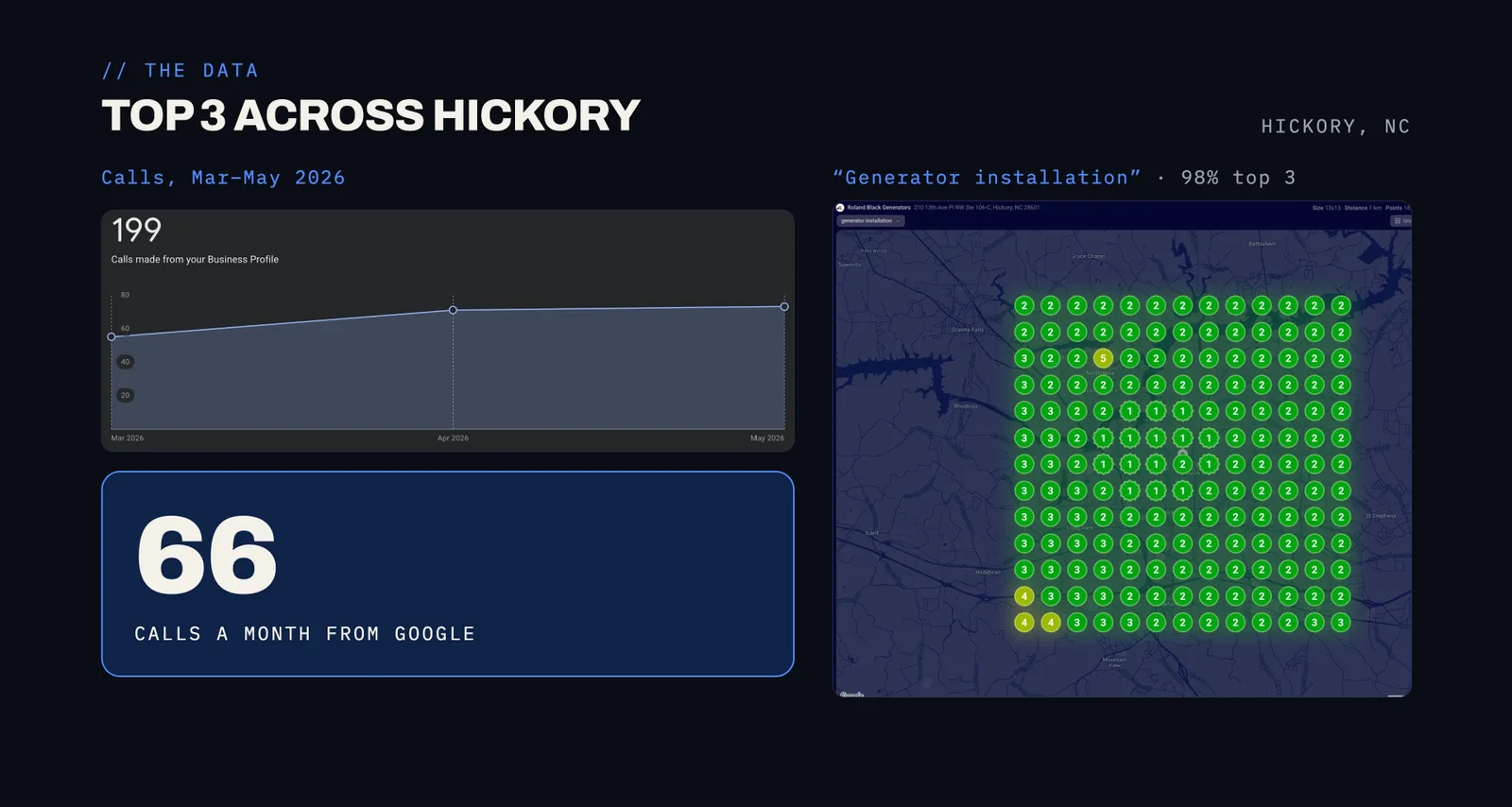
Roland Black Generators shows why service pages and a focused profile matter. Generators are the whole business in Hickory, North Carolina, and the profile and pages say so. From March to May 2026 it took 199 calls from its Business Profile, and 98% of its "generator installation" grid sat in the top three, mostly #1 and #2. Those terms come from people who already know what they want and need someone certified to install it.
How do licensing, permits and the NEC help an electrician rank?
They give you content no handyman or lead site can copy, and they answer the questions that make homeowners trust you. Google rewards pages that show real expertise, and in electrical work, licensing and code knowledge are the expertise.
Licensing pages that fit your state
Licensing rules vary a lot. Florida licenses electrical contractors through the Electrical Contractors' Licensing Board. Texas licenses electricians and contractors through TDLR. California requires a C-10 contractor license from the CSLB plus state certification for electricians who do the work. Massachusetts licenses master and journeyman electricians through its Board of State Examiners of Electricians. North Carolina licenses electrical contractors by the size of job they can take on. Some states, such as New York and Illinois, leave licensing to cities and counties. A short "Licensed in [state]" page that explains what your license allows, links to the state lookup and lists your number is a trust page and a ranking page at once.
Permit and code content
The National Electrical Code (NFPA 70) is revised every three years, and each state adopts a version on its own schedule. When a new version arrives in your area, write about the changes homeowners will notice. Recent editions extended GFCI protection to more locations, required surge protection on new and replaced dwelling services, and added an outdoor emergency disconnect for one- and two-family homes. Those make good pages: "Why your new panel needs a surge protector," "What the outside disconnect is for." Keep them specific to the edition your state or city enforces and say which one it is.
Permit pages work the same way. "Do I need a permit for an EV charger in [city]?" is a real search, and the honest answer (almost always yes, and here's what the inspection checks) builds trust with a buyer who just got a cheaper quote from someone who skipped it.
How many town pages should an electrician build, and what goes on them?
Build a page for each town where you want more work and can say something true and specific. Five strong town pages beat fifty copies with the name swapped, which Google treats as doorway pages and tends to ignore.
What makes an electrical town page specific:
- The building stock. Neighborhoods with 1950s homes on 60- or 100-amp service, condos with aluminum branch wiring, new subdivisions where every garage wants a charger, lake houses with long service runs.
- The utility. Who disconnects the service for a panel swap, how long that usually takes to schedule, and any utility rebate programs you help with.
- The permit office. Which building department handles electrical permits and how inspections work there.
- Weather and power. Hurricane season, ice storms, wildfire power shutoffs and heat waves all drive generator and surge demand.
- Your own jobs. Photos and short write-ups of work done in that town, with the homeowner's permission.
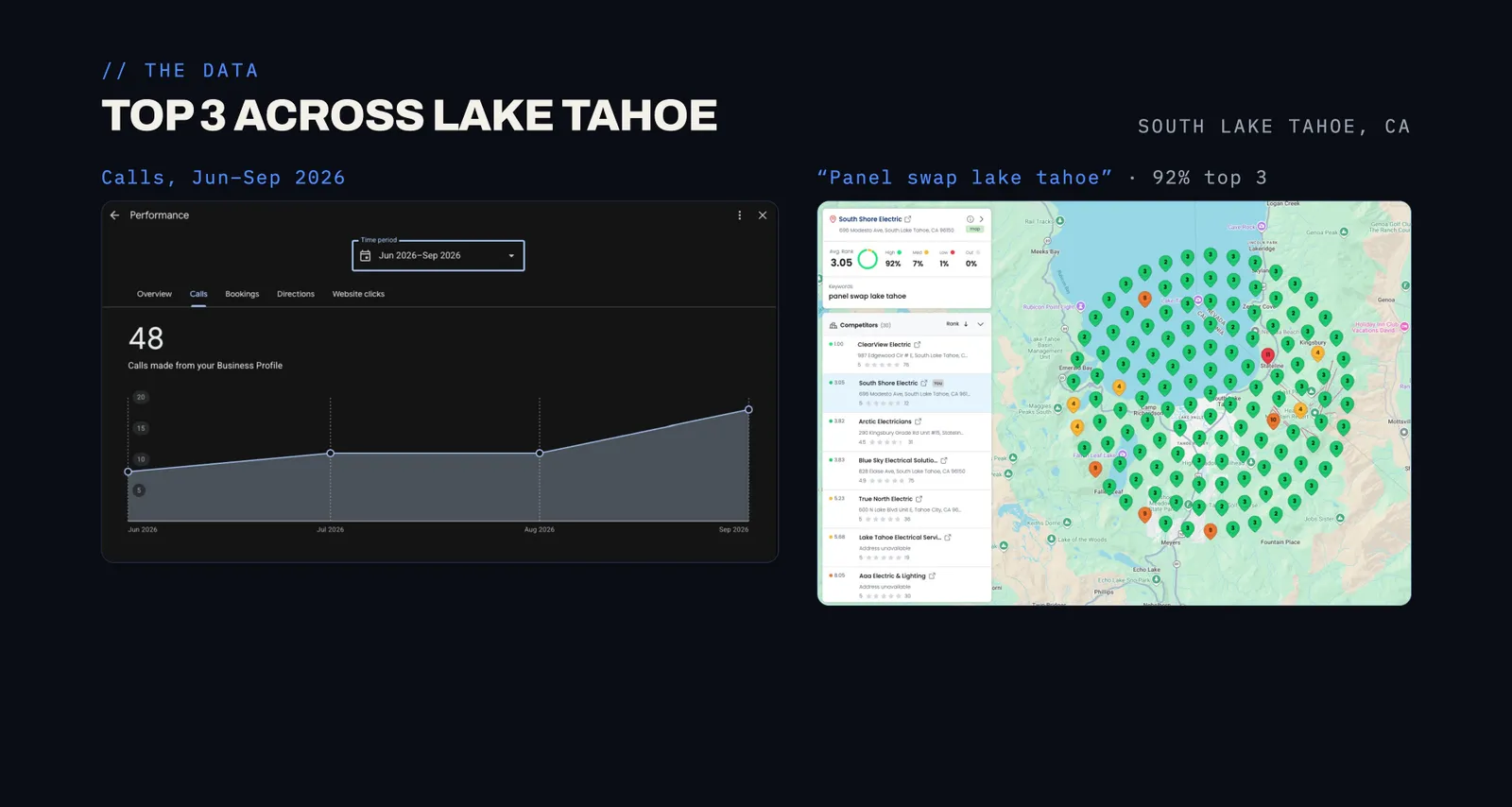
South Shore Electric is a good example. Lake Tahoe has older cabins, snow loads and long winters, and panel swaps are steady work. Two months after we started in July 2026, they held 92% of their "panel swap lake tahoe" map grid in the top three, with no points outside the results. A town-aware panel page and a well-built profile did most of that.
How do reviews help an electrician rank, and how do you get more?
Reviews are a ranking signal and the thing buyers read before letting someone work on their wiring. Ask every customer, make it easy with a text link the same day, and reply to every review. Steady flow matters more than a one-time burst.
BrightLocal's 2026 consumer survey found 97% of people read reviews for local businesses and 47% won't use a business with fewer than 20 reviews. For an electrician competing against 15 other shops on the map, review count and recency are often what separates the top three from the rest.
How strong electrical shops ask:
- At the end of the job, in person. The electrician shows the finished panel or charger, explains what was done and asks if the customer would mind leaving a review.
- Same-day text with the direct link. Before the truck leaves the street, while the customer is still happy the lights are on.
- One follow-up email. Two or three days later, with the link and a thank-you.
- Reply to every review. Name the customer and mention the work in a natural way. Replies show buyers you care and give Google more context.
Customers write whatever they want. You can't offer discounts, gift cards or entries for reviews: Google's policies forbid incentives, and the FTC's rule on fake reviews prohibits buying them. What you can do is make asking a habit for every crew. Our best-performing clients get 25 new reviews/month, and they get there by asking every customer, not by any trick.
Which listings and links matter for electricians?
The ones that confirm you're a real, licensed electrical business: the main directories, your state license lookup, manufacturer installer locators, trade associations and local organizations. Consistency matters as much as quantity: your name, address and phone number should match everywhere.
| Source type | Examples | Why it helps |
|---|---|---|
| Core directories | Google, Apple Business Connect, Bing Places, Yelp, BBB, Nextdoor, Angi | Base consistency and visibility on other maps |
| Manufacturer locators | Generac, Kohler and Briggs & Stratton dealer finders; EV charger installer networks; solar and battery installer lists | Highly relevant links and leads from buyers already sold on a brand |
| Trade associations | IEC and NECA chapters, NASGD for generator dealers, state electrical associations | Industry relevance and trust |
| Local organizations | Chamber of commerce, home builder associations, sponsorships of teams and events | Local relevance and real referrals |
| Supply houses and partners | Supply house contractor lists, builder and remodeler partner pages | Links from businesses that see your work |
Manufacturer locators are worth singling out. If you're a certified Generac dealer, the dealer finder sends you buyers who have already chosen the brand. Make sure your listing there has the same name, phone and website as your Google profile, and link to the brand's page from your own generator page.
Andy's video makes the point about consistency: if the same business shows three phone numbers and two addresses across the web, Google trusts it less. Clean it up once, then check it whenever you move or change numbers.
What technical setup does an electrician website need?
A fast mobile site, a clear structure with one URL per service and town, schema markup that names your business and services, and nothing broken. Most electrician sites fail on speed and structure, not on anything exotic.
- Speed on a phone. Many fault searches happen on a phone with poor signal. Compress photos, drop heavy sliders and keep the phone number visible without scrolling.
- Clear structure. /panel-upgrades, /ev-charger-installation, /generators, /commercial, and town pages under one folder. No duplicate pages competing for the same term.
- Schema. Electrician LocalBusiness markup with your name, phone, areas served, license and opening hours, plus Service markup for each money page and FAQ markup where you answer questions.
- Search Console and analytics. Set them up on day one so you can see which searches you're winning.
- Call tracking. Separate numbers for the website, Google profile and ads, so you know where calls come from. Keep the main number on the profile consistent.
The electrician website design guide covers page structure, speed and what to put above the fold.
Should residential and commercial electrical work have separate SEO?
Yes. The buyers, searches and proof are different enough that one page can't serve both. A homeowner wants a friendly, clean electrician who explains the panel. A facilities manager wants capacity, safety records and someone who can work after hours.
| Residential | Commercial | |
|---|---|---|
| Who searches | Homeowner, landlord, sometimes a realtor | Property manager, facilities director, general contractor, business owner |
| Typical searches | "electrician near me," "panel upgrade cost," "generac installer" | "commercial electrician [city]," "tenant improvement electrical," "parking lot lighting repair" |
| Proof that sells | Reviews, photos, license, warranty | Project list, insurance limits, safety program, references |
| Map pack role | Huge | Smaller; many find you through organic results, referrals and bid platforms |
Separate commercial pages should cover the work you take (tenant improvements, lighting retrofits, service upgrades, preventive maintenance, emergency repairs), the kinds of buildings you work in, and how you handle safety and scheduling. A gallery of finished projects does more than any paragraph.
Does electrician SEO help you show up in ChatGPT and Google's AI answers?
Yes. AI assistants lean on the same signals: consistent listings, reviews, clear answers on your site and mentions on other trusted sites. A site that answers "how much does a 200 amp upgrade cost in [city]" plainly is easier for an AI system to quote than one that hides everything behind "call for a quote."
Bodhi's family Generac business is a small but clear example. After the website and profile were built out, a ChatGPT search for a generator company in Rockland County returned that business and linked to its homepage. That happened because the business had a clear name, a clear service, a strong profile and pages that answered buyer questions.
Practical steps for AI visibility: answer the question at the top of each section, use plain language, keep your name and details consistent, and earn mentions on local news, association and partner sites.
What do results from electrician SEO look like?
Calls from Google and map grid rankings are the clearest measures. Here's what our electrical clients' numbers looked like in 2026.
| Client | Market | Result |
|---|---|---|
| TLC Electrical | Southlake and Frisco, TX | 225 calls from Google, May to September 2026; Southlake up 26%; "electrician southlake" averaging 2.16, 94% of the grid in the top three |
| Roland Black Generators | Hickory, NC | 199 calls from the Google Business Profile, March to May 2026, about 66 a month; 98% of the "generator installation" grid in the top three |
| JMR Electric Group | Stoneham, MA | 92 calls from Google, April to August 2026, up 207% from about 30 in the same months of 2025 |
| South Shore Electric | South Lake Tahoe, CA | 48 calls, June to September 2026; 92% of "panel swap lake tahoe" in the top three |
Results are specific to each client and campaign and won't be the same for every business. Market size, competition, review count and how fast calls are answered all change the outcome. The full breakdowns, including the weak spots, are on the electrician case studies page.
How long does electrician SEO take to work?
Profile fixes can move map rankings within weeks. New service and town pages usually take three to six months to rank, depending on competition. Metro markets with established shops take longer; smaller towns and specific services like generators or panel swaps often move faster.
South Shore Electric's panel grid moved within two months of starting. TLC Electrical's Southlake location grew calls 26% over its starting point while Frisco was still building. Big metros like Boston take longer: JMR Electric Group tripled calls year over year, but its grid for "24 hour electrician near me" still shows plenty of red, and we're still working on it.
What should an electrician do first? A 90-day SEO checklist
- Fix the Google profile. Real name, Electrician as primary category, real secondary categories, true service area, every service listed, license number in the description, real photos.
- Set up tracking. Search Console, analytics, call tracking and a monthly map grid for your main searches.
- Start the review habit. Ask in person, text the link the same day, follow up once, reply to every review.
- Build the panel upgrade page. Your most profitable residential service usually comes first. Include permit steps, utility coordination, photos and a short FAQ.
- Build generator and EV charger pages. Include brand certifications, load calculation, permits and maintenance.
- Clean up listings. Main directories, state license lookup, manufacturer locators and associations, all matching.
- Build your first town pages. Start with three to five towns where you want more work and can write something specific.
- Add the emergency page. Hours, area, what counts as an emergency, and what to do until you arrive.
- Review and expand. Look at which pages and searches moved, then add the next services and towns.
Which problem searches should an electrician write about?
The symptoms homeowners type before they know what they need: "breaker keeps tripping," "lights flicker when the AC turns on," "outlet is warm," "burning smell from outlet," "half the house has no power" and "do I need a bigger panel." These rank more easily than "electrician near me" and reach the buyer a step earlier.
Write each one as a short, safe answer: what the symptom usually means, what the homeowner can check without opening anything (a tripped breaker, a GFCI reset), the signs that mean stop and call, and a link to the matching service page. Never give step-by-step instructions for work inside a panel or box; that's unsafe, and it attracts DIY readers rather than buyers.
Cost questions work the same way. "How much does a panel upgrade cost" and "EV charger installation cost" are some of the most-searched electrical questions. You don't need to publish a fixed price; explain what changes the price (panel capacity, distance from the panel, the utility's service, permits, trenching) and give a range only if you're comfortable standing behind it.
How do you show Google a real, licensed electrician runs the site?
With the evidence a buyer would check: the license number with a link to the state lookup, an about page that names the master electrician or owner, photos of your own crews and jobs, a byline and updated date on guides, and links to the sources you rely on, such as the state licensing board and the NEC edition your area enforces.
Google's quality guidelines ask whether content shows first-hand experience and comes from a trustworthy source. For electrical work, where safety is involved, that matters more than on most local sites. A stock-photo team and an anonymous blog don't pass that test. A page that says who wired the job, shows the panel before and after, and names the inspection it passed does.
The same signals help in AI answers, which pull from pages that state facts plainly and name their sources. Keep your name, address and phone identical across the site, the profile and your listings so every source agrees about who you are.
Should an electrician do SEO in-house or hire help?
Most owners do best with a split: keep the parts that need your voice and your customers, and hand off the technical and production work.
| Usually in-house | Usually hired out |
|---|---|
| Asking every customer for a review and replying to reviews | Technical setup: speed, schema, Search Console, site structure |
| Job photos from the field each week | Writing and maintaining service and town pages |
| Answering the phone and following up on estimates | Map grid tracking and monthly reporting |
| Trade and supply-house relationships that lead to links | Listing cleanup and ongoing link work |
If you hire, ask to see dated results from other electricians, confirm you'll own the site, profile and tracking numbers, and agree up front on what's reported each month. Our electrician case studies show the kind of reporting we think you should expect from anyone.
On a free growth call we check where you rank for “electrician near me,” how your site sells panel, charger and generator jobs, and where calls slip through.
Book a Growth CallElectrician SEO FAQ
What is electrician SEO?
The work of getting an electrical contractor found on Google for the services it sells in the towns it serves, in both the map pack and the regular results. It covers the Google Business Profile, service and town pages, reviews, listings and the technical health of the site.
How long does SEO take for an electrician?
Profile fixes can move map rankings in weeks. New service and town pages usually rank in three to six months. Crowded metros and broad searches like "electrician [big city]" take longest; niches like panel swaps or generators often move faster.
What's the best Google Business Profile category for an electrician?
"Electrician" as the primary category for most shops. Add secondaries such as "Electrical installation service," "Lighting contractor," "Electric vehicle charging station contractor" or "Generator shop" only for work you really do.
Can I add "electrician" or my city to my Google business name?
Only if it's part of your real, registered business name. Google's guidelines say the name must match how the business appears in the real world, and added keywords can get a profile suspended.
Which service pages should an electrician build first?
The jobs that pay best: usually panel upgrades, standby generators, EV chargers, rewiring and emergency service. Each needs its own page with the process, permits, photos and an FAQ.
How many town pages should an electrical contractor have?
One for each town where you want work and can write something specific: building stock, utility, permit office, weather and jobs you've done there. A few strong pages beat dozens of copies.
Do electricians need to blog for SEO?
Only after the service and town pages are built. Then, short answers to real questions, like why a breaker keeps tripping or whether a panel can handle a charger, bring traffic and should link to the matching service page.
Does the National Electrical Code help with SEO?
Yes, as content. Explaining code changes homeowners notice, such as surge protection on new services or the outdoor emergency disconnect, shows expertise. Name the edition your state or city enforces.
Which listings matter most for electricians?
Google, Apple Business Connect, Bing, Yelp, BBB and Nextdoor, plus your state license lookup, manufacturer dealer and installer locators, and trade associations like IEC, NECA or NASGD. Keep details matching everywhere.
Does SEO help electricians show up in ChatGPT and AI answers?
Yes. AI assistants use the same signals: consistent listings, reviews, clear answers on your site and mentions on trusted sites.