
To get an electrical company into the Google Maps three-pack, you need relevance, distance and prominence: the right categories and services on a verified profile, a real location or a true service area near the searcher, and enough reviews, links and listings to beat the other shops nearby. You can't move the searcher, so the work is making the profile complete, building pages the profile can point to, keeping reviews steady, and measuring with a map grid instead of one search from your office.
For most electrical contractors, the Google Maps listing brings in more calls than the website, the ads and the yard signs put together. TLC Electrical's two North Texas locations took 225 calls from Google between May and September 2026, and Roland Black Generators took 199 from its Business Profile in three months. This guide explains how the map pack works for electricians, what to fix on the profile, how to read a map grid, and what our electrical clients' grids looked like in 2026.

In the video above, Andy Walker walks through how electricians rank on Google Maps: the profile, a page for each service and town, steady reviews and clean listings. We'd add one caution to it: Google's rules say your listed name must be the name you really use, so build any keyword into your real brand first rather than adding it only on Google.
How does Google decide which electricians show in the map pack?
Google says local results are based on three things: relevance (how well your profile matches the search), distance (how far you are from the searcher or the place named in the search) and prominence (how well known and trusted your business is). Every fix on this page works on one of those three.
| Factor | What it means for an electrician | What you control |
|---|---|---|
| Relevance | Does the profile match "panel upgrade," "generator repair," "EV charger installer"? | Primary and secondary categories, services, products, description, linked website pages |
| Distance | How close is your verified location to the person searching? | Where your office is, which locations you verify, which towns you list |
| Prominence | Is this a known, trusted electrical business? | Reviews, links, listings, press, how strong your website is |
Whitespark's local search ranking factors survey has listed primary category, keywords in the business name, proximity, and the number and quality of reviews among the strongest map pack factors for years. You can choose the right category and earn the reviews. Proximity and your real name are mostly fixed, which is why the other factors matter so much.
Why are map rankings so different from one street to the next?
Because distance from the searcher is built in. A shop can be #1 for "electrician" half a mile from its office and invisible four miles away. Electricians feel this more than most trades because they usually cover a wide area from one shop, and the towns at the edge of that area are where rankings fade.
That's why checking rankings by searching from your own office tells you almost nothing. You'll see yourself near the top and assume the map is working. A homeowner across town, or in the next county where you also want panel work, may never see you.
The fix isn't to fake a location. It's to measure properly with a grid, see where you fade, and push on relevance and prominence so the fade happens further out. If you really do have crews based in another town, a second verified location can help, as it did for TLC Electrical's Frisco shop.
What is a map grid, and how should an electrician read one?
A map grid runs the same search from dozens of points across your service area and shows your rank at each point as a colored dot. Green means you're near the top; red means you're buried or missing. It's the only honest way to see how you rank where your customers are.
How to read one:
- Average rank. The mean position across all points. Below 3 is strong for a competitive search.
- Share in the top three. The percentage of points where you show in the three-pack, which is what most people see without scrolling.
- Shape of the green. Green clustered round your office and fading at the edges is normal. Green that stops short of a town you want work in shows you where to focus.
- Different searches, different grids. "Electrician," "panel upgrade" and "generator repair" each have their own grid. Run your main money searches, not just one.
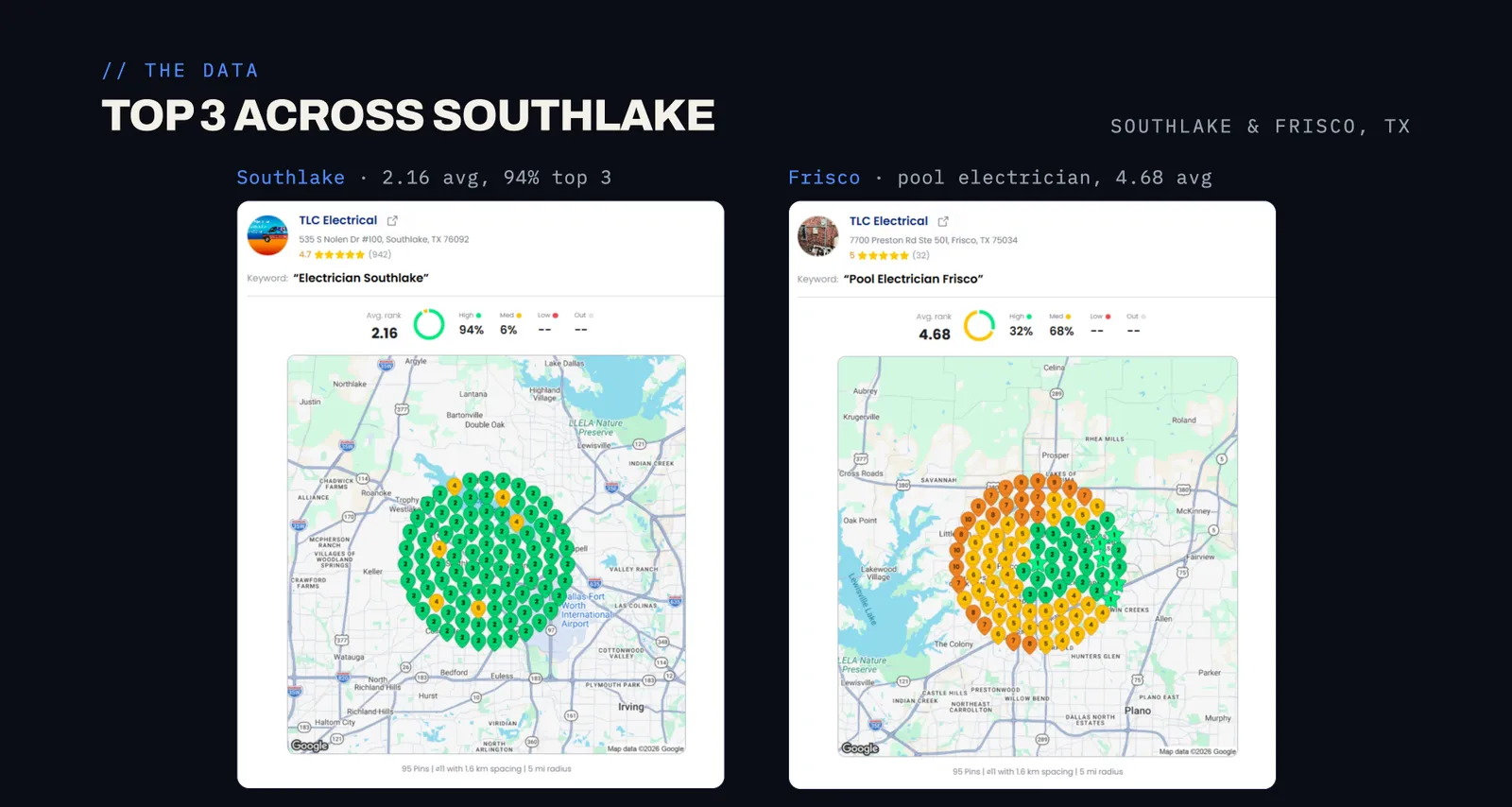
TLC Electrical's two grids show the difference between a settled location and a newer one. In Southlake, "electrician southlake" averaged 2.16 with 94% of points in the top three. In Frisco, a narrower search, "pool electrician," averaged 4.68. Pool and spa wiring is a real niche in North Texas, with bonding, GFCI and equipment pad work, and the Frisco grid tells us where to keep pushing.
Which Google Business Profile categories should an electrician use?
Use "Electrician" as the primary category for most shops. Add secondary categories for real lines of work, such as "Electrical installation service," "Lighting contractor," "Electric vehicle charging station contractor," "Generator shop" or "Solar energy contractor." Don't add categories for work you don't do; it confuses Google and wastes calls.
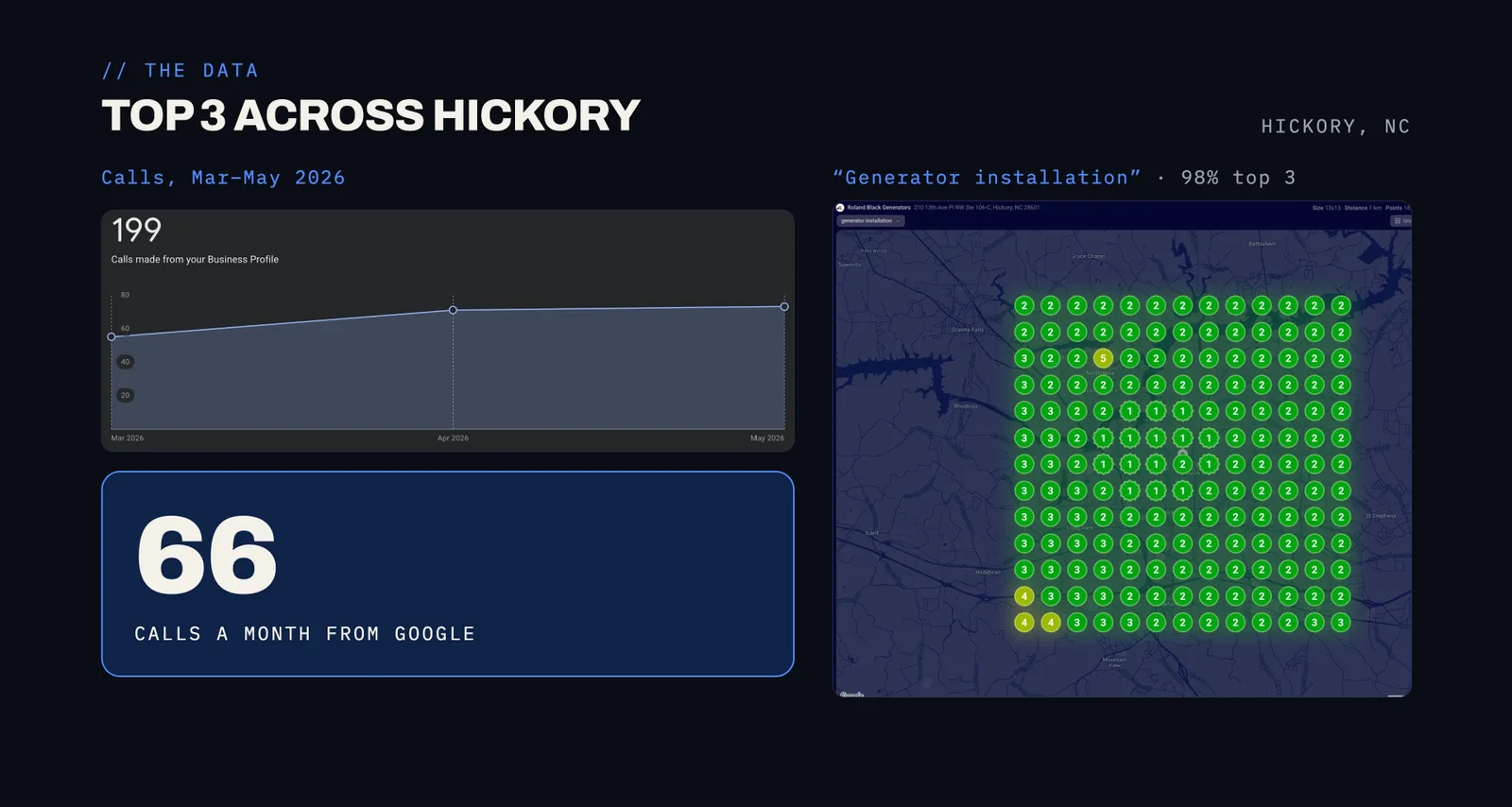
Category choice matters most when your business leans heavily one way. Roland Black Generators in Hickory, North Carolina is mostly a standby power business, and the profile is built around generators. From March to May 2026, the profile brought 199 calls, about 66 a month, and 98% of the "generator installation" grid was in the top three, mostly at #1 and #2.
If you change your primary category, run a grid before and after, and give it a few weeks. Category changes can move rankings for some searches up and others down.
How should an electrician fill out services, products and posts?
List every service you sell with a short, plain description, use Products for branded equipment and fixed-price jobs, and post updates about real jobs. These sections add relevance and give buyers reasons to call.
Services
Google offers some preset services under the Electrician category. Use the ones that fit and add your own for the rest: "200 amp panel upgrade," "Federal Pacific panel replacement," "Level 2 EV charger installation," "whole-home surge protection," "standby generator installation," "generator maintenance," "knob-and-tube rewiring," "hot tub and pool wiring," "landscape lighting." Short descriptions in buyer language beat lists of trade jargon.
Products
Products show as cards with photos. Use them for generator models you install, charger brands, maintenance plans and any job you price as a package. Bodhi's family Generac business in Rockland County lists inspections, battery replacement, oil changes and emergency service as products, each linked to the matching page on the website.

In the video above, Bodhi shows that profile from the inside, including the calls and map grids from the first months. The profile was verified in February 2026 and SEO work started around April. By late July, "generator repair near me" had gone from invisible in May to the top three across much of the area, and calls grew from 3 in May to about 20 in July. It's a small business with a narrow service, which is exactly where a well-built profile shows results fastest. One thing we'd do differently for your shop: use real photos of your crew and work, not generated images.
Posts and photos
Post about real jobs: a panel swap with a short note on what was replaced and why, a generator install before a storm season, a charger install in a new subdivision. Photos of tidy, labeled panels are electrician-specific proof. Homeowners can't judge wiring, but they can see neat work.
Do electricians need a physical address to rank on Google Maps?
No, but a real, staffed address in the right place usually helps. A service-area profile with a hidden address is allowed and normal for electricians who work at customers' homes. What you can't do is use a virtual office, mailbox or coworking desk that isn't staffed; Google's guidelines don't allow it, and those profiles get suspended.
Your address still matters for ranking even if it's hidden, because Google uses it for distance. If your shop is on the edge of your service area, you'll fade on the far side. Options:
- Open a real second location where you base crews or a warehouse with staff, and verify it as its own profile.
- Push relevance and prominence harder in the far towns: town pages, reviews from customers there, local links.
- Use ads to fill the gap while organic rankings catch up. The electrician Google Ads guide covers how.
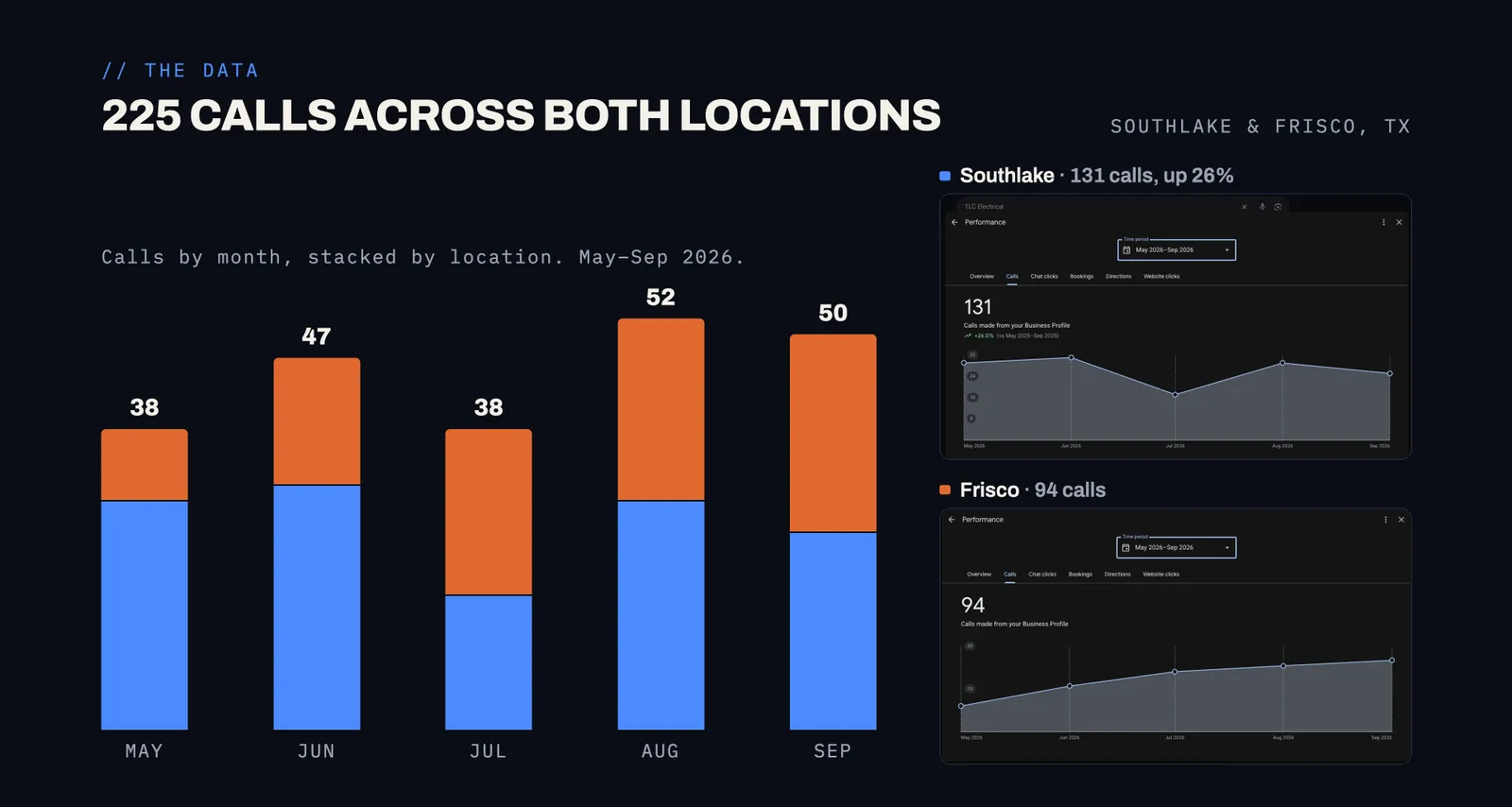
TLC Electrical's Frisco office shows how a second real location builds. From May to September 2026, Southlake brought 131 calls and Frisco 94, and Frisco's "pool electrician" grid averages 4.68 while reviews and local signals catch up with the home office.
How much do reviews affect an electrician's map rankings?
A lot. Review count, rating and how recently reviews came in all feed prominence, and they decide which of the three listings a buyer taps. Steady reviews from customers across your service area help you rank in more of it.
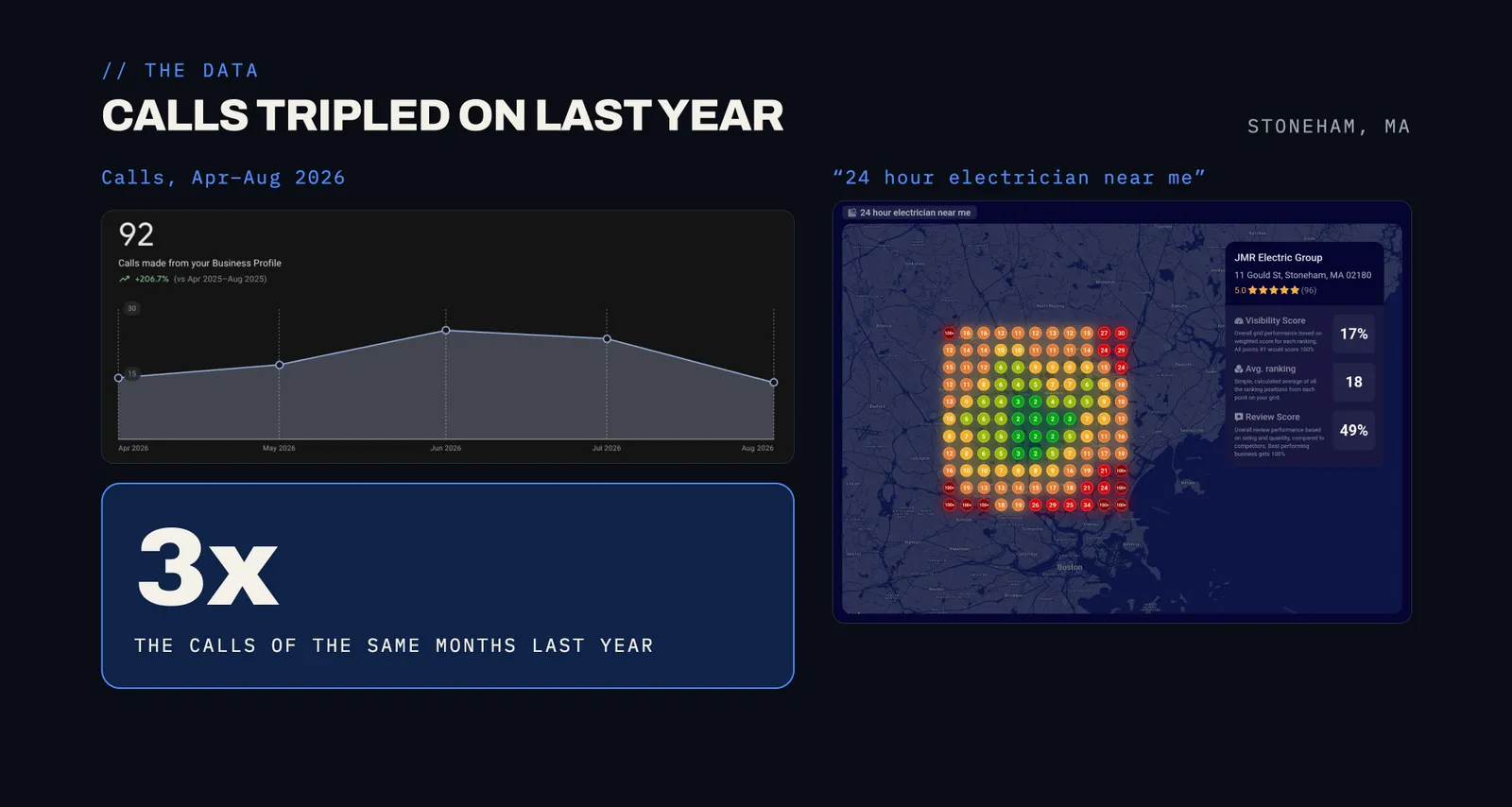
JMR Electric Group shows the effect of competition. "24 hour electrician near me" in Boston's north suburbs is crowded with shops that have long histories of night calls and reviews, and JMR's grid there is still mostly red even though its calls tripled. In Hickory, Roland Black's narrower "generator installation" search sits in the top three on 98% of the grid. Broad searches need more reviews and links; narrow ones reward relevance.
How to keep reviews coming: the electrician asks at the end of every job, the office texts the link the same day, one follow-up goes out a few days later, and someone replies to every review. Customers say what they want in their own words. Google forbids incentives for reviews, and the FTC's rule bans buying them. Our best-performing clients get 25 new reviews/month by asking everyone.
How should the profile change for panels, chargers, generators and solar?
Each high-value job has its own searches, its own photos and its own questions, so give each one its own space on the profile: a service entry, a product card where it fits, photos and posts. The aim is to show up when someone searches the job, not only when they search "electrician."
| Job | Searches to win on the map | Profile proof that helps |
|---|---|---|
| Panel upgrades | "panel upgrade near me," "breaker box replacement," "panel swap [town]" | Before and after photos of the panel, a note on permits and the inspection, reviews that mention the upgrade |
| EV chargers | "ev charger installer near me," "tesla charger installation" | Photos of the charger and the neat conduit run, the brands you install, a post on load management when the panel is small |
| Standby generators | "generac installer near me," "generator repair [town]," "generator maintenance" | Generator category, dealer status where true, pad and transfer switch photos, maintenance products |
| Solar and batteries | "solar electrician," "battery backup installer," "solar panel repair" | Solar category if you sell systems, photos of the inverter and battery wiring, notes on utility interconnection |
| Pools, spas and outdoor | "pool electrician," "hot tub wiring," "landscape lighting" | Photos of bonding and equipment pads, outdoor lighting at night, reviews from those jobs |
Don't stack all of this in the first month. Start with the job that pays you best and that your crews do most, get its grid green, then add the next.
Which Google Maps shortcuts get electricians in trouble?
Keyword-stuffed names, fake or virtual addresses, review swaps and paid reviews, and profiles for towns where you have no office. They can work for a few weeks, then the profile gets suspended, often right when the phone is busiest.
- Stuffed names. "Smith Electric | Electrician | Panel Upgrades | EV Chargers" breaks Google's name rules. Competitors report it, and Google suspends it.
- Virtual offices. A mailbox store or coworking desk with nobody there isn't an eligible address.
- Review swaps and incentives. Trading reviews with other contractors, offering money off for a review, or buying reviews breaks Google's rules and the FTC's rule.
- Fake service-area profiles. One profile per real location. Extra towns go on your service area and your website.
- Generated or stock photos. Use photos of your actual work and crew. Buyers can tell, and real panel and generator photos are proof that a rival can't fake.
If an agency promises you'll rank by any of these methods, walk away. A suspended profile in the middle of storm season costs more than any shortcut gains.
Which photos help an electrician's Google profile most?
Real ones of finished work and the crew. Clean, labeled panels, tidy conduit runs on a charger install, a generator on its pad with the transfer switch, before and after shots of an old fuse box replaced, and the team next to the trucks. Upload a few every month, from jobs across your service area.
Avoid photos that show open live panels with a customer's home details visible, or anything that looks unsafe. Homeowners notice. Captions in posts can explain what the photo shows: "Replaced a 100-amp Zinsco panel with a 200-amp panel and whole-home surge protection in [town]."
What should an electrician do about duplicates, suspensions and spam competitors?
Merge or remove duplicate profiles, follow Google's rules so you don't get suspended, and report competitors who break them. Electrical searches attract a lot of lead-generation listings and fake locations, and cleaning them up can move you up without any other change.
- Duplicates. Old profiles from a previous address or name split your reviews and confuse Google. Claim them and ask Google to merge or close them.
- Suspensions. The usual causes are a name with added keywords, a virtual office address, or a sudden change of name, address and category together. If suspended, fix the cause and file a reinstatement request with proof (license, utility bill, photos of the shop).
- Spam competitors. Listings with keyword-stuffed names or fake addresses can be reported through Google's Business Redressal form. Keep evidence: screenshots, street view, the state license lookup.
How do website pages help a Google Maps ranking?
The website is part of relevance and prominence. Google reads the page your profile links to and the rest of your site to understand what you do. A profile that links to a strong electrician homepage, with service and town pages behind it, ranks better than one that links to a single thin page.
For each main service in the profile, have a matching page. Link Products and Services to those pages where Google allows. Make sure the name, address and phone on the site match the profile exactly. The electrician SEO guide covers what those pages need.
How do hours and emergency service affect map rankings?
Google tends to favor businesses that are open when someone searches, especially for urgent searches like "electrician open now" or "emergency electrician." If you really answer the phone at night and on weekends, set your hours to show it. If you don't, don't; customers who call and get voicemail at 10pm leave bad reviews.
JMR Electric Group's story is honest about this. Calls from Google tripled year over year in Stoneham, from about 30 to 92 between April and August. But the grid for "24 hour electrician near me" still shows mostly red. Boston's north suburbs are full of 24-hour shops with years of reviews, and that search is the one we're still working on. A clear emergency page, accurate hours and reviews that mention night calls are the next steps.
How does the map pack compare with Local Services Ads for electricians?
They sit on the same results page but work differently. Local Services Ads show above the map pack, carry the Google Verified badge, and charge per lead. The map pack is free and earned. Electricians qualify for Local Services Ads after a background check and license and insurance verification, and the best shops use both: ads at the top while the map listing is strong underneath.
| Map pack (Business Profile) | Local Services Ads | |
|---|---|---|
| Cost | No cost per click or call | Paid per lead; you can dispute some invalid leads |
| Screening | Verification of the business | Background checks, license and insurance checks, then the Google Verified badge |
| What decides position | Relevance, distance, prominence | Budget, reviews, responsiveness, distance, hours |
| Speed | Weeks to months | Days once approved |
| Best for | Steady long-term call flow | Filling gaps, new locations, towns where you fade on the map |
Reviews feed both. A strong profile with lots of recent reviews also helps your Local Services Ads rank, which is one more reason to make asking a habit for every crew.
How should an electrical company with several locations handle Google Maps?
Give each real, staffed location its own verified profile, its own local phone number, its own page on the website, and its own reviews. Don't create profiles for towns where you only have customers.
TLC Electrical runs Southlake and Frisco as separate profiles. Over May to September 2026, Southlake brought 131 calls, up 26%, and Frisco 94. Each location has its own grid and its own strengths: Southlake holds 94% of its "electrician southlake" grid in the top three, while Frisco is building around pool electrical work at a 4.68 average. Treating them as one business on Google would blur both.
For each location page on the website, include the address, local phone, the crew or manager there, photos from that office and jobs in nearby towns, and the services that location offers. Link the profile to that page, not the homepage.
How do storms and outages change electrician map searches?
They spike them. After a hurricane, ice storm or long outage, searches for generator repair, emergency electricians and power restoration jump, and the shops already ranking get the calls. Shops that start working on their profile after the storm are too late for that season.
Bodhi saw it in his family's business: a round of summer thunderstorms in New York knocked out power, and profile interactions jumped in June, with his dad out on emergency calls over the Fourth of July. In western North Carolina, ice storms and hurricane remnants do the same for Roland Black Generators' searches.
What to do before storm season: post about generator maintenance and readiness, make sure hours and emergency availability are accurate, and add photos of recent generator installs. After a storm, reply to every review, and keep the profile updated if you're booked out, so customers know when you can come.
Do commercial electricians need the map pack?
Less than residential shops, but it still matters. Facilities managers and business owners search "commercial electrician [city]" and look at the map, especially for repairs. Bigger commercial projects come more often through general contractors, bid platforms and referrals.
If commercial work is a big part of your business, add it to your profile services, post photos of commercial jobs, and ask commercial customers for reviews too. Their reviews carry weight with other businesses reading them. The electrician lead generation guide covers bid platforms and builder relationships.
What about Apple Maps, Bing and AI assistants?
Claim them too. Apple Business Connect controls how you show in Apple Maps and Siri, which iPhone users rely on. Bing Places feeds Bing and some AI assistants. Both take an hour to set up and use the same name, address, phone and categories as Google.
AI assistants answering "who's a good electrician in [town]" draw on listings, reviews and website content. Consistent details and a strong review profile across Google, Apple, Bing and Yelp give them more to work with. When Bodhi asked ChatGPT for a generator company in Rockland County, it returned his family's business and linked to the homepage, because the business was clear and consistent everywhere.
How do you track how many calls come from Google Maps?
Use the call count in the Google Business Profile performance report, and add call tracking with a dedicated number on the profile (with your main number set as an additional phone). Then match calls to booked jobs in your field software.
The profile's own numbers are what we used for Roland Black Generators: 199 calls from the profile between March and May 2026. Call tracking adds recordings and lets you see how many calls were real jobs versus sales calls and wrong numbers, which matters because not every call is a customer.
How long does it take an electrician to rank on Google Maps?
Weeks for fixes to a neglected profile in a light market, a few months for a new profile or a new location, and longer in crowded metros. Narrow searches, like a specific service in a specific town, usually move first.
South Shore Electric reached 92% top three for "panel swap lake tahoe" within about two months of starting in July 2026. TLC's Frisco "pool electrician" grid sits at 4.68 while Southlake's broad search is at 2.16. JMR's 24-hour grid in Boston's suburbs is still red despite calls tripling. The pattern is consistent: specific services and smaller markets move fast; broad terms in big markets take patience.
What's the Google Maps checklist for electricians?
- Verify and claim everything. Your main profile, any old duplicates, and real second locations.
- Set categories. Electrician as primary for most shops; secondaries only for real work.
- List services and products. Every money service, in buyer language, linked to a matching page.
- Show your license. Number in the description and on the website, matching the state record.
- Upload real photos. Panels, chargers, generators, crew and trucks.
- Set true hours. Show emergency hours only if someone answers.
- Run grids. Monthly, for your three to five main searches, across the whole service area.
- Ask for reviews every job. In person, by text the same day, one follow-up, reply to all.
- Clean up listings. Main directories, manufacturer locators and associations, all matching.
- Report spam. Fake listings near you, with evidence.
What should an electrician's business description say?
Up to 750 characters, in plain language: what you do, which towns you serve, the jobs you specialize in, and the license that lets you do them. Google shows the description on the profile, and buyers read it when they're choosing between three listings.
Lead with the services buyers search for most in your area, then the towns. Mention emergency service only if a person really answers after hours. Leave out links, prices that change, promotions and lists of keywords; Google's guidelines don't allow some of those, and the rest read badly. Rewrite it when you add a service line, such as generators or chargers, so the profile matches the work.
What happened to questions and answers on the Google profile?
Google retired the public Q&A section on Business Profiles. It was phased out from December 2025 and replaced in Maps by an AI "Ask" feature that answers buyers' questions from your profile, reviews, website and other sources.
Older guides still tell electricians to seed their own Q&A. That advice no longer applies. The practical change is that Google now builds answers from what's already written about you, so:
- Fill in every service, attribute and hour on the profile, because the AI answers from them.
- Put clear answers on your website: service areas, emergency hours, brands you install, whether you pull permits, how estimates work.
- Keep reviews coming that mention the job and the town; reviews are one of the sources the answers draw on.
How often should an electrician post photos and updates to the profile?
Weekly is a good, realistic rhythm: a few new job photos and one short update about a recent job or a seasonal service. Steady activity keeps the profile accurate and gives buyers recent work to look at; there's no need to post daily.
Use your own photos, taken on the job: a finished panel, a charger on a garage wall, a generator pad, the truck at the house. Geotagging photos doesn't help rankings, so don't spend time on it. A simple habit works: the lead electrician sends three photos from every finished job to the office, and the office picks the best one for the week.
On a free growth call we check where you rank for “electrician near me,” how your site sells panel, charger and generator jobs, and where calls slip through.
Book a Growth CallGoogle Maps for electricians FAQ
How do electricians rank higher on Google Maps?
Choose the right categories, list every service, show your license, upload real photos, keep hours accurate, ask every customer for a review, build matching website pages, and keep listings consistent. Measure with a map grid.
Do electricians need a physical address for Google Maps?
No. Service-area profiles with a hidden address are allowed and normal. You can't use a virtual office or unstaffed mailbox. A real, staffed office closer to your customers helps with distance.
What is a map grid?
A scan that runs one search from many points across your service area and shows your rank at each. It shows where you're visible, unlike a single search from your office.
Why do I rank well near my shop but not across town?
Distance from the searcher is a ranking factor. Push relevance and prominence (pages, reviews from that area, local links) and, if you have a real second location, verify it.
How many Google reviews does an electrician need?
More than the shops ranking above you, with steady new ones. BrightLocal's 2026 survey found 47% of people won't use a business with fewer than 20 reviews. Our best-performing clients get 25 new reviews/month by asking every customer.
Should a generator-focused electrician use Generator shop as the primary category?
Possibly, if generators are most of your business. Test with a grid before and after, and keep Electrician as a secondary if you also do general work.
What gets an electrician's Google profile suspended?
Keyword-stuffed names, virtual or fake addresses, extra profiles for towns without offices, and sudden changes to name, address and category together. Follow Google's guidelines and keep records to prove your business is real.
Do Local Services Ads affect map rankings?
They're separate placements. Strong reviews and responsiveness help both, and ads can fill gaps where your map ranking fades.
How often should an electrician post on Google?
Weekly or every couple of weeks, with real photos and short notes about jobs. Posts add relevance and give buyers a reason to call.
How long does it take to rank on Google Maps?
Weeks for a neglected profile in a lighter market; a few months for a new profile or location; longer for broad searches in big metros.