
The best electrician leads come from sources you own: your Google Business Profile, your website's service pages, reviews, past customers, and referral partners like builders, remodelers, realtors, home inspectors and solar, HVAC and pool companies. Paid sources (Local Services Ads, Google Ads and lead marketplaces) fill gaps, but only after you know what a booked job is worth to you. The biggest lead leak for most electrical shops isn't a lack of leads; it's missed calls and slow follow-up.
Electricians get leads from more places than most trades because electrical work touches almost every other part of a house or building. A remodel needs an electrician. A pool, a hot tub, a heat pump, a solar array, an EV, a generator and a home sale all need one. This guide compares every major source of electrical leads, shows how to work out what a lead is worth to your shop, and explains how our electrical clients turn Google into steady calls.
Which lead sources work best for electricians?
Owned sources win over time: they cost less per job, the leads aren't shared, and they compound. Paid and shared sources are faster to start but cost more and stop when you stop paying.
| Source | Lead quality | Cost | Speed to start | Best for |
|---|---|---|---|---|
| Google Business Profile | High; buyer chose you | Time and agency fees | Weeks to months | Service calls, emergencies, upgrades |
| Website service pages | High; researched buyers | Build and upkeep | Months | Panels, generators, chargers, rewiring |
| Local Services Ads | Good; Google Verified badge | Per lead | Days to weeks | Residential calls in your area |
| Google Search ads | Good when well built | Per click | Days | Specific high-value jobs |
| Past customers | Very high | Low | Immediate | Repeat work, referrals, maintenance |
| Trade and builder partners | High; steady | Time and service | Months | Remodels, new builds, solar, pools |
| Realtors and inspectors | High; urgent | Time | Months | Pre-sale repairs, inspection fixes |
| Shared lead marketplaces | Mixed; sold to several shops | Per lead | Immediate | Filling gaps when slow |
| Commercial bid platforms | Mixed | Subscription and estimating time | Weeks | Commercial and new construction |
How do you work out what an electrical lead is worth?
Multiply your average gross profit per job by your close rate for that kind of lead. The result is the most you can pay for a lead and still break even on the first job. Do it separately for each job type, because a service call and a panel upgrade are worth very different amounts.
Here's how to calculate it with your own numbers:
- Average ticket for the job type. Pull the last six to twelve months from your field software. Service calls, panel upgrades, generator installs and chargers each get their own number.
- Gross margin. Ticket minus materials and labor, as a percentage.
- Close rate. Of the leads for that job, how many booked? Calls usually close better than web forms.
- Value per lead = ticket × margin × close rate.
| Job type | Your average ticket | Your margin | Your close rate | Value per lead |
|---|---|---|---|---|
| Service call | A | B | C | A × B × C |
| Panel upgrade | D | E | F | D × E × F |
| Standby generator | G | H | I | G × H × I |
| EV charger circuit | J | K | L | J × K × L |
Then add lifetime value. A homeowner who has a generator installed usually needs annual maintenance. A panel customer calls back for a charger or a remodel. A happy customer refers neighbors. Lifetime value is why owned leads, where you keep the customer relationship, beat shared ones.
How do electricians get more leads from Google?
Rank in the map pack for your main searches, build a page for each money job, keep reviews coming, and use Local Services Ads to fill gaps. For most residential electricians, Google is the largest single source of new customers.
Our electrical clients' numbers from 2026:
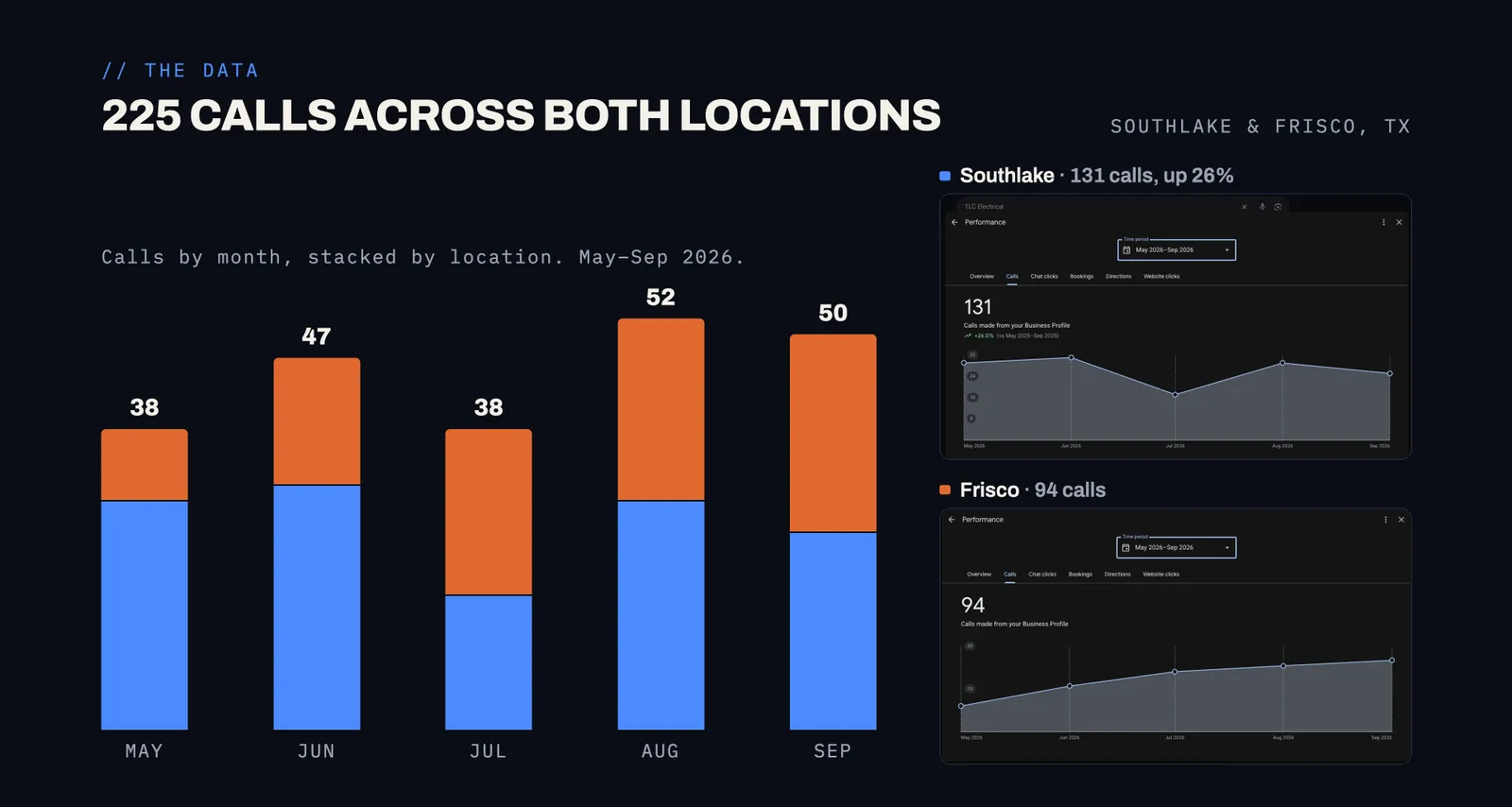
- TLC Electrical (Southlake and Frisco, Texas): 225 calls from Google, May to September 2026, with Southlake up 26% and Frisco adding 94.
- Roland Black Generators (Hickory, North Carolina): 199 calls from the Google Business Profile, March to May 2026, about 66 a month.
- JMR Electric Group (Stoneham, Massachusetts): 92 calls from Google, April to August 2026, up 207% from about 30 in the same months a year earlier.
- South Shore Electric (South Lake Tahoe, California): 48 calls, June to September 2026, with 18 in September, its best month so far.
These are calls, not booked jobs, and not every call is a customer. Results are specific to each client and market. The Google Maps guide and SEO guide cover how each one was built.
Which trade partners send electricians the most leads?
Builders and remodelers, HVAC contractors, solar installers, pool and spa builders, generator and battery dealers, and property managers. Each one regularly needs an electrician and would rather refer someone reliable than find a new one every job.
| Partner | What they need from you | How to earn it |
|---|---|---|
| Remodelers and builders | Rough-in and finish on schedule, passed inspections | Show up when you say, keep the site clean, communicate with their project manager |
| HVAC contractors | Dedicated circuits, heat pump and mini-split wiring, panel upgrades when the new system needs more capacity | Fast turnaround so their install isn't held up |
| Solar and battery installers | Main panel upgrades, interconnection, battery wiring | Know the utility's interconnection steps and the code sections for solar |
| Pool and spa builders | Bonding, GFCI protection, equipment wiring | Get bonding right the first time; failed inspections delay their fill |
| Generator dealers | Transfer switch and panel work, permits | Coordinate with their delivery and gas plumber |
| Property managers | Fast repairs, clear invoices, after-hours response | Answer the phone and send photos of the fix |
Bodhi's family Generac business started this way: his dad worked as a subcontractor for a friend's electrical company before the family built its own generator service brand. Many electrical shops grow the same way, from partner work into their own customers.
How do electricians get leads from realtors and home inspectors?
Be the electrician who answers fast, quotes the inspection items clearly and finishes before closing. Home sales have hard deadlines, and inspection reports often flag electrical items: double-tapped breakers, missing GFCI protection, recalled panels, ungrounded outlets, aluminum wiring.
How to build these relationships:
- Offer quick quotes from the inspection report, including photos.
- Know which panels insurers and buyers worry about (Federal Pacific, Zinsco and some older brands) and explain the options plainly.
- Give realtors a single number to call and a promise of a callback within the hour during business hours.
- Send a clean invoice and photos when the job is done, so they can pass it to the buyer.
How should electricians turn past customers into new leads?
Stay in touch with useful reminders, ask for referrals when they're happiest, and offer maintenance where it makes sense. Past customers already trust you, so they book faster and haggle less.
- Generator maintenance plans. Standby generators need regular service. A maintenance plan keeps customers coming back every year and gives you a reason to call before storm season.
- Surge protection and safety checks. After a panel job, follow up about whole-home surge protection or a safety check of older circuits.
- Seasonal emails or texts. Before storm season, holiday lighting season, or when new code rules affect homes in your area.
- Referral asks. At the end of a job, ask if they know anyone with an old panel, an EV on order, or a remodel coming up.
Are shared lead sites worth it for electricians?
Sometimes, as a filler. Sites like Angi, Thumbtack and similar marketplaces sell the same lead to several electricians, so you're competing on speed and price. They can keep crews busy in slow weeks, but they rarely build a business on their own.
If you use them:
- Know your value per lead for each job type before you set budgets.
- Respond within minutes; the first callback usually wins.
- Track booked jobs per source, not leads.
- Choose job types carefully. Small service calls on shared sites often cost more than they earn.
- Ask every marketplace customer for a Google review, so the lead builds your own profile too.
How do electricians get commercial leads?
Through general contractors, property managers, facilities directors, bid platforms and commercial search. Commercial work takes longer to win, but jobs are bigger and customers often come back.
- General contractors. Get on their bid lists. Bid accurately, deliver on schedule and keep their inspectors happy.
- Bid platforms. Construction bid platforms list public and private projects. Pick projects that fit your crew size.
- Property managers and facilities. Service agreements for lighting, repairs and maintenance bring steady work.
- Commercial pages and search. "Commercial electrician [city]" and "lighting retrofit [city]" searches come from business owners who need help now.
- Safety record. Commercial buyers often ask for safety documentation, insurance limits and training on NFPA 70E. Have it ready.
Why is answering fast the biggest lead fix for electricians?
Because electrical buyers usually call the first shop that looks trustworthy, and if nobody answers, they call the next. Every lead source is worth less if calls go to voicemail or forms wait until the next day.
What to fix first:
- Answer live during business hours, with a backup when the office is busy.
- Use an answering service or on-call schedule after hours if you advertise emergency service.
- Text back missed calls automatically with a short message and a link to book.
- Call back web forms within minutes, not hours.
- Follow up on quotes for panels, generators and rewires at least twice.
Call tracking shows how many calls you miss. Listening to calls is how you catch both missed jobs and wasted spend.
Where do leads for each kind of electrical job come from?
| Job | Best lead sources | What wins the job |
|---|---|---|
| Emergency service | Map pack, Local Services Ads, call ads | Answering live, arriving fast, clear after-hours pricing |
| Panel upgrades | Service page, map pack, realtors, solar and HVAC partners | Explaining permits and utility steps, neat photos, a clear quote |
| Standby generators | Brand searches, dealer locators, past customers, storm-season ads | Sizing advice, brand certification, maintenance plan |
| EV chargers | Charger and car searches, dealerships, charger installer networks | Answering the panel capacity question, quick quotes from photos |
| Rewiring | Service page, realtors, inspectors, insurance-driven searches | Explaining the risk calmly, how you patch walls |
| Commercial | GCs, bid platforms, property managers, commercial search | Capacity, safety record, schedule |
Which trends are creating new electrical leads in 2026?
Home electrification is the big one. Heat pumps, induction ranges, heat pump water heaters, EVs, home batteries and solar all add load, and many older homes can't take it without a panel upgrade, a service change or a load management device. Each of those is a lead for an electrician, often handed over by another trade.
- EVs. A Level 2 charger needs a 240-volt circuit, and older 100-amp services often can't support it with everything else running. Some buyers need a panel upgrade; others can use a load management device instead. Explaining both options wins trust.
- Heat pumps. When HVAC contractors replace gas furnaces with heat pumps, the electrical service often needs work. That's a steady referral stream for shops that partner with HVAC companies.
- Induction ranges and electric water heaters. New 240-volt circuits, sometimes in kitchens with no spare panel space.
- Batteries and solar. Interconnection, main panel upgrades and battery backup wiring. Federal residential solar and battery credits under 25D ended for installs completed after 2025, which changed buying patterns; state and utility programs vary.
- Storm backup. Longer and more frequent outages in many regions keep standby generator demand strong.
Write a page for each of these where you do the work. People search them with specific questions ("can my panel handle a heat pump," "do I need a new panel for an EV charger"), and good answers turn into calls.
Can utility and manufacturer programs bring electricians leads?
Yes. Many utilities run rebate or installer programs for EV chargers, heat pumps, panel upgrades or demand response, and some keep lists of approved contractors. Manufacturers do the same: generator brands have dealer locators, and charger makers and car brands have installer networks.
Getting on those lists usually means training, insurance documentation and sometimes a minimum number of installs. The leads they send have already chosen the product, which makes them easy to close. Check the requirements in your area, and keep your listing details matching your Google profile.
What are the best free ways for electricians to get leads?
Your Google Business Profile, Apple and Bing listings, Nextdoor, past customers, referrals from other trades, local Facebook groups where you answer questions helpfully, and yard signs on jobs where the homeowner agrees. None cost money; all take time.
The profile is the biggest. For Roland Black Generators, 199 calls in three months came straight from the Business Profile. For Bodhi's family Generac business, he estimates 80 to 90% of business came through the profile in its first months.
How do insurance and safety issues create electrical leads?
Home insurers often ask about the electrical system before they'll write or renew a policy, and some won't cover homes with certain old panels, fuse boxes or knob-and-tube wiring without changes. Those homeowners need an electrician quickly, and they search for exactly what their insurer told them.
Common insurance-driven searches include "replace Federal Pacific panel," "Zinsco panel replacement," "fuse box replacement for insurance," "knob and tube wiring removal" and "electrical inspection for insurance." A page for each that explains the issue calmly, without scare tactics, and lists what you'll provide for the insurer (photos, a letter, the permit) turns these searches into booked jobs.
Safety recalls and news stories do the same. When a product recall or local fire makes the news, people search for inspections. Have a general "electrical safety inspection" page ready, and write a short, factual post when a recall affects homes in your area.
How should electricians handle storm-driven leads?
Prepare before the season, triage calls during it, and follow up after. Storms bring three waves of leads: emergency repairs (damaged service masts, meter bases, flooded panels), generator repairs and hookups, and, weeks later, new generator and surge protection sales from people who don't want to go through it again.
- Before: generator maintenance reminders, posts about storm readiness, accurate hours and emergency availability on your profile.
- During: triage calls by safety (sparking, burning smell, water in the panel first), be honest about wait times, and update your profile if you're booked out.
- After: follow up with customers who asked about generators, reply to every review, and post about the work you did.
Roland Black Generators' rankings in Hickory, with 98% of its "generator installation" grid in the top three, mean that when an ice storm or hurricane remnant knocks out power, it's among the first calls. Ranking before the storm is what counts.
Do community events and social media bring electricians leads?
Slowly, but they build the trust that makes other sources work. Sponsor a local team, help at a community event, and post real work on Facebook, Instagram and Nextdoor. Neighbors who see your truck, your crew and your work at the ballfield are more likely to call you when their panel acts up.
What works on social for electricians: before and after panel photos, short videos explaining a common problem (why GFCIs trip, what the outside disconnect is), crew introductions, and storm readiness tips. What doesn't: stock photos and constant discount posts. The electrician marketing ideas guide has more examples.
Should electricians chase new construction leads?
Only if new construction fits your crew and cash flow. New builds can bring steady volume from builders, but margins are often thin, payment can be slow, and schedules are set by someone else. Many residential service shops prefer remodels and service work, where margins are better and customers come back.
If you do want builder work, build relationships with two or three builders whose payment terms you trust, rather than bidding every project.
How should an electrician track where leads come from?
Use call tracking numbers for each source, ask every caller how they found you, and record the source in your field software when you book the job. At the end of each month, compare booked jobs and revenue by source.
- One tracked number on the Google profile (with your main number as additional), one on the website, one in ads.
- A "How did you hear about us?" field in your booking form and software.
- Tags for partner referrals by partner name, so you know which builders and realtors send the most.
- A simple monthly report: leads, booked jobs, revenue and cost per booked job by source.
What are the red flags when buying electrician leads?
- Leads sold to many contractors at once with no limit.
- No clear way to dispute bad leads.
- Long sign-up commitments before you've tested quality.
- Leads for areas or jobs you didn't choose.
- No call recordings or contact details you can verify.
- Promises of a set number of jobs.
Test any paid lead source for a month with a small budget, track booked jobs, and only scale what pays.
What if you get more leads than your crews can handle?
Raise prices on small jobs, focus marketing on the jobs that pay best, and hire. The Bureau of Labor Statistics projects about 72,700 openings for electricians each year through 2035, and finding licensed electricians is hard in most markets. More leads only help if you can staff them.
Use your marketing to recruit too: a careers page, job posts on your Google profile, and photos of your crew. The same reputation that brings customers attracts electricians who want to work for a good shop.
How much should an electrician spend on lead generation?
Work backward from value per lead and the jobs you want. Start with owned sources (profile, pages, reviews) because they're cheapest per job over time, then add paid sources where you can afford the cost per booked job. Many shops spend a share of revenue on marketing, but the right number depends on your growth goals, margins and market.
If you're growing into new towns or a new service, you'll spend more at first. If you're full and want steady work, you can spend less and focus on your profile, reviews and partners.
What does a simple electrician lead system look like?
- Know your numbers. Value per lead for each job type.
- Fix your Google profile. Categories, services, photos, license and hours.
- Build pages for money jobs. Panels, generators, chargers, rewiring, emergency.
- Ask every customer for a review. In person and by text the same day.
- Answer every call. Live answering, missed-call texts, fast form callbacks.
- Build partner referrals. Two or three trade partners and realtors to start.
- Stay in touch with past customers. Maintenance plans and seasonal reminders.
- Add paid sources. Local Services Ads and Search, once the pages and phones are ready.
- Track booked jobs by source. Cut what doesn't pay; grow what does.
How should electricians qualify leads on the first call?
With a short, friendly script that answers the caller's question and gathers what you need to quote or schedule. The goal is to book the right jobs and politely decline the wrong ones, without making good customers feel interrogated.
- What's going on? Let them explain the problem or project.
- Is it urgent or unsafe? Burning smell, sparking, power out, water near electrical: give safety steps and dispatch or refer.
- Where is it? Address, to confirm you serve the area.
- What kind of property? House, condo, rental, business. Owner or tenant.
- Anything we should know? Panel brand and age, square footage, existing generator or solar.
- Can you send photos? Panel, meter, the problem. Many quotes start here.
- Book it. Offer two times, confirm by text, explain any trip charge.
- How did you hear about us? Record the source.
For panel, generator and charger leads, a photo of the panel and meter often lets your estimator give a range on the first call, which speeds up the sale.
How should electricians follow up on quotes?
Every time, on a schedule. Larger jobs like panels, generators and rewiring often get two or three quotes, and the shop that follows up politely and answers questions often wins. A simple routine works:
- Same day: Send the written quote with photos, the scope and what's included (permit, inspection, patching).
- Two days later: A text or call asking if they have questions.
- One week later: A short follow-up with a review or a photo of a similar job.
- Two to four weeks later: A final check-in, and a note that the quote's valid until a date.
Track open quotes in your field software and review them weekly. Quotes left unanswered are among the cheapest leads you have, because you've already paid to get them.
How should multi-location electricians manage leads?
Separate each location's numbers, profiles and reporting, then route calls to the right team. TLC Electrical runs two locations, Southlake and Frisco, and its 225 calls from Google split 131 and 94. Each location needs its own verified profile, location page, tracking number and reviews, and calls should route to the office that serves the caller. Report by location so you can see where to add crews or marketing.
How do electricians turn one lead into a long-term customer?
By doing great work, asking for the review, and staying in touch. A service call today can become a panel upgrade next year, a generator the year after and referrals to neighbors. Keep customer records with panel type, equipment and dates, send a short check-in or seasonal reminder a few times a year, offer maintenance plans for generators, and thank customers who refer. The cheapest lead is the customer you already have.
When do electrical leads peak?
It depends on region and work mix. Storm seasons bring generator and emergency leads, spring and summer bring remodel, pool and outdoor work, home sale seasons bring inspection repairs, and winter brings heating-related panel and outage calls in cold regions. Look at two years of your own booked jobs by month, plan staffing and budgets for the peaks, and use slow months for trade partner meetings, maintenance plans and website work.
Which numbers show whether your lead system works?
Five ratios, tracked by lead source and job type, show where leads are lost between the first call and the paid invoice.
| Number | What it shows | Where to look if it's low |
|---|---|---|
| Answer rate | Share of calls a person picks up | Hours, overflow answering, after-hours coverage |
| Response time | Minutes from form or missed call to reply | Who owns new leads during the day |
| Lead to appointment | Share of leads that book a visit or estimate | The first call, qualification questions, scheduling |
| Estimate win rate | Share of quotes accepted | Follow-up, options on the quote, financing |
| Cost per booked job | Spend divided by jobs won, per source | The source itself, once the steps above are healthy |
Fix the steps in that order. Cutting a lead source because it "doesn't work" is a mistake if the real problem is that half its calls went to voicemail.
How should an electrician's lead plan change with the size of the shop?
- Owner-operator: the Google profile, reviews, a few service pages, two or three trade partners, and a way to catch calls while you're on a ladder. Keep the tools to one job app and one phone system.
- Two to five trucks: add town pages, estimate follow-up, call tracking by source and Local Services Ads. Someone in the office owns new leads.
- Six or more trucks or several locations: add paid search by service line, past-customer campaigns, a profile and tracking number for each location, and reporting by location and source.
- Commercial-focused: fewer, larger leads from relationships. Track bids, general contractors and property managers in the CRM, and expect longer sales cycles.
Our clients cover most of that range: South Shore Electric is a focused shop at Lake Tahoe, while TLC Electrical runs two locations in North Texas and reports each separately.
Is email worth it for electrical leads?
Yes, to past customers, because it costs almost nothing and reaches people who already trust you. Keep it useful: most emails should be reminders and advice, with an offer only now and then.
- Segment by what you installed. Generator owners get maintenance reminders before storm season; charger customers hear about rebates; older homes hear about panel and surge protection.
- Send few, send relevant. Four to six emails a year beats a weekly newsletter nobody opens.
- Make it easy to act. One link to book, one phone number, and the electrician's name.
- Follow the rules. Send only to customers who've given you their address, include your business address and an unsubscribe link.
On a free growth call we check where you rank for “electrician near me,” how your site sells panel, charger and generator jobs, and where calls slip through.
Book a Growth CallElectrician lead generation FAQ
What's the best way for electricians to get leads?
Your Google Business Profile and reviews, website pages for each money job, and referrals from HVAC, solar, pool, remodeling and generator partners. Paid sources fill gaps once you know what a lead is worth.
How do electricians get free leads?
The Google profile, Apple and Bing listings, Nextdoor, past customers, trade partners, realtors and home inspectors, yard signs, and helpful answers in local groups.
How much should an electrician pay for a lead?
No more than average gross profit for that job times your close rate. Work it out separately for service calls, panel upgrades, generators and chargers, because they're worth very different amounts.
Are shared lead sites good for electricians?
As a filler. Leads are often sold to several shops, so you compete on speed and price. Track booked jobs per source and keep only what pays.
How do electricians get commercial leads?
Through general contractor bid lists, property managers, facilities directors, bid platforms and commercial search. Commercial buyers want a project portfolio, insurance documentation and a safety record.
Which trades refer the most work to electricians?
HVAC contractors (heat pumps and panel upgrades), solar and battery installers, pool and spa builders, remodelers, generator dealers and property managers.
Why do electricians lose leads?
Missed calls, slow callbacks on forms and no follow-up on quotes. Fixing call handling often improves results more than adding new lead sources.
How do realtors help electricians get work?
Home inspections often flag electrical items, and sales have deadlines. Electricians who quote quickly from the inspection report and finish before closing get steady referrals.
How does electrification create electrical leads?
EVs, heat pumps, induction ranges, batteries and solar add load. Many older homes need panel upgrades, service changes or load management, often referred by another trade.
How should electricians track lead sources?
Use call tracking numbers by source, ask every caller how they found you, record it in your field software, and compare booked jobs and revenue by source monthly.
Do generator maintenance plans bring more leads?
Yes. They bring customers back every year, give you a reason to call before storm season, and often lead to referrals and other electrical work.