
Google ranks pest control companies on Maps by three things: relevance (how well your profile matches the search), distance (how close you are to the person searching) and prominence (how well known you are, including reviews and links). You can't move your office, so the work goes into relevance and prominence. Set the right categories, list every pest as a service, link each profile to a matching page on your site, and keep reviews coming in every week. To rank in more towns, open real, staffed locations and give each one its own profile. Track rankings on a grid across your whole service area, not from your office.
When someone searches "exterminator near me," Google shows a map and three companies before any regular website result. On Google Maps itself, the list is all there is. For most pest control companies, that map is where the majority of new calls start. Our eight pest control clients got about 7,400 calls from their Google profiles and Google search between May and September 2026, and most of it came from the map.
This guide explains how the map ranking works, what moves it for pest control, how to read a ranking grid, when a second location makes sense, and what our clients' grids look like in 2026.
How does Google decide which pest control companies show on the map?
Google says local results are "mainly based on relevance, distance, and popularity," and explains each one on its local ranking help page. It also says there's "no way to request or pay for a better local ranking." Here's what each factor means for a pest control company.
| Factor | Google's definition | What it means for pest control | What you control |
|---|---|---|---|
| Relevance | "How well a Business Profile matches what someone is searching for" | Does your profile clearly say you handle termites, rodents, bed bugs or whatever they searched? | Categories, services, description, the page your profile links to, words in your reviews |
| Distance | "How far each business is from the customer who's searching" | You rank best near your address and fade with distance | Where your real offices are, and whether you have one in each market |
| Prominence | "How well-known a business is," including "how many websites link to your business and how many reviews you have" | Established companies with lots of reviews and links rank further from their office | Reviews, links, citations, your website's strength |
Distance is the one that surprises owners. Your map ranking changes with where the searcher is standing. You can be #1 two miles from your office and invisible eight miles away, in a town you service every day. That's why a single ranking number tells you almost nothing, and why we track rankings on a grid.
Where does the map sit among ads and Local Services Ads?
On a typical "pest control near me" search on a phone, a customer can see up to four kinds of results before the regular website links: Local Services Ads with the Google Verified badge, regular search ads, sometimes an AI Overview, and then the map pack. The exact layout changes by search and by market, and Google tests new layouts all the time.
| Result | How you get in | How you pay | What it needs |
|---|---|---|---|
| Local Services Ads | Pass Google's screening, set a budget | Per lead | License checks, a verified Google Business Profile, reviews |
| Search ads | Bid on keywords | Per click | A landing page and good call handling |
| Map pack | Earn it with relevance, distance and prominence | Free | A strong Google Business Profile |
| Organic results | Earn it with your website | Free | Pest and city pages, links |
The map and Local Services Ads draw on the same profile, so profile work helps both. Local Services Ads require "a public and verified Google Business profile," according to Google's verification requirements, and your reviews show on the ad. A company that ranks well on the map and runs LSA in peak season can appear twice in the first screen. More on that in our Google Ads and LSA guide for pest control.
How do you read a Google Maps ranking grid?
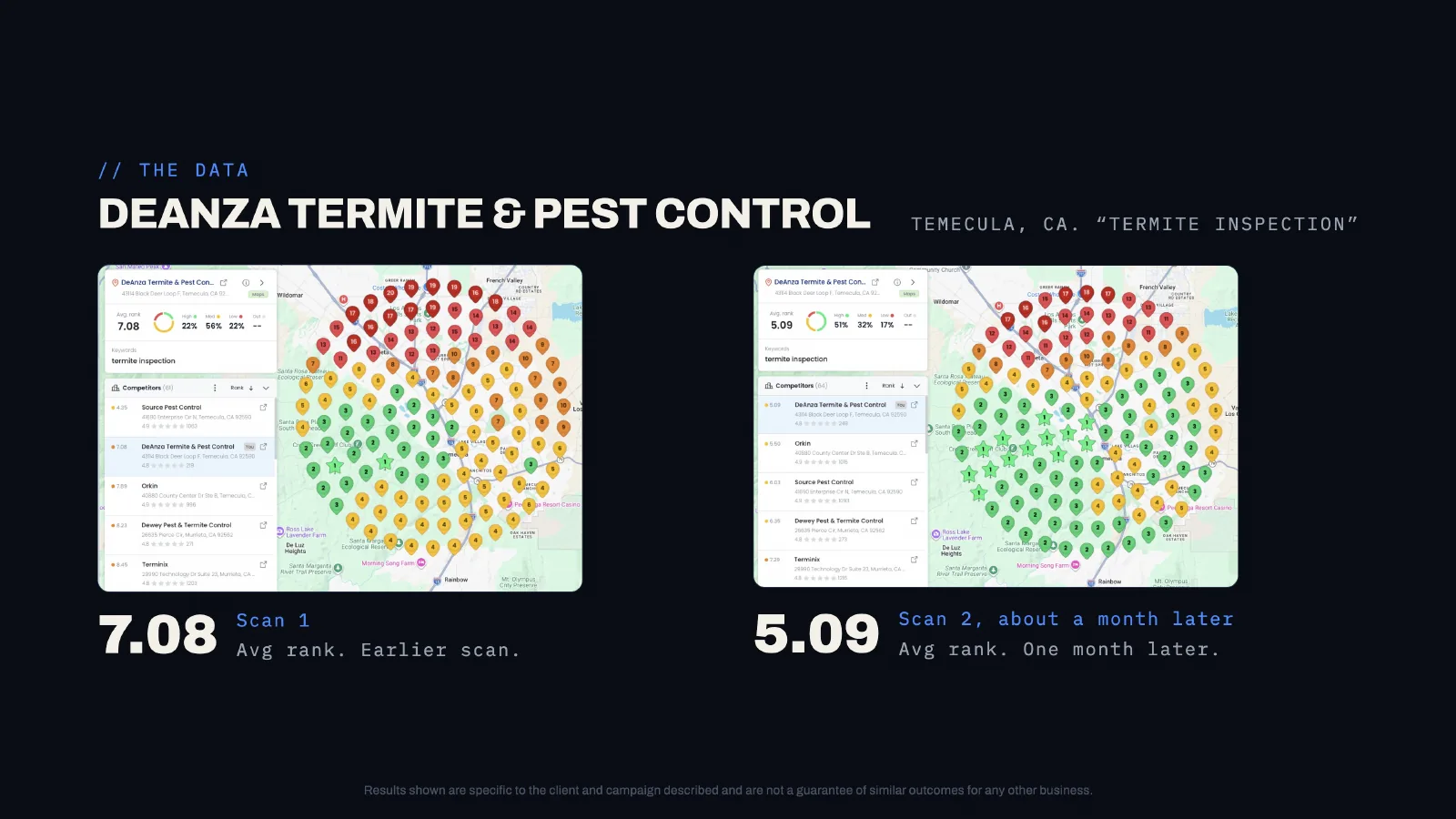
A ranking grid checks your map position for one keyword from dozens of points across your service area, as if a customer were searching from each one. Each dot shows your rank from that spot. Green dots are top three, where most calls happen. Yellow and red mean you're lower or not showing.
Two numbers summarize a grid:
- Average rank: your average map position across every point. Under 3 means you're in the top three across most of the area.
- Share of the grid in the top 3: the percentage of points where you're in the top three. This is the closer measure of how much of your market sees you.
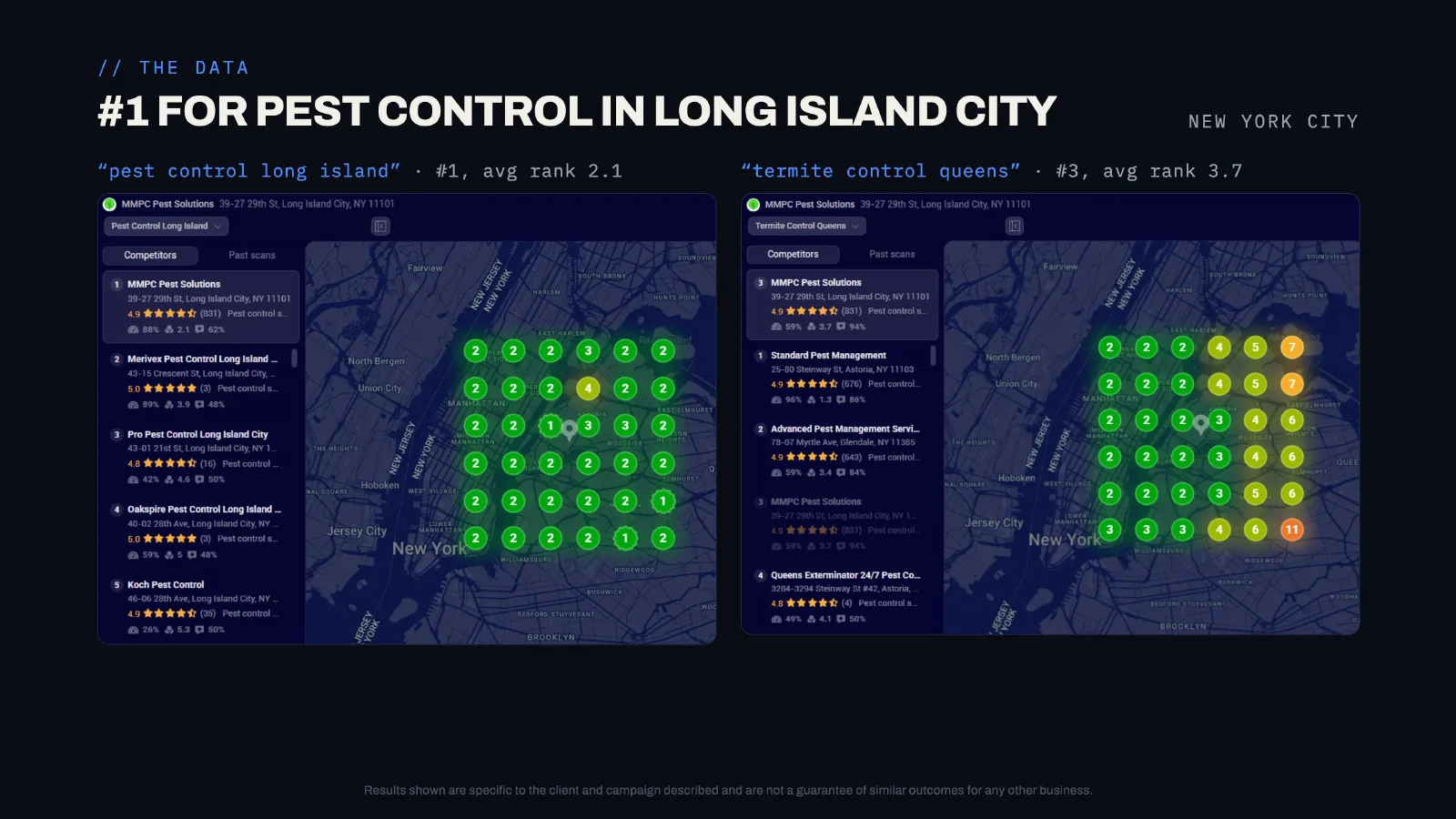
The MMPC grids show something important: one company can rank very differently for different pests. MMPC is #1 for general pest control across its area but #3 for termite control in Queens. Termite, rodent, bed bug and mosquito searches each have their own competition, so track the ones that bring you the most revenue, not just "pest control."
Check grids monthly, and always with the same settings (keyword, grid size and spacing), so the comparison is fair. Pair it with calls from your profile's performance report, because a better grid that doesn't bring more calls usually means the profile ranks but doesn't convince people to call.
How do you make your profile more relevant to pest searches?
Relevance is mostly about telling Google, clearly and in several places, what you do. For pest control that means naming each pest and service, not just "pest control."
Categories
Your primary category has more influence on which searches you appear for than almost anything else on the profile. For most companies it's "Pest control service." Add secondary categories only for services you actually provide, and search the category list in your profile for the exact names Google offers, because the list changes. Don't add categories for work you don't do. It confuses Google and customers.
Services
List every pest and service as its own service on the profile, with a short plain description: termite inspection, termite treatment, rodent control, rodent exclusion, mosquito treatment, bed bug treatment, ant control, wasp and hornet removal, wildlife removal if you're licensed for it, commercial pest control and recurring plans. Each one is another way to match what someone types.
The page your profile links to
Each profile should link to a page about that location: the city name, the same address and phone number as the profile, the services offered there and reviews from customers nearby. If you have one office, the home page is fine, as long as it names your main city and links to a page for every pest. In Bodhi's Capture Pest Control audit, a state-wide title tag ("New Jersey") was one reason a strong company was outranked in its own county.
Your business name
Use your real business name. Adding keywords like "Best Exterminator Termite Control [City]" breaks Google's guidelines for representing your business and is a common reason profiles get suspended. If a competitor does it, you can report it to Google. Getting a spammy name corrected sometimes moves you up a spot.
What about Q&A?
Older guides tell you to seed the Questions and Answers section of your profile. Google removed Q&A from Maps in December 2025, so put those answers on your website instead, on the pest pages and in FAQs, where they also help your SEO and AI search visibility.
How do you build prominence on Google Maps?
Prominence is how well known you are, online and off. Google names two signals directly: links to your business from other websites and reviews. In our experience with pest control, these matter most:
| Signal | What good looks like | How to get it |
|---|---|---|
| Review count | More than the companies ranking above you in your market | Ask after every completed service, by text, with the direct link |
| Review recency | New reviews every week, not a burst every few months | Make it part of the technician's routine. Our best-performing clients get 25 new reviews/month |
| Review text | Customers describe the pest and the town in their own words | Ask at the right moment. Never tell them what to write |
| Rating | High, with calm replies to the few bad ones | Fix problems fast and reply to every review |
| Links to your site | Associations, real estate partners, local news, suppliers | See the link sources in our pest control SEO guide |
| Citations | The same name, address and phone on every major directory | Clean up duplicates and old addresses |
| Website strength | A site with real pest and city pages and good links | Seth Fenn's domain authority went from 8 to 24 as his map ranks climbed |
Seth Fenn at Cura Termite & Pest Control has about 1,500 reviews across four of his profiles, rated 4.9 and 5.0. That review base, plus a stronger website, is why Cura ranks well beyond the block around each office.

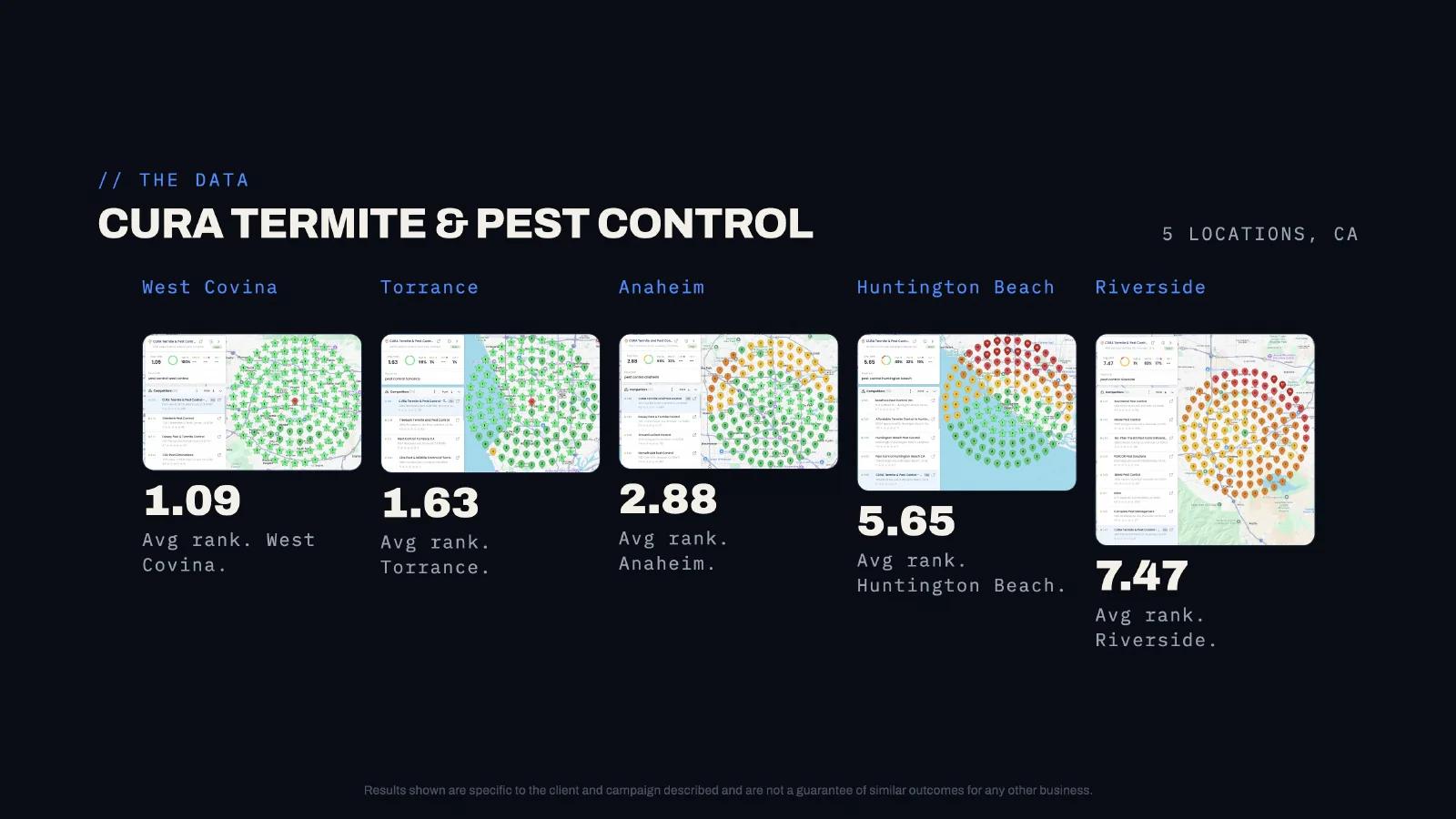
Cura Termite & Pest Control (Seth Fenn, six offices in Southern California). Average map rank across five tracked locations is 3.74: West Covina 1.09, Torrance 1.63, Anaheim 2.88, Huntington Beach 5.65 and Riverside 7.47, the last two being newer profiles. Calls from Google reached 2,627 from May to September 2026, up 77% year over year. In Seth's words: "we were on the second and third page. Now I'm in the map pack number one."
Want this built for your pest control company? Book a free growth call and we'll review your Google profiles, site and rankings.
Book a Growth CallHow do you rank on the map in towns farther from your office?
Mostly, you don't, at least not with the same profile. Distance is a strong factor, so a profile ranks best around its address and fades with distance. A larger service area setting doesn't change that. Strong prominence stretches the circle a bit, but it doesn't make an office in one city rank in a town 25 miles away.
There are two honest ways to win more towns:
- Open a real, staffed location and give it its own profile. The location needs to be a real place where you do business, with signage and staff, as Google's guidelines require. That's what our multi-location pest clients do, and it's often the single biggest jump in calls.
- Rank in the regular results with city pages. Where you can't have an office, a city page with real local detail can rank in the organic results below the map. It won't put you on the map in that town, but it catches a share of searchers.
Never use a virtual office, a shared coworking desk or a mailbox address to fake a location. Those profiles get suspended, and a suspension can drag down your trust with Google. If a profile is already suspended, see our Google Business Profile guide.
Should a pest control company show or hide its address?
Most pest control companies go to the customer, so Google treats them as service-area businesses. Google's guidelines say to hide your address if customers don't come to your location, and show it if you serve customers there, for example an office where people pick up products or drop off paperwork. Either way, the profile has to be tied to a real address, and Google still uses that location to judge distance even when it's hidden.
- Office or shop open to customers during posted hours: show the address.
- Office where customers never visit: hide the address and set service areas.
- Running the business from home: hide the address. Never list a home address publicly as a storefront.
- Service areas: list the cities and ZIP codes you actually service, within a reasonable drive. Google's guidelines say service areas shouldn't extend farther than about two hours' driving time from your location.
Hiding the address doesn't hurt rankings in our experience, but switching back and forth, or moving the pin, can trigger reverification. Decide once and keep it consistent across the profile, your website and your listings.
What happens when you add a second Google Business Profile?
Done right, a second location adds a new circle of rankings and calls without taking much from the first. In 2026, second profiles for Surge, Scout, State Termite and King all added calls while the original locations kept growing. The client results table below has the numbers.
New profiles take time. They start with no reviews and no history, so expect a few months of slower growth. Cura's newer Riverside and Huntington Beach profiles are still climbing (7.47 and 5.65 average rank) while its established profiles sit near #1.

In the Surge interview above, Forrest Jensen and Bodhi talk about the second profile. Bodhi says it's now "ripping," and Forrest answers, "I'm sure we'll get a third one."

In the audit above, Bodhi recommends Capture Pest Control add profiles in Essex and Passaic counties, where it already does work, if it has real locations there. A Bergen County office alone can't rank across three counties.
Do photos and posts help pest control map rankings?
Google lists photos and videos and replying to reviews among its tips to improve local ranking. Their bigger effect for pest control is on whether people call once they see you. A profile with recent photos of your trucks, technicians in uniform and real job sites looks like an active, trustworthy business. One with three stock photos from 2019 doesn't.
- Add new photos every month: trucks, team, equipment, exterior inspections, exclusion work. Skip graphic close-ups of infestations.
- Post when there's something real to say: termite swarm season, mosquito service starting, rodent exclusion before winter.
- Keep hours accurate, including holidays. Only say you're open 24/7 if someone actually answers.
- Reply to every review, good or bad, within a day or two.
Do hours, the map pin and customer actions affect pest control map rankings?
Yes, indirectly. Hours and the pin are part of the complete, accurate information Google says helps a profile show up, and calls and direction requests show the profile is doing its job.
- Hours decide "open now" searches. If you take after-hours rodent or wasp calls, set hours that say so, and keep special hours current for holidays. A profile that shows closed at 8 p.m. loses the homeowner who just found a mouse in the kitchen.
- The pin is where distance is measured from. Service-area businesses that hide their address still have a location behind the scenes. Make sure it is your real office or shop, not a P.O. box or a virtual office, which breaks Google's rules.
- Calls and website clicks are the result you want anyway. Some local SEO specialists believe these actions feed rankings, but Google hasn't confirmed it. Either way, a profile with good photos, true hours and recent reviews gets more of them.
- Ask Maps reads your reviews. Google's Ask Maps uses Gemini to answer questions in Maps, drawing on reviews and place information. A profile whose customers mention bed bugs, termites or rodents in their own words gives it something to work with.
What do map results look like across our pest control clients?
They vary by market and by how long the profile has existed. Here's where several clients stood in 2026, with calls by profile and rankings from their grids:
| Client | Calls from Google by profile | Map ranking |
|---|---|---|
| King Pest Solutions | Grand Junction, CO: 1,026. Colorado Springs, CO: 763. Total 1,789, up 47% (May–Sep 2026) | #1 for "pest control" in Grand Junction, ahead of 10 tracked competitors |
| MMPC Pest Solutions | 744 (May–Sep 2026) | #1 for "pest control long island," with 88% of the grid in the top three |
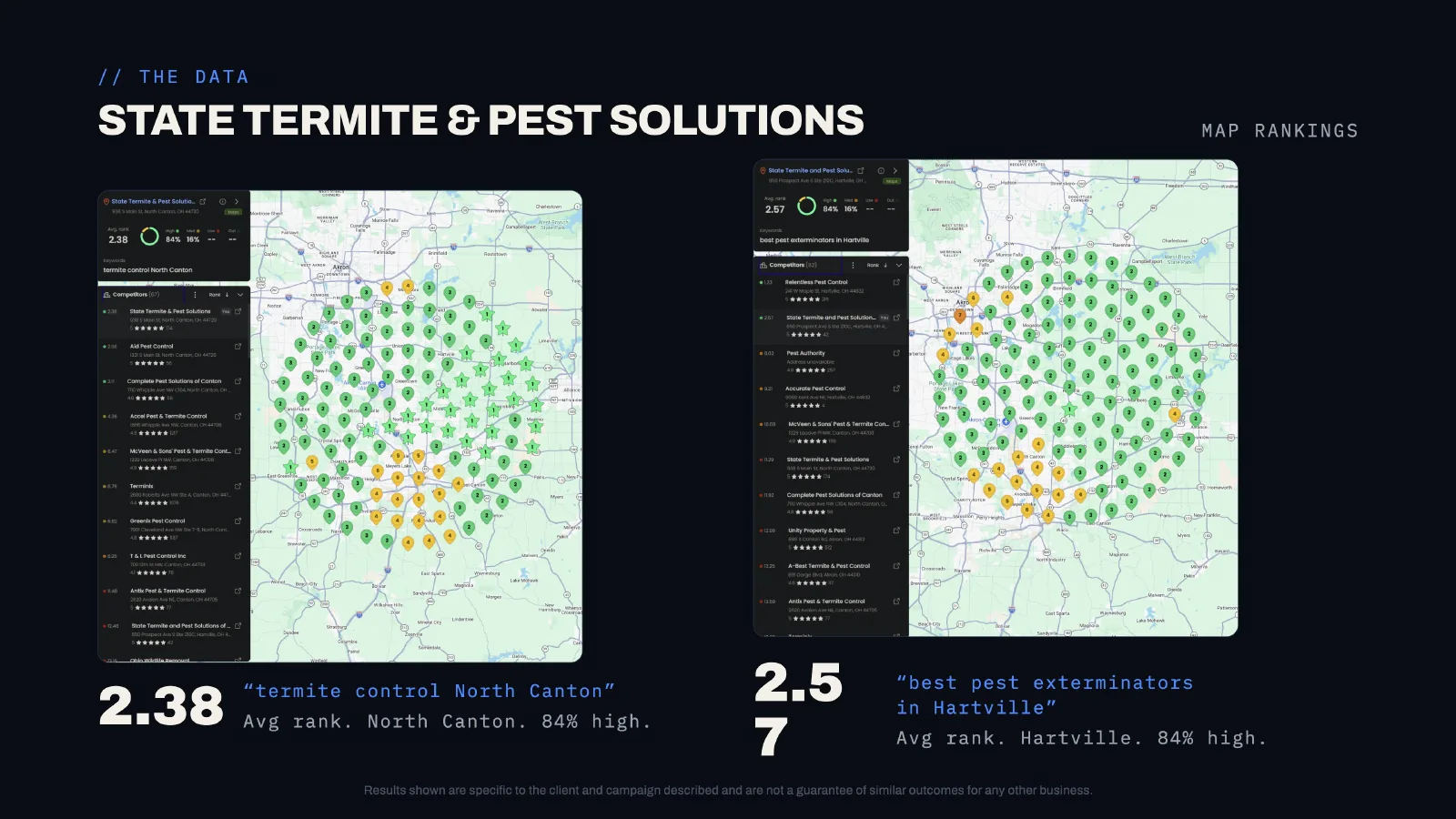
| State Termite & Pest Solutions | North Canton, OH: 197, up 34.9%. Hartville, OH (new profile): 22 (Jun–Aug 2026) | 2.38 for "termite control North Canton" and 2.57 for "best pest exterminators in Hartville," both with 84% of the grid ranking high |
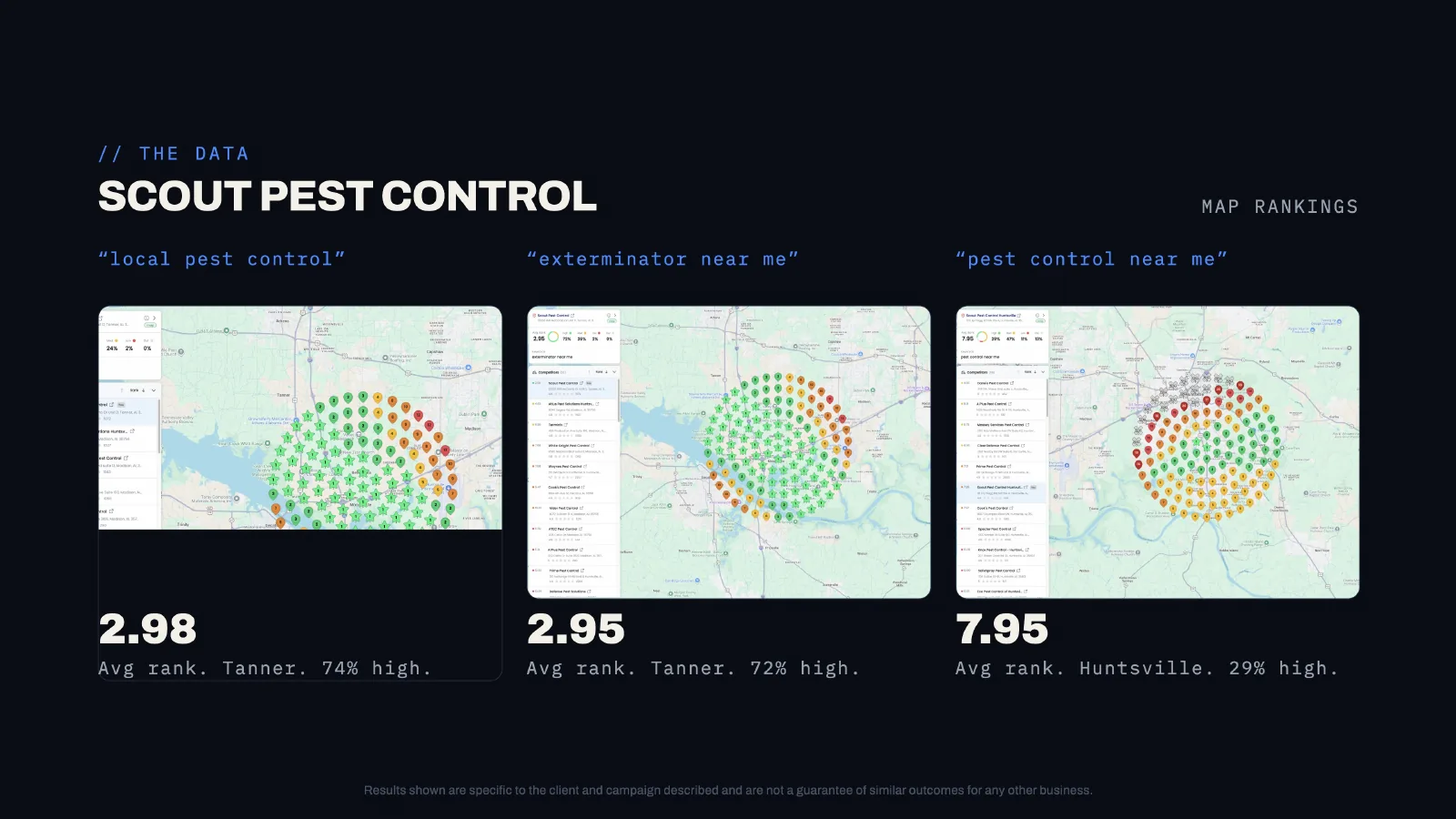
| Scout Pest Control | Tanner, AL: 1,243. Huntsville, AL (second profile): 195, up 1,119% (May–Sep 2026) | 2.98 for "local pest control" in Tanner |
| Surge Pest Control | Georgetown, TX: 275. Leander, TX (second profile we recommended): 140 (May–Sep 2026) | 3.67 for "pest control" in Leander, with 67% of the grid in the top three |
The pattern: termite searches and newer towns can rank well quickly when the profile, the matching location page and reviews line up, while broad "pest control" searches in big markets take longer.
Why do termite and rodent searches rank differently from "pest control"?
Because Google treats them as different searches with different competitors. A termite-only company might outrank you for "termite inspection" even if you beat them for "pest control." Our clients' grids show this clearly:
| Company | Keyword | Average rank | Share of grid high |
|---|---|---|---|
| Modern Pest Control, Staunton, VA | pest control services | 1.74 | 99% top 3 |
| Modern Pest Control | rodent removal | 1.88 | #1 overall |
| Modern Pest Control | mice removal | 2.07 | #1 overall |
| State Termite, North Canton, OH | termite control North Canton | 2.38 | 84% |
| Scout Pest Control, Tanner, AL | exterminator near me | 2.95 | 72% |
| Scout Pest Control, Tanner, AL | local pest control | 2.98 | 74% |
| Surge Pest Control, Georgetown, TX | exterminator | 2.89 | 72% |
| Surge Pest Control, Georgetown, TX | pest control | 3.48 | 61% |
| Scout Pest Control, Huntsville, AL | pest control near me | 7.95 | 29% |
To rank for a specific pest, list it as a service on the profile, give it a full page on your site that the profile can support, and get reviews from customers who had that problem. Scout's Huntsville numbers show where a newer profile starts: present, but not yet in the top three for most of the city.
How should a multi-location pest control company set up its profiles?
Each real location gets its own profile, and each profile should be able to stand on its own. Here's the checklist we use when a pest client opens a new office:
| Item | Why it matters |
|---|---|
| A real, staffed address with signage | Required by Google's guidelines, and checked during verification |
| A local phone number for that office | Each profile needs its own number. Sharing one number across profiles muddles which location a call belongs to |
| Its own location page on the website | The profile links there. The page names the city, shows the address and lists services and reviews |
| The same brand name on every profile | "Cura Termite & Pest Control," not "Cura Anaheim Termite Exterminators" |
| The same primary category | Keeps relevance consistent across locations |
| Reviews requested to the right profile | Customers near each office review that office, so every profile builds its own prominence |
| Owner access kept in the company's name | So the profile stays with the business if staff or agencies change |
| Citations for the new address | Yelp, BBB, Bing, Apple Maps and your state association, all matching |
Cura shows how this scales. Its six offices cover Anaheim, Laguna Niguel, Huntington Beach, Riverside, Torrance and West Covina, each with its own location pages on curapest.com. Anaheim alone produced 1,768 calls from May to September 2026, and the DeAnza (Temecula) location added 579.
How do you outrank a pest control company with more reviews?
Review count isn't everything. When a competitor with twice your reviews ranks above you, look at what else they have, and where you can win.
- Are their reviews recent? A company with 300 reviews and nothing new for a year is beatable by one getting new reviews every week.
- Is their profile complete? Many competitors list "pest control" and nothing else. Every pest you list as a service is a search they're weaker on.
- Is their name keyword-stuffed? That breaks Google's guidelines. Report it, and win back the spot when it's corrected.
- Where is their office? If they rank because they're closer to the center of town, you won't beat them there with reviews alone. Win the neighborhoods closer to you, and the pest-specific searches.
- Is their website better? Compare the page their profile links to with yours. A strong location page with local reviews and a page for each pest often closes the gap.
Picking the right battles matters. Modern Pest Control in Staunton ranks #1 for "rodent removal" and "mice removal," not just "pest control services." Those pest-specific searches are often easier to win and bring callers who know exactly what they need.
What should you do about fake or spammy pest control listings?
Lead generation companies and some competitors create profiles at fake addresses or with keyword-stuffed names. They take map spots from real businesses. You can report them:
- Suggest an edit on the listing in Google Maps to fix a stuffed name or flag that a place doesn't exist at that address.
- Use Google's Business Redressal Complaint Form for repeat or larger-scale spam, with screenshots and evidence (Street View of the address, the real business name from the state registry).
- Keep a record and check back. Edits don't always stick the first time.
Spend your time on your own profile first. Reporting spam helps, but it doesn't replace reviews, services and a strong site.
What should a monthly Google Maps report include?
If an agency or employee runs your profiles, the monthly report should answer, "Are we getting more calls from more of our area?" At minimum:
- Grids for your top keywords per location, with average rank and share of grid in the top 3, compared with last month.
- Calls, website clicks and direction requests from each profile, compared with the same month last year.
- New reviews per profile and the average rating.
- What changed on the profile (services, photos, posts, categories) and on the site.
- New recurring customers from Google, from your CRM.
- What's planned next month and why.
Every number in our pest clients' reports above comes from that kind of monthly reporting. If yours only shows "impressions," ask for calls.
How long does it take to rank on Google Maps?
Fixes to the profile itself can move rankings within weeks, because Google reads the changes directly. Cura's DeAnza profile improved two full positions for "termite inspection" in about a month. Moving from the middle of the pack to #1 across a whole city usually takes several months of steady reviews and links, and longer in dense metros where competitors have years of reviews. Brand new profiles are the slowest. Plan on a few months before they reach the top three in most of their area.
What should you do in the first 90 days of a new pest control profile?
A new profile starts with no reviews, no photos and no history, so the first three months are about getting it verified, complete and active. This is the order we follow for a new pest control location:
| When | Work |
|---|---|
| Before launch | Signage up, local phone line live, location page built on the website, office staffed during posted hours |
| Week 1 | Create and verify the profile (Google often asks for a video showing the signage, the office and proof of management), set categories and hours |
| Weeks 1–2 | Add every service, a plain description, 15–20 real photos, and the link to the location page |
| Weeks 2–4 | Start review requests from customers serviced out of the new office. Build the core citations for the new address |
| Months 2–3 | Run the first grids, compare with competitors, add city pages for the towns around the office, keep reviews steady |
State Termite's Hartville profile followed this path. It produced 22 calls in its first three months and already ranks 2.57 for "best pest exterminators in Hartville," with 84% of the grid ranking high. Small numbers at first are normal. What matters is that the trend is up.
Do Google Maps rankings change with the pest season?
Rankings themselves don't follow the season much, but the searches do, so the value of a top-three spot rises and falls through the year. A #1 ranking for "termite inspection" matters most during your local swarm season, which can start in late winter in the South and run into fall in some regions, according to NC State Extension. Rodent searches tend to pick up as it gets colder.
That timing should shape your work. Push reviews and photos hardest in the months before your busy season, so the profile is at its strongest when the calls come. Use the quiet months to open new locations and build links, because new profiles need a few months to mature before peak demand.
How do you know if better map rankings are paying off?
Look at calls, not just ranks. Your profile's performance report shows calls, website clicks and direction requests. Call tracking shows which calls came from which profile. Your CRM shows which calls became recurring customers.
| Company | Calls from Google, May–Sep 2026 | Monthly trend |
|---|---|---|
| Cura Termite & Pest Control | 2,627 (+77% YoY) | 391 → 493 → 543 → 559 → 641 |
| King Pest Solutions | 1,789 (+47% YoY) | 249 → 405 → 395 → 385 → 355 |
| Scout Pest Control | 1,438 | 226 → 297 → 278 → 297 → 262 |
| MMPC Pest Solutions | 744 | About 140 a month |
| Surge Pest Control | 415 | 62 → 73 → 101 → 86 → 93 |
| State Termite & Pest Solutions | 219 (Jun–Aug) | 53 → 76 → 90 |
| Bad Termite | 159, up YoY | #1 for "termite inspection" |
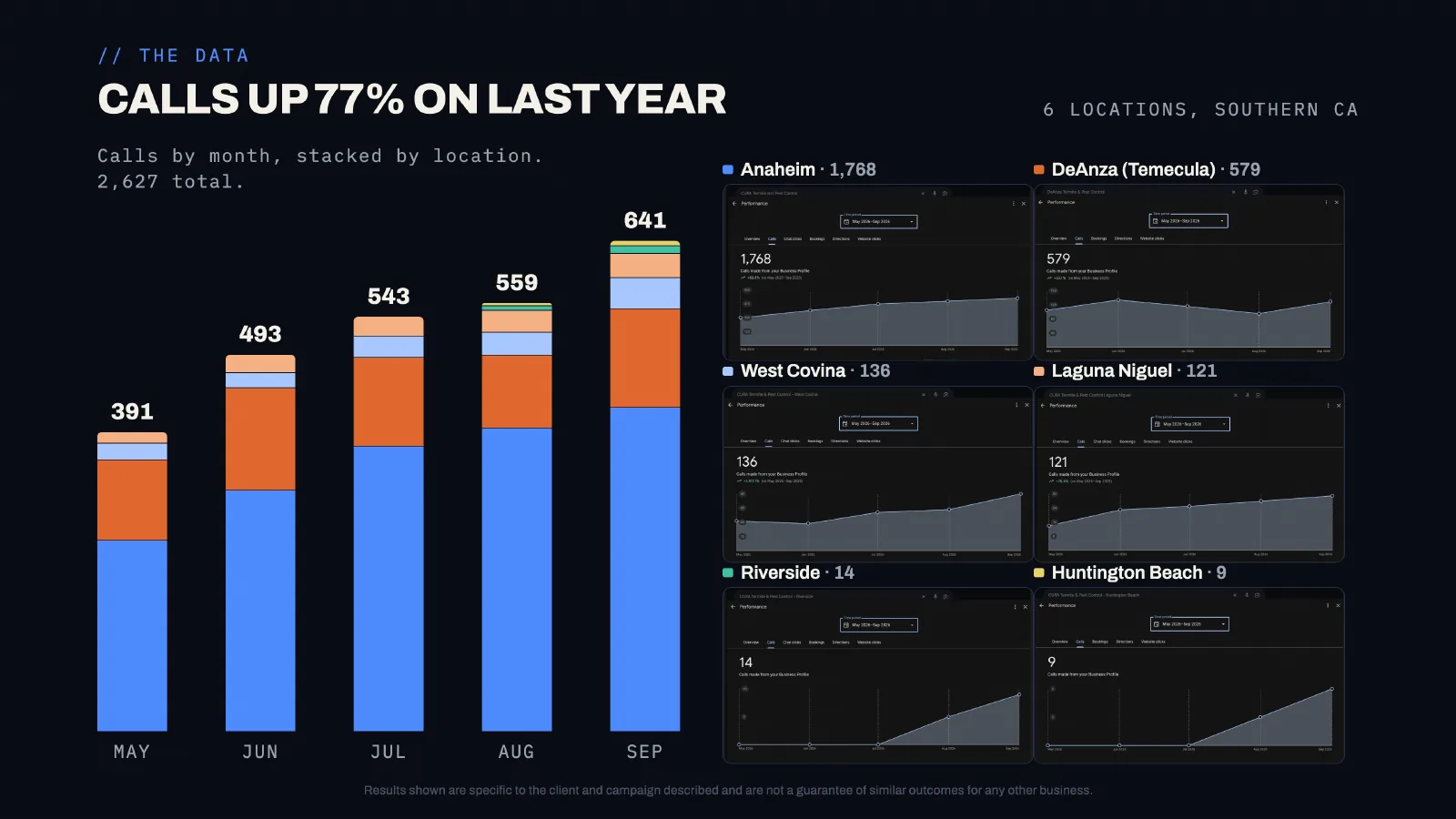
Compare each month with the same month last year. Pest calls follow the season, so a dip in fall isn't a ranking problem by itself. A drop compared with last fall might be.
How to rank a pest control company on Google Maps, step by step
- Audit the profile and the competition. Run a grid for your top keywords and look at the three companies above you: categories, review counts, review dates, photos and the pages they link to.
- Fix categories, services and the business name. "Pest control service" as primary for most companies, accurate secondaries, every pest as a service, your real name.
- Link each profile to a matching location page. Same name, address and phone, the city named, services and local reviews on the page.
- Start a weekly review habit. A text with the direct link after every completed service. Reply to every review.
- Clean up citations. Fix old addresses, duplicates and mismatched phone numbers across major directories.
- Build links and city pages. Associations, real estate and property management partners, local news, and city pages for nearby towns.
- Add real locations where the revenue justifies it. A staffed office and a new profile in each market you want to own.
- Track grids and calls monthly. Same grid settings every time, and calls compared with the same month last year.
Common Google Maps mistakes pest control companies make
Most map problems come from shortcuts that risk a suspension, or from measuring rank only from your own office:
- Keywords in the business name, which risks suspension.
- Profiles at virtual offices or mailbox addresses.
- Only "pest control" as a service, with no pests listed.
- Linking every profile to the home page when there are several offices.
- A burst of reviews followed by months of nothing.
- Telling customers what to write, or offering discounts for reviews.
- Measuring rank from the office address only.
- Expecting one profile to rank across several counties.
- Spending time on Q&A, which Google removed from Maps in December 2025.
Google Maps for pest control: FAQs
How do I get my pest control company on the Google Maps map pack?
Verify a Google Business Profile at a real address, choose "Pest control service" as the primary category, list every pest you treat as a service, link it to a matching page on your site, and build a steady flow of reviews. Then track your rank on a grid across your service area.
Why does my pest control company rank in one town but not the next?
Distance. Google ranks profiles mainly by relevance, distance and prominence, so you rank best near your address. More reviews and links stretch your reach a little. A real, staffed office with its own profile is how you rank in a town farther away.
Does the service area setting help me rank in more cities?
Not much. It tells customers where you work, but it doesn't make a profile rank far from its address. Use city pages on your website to compete in the regular results in those towns.
How many reviews do I need to rank on Google Maps?
More than the companies ranking above you, and arriving more steadily. Check the top three in your area. Our best-performing clients get 25 new reviews/month.
Can I use a virtual office for a second Google Business Profile?
No. Google requires a real location where you do business. Virtual offices and mailbox addresses get profiles suspended.
How long does it take to rank on Google Maps?
Profile fixes can move rankings within weeks. Cura's Temecula profile moved from 7.08 to 5.09 for "termite inspection" in about a month. Reaching #1 across a city usually takes months of steady reviews and links.
What is a Google Maps ranking grid?
A grid checks your map position for one keyword from many points across your service area. It shows where you're in the top three and where you disappear, which a single rank check from your office can't.
Should I still use Google Business Profile Q&A?
No. Google removed Q&A from Maps in December 2025. Put those answers on your website's pest pages and FAQs instead.
Maps is one part of the system. See how it fits with SEO, ads and AI search in our pest control marketing guide.