
Pest control SEO means ranking in two places: the Google map pack, which runs on your Google Business Profile, and the regular results below it, which run on your website. To win both, you need a fully built profile for each real office, a page for every pest you treat, a page for every town you serve, a steady stream of reviews, and links and listings that confirm who you are. Title tags should name the county or city, not the state. Measure it in calls and new recurring customers, not traffic. Map rankings can move within weeks. Page rankings usually take a few months.
Almost every pest control job starts with a search. Someone finds droppings under the sink, a line of ants on the counter or wings on the windowsill, and they type "exterminator near me," "termite inspection [town]" or "mice in walls." The company that shows up first, with recent reviews and a page that answers their question, usually gets the call. If that call turns into a quarterly plan, it's worth years of revenue.
This guide covers how we do SEO for pest control companies at Stryker Digital, and what we've seen work across eight pest control clients in 2026. Together they got about 7,400 calls from Google between May and September. You'll see the keyword research, the page structure, the on-page details, links, technical setup, seasonal timing and how to measure it, plus real rankings for searches like "termite inspection," "rodent removal" and "pest control services."
What is pest control SEO?
Pest control SEO is the work that makes your company show up in Google, unpaid, when people in your service area search for pest control, a specific pest or a specific service. For a local service business there are two kinds of unpaid results, and they work differently.
| The map pack (local results) | Regular results (organic) | |
|---|---|---|
| What ranks | Your Google Business Profile | Pages on your website |
| Where it shows | The map and three listings near the top, and Google Maps itself | The blue links below the map |
| What Google weighs | Relevance, distance and prominence (Google's own explanation) | Relevance of the page, quality and helpfulness, links and site trust |
| Biggest levers | Categories, services, real address, reviews, photos, website link quality | Pest and city pages, title tags, internal links, backlinks, speed |
| How fast it moves | Often weeks after the profile is fixed | Usually a few months |
The two are connected. The website your profile links to is part of how Google judges the profile, and a strong profile sends people to your site. A company with a great profile and a weak site usually stalls around positions four to eight on the map. A company with a great site and no real profile misses the map entirely, and the map is where most "near me" calls happen.
This page focuses on the website and organic side, plus the parts of the profile that connect to it. For the profile itself, see our pest control Google Business Profile guide, and for the map rankings, how to rank on Google Maps.
Why it's so local: in 2025 there were 16,565 pest control firms in the U.S., and 81.4% had only one or two locations, according to Specialty Consultants data reported by the National Pest Management Association (as cited by Thryv). Most of your competition is a handful of companies fighting for the same towns, which is why winning your own map and your own pest-plus-town searches matters more than national rankings.
How do people search for pest control?
Pest searches fall into a few clear groups, and each group needs a different kind of page. The mistake most pest control websites make is having one "Services" page try to cover all of them.
| Search type | Examples | What they need | The page that wins |
|---|---|---|---|
| Urgent, general | exterminator near me, pest control [town] | Someone credible, nearby, today | Your Google profile and a city page |
| Urgent, specific pest | mice in walls, wasp nest removal, bed bug exterminator | Proof you handle that pest | A page for that pest |
| Inspection | termite inspection [town], WDI inspection for home sale | A date, a price range, a report | A termite inspection page, often per city |
| Recurring service | quarterly pest control, pest control plans, mosquito service | What's included and how often | A plans page that explains each visit |
| Cost | how much is pest control, termite treatment cost | A straight answer | A cost page with honest ranges and what drives them |
| Identification | what do termite droppings look like, small black bugs in bathroom | To know what they have | An ID guide that links to the service page |
| Commercial | restaurant pest control, property management pest control | Reporting, response times, recurring service | A commercial page per sector you serve |
Most revenue comes from the first four rows. The identification and cost pages bring in people earlier, earn links and give AI assistants clear answers to quote. They're worth building after the money pages are done, not before.
How do you do keyword research for pest control?
Pest control keywords are built from three parts: a pest or service, an intent word, and a place. Once you see that pattern, the keyword list mostly writes itself, and the hard part becomes deciding which combinations deserve their own page.
| Part | Examples |
|---|---|
| General service | pest control, exterminator, pest control company, pest control services |
| Pest | termite, ant, mice, rat, rodent, roach, bed bug, mosquito, wasp, spider, flea, tick, wildlife |
| Service | inspection, treatment, removal, control, exclusion, fumigation, prevention |
| Place | city, neighborhood, county, "near me" |
To build the list, start with your own data. Your Google Search Console account shows the searches that already bring you clicks and impressions, and your call notes show what people ask for. Then type your main services into Google and read the autocomplete suggestions and the "People also ask" questions. A keyword tool like Semrush or Ahrefs adds estimated search volumes and shows what your competitors rank for.
Two things make pest control keyword research different from most trades:
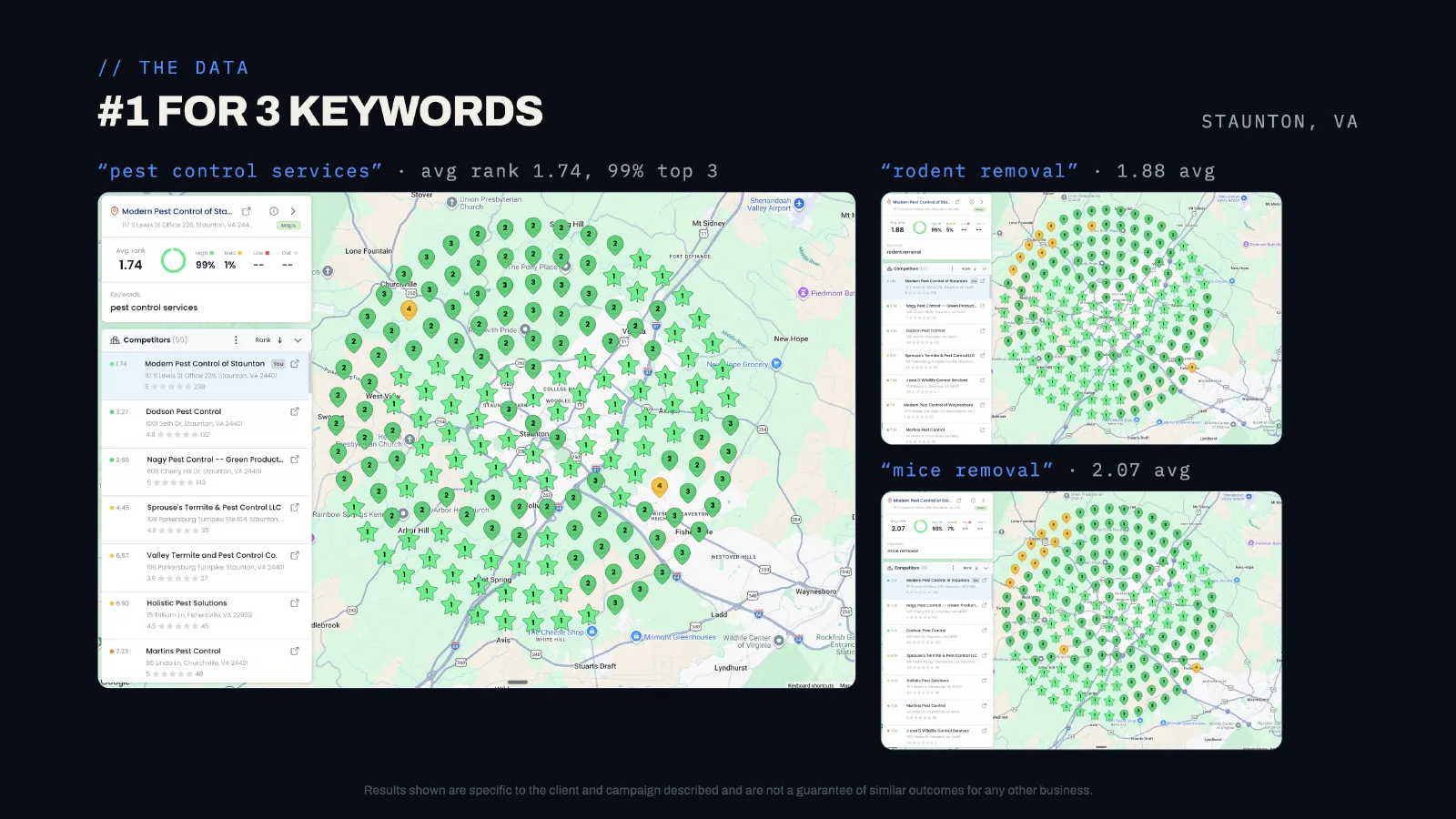
- The pest is the keyword. People search "rodent removal" and "mice removal" as separate searches, and Google treats them as separate topics. Modern Pest Control in Staunton, Virginia ranks #1 on the map for "rodent removal" (1.88 average rank) and "mice removal" (2.07) as well as "pest control services" (1.74). Those are three different groups of callers.
- Termite searches are their own world. "Termite inspection," "termite control" and "termite treatment" are high-value searches and often come from home sales, where the buyer's lender or agent wants a report. Bad Termite ranks #1 for "termite inspection" across Granada Hills, and State Termite & Pest Solutions averages 2.38 for "termite control North Canton." A general pest page won't win those.
Search volume per city is small, but it adds up. In the audit video further down, Bodhi shows that "pest control anaheim" gets about 1,300 searches a month in Semrush, and Cura Termite & Pest Control ranks #1 for it. Across all their city searches, Cura gets about 5,000 website visitors a month. That's the difference between one page that says "we serve Orange County" and a page for every city you actually service.
What pages should a pest control website have?
A pest control website needs a page for each pest or service you sell, a page for each city or area you serve, and a few supporting pages that build trust. Here's the structure we build, and why each part exists.
| Page type | Example URL | Targets | Must include |
|---|---|---|---|
| Home page | / | Your brand, "pest control [main city]" | Main city, license, reviews, every service linked |
| Pest or service pages | /termite-control, /rodent-control, /mosquito-control | "[pest] control," "[pest] exterminator" | Signs, treatment, visits, prep, safety, plan options |
| City pages | /pest-control-anaheim | "pest control [city]," "exterminator [city]" | Local pests, neighborhoods, office, reviews from that city |
| City plus pest pages | /termite-inspection-anaheim | "termite inspection [city]" | Only where the search exists and you have real local detail |
| Plans page | /pest-control-plans | "quarterly pest control," "pest control plans" | What each visit includes, which pests are covered, how to cancel |
| Commercial pages | /commercial-pest-control | "commercial pest control [city]" | Sectors served, reporting, response times |
| Location (office) pages | /locations/riverside | "pest control [city]" near each office | Address, hours, map, the matching Google profile |
| Trust pages | /about, /reviews, /licenses | Brand searches, AI assistants | License numbers, owner, team, real photos |
Cura's site is a good example of the location pattern, with pages like /locations/orange-county-ca/anaheim for each city it serves. Each page ties to the area around one of its six offices.
How do you avoid thin or duplicate city pages?
Google's spam policies name "doorway" pages as a problem: many pages built only to rank for similar searches, each one sending people to the same place. A set of city pages that are identical except for the city name fits that description. The fix is to give each page something only it can say:
- The pests that are actually common there. A coastal city and a desert city a short drive away often deal with different termites, ants and rodents.
- Neighborhoods, landmarks and housing types you service (older homes with crawl spaces, new builds, apartments).
- Reviews from customers in that city, shown on the page and linked to the Google profile they came from.
- Photos from jobs in that area, with plain descriptions.
- Which office and technicians cover it, and typical response times.
- Local rules where they matter, such as a state's termite inspection report for home sales.
If you can't write at least a few hundred useful words about a town that no other page on your site would say, don't build the page yet. Cover it on the nearest city page instead.

What a real pest control SEO audit finds
In the video above, Bodhi reviews the site of Capture Pest Control, a company in Bergen County, New Jersey doing about $107K a month. The issues are typical of the pest control sites we audit:
- The title tag targeted the state. The home page title said "New Jersey." Nobody searches for an exterminator across a whole state. People search their town or county. The fix was to target Bergen County and its towns.
- Pages weren't localized. Service pages talked about pests in general, not about Bergen County homes, so they had no reason to rank for local searches.
- Reviews weren't connected. The site had a reviews section that didn't link to the Google profile. Linking it lets visitors check the reviews are real and sends more people to the profile.
- No profiles in nearby counties. The company served Essex and Passaic counties but had no Google profile there. Where a company has a real, staffed office, a second profile can rank around that address.
- The site looked like 2015. An older front end makes a strong company look small. The audit recommended a modern build with clear calls, reviews and service areas.
- Competitors with weaker businesses outranked it, because they had done the basics above.
None of these are hard fixes. They're the kind of thing that gets missed when a website was built once and never revisited.
What makes a pest service page rank and convert?
A pest page ranks when it answers everything a worried homeowner wants to know about that pest in your area, better than the other pages Google could show. It converts when it makes calling you feel safe and easy. Government guidance tells homeowners exactly what to ask a pest control company. The EPA tells them to check licenses and references and not to choose on price alone, and the National Pesticide Information Center adds insurance, Integrated Pest Management, experience with the specific pest and written estimates. Your page should answer those questions before they're asked.
- A direct answer at the top. One short paragraph: what you do for this pest, where, and how fast you can come out.
- Signs and identification. What the customer is likely seeing, with your own photos where you have them. Avoid graphic stock images.
- Your treatment process. Inspection, treatment, follow-up. How many visits it usually takes.
- How to prepare. What to move, how long to keep kids and pets out, what to expect afterward.
- Safety. Which kinds of products you use, low-toxicity options and how you protect kids and pets. Keep claims within what product labels and your state allow.
- Your license and insurance. License number and the categories it covers. Homeowners are told to check them.
- Plans and follow-up. Whether this pest is covered by your recurring plan and what happens if it comes back.
- Reviews that mention this pest. Real ones, linked to your Google profile.
- The cities you treat this pest in, linked to the city pages.
- FAQs taken from real calls.
- A clear way to call or book, with a tap-to-call button that stays visible on mobile.
A note on pricing: you don't have to list prices, but cost questions are some of the most searched pest topics. A page that explains what drives the price (size of home, type of pest, how bad it is, one-time or recurring) answers the question honestly and keeps people on your site rather than a lead-gen directory.
How should a pest control company write title tags?
The title tag is the blue headline in Google's results and one of the clearest signals of what a page is about. Name the service and the place people actually search, keep it under about 60 characters so it isn't cut off, and put your brand at the end.
| Page | Weak title | Stronger title |
|---|---|---|
| Home | Home | ABC Pest Control | Pest Control in Bergen County, NJ | ABC Pest Control |
| Home | New Jersey's Best Exterminator | Exterminator in Hackensack & Bergen County | ABC |
| Pest page | Termites | Termite Inspection & Treatment in Anaheim | ABC |
| City page | Service Area: Riverside | Pest Control in Riverside, CA | Local Techs | ABC |
| Rodent page | Rodent Services | Rodent & Mice Removal in Staunton, VA | ABC |
The same rule applies to the H1 heading, the first paragraph and the image alt text: say the service and the place in plain words. Don't repeat the keyword over and over. Google reads normal sentences well, and customers do too.
Meta descriptions don't directly affect rankings, but they're your ad copy in the results. Say what you do, where, and one reason to choose you, in about 150 characters.
Want this built for your pest control company? Book a free growth call and we'll review your Google profiles, site and rankings.
Book a Growth CallHow does your Google Business Profile connect to SEO?
Your Google Business Profile ranks in the map pack, and your website helps it rank. Google says prominence is based partly on information from across the web, including links and articles, and that your position in regular results is a factor too. In practice, the page your profile links to matters a lot.
- Link each profile to its own location page, not the home page, when you have more than one office. The page should name that city, show the same address and phone number, and list the services offered there.
- Match the services on the profile to pages on the site. If the profile lists termite inspection, rodent exclusion and mosquito service, each one should have a page.
- Keep your name, address and phone the same everywhere: profile, website, Yelp, BBB, your state association listing and any other directories.
- Link to your Google reviews from the site, and show reviews on the matching pages.
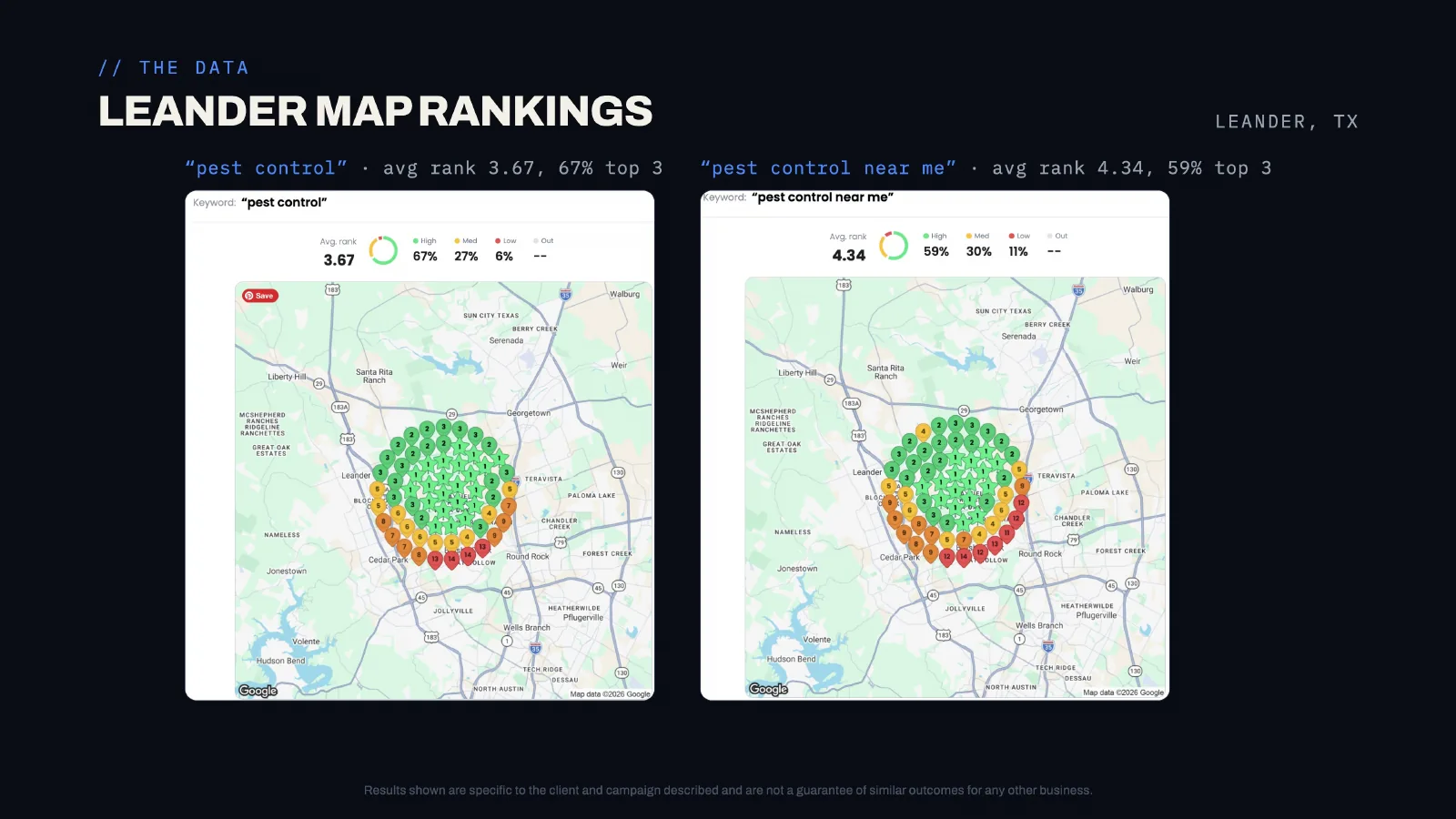
Additional profiles can be the single biggest jump in calls for a growing company, as long as each one is a real, staffed location. When we recommended a second profile for Surge Pest Control in Leander, Texas, it produced 140 calls from May to September 2026, on top of 275 from the original Georgetown profile. State Termite & Pest Solutions' new Hartville, Ohio profile added 22 calls in its first three months while it built reviews. Never use a virtual office or a mailbox address, because those profiles get suspended.
How do reviews help pest control SEO?
Google says directly that "more reviews and positive ratings can help your business's local ranking" (Google Business Profile Help). Reviews also decide which company a homeowner calls. When customers mention the pest and the town in their own words, the review also tells Google and AI assistants what you do and where.
What works for pest control:
- Ask at the follow-up visit or once the problem is gone. That's when the customer is happiest. For recurring plans, the first service and the first follow-up are good moments.
- Make it a habit, not a campaign. Our best-performing clients get 25 new reviews/month. A steady flow beats a burst followed by silence.
- Send the direct link by text right after the visit, under the technician's name if you can.
- Don't tell customers what to write, and never offer a discount for a review. Google's policy on incentivized reviews prohibits it.
- Reply to every review. Thank people by name. For a complaint, give a short, calm public reply and fix it offline.
Seth Fenn at Cura has about 1,500 reviews across four of his profiles, rated 4.9 and 5.0. He uses a review tool that sends unhappy ratings to him first so he can call the customer and fix the problem. Fixing the problem is the point. You can't screen who's allowed to leave a review, but you can make sure an unhappy customer hears from the owner.
How do pest control companies get backlinks and citations?
Backlinks (links from other sites to yours) and citations (listings of your name, address and phone) tell Google your business is real and well known. Pest control companies have more natural link sources than most trades because their work touches real estate, property management and public health.
| Source | How to get it | Why it works for pest control |
|---|---|---|
| Core citations | Google, Bing, Apple Maps, Yelp, BBB, Angi, Nextdoor, Facebook | Confirms name, address and phone. Inconsistent data confuses Google |
| State pest control association | Join and fill in the member directory | A relevant, trusted industry link |
| Real estate agents and home inspectors | Offer fast termite inspection reports for home sales and ask to be listed on their vendor pages | Termite reports are often part of buying a home, so it's a real referral relationship |
| Property managers and HOAs | Recurring service plus a listing on their preferred vendors page | Local, relevant and tied to recurring work |
| Local news and community | Seasonal tips (termite swarms, mosquito season, mice in fall), sponsorships | Local links from sites Google trusts |
| Suppliers and manufacturers | Certified applicator or dealer listings | Confirms the services you list |
| Chamber of commerce | Membership listing | Local and easy to get |
Skip paid link packages and lists of hundreds of directories nobody uses. They don't help, and some can hurt. Bodhi covers the free listings every pest control company should claim in 3 Free Citations Every Pest Control Company Needs.
Seth's experience shows why links matter. His previous agency only wrote blog posts. With us, Cura's domain authority (a third-party score of link strength) went from 8 to 24, and his profiles moved from pages two and three to the top of the map pack.

Cura Termite & Pest Control (Seth Fenn, six offices across Orange County, Los Angeles County and the Inland Empire). 2,627 calls from Google, May to September 2026, up 77% on the year before. Anaheim alone produced 1,768. Average map rank is 1.09 in West Covina, 1.63 in Torrance and 2.88 in Anaheim. "We were on the second and third page. Now I'm in the map pack number one, and I'm on the first page."
What technical SEO does a pest control site need?
Most pest control customers search on their phones, often while looking at the problem. The site has to load fast, work with one thumb and make calling easy. The technical basics:
- Speed. Compress images, use modern formats like WebP, and cut heavy chat widgets and sliders. Check pages in PageSpeed Insights.
- Mobile layout. No sideways scrolling, buttons big enough to tap, and a phone number that's visible without hunting.
- HTTPS on every page, so forms don't show a "Not secure" warning.
- A sitemap submitted in Google Search Console, and a regular check of the indexing report for pages Google has skipped.
- Clean URLs and internal links. Pest pages link to city pages and back. Every page is reachable within a few clicks of the home page.
- Structured data. Schema.org has no specific pest control type, so use LocalBusiness markup (or HomeAndConstructionBusiness) with your real name, address, phone, hours and service area, plus FAQ and review markup only where it matches what's on the page.
- One page per topic. Two pages both targeting "termite control" compete with each other. Merge them and redirect the weaker one.
What content should a pest control company publish?
Once the service and city pages are strong, content can bring in searches earlier in the customer's journey. Seth's old agency wrote blog posts and nothing else, and it didn't move his rankings. Content works when it supports the money pages rather than replacing them.
| Content type | Example | Links to |
|---|---|---|
| Identification guides | Termite droppings vs. ant droppings, with your own photos | The pest page and inspection page |
| Seasonal guides | When termites swarm in [region] and what to do | Termite inspection and city pages |
| Cost explainers | What affects the cost of pest control in [city] | Plans page and contact |
| Prevention | How to keep mice out before winter | Rodent exclusion page |
| Honest DIY guides | When store-bought ant bait works and when it doesn't | Ant control page |
| Local proof | A real job write-up from a neighborhood, with permission | That city page |
Write it the way a good technician explains things at the door: plain words, what you saw, what you did, and what the homeowner should watch for. That's also the kind of first-hand detail Google's helpful content guidance asks for.
How should pest control SEO change by season?
Pages take time to rank, so publish and update them before the season, not during it. Use last year's call data and Search Console as your real calendar, because timing differs by region and species. As a general pattern, subterranean termites swarm on warm days after rain, mostly in spring, though the UC Statewide IPM Program notes some species fly in fall, and NC State Extension says native species in North Carolina swarm from late winter into September or October. Mice tend to move indoors as it gets colder in fall.
| When | SEO work |
|---|---|
| 6–8 weeks before termite season | Refresh termite inspection and treatment pages, add new reviews and photos, update city pages |
| Before summer | Mosquito, ant and stinging insect pages, plan pages for summer service |
| Late summer | Rodent exclusion and "mice in house" pages, fall prevention content |
| Winter | Build new city pages and links while it's quiet, so they're ranking by spring |
Use Google Business Profile posts to highlight the season's service, and line up review requests for the busy months, when you have the most happy customers.
How does SEO help with AI search?
AI Overviews, ChatGPT, Gemini and Perplexity increasingly answer "best pest control in [town]" and "what do I do about termites" before anyone clicks. They tend to pull from the same signals good SEO builds: consistent listings, strong reviews that describe the work, clear answers on your own pages and mentions on other trusted sites. Short direct answers at the top of each page, real FAQs and accurate business details make your site easier to quote. King Pest Solutions tracks its AI search visibility alongside its #1 map ranking for "pest control" in Grand Junction. Nobody can promise an AI tool will recommend you, but a business with weak SEO rarely shows up there. More in our AI search guide for pest control.
What results does pest control SEO produce?
Here's what pest control SEO and map work produced for our clients in 2026. Calls are from Google, reported in each client's dashboard, May to September unless noted.
| Company | Market | Calls from Google | Example ranking |
|---|---|---|---|
| Cura Termite & Pest Control | Orange County, LA County and Inland Empire, CA | 2,627 (+77% YoY) | 1.09 average map rank in West Covina |
| King Pest Solutions | Grand Junction & Colorado Springs, CO | 1,789 (+47% YoY) | #1 for "pest control" in Grand Junction |
| Scout Pest Control | Tanner & Huntsville, AL | 1,438 | 2.95 for "exterminator near me" in Tanner |
| MMPC Pest Solutions | Long Island City, NY | 744 | #1 for "pest control long island," 88% of grid top 3 |
| Surge Pest Control | Georgetown & Leander, TX | 415 | 2.89 for "exterminator" in Georgetown |
| State Termite & Pest Solutions | North Canton & Hartville, OH | 219 (Jun–Aug) | 2.38 for "termite control North Canton" |
| Bad Termite | Granada Hills, CA | 159 | #1 for "termite inspection" |
| Modern Pest Control | Staunton, VA | Not reported | #1 for "pest control services," "rodent removal" and "mice removal" |
See all eight in our pest control case studies.
How long does pest control SEO take?
Map rankings can move within weeks once the profile is fixed. Cura's DeAnza location in Temecula went from an average rank of 7.08 to 5.09 for "termite inspection" in about a month. New city and pest pages usually take a few months to rank, longer in big metros with established competitors. Links and reviews keep compounding after that, which is why companies that stay consistent for a year usually see their best months in the second season, not the first.
What slows it down: a site with technical problems that need fixing first, a profile at a questionable address, or a market where competitors have years of reviews. What speeds it up: a real office in each area, a steady flow of reviews, and fixing the basics before chasing advanced tactics.
How do you measure pest control SEO?
Rankings are a means, not the goal. Measure SEO by what it does for the business.
| Metric | Where to find it | Why it matters |
|---|---|---|
| Calls from Google Business Profile | Profile performance report, call tracking | The most direct measure of map results |
| Organic calls and forms | Call tracking with a separate number for organic, Google Analytics events | What the website itself produces |
| Map grid rankings | A grid tracking tool, by keyword and area | Shows where you rank across the whole service area, not just at your office |
| Search Console clicks and impressions | Google Search Console, by page and query | Which pages are gaining and which searches you're close on |
| New recurring customers by source | Your CRM, with lead source required | The number that pays the bills |
Compare each month with the same month last year, because pest demand is seasonal. A drop from July to October may be normal. A drop from last October to this October isn't.
Should you do pest control SEO yourself or hire an agency?
You can do a lot of this yourself if you serve one area and have a few hours a week: build out the profile, ask for reviews, fix title tags and write a page for each pest. Hiring makes more sense once you have several locations, a competitive metro, or no time, because the work that moves results (city pages with real local detail, links, multiple profiles, tracking) adds up fast. Whoever does it, ask for calls and new customers by source every month, not just rankings. Here's how to choose a pest control marketing agency.
Pest control SEO in eight steps
- Set up tracking first. Search Console, Google Analytics with call and form events, call tracking with separate numbers by source, and a required lead source field in your CRM.
- Fix every Google Business Profile. Correct categories, every service, real address and hours, photos, and a link to the matching location page.
- Build a keyword map. List every pest and service you sell and every town you serve, and decide which combinations deserve a page.
- Build pest and service pages. One per pest or service, with signs, treatment, prep, safety, license and reviews.
- Build city pages with real local detail. Local pests, neighborhoods, office and reviews, never copy-and-paste.
- Fix titles, headings and internal links. Service plus city in each title, pest pages linked to city pages and back.
- Build reviews, citations and links. A weekly review habit, consistent listings, and links from associations, real estate partners and local sites.
- Refresh before each season and measure monthly. Update seasonal pages six to eight weeks early and compare calls with the same month last year.
Common pest control SEO mistakes
The most common is a home page title aimed at the state instead of the towns you serve:
- Targeting the state in the title tag instead of the city or county.
- One "Services" page for every pest.
- City pages that differ only by the city name.
- Keyword-stuffed business names on the Google profile, which can get the profile suspended.
- Profiles at virtual offices or mailbox addresses.
- A blog-only strategy with no pest or city pages behind it.
- Reviews shown on the site but not linked to Google.
- Measuring traffic and rankings instead of calls and new recurring customers.
- Starting seasonal pages when the season starts.
Pest control SEO FAQs
What is pest control SEO?
It's the work that gets a pest control company into Google's unpaid results: the map pack, through your Google Business Profile, and the regular results, through your website's pest, service and city pages. It covers keywords, page structure, reviews, links, listings and technical setup.
How long does pest control SEO take to work?
Map rankings can move within weeks after a profile is fixed. Cura's Temecula profile went from 7.08 to 5.09 for "termite inspection" in about a month. New pages usually take a few months, longer in competitive metros.
What keywords should a pest control company target?
General terms like "pest control [city]" and "exterminator near me," plus every pest and service you sell, such as "termite inspection [city]," "rodent removal" and "mosquito control." Use Search Console, Google's autocomplete and a keyword tool to find the real searches in your area.
Do I need a separate page for every city?
Only for cities you actually serve and can write something useful and different about: local pests, neighborhoods, the office that covers it and reviews from there. Pages that only swap the city name look like doorway pages to Google.
Should my title tag say my state or my city?
Your city or county. People search for an exterminator in their town, not across a state. Changing a state-wide title to the county and main cities is one of the fixes from Bodhi's Capture Pest Control audit.
Do blog posts help pest control SEO?
Only as support. Seth Fenn's previous agency only wrote blogs and his profiles stayed on pages two and three. Build pest, service and city pages first, then add identification, seasonal and cost content that links to them.
Is there schema markup for pest control companies?
Schema.org has no pest control type, so use LocalBusiness or HomeAndConstructionBusiness with your real name, address, phone, hours and service area. Add FAQ markup only where the questions appear on the page.
How do I know if my SEO is working?
Track calls from your Google profiles, organic calls and forms, map grid rankings and Search Console clicks, and above all new recurring customers by source in your CRM. Compare each month with the same month last year.
For the full picture of how SEO fits with ads, Local Services Ads and the rest, go back to our pest control marketing guide.