
To get more Google reviews for a pest control company, ask every customer after every completed service, make it easy with your direct review link or QR code, and text the link the same day to anyone who'd rather do it later. Ask everyone, not just happy customers, never offer anything in exchange, and never suggest what to write. Keep the pace steady so reviews arrive with your normal work instead of in bursts, and reply to every review. Reviews sit on top of a fully built Google Business Profile: the right primary category, every pest listed as a service, accurate service areas and hours, real photos, and a link to a matching page on your site.
When a homeowner finds ants in the kitchen and searches Google, they usually see three pest control companies on the map, each with a star rating, a review count and a few lines from recent reviews. They call one. Your Google Business Profile and your reviews decide a lot of those calls, and they also feed how high you rank on the map in the first place.
Our eight pest control clients got about 7,400 calls from their Google profiles and Google search between May and September 2026. This guide covers how we build those profiles, how to get Google reviews steadily without breaking Google's rules, how to reply, and what to do when reviews disappear or a profile gets suspended.
Why do Google reviews matter so much for pest control?
Google's own local ranking help page says review count and rating factor into local ranking, and that more reviews and positive ratings can improve a business's ranking. Reviews are part of what Google calls prominence, how well known a business is. Of everything that goes into local ranking, they're the part you control most directly. Reviews also reach further than the map:
- The call decision. A homeowner comparing three companies looks at the rating, the count and how recent the last review is. A profile with no review in two months looks like a company that's slowing down.
- Local Services Ads. Your rating and review count show on the ad, and Google uses reviews when deciding how ads rank. More in our Google Ads and LSA guide.
- AI answers. Google's AI Overviews and other AI tools describe local companies using what's written about them, including reviews. More in AI search for pest control.
- Your own website. Real reviews on your service pages, linked back to Google, help visitors trust the page.
Pest control is a trust purchase. A technician is going inside the house, around kids and pets, with products the homeowner can't evaluate. The EPA's tips for choosing a pest control service tell homeowners to ask neighbors and friends about companies they've used. For most people today, that's what reading reviews is.
How should a pest control company set up its Google Business Profile?
Reviews do the most good on a profile that's complete and accurate. Before you push for reviews, check every field. This is the setup we use for pest control clients:
| Field | What to do | Common mistake |
|---|---|---|
| Business name | Your real name, exactly as it appears on your signage and paperwork | Adding keywords like "Best Exterminator Dallas," which breaks Google's guidelines and risks a suspension |
| Primary category | "Pest control service" for most companies. Search the category list in your profile to see the exact names available | Picking a narrow category that doesn't describe most of your work |
| Secondary categories | Only for real lines of work you offer, such as termite or wildlife work, if a matching category exists | Adding every category that sounds close |
| Services | Every pest and service you handle: ants, roaches, rodents, termites, bed bugs, mosquitoes, wildlife, inspections, commercial service | Leaving the services list empty, so Google has less to match |
| Service areas | The cities and ZIP codes you actually service | Listing far-off cities, which doesn't help you rank there |
| Address | Shown if customers visit, hidden if they don't | Listing a virtual office or mailbox, which gets profiles suspended |
| Hours | Real hours, plus special hours for holidays | Listing 24/7 when nobody answers at night |
| Phone | A local number answered by your team | Changing numbers often, or using a number that goes to voicemail |
| Website link | The matching location page, with a UTM tag so you can track visits | Linking every profile to the homepage |
| Description | Plain language: who you are, what you treat, where you work, how long you've been in business, licensing | Keyword stuffing or promotional claims |
| Photos | Real trucks, technicians, office, signage, and work like exclusion repairs | Stock photos, or nothing new for a year |
Google's guidelines for representing your business govern most of this: the real name, a real location, and accurate categories. Breaking them is the main cause of suspended profiles. For how ranking works across your service area, see our Google Maps guide for pest control.
How does verification work for a pest control profile?
New profiles, and existing ones after big changes like a new address or name, have to be verified. Google picks the method, and for many service businesses it asks for a short, unedited video. In our experience, the video should show:
- The outside of the location, with permanent signage and the street or nearby landmarks so Google can match the address.
- Your branded truck or equipment, if you have one.
- Proof that you manage the business, such as unlocking the office or showing business paperwork or tools.
Verification can take a few days or longer. Don't make big edits to the name, address or categories while it's pending, and don't create a second profile for the same location to get around it.
What do Google's review rules allow?
Asking for reviews is allowed. Google's Maps user-generated content policy says businesses may "solicit or encourage the posting of content that does represent a genuine experience, without offering incentives to do so or attempting to influence the rating or the contents of the review." Most of the rest of that section is a list of what businesses can't do:
| Google doesn't allow businesses to | What that means for a pest control company |
|---|---|
| Offer incentives "such as payment, discounts, free goods and/or services" for a review | No discount on the next service, no free mosquito treatment, no gift card drawing for reviewers |
| "Discourage or prohibit negative reviews, or selectively solicit positive reviews from customers" | Ask every customer, including the one whose callback ran late. Don't screen customers with a survey and send only the happy ones to Google |
| "Require or pressure users to leave ratings or write reviews while on the premises" | Make it an offer, never a condition, and don't stand over someone while they type |
| "Request that specific content be included" | Don't suggest words, pests, your town, or a technician's name. Let customers write in their own words |
| Request "that staff solicit a certain number of reviews" | No review quotas for each technician |
| Post or request reviews based on a conflict of interest, such as "current or former employment" or family relationships | No reviews from employees, relatives or friends who weren't real customers |
| Offer incentives in exchange for "revision or removal of a negative review" | Fix problems because it's right, never as a trade for changing a review |
The policy also flags "unusual volumes or patterns of review contributions" as a sign of rating manipulation. That's the rule behind most disappearing reviews, covered below.
The selective-ask rule catches a lot of review software. A common setup sends a "How did we do?" survey first, then sends only 4- and 5-star responses to Google and routes everyone else to a private form. That's review gating, and Google's policy bans it. Use your survey to find problems and fix them, but send the review link to everyone.
Fake reviews are a legal problem too
The FTC's final rule banning fake reviews and testimonials took effect in October 2024. It bans fake reviews, including AI-generated ones, buying positive or negative reviews, undisclosed insider reviews from officers and managers, and suppressing negative reviews through threats. Civil penalties can apply to knowing violations. Never buy reviews, write them yourself, or have staff and family post them.
How do you get more Google reviews for pest control?
The method is simple. The hard part is doing it after every service, every week.
1. Ask in person, right after the service
The technician is the one at the house, and the best time to ask is right after the work is done and explained. Make sure the customer is happy with the service and fix anything that's wrong before you leave. That's about the service, not choosing who gets asked. Then ask plainly whether they'd be willing to leave a Google review, and show them how with a QR code on a card or on the technician's phone. Keep it an offer. If they'd rather do it later, that's fine.
2. Get your review link and QR code for each profile
Google gives every profile its own review link and QR code. According to Google's tips to get more reviews, you can find them in your Business Profile under the option to ask for reviews, and share them by text, email, receipts and other channels. If you have several locations, label every link and QR code by office so no technician hands out another office's code.
3. Text the link the same day
Text the link to customers who weren't home and to anyone who'd rather do it later. Keep it short and neutral. Don't mention stars, don't ask how happy they were, and don't tell them what to write. Something like:
Hi Maria, thanks for having us out today. If you have a minute, we'd appreciate a Google review: [link]
If your CRM can send a text when a service is marked complete, set it up once and let it run. Add the link to invoices and service-completion emails too.
4. Ask recurring customers at the right moment
Pest control has a built-in advantage: most of your customers are on recurring plans, so you see them again and again. Many companies ask after the initial service, when the problem is fresh and the customer has just seen results. If a customer didn't review after the first visit, ask once more after a later service, then leave it. Asking every quarter forever annoys people.
5. Keep the pace steady
Steady matters as much as the total. Our best-performing clients get 25 new reviews/month. More important than any number is that reviews arrive every week at the pace of your normal work. A month of nothing followed by a batch of 40 looks like manipulation, and that's when Google removes reviews.
Want this built for your pest control company? Book a free growth call and we'll review your Google profiles, site and rankings.
Book a Growth CallWhat does a review system look like in its first 30 days?
Most pest control companies that struggle with reviews don't need new software. They need a routine that happens without anyone remembering it. Here's a 30-day rollout:
| When | What happens |
|---|---|
| Days 1–3 | Pull the review link and QR code for each profile, label them by office, print cards, and load them on every technician's phone |
| Days 3–7 | A 15-minute team meeting: why reviews matter, the plain ask, and the rules (everyone gets asked, no incentives, no suggested wording, no quotas) |
| Week 2 | Turn on the same-day text from your CRM when a service is completed, and add the link to invoices |
| Weeks 2–4 | Reply to every new review within two business days. Call every low-rated reviewer |
| Day 30 | Compare new reviews per profile with the month before, and check that the newest location is getting its share |
After that, the only job is keeping it running, especially in peak season, when technicians are busiest and most likely to skip the ask.
Should you use review software?
Once you have more technicians than one person can keep track of, software helps. Most pest control CRMs have review requests built in, and standalone tools connect to your CRM and text customers when a service is completed. Before you turn one on, check how it works:
| Check | Why |
|---|---|
| Does it send the Google link to every customer, or only to those who rate you highly? | Sending only to happy customers is gating, which Google bans |
| Does the message mention stars or suggest what to write? | Google bans influencing the rating or content |
| Does it send each customer to the profile for the office that served them? | A review should reflect a real experience with that location |
| Does it limit how often a customer is asked? | Recurring customers shouldn't get a request after every visit |
| Can you spread sends over time? | Importing your whole list and texting it in one afternoon creates exactly the burst Google flags |
| Does it alert you to new reviews, especially low ones? | So you can reply quickly and follow up with the customer |
That last point is what Seth Fenn at Cura values most. When a low rating comes in, he hears about it right away, so he can "reach out to the customer and handle that situation." He hears about it after the review is posted. He doesn't screen people out before they can post one.

Can you reward technicians for reviews?
A lot of pest control companies pay technicians a bonus for each review that names them. Be careful. Google's policy bans asking staff to get "a certain number of reviews" and bans asking for reviews that identify a staff member, and a per-review bonus usually depends on both. Google removes reviews it decides break the policy.
A safer approach is to reward the behavior, not the count. Track whether every technician offers the review link at every completed service, and reward service quality measures like low callback rates, on-time arrival and customer retention. Good technicians tend to get named in reviews anyway, without being asked.
Why do Google reviews disappear?
Owners ask about this more than anything else. Google's filters remove reviews that look suspicious, sometimes with no explanation. The most common causes we see:
- Bursts. A profile that doubles its review count in a week often loses most of the new ones, even when every customer was real.
- Reviews from the same network or device. Customers reviewing on the office tablet or the office Wi-Fi can look like one person posting from many accounts.
- Employees and family. Google treats these as a conflict of interest.
- Incentives mentioned in a review, such as "they gave me a discount for this review."
- Profile changes. Big edits or a suspension can make reviews temporarily disappear.
Google also says new reviews can be delayed while they're checked, so a review that isn't showing yet may appear in a few days. Have customers review on their own phones, on their own network, at the pace of your normal work.
How should reviews work across several locations?
Each real location has its own profile, and each profile needs its own steady flow of reviews to rank around its own address. The companies with the most calls in our client group run more than one profile: Cura has six, and King Pest Solutions, Scout Pest Control, Surge Pest Control and State Termite each have two. The newest profiles in that group are the ones still climbing, mostly because they have far fewer reviews than the main office.
- Route by the office that did the work. Your CRM knows which branch serviced the customer. The review link should match it.
- Never send one customer to several of your profiles. A review should reflect a real experience with that location.
- Watch the newest profile closely. If a location goes weeks without a review, check whether its technicians are actually asking and whether the link they use is the right one.
- Compare profiles monthly. New reviews, average rating and the date of the last review for each location, side by side.
Can you ask past customers for reviews?
Yes, if they were real customers and you ask them the same way you ask everyone, without incentives. The risk is the burst. Texting 2,000 past customers in one afternoon can bring in dozens of reviews in a few days, and that pattern is exactly what Google's filters look for. If you want to ask past customers, spread it out over weeks, in small daily batches, starting with customers serviced most recently. Better still, ask recurring customers at their next scheduled visit, which spreads the asks out naturally.
Who should reply to reviews, and how fast?
Pick one person per location, usually the office manager or the owner, and give them manager access to the profile. Set a simple standard: every review gets a reply within two business days, and any rating of three stars or lower gets a reply and a phone call the same day if possible. Keep a short internal guide on tone, what not to share (customer details, treatment specifics, anything about the customer's home), and when to escalate to the owner.
Many companies use AI to draft replies now. That's fine as a starting point if a person edits each one to mention what the customer actually said. Fifty identical replies read worse than no reply at all.
How do reviews affect Local Services Ads?
Local Services Ads show your star rating and review count right on the ad, next to the Google Verified badge. Google's page on Local Services Ads rankings lists profile quality, including "your rating, number of reviews, average response time," as a factor, alongside your bid, your responsiveness and the search itself, and says higher-quality profiles "may rank higher and may also pay lower costs per lead." A pest control company with a strong, current review profile has an advantage on both the map and the ad. Lead costs vary by market, service and competition, so judge them against what a new recurring customer is worth to you. See our Google Ads and LSA guide for setup and tracking.
How should a pest control company reply to reviews?
Reply to every review. Replies show prospective customers how you treat people, and they show the reviewer you read what they wrote.
Positive reviews
Thank the customer by name and respond to what they actually said. If they mention the technician who found the rodent entry point behind the dryer, thank them for that. A specific reply reads like a person wrote it. A copied "Thanks for the 5 stars!" on every review reads like nobody did. Don't add promotions or keyword lists to replies.
Negative reviews
A one-star review is a chance to show how your company handles problems, and future customers read those replies closely.
- Reply within a day or two, calmly and without arguing.
- Acknowledge the problem and say what you're doing about it, such as a free re-service for a covered pest under their plan.
- Keep private details out of it. Don't post the customer's address, account history or treatment details.
- Take it offline with a call from a manager.
- Fix the problem because it's the right thing to do. Never offer anything in exchange for changing or removing the review.
Pest control has some unusual complaints. Customers sometimes see more insects right after a treatment, or expect a single visit to clear an infestation that takes several. A reply that explains that calmly, and offers a follow-up visit, helps the reader who's deciding whether to call you.
Fake or policy-violating reviews
If a review isn't from a real customer, or it breaks Google's policy (spam, a competitor, harassment, conflict of interest), report it from your Business Profile. Google's help page on managing reviews explains how to report one and check its status. Google won't remove a review just because it's negative. In the meantime, reply politely and say you can't find a record of the customer and would like to hear from them.
Should you show Google reviews on your website?
Yes, on the pages where people decide to call: service pages, city pages and location pages. Bodhi made the point in an audit of a $107K/month pest control company: a reviews page on your own site needs to link out to the real Google profile, because to a visitor, "this page could be completely fake." Show the reviewer's name and date, and link to the source.
- Show reviews that mention the pest on that pest's page, such as termite reviews on the termite page.
- Show reviews from customers in that city on the city page.
- Link to the Google profile so visitors can check.
- Don't mark up Google reviews with review structured data on your own site. Google's review snippet guidelines don't allow self-serving reviews for local businesses to show stars in search.

What about Yelp, Facebook, Nextdoor and the BBB?
Google is where most of our pest control clients' calls start, but it's not the only review site that matters. Seth Fenn names Cura's three best channels as "the SEO, our door knocking, and then obviously Yelp."
| Site | Can you ask for reviews? | Notes |
|---|---|---|
| Yes, from every customer, with no incentives | Drives map rankings and most calls | |
| Yelp | No. Yelp's content guidelines tell businesses not to ask customers for reviews | Keep the profile complete and reply to reviews. Strong in some markets, especially California |
| Yes | Recommendations show on your page | |
| Nextdoor | Yes, recommendations from neighbors | Neighborhood word of mouth, useful for recurring residential service |
| BBB | Yes | Some homeowners and commercial buyers check it |
| Angi and similar | Usually yes | Often tied to their lead programs |
Don't ask one customer to review you on five sites. Pick Google first, and if they've already left a Google review, a later ask can point to Facebook or Nextdoor.
Do posts, photos and updates help?
They keep the profile current and give searchers more to look at. Google hasn't said posts are a ranking factor, and we don't treat them as one. What they do well is show that the company is active and real.
- Photos: add real ones every month. Technicians in uniform, branded trucks, exclusion work, termite damage you found and repaired, your office and team.
- Posts: seasonal reminders (termite swarm season, mosquito season, rodents moving in for winter), new services, and community work.
- Q&A: Google removed Q&A from Maps in December 2025. Put the answers to common questions on your website's pest pages and FAQs instead.
- Attributes: set the ones that apply, such as online estimates or veteran-owned, if offered for your category.
How do you avoid a Google Business Profile suspension?
Suspensions are the worst thing that can happen to a pest control company's map presence. Calls from the profile stop until it's reinstated. The causes we see most:
| Cause | Prevention |
|---|---|
| Keywords in the business name | Use your real name only |
| Virtual office, mailbox or coworking address | Only list real, staffed locations |
| Duplicate profiles for one location | One profile per real location. Merge or remove duplicates |
| Big edits all at once (name, address, category) | Make changes one at a time, and only when they're true |
| Address that doesn't match signage or Street View | Permanent signage at the location, matching your paperwork |
| Review manipulation | Follow the review rules above |
If it happens, don't create a new profile. Fix the cause and file a reinstatement request with proof: business license, utility bill, photos of signage. Our guide to suspended Google Business Profiles walks through the process. It's written for HVAC, but the steps are the same for pest control.
Who should own your Google Business Profile?
Your company should. The primary owner should be an account controlled by the business, not an employee's personal email and not an agency. Give agencies and staff manager access, which lets them do the work without the ability to remove you. When an employee or agency leaves, remove their access the same day. Getting a profile back from a former employee or agency who owns it can take weeks of back and forth with Google support.
How do you measure what your profile produces?
Google's profile performance report shows calls, website clicks, direction requests and searches that found you. That's a start, but owners need to know which calls turned into recurring customers.
- Add a UTM tag to the profile's website link so Google Analytics separates profile visits from other search traffic.
- Make lead source a required field in your CRM, with "Google Maps" as its own option.
- Track new reviews per profile per month, and the date of the last one.
- Compare calls per profile month over month and against the same month last year, since pest control is seasonal.
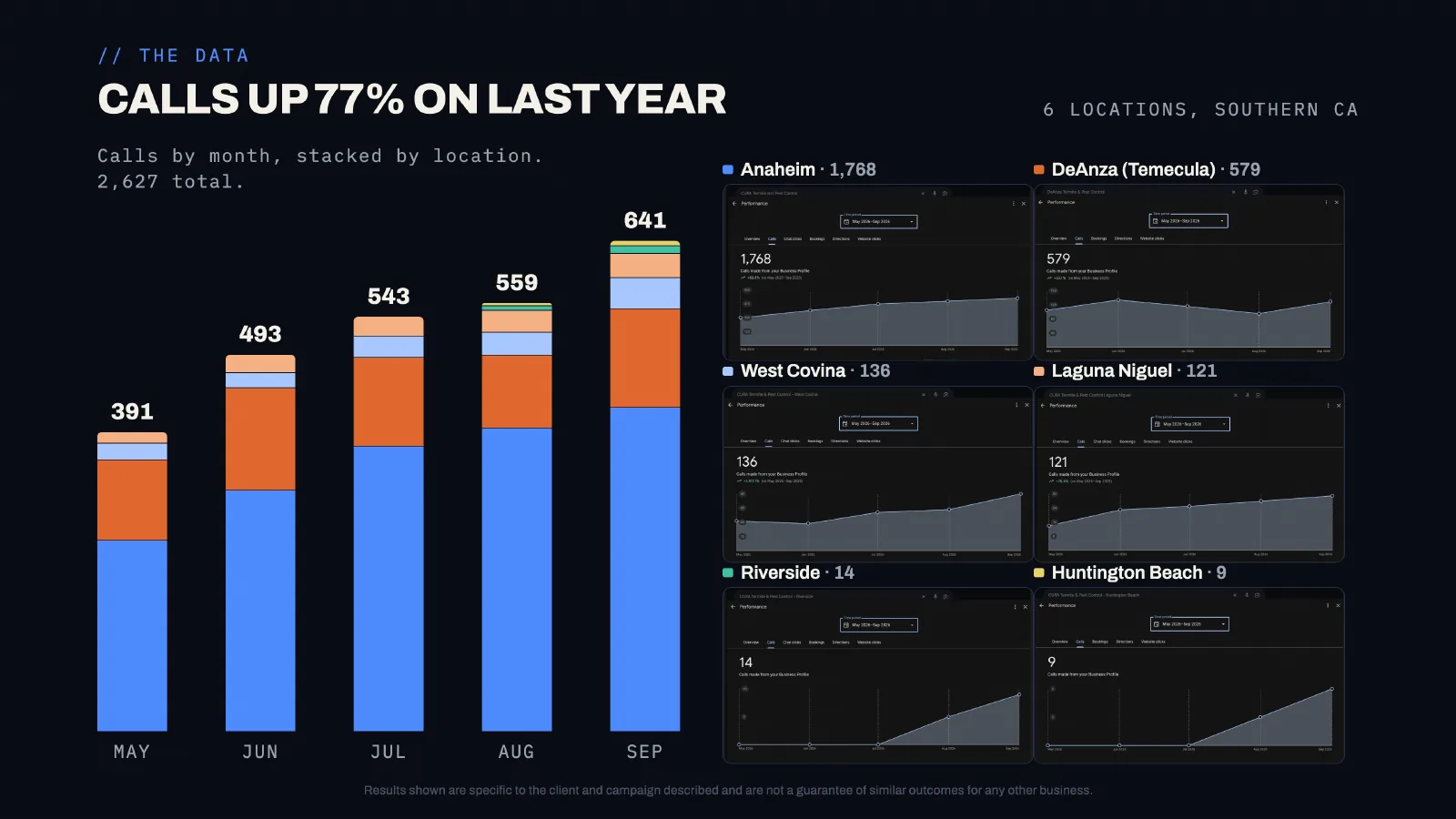
This is how our client numbers are measured. Cura's 2,627 calls from Google from May to September 2026, up 77% on the year before, are calls from its six Google profiles and Google search. King Pest Solutions' 1,789 calls over the same months were up 47% year over year. Full details are in our pest control case studies.
Step-by-step: building a pest control profile that earns reviews
- Audit the profile against the guidelines. Real name, real address, accurate categories, no duplicates, the business as primary owner.
- Complete every field. Services for every pest, service areas, hours, a plain description, and a tagged link to the matching location page.
- Add real photos. Trucks, technicians, office, signage and work, and keep adding them monthly.
- Set up review links and QR codes per location. Label them by office and put them on cards, technicians' phones and invoices.
- Train every technician to ask every customer. The same plain ask, after the work is explained, with no quotas and no suggested wording.
- Automate a same-day text. Triggered when a service is completed, sent to every customer, neutral wording.
- Reply to every review. Specific thanks for positive ones, a calm reply and a call for negative ones.
- Show reviews on your site. On pest, city and location pages, linked to Google.
- Track reviews and calls monthly. New reviews per profile, last review date, calls and new customers by source.
Common Google review mistakes pest control companies make
The costly ones break Google's rules, such as filtering who gets asked or offering a discount, and can wipe out reviews you already earned:
- Asking only customers who seem happy, or using a survey to filter who gets the Google link.
- Offering a discount or free treatment for a review.
- Suggesting what to write, including the technician's name or the pest.
- Running a big review drive once a year instead of asking every week.
- Having customers leave reviews on the office tablet or Wi-Fi.
- Sending every customer to the main office's profile when they were serviced by another location.
- Asking for Yelp reviews.
- Ignoring negative reviews, or arguing in public.
- Letting an employee or agency own the profile.
- Spending effort on Q&A, which Google removed in December 2025.
How we help pest control companies with profiles and reviews
We build and manage Google Business Profiles for pest control companies, set up review systems that follow Google's rules, track map rankings on grids, and report calls by profile every month. When Surge Pest Control's new profile was missing services, Forrest Jensen says, "two days later it was done." Reviews are one part of the work. The profile, the pages it links to, and the links behind them are the rest, covered in our pest control SEO guide and the full pest control marketing guide.