
To show up in AI search as a pest control company, do the things that already win local search, more thoroughly: a complete, accurate Google Business Profile, steady recent reviews, the same business details on every directory, one clear page per pest and per town, plain answers to the questions homeowners ask, and a site AI crawlers are allowed to read. Google says there are no special requirements or files needed for AI Overviews or AI Mode. Other assistants, like ChatGPT, Perplexity and Copilot, pull from search indexes, directories and review sites, so being consistent everywhere matters more than ever.
Homeowners are starting to ask AI tools questions they used to type into Google: "Who's the best termite company near me?" "Is it normal to see flying ants in March?" "How much does rodent exclusion usually cost?" Some get an answer from Google's AI Overviews or AI Mode, some from ChatGPT, Gemini, Perplexity or Copilot. When the answer names local companies, most people call one of the ones it names.
There's a lot of hype around "AI search optimization." This guide sticks to what the platforms themselves say, what we can see in our pest control clients' results, and the work that actually moves the needle. Most of it is the same work that wins Google Maps and organic search. That's the good news.
What is AI search, and why does it matter for pest control?
AI search means answers written by an AI system instead of a list of ten links. The main places pest control customers run into it:
| Where | What it is | What it draws on |
|---|---|---|
| Google AI Overviews | An AI summary above some regular Google results | Google's search index and, for local queries, Google's business data |
| Google AI Mode | A conversational search mode inside Google | The same, using several related searches per question |
| Gemini | Google's AI assistant | Google search and Google Maps data |
| ChatGPT search | OpenAI's assistant with web results | Web search results, its own crawler and partner data |
| Perplexity | An answer engine that cites sources | Web search and its own crawler |
| Microsoft Copilot | Microsoft's assistant, built into Bing and Windows | Bing search and Bing's business listings |
| Siri and Apple Maps | Voice and map answers on iPhones | Apple Business Connect and Apple Maps data |
For pest control, two kinds of questions matter. Research questions ("what do termite mud tubes look like," "are carpenter ants dangerous") get long AI answers, and fewer people click through. Hiring questions ("best pest control in Round Rock," "who removes mice near me") often still show the map pack, sometimes with an AI summary of companies and their reviews. The research answers shape what homeowners believe. The hiring answers decide who they call.
What does Google say about appearing in AI Overviews and AI Mode?
Google's own guide to AI features and your website is unusually direct:
- "There are no additional requirements to appear in AI Overviews or AI Mode, nor other special optimizations necessary."
- To appear as a supporting link, a page must be indexed and eligible to show with a snippet in regular Google Search.
- "You don't need to create new machine readable files, AI text files, or markup to appear in these features. There's also no special schema.org structured data that you need to add."
- Google lists the usual fundamentals: allow crawling, use internal links, offer a good page experience, keep important content in text, support it with good images and video, make structured data match the visible page, and keep your Business Profile up to date.
- AI Overviews and AI Mode can use "query fan-out," running several related searches to build one answer.
- Traffic from AI features is counted in Search Console's Performance report under the "Web" search type, not as its own line.
That last line in the fundamentals list matters most for pest control: Google explicitly names your Business Profile. For local hiring questions, the profile is the source.
The query fan-out point matters too. When someone asks Google's AI Mode "who should I call about termites in my crawl space in Georgetown," it may run searches for termite treatment in Georgetown, crawl space termite signs, and reviews of local companies. A company with a strong termite page, a strong Georgetown page and strong reviews shows up across more of those searches.
What's hype and what's real?
Most of what's real is ordinary local SEO done well; most of the hype is a new file or a paid "AI listing" that no AI tool has said it uses. Here's how the common claims compare with what's documented:
| Claim you'll hear | What's actually true |
|---|---|
| "You need a special AI file to show up." | Google says no special files are needed for its AI features. An llms.txt file is harmless and some tools may read it, but it isn't a ranking switch. |
| "You need special AI schema." | Google says no special structured data is needed. Normal LocalBusiness and Service markup that matches the page is still good practice. |
| "SEO is dead." | Google says SEO fundamentals still apply, and most AI tools build answers from search results. |
| "We can get you recommended by ChatGPT." | No one controls what an AI assistant says. Anyone promising specific placement is guessing. |
| "Write for robots, not people." | Google's guidance is helpful, people-first content. Pages stuffed with keywords and questions read badly and rank badly. |
| "Reviews don't matter to AI." | Reviews are some of the most visible information about a local business, and AI answers about local companies often summarize them. |
How do AI tools decide which pest control companies to name?
None of the platforms publish a formula, so be wary of anyone who claims to know one. What we can say from the platforms' own documentation and from watching results:
- They start with search. Google's AI features run on Google's index and business data. Copilot runs on Bing. ChatGPT and Perplexity use web search plus their own crawlers. If you don't rank in regular search, you have little chance in AI answers.
- They use business listings. For "near me" questions, assistants lean on map and directory data: Google Business Profile, Bing Places, Apple Business Connect, Yelp and others.
- They read reviews. AI summaries of local companies often reflect what reviewers say, like fast response, thorough technicians or good communication.
- They look for agreement. When your name, address, phone, services and towns match across your site and every directory, an AI system can describe you with confidence. When they conflict, it may skip you or get you wrong.
- They quote clear pages. A page that answers a question plainly in its first lines is easier to cite than one that buries the answer.
The foundation: Google Business Profile and reviews
For hiring questions, your Google Business Profile is the most important thing you own in AI search, because Google's AI features and Gemini draw directly on Google's business data. Make sure it has:
- The right primary category, usually "Pest control service," and only relevant secondary categories.
- Every pest you treat listed as a service, with a plain description.
- Real service areas that match where you actually work.
- Accurate hours, including emergency or weekend availability if you offer it.
- A business description that says who you are, what you treat and where, in plain words.
- Real photos of your team, trucks, office and work.
- A website link to the matching location page.
- Steady, recent reviews from every customer you ask, with replies.
Reviews deserve extra attention because they're the richest description of your company anywhere online. When customers mention the pest, the town and what the technician did, that detail is there for any system summarizing your business. But you can't tell them to write it. Google's review policy doesn't allow businesses to ask for specific content. Ask everyone, offer nothing in return, and let customers say what they want. Detailed reviews come naturally when the service was good and the technician explained it. Our best-performing clients get 25 new reviews/month.
The full setup is in our Google reviews and Business Profile guide, and ranking on the map is in our Google Maps guide.
Where does ChatGPT get its local pest control answers?
Mostly from business websites. In BrightLocal's study of 800 local ChatGPT searches across 20 industries and 20 US cities (December 2024), business websites made up 58% of the sources shown, mentions on other sites 27% and directories 15%. For searches with buying intent, like "best exterminator near me," websites were 72% of sources.
That makes your own site the part of AI search you control most. A page that names the pest, the town, the treatment and how soon you can come out is what ChatGPT can cite. The study is almost two years old and AI tools change often, so treat the numbers as direction, not a rule.
Listings beyond Google: Bing, Apple and directories
Because different assistants use different sources, you need to be accurate in more places than you did a few years ago.
| Listing | Why it matters for AI | What to do |
|---|---|---|
| Bing Places | Feeds Bing and Copilot, and Bing results are used by other tools | Claim it, or import from Google, then check every field |
| Apple Business Connect | Feeds Apple Maps and Siri on iPhones | Claim each location, add hours, photos and categories |
| Yelp | Widely used review source | Claim it and keep details current. Yelp asks businesses not to request reviews, so don't. |
| BBB | Trust signal many homeowners check | Keep details and services current |
| Nextdoor, Angi and industry directories | More mentions that confirm your details | Match name, address, phone and website exactly |
| State pest control association | Credible, relevant mention and often a link | Join and keep your member listing current |
Pick one exact version of your business name, address and phone number and use it everywhere. Fix old addresses from past moves and remove duplicate listings. Inconsistent details confuse map rankings and AI answers in the same way.
Making your website easy for AI to read and quote
Let the crawlers in
AI tools can only use what they can read. Check your robots.txt file and any firewall or bot-blocking settings on your hosting. Google says crawling must be allowed in robots.txt "and by any CDN or hosting infrastructure." Other crawlers to know:
- Googlebot controls Google Search, including AI Overviews and AI Mode. Google-Extended is a separate control for some of Google's other AI systems and doesn't affect Search.
- Bingbot feeds Bing and Copilot.
- OAI-SearchBot is the crawler OpenAI uses for ChatGPT search. Its training crawler, GPTBot, is separate, so you can allow search without allowing training. OpenAI says sites that opt out of OAI-SearchBot "will not be shown in ChatGPT search answers."
- PerplexityBot is used by Perplexity to find and cite pages.
Many hosting companies and security plugins now block AI crawlers by default. If you want to be cited, make sure the search crawlers are allowed. Whether to allow training crawlers is a separate business decision.
Answer first, then explain
Every important page should answer its main question in the first two or three sentences, then go deeper. A rodent page should say what you do about rodents, where, and how it works before it gets into life cycles and history. That helps people skimming on phones, and it gives AI systems a clean passage to quote.
One page per pest and per town
A single "services" page can't answer "who does termite inspections in Leander" well. Separate pages for each pest and each town you serve, written with real local detail, match the specific questions people ask AI tools. See our pest control SEO guide for how to structure them, and avoid near-duplicate "doorway" pages that only swap the town name.
Real questions, real answers
Add a short set of questions to each page, drawn from what customers actually ask your office: "Do I need to leave the house during treatment?" "How long until I stop seeing roaches?" "Do you treat for carpenter ants?" Answer each plainly. Don't invent questions to pack in keywords.
Keep important facts in text
Service areas, license numbers, hours and pests treated should be written in text on the page, not only inside images, PDFs or maps. Google calls this out specifically.
Structured data that matches the page
Use standard markup: LocalBusiness (or PestControl, which schema.org defines as a type of local business) with your name, address, phone, hours and areas served, plus Service markup for main services. Google's rule is that structured data must match what's visible on the page. Don't mark up reviews of your own business on your own site; Google doesn't show those as review stars. More in our pest control website design guide.
Be careful with safety claims
AI answers often repeat what a company says about itself. If your site calls treatments "safe" or "harmless," that claim can travel. The EPA considers those words false or misleading on pesticide labeling, and they invite trouble in marketing too. Describe what you actually do instead: the products are EPA-registered, applied by licensed technicians according to the label, with clear instructions for families and pets.

What content helps pest control companies show up in AI answers?
Research questions are where AI answers are longest, and where your expertise can be cited. Good topics come straight from your phones:
- Identification: termites vs. flying ants, carpenter ants vs. regular ants, signs of mice vs. rats.
- Timing: when termites swarm in your area, when mosquitoes and ticks start, when rodents move indoors.
- What to expect: what happens during a termite inspection, how long a bed bug treatment takes, how to prepare for service.
- Decisions: repair vs. treatment, one-time service vs. a recurring plan, DIY vs. professional.
- Local specifics: pests common in your region, local building types, soil or climate factors, with sources like your state extension service.
What makes this content worth citing is experience. A short story from a technician, a real photo from a real job, a clear explanation of what you saw and why, is more useful than a generic summary any website could publish. Link each guide to the matching pest page so readers, and AI tools, can see you treat what you explain.
Mentions and links from other sites
AI answers about "the best" local companies tend to reflect what other sources say about them, not only what the company says about itself. Real local mentions help:
- Local news coverage, such as a technician explaining a seasonal pest surge.
- Chamber of commerce and community organization listings.
- Sponsorships of local teams, schools and events.
- Real estate agents, property managers and home inspectors who link to you.
- Industry association membership and awards.
Avoid paying for placement on generic "best pest control in [city]" lists. Some are pay-to-play with no real evaluation, and they can disappear or change at any time.
What an AI-ready location page looks like
Here's an outline we use for a pest control location page. It works for people, for regular search and for AI answers, because it's built around the questions people actually ask.
- Opening answer. Two or three sentences: who you are, what pests you treat in this town, and how to reach the local office.
- Office details in text. Address if it's a storefront, phone number, hours and the towns and neighborhoods this office serves.
- Pests common in this area, with a sentence on why, such as older homes, nearby water or local soil, and links to each pest page.
- How service works here, including how fast you can usually get out and what a first visit looks like.
- Local team. The people who work out of this office, with real photos.
- Reviews from this area, shown as quotes or an embedded feed, without review markup for your own business.
- Local questions, drawn from calls to this office.
- Map and directions for storefronts, and a link to the Google profile.
The difference between this and a doorway page is real local information. If you can't write the third and fifth items for a town, you probably don't have enough presence there for a separate page yet.
AI search for multi-location pest control companies
More offices means more chances to be named, and more chances for confusion. A few rules:
- One profile, one page, one phone number per real location, consistent across every directory.
- Make the brand obvious. Use the same business name on every location, so assistants understand the offices belong to one company.
- List locations on one page that links to each location page, and mark each up as its own local business.
- Keep reviews flowing at every office, not just the original one. A new office with no recent reviews is easy to skip.
- Check AI answers in each market, because an assistant may describe your Georgetown office well and get Leander wrong.
Surge Pest Control is a good example of a company adding a market the right way: a real second office in Leander with its own profile, which produced 140 calls in its first five months of tracking. Read more in the Surge Pest Control case study.
Voice search, Siri and Apple Maps
When someone says "Hey Siri, find an exterminator near me," the answer usually comes from Apple Maps, which draws on Apple's own business data and partners. Many pest control companies have never claimed their Apple listing. Claim each location in Apple Business Connect, match your details to Google exactly, add hours and photos, and check that the category fits. Voice answers are short, often naming only one or two companies, so accurate hours and a strong rating matter even more.
What to do when an AI tool gets your business wrong
Assistants sometimes give wrong hours, list a service you don't offer, mix you up with a similarly named company or name an old address. You usually can't edit the answer directly, but you can fix what it learned from:
- Note exactly what's wrong and on which platform.
- Search your business name and the wrong detail to find where it comes from, often an old directory listing, a past address or a duplicate profile.
- Fix the source, starting with Google, Bing Places, Apple Business Connect and Yelp.
- Make sure your own website states the correct detail clearly in text.
- Use the platform's feedback option on the answer where one exists.
- Recheck in a few weeks. Corrections take time to work through.
If you're being confused with another company with a similar name, make your full business name, town and website consistent everywhere, and consider a short "about us" section that says plainly where you're based and how long you've operated.
How different pest questions show up in AI answers
Urgent questions like "exterminator near me" mostly pull from map listings and reviews, while research questions like "how much does termite treatment cost" pull from pages that explain the topic clearly. The table shows the pattern:
| Question type | Example | What tends to appear | What helps you |
|---|---|---|---|
| Identification | "Are these termites or flying ants?" | A written explanation, sometimes with source links | Clear identification guides with real photos |
| Urgent hiring | "Mice in my walls, who can come today?" | Map results, sometimes Local Services Ads and a short summary | Google profile, hours, reviews, fast answering |
| Comparison | "Best termite company in Round Rock" | A few named companies with review themes | Reviews, location page, termite page, local mentions |
| Cost | "How much does termite treatment cost?" | General ranges and factors | A page explaining what affects the price in your market |
| Safety | "Is pest control safe for my dog?" | General guidance, often citing government sources | Plain, accurate preparation instructions, without "safe" claims |
| Prevention | "How do I keep mice out this winter?" | A how-to answer with source links | Seasonal guides tied to exclusion services |
For cost questions, you don't have to publish prices to be useful. Explaining what drives the cost, such as home size, the pest, how bad the problem is and whether it needs follow-up visits, answers the question honestly and gives AI tools something accurate to say.
Questions to ask an agency about AI search
Ask what they'll change and how they'll measure it. An agency that can't name specific listing, page and review work is selling a label:
- What exactly will you change on my listings, website and review process?
- How will you check whether my company appears in AI answers, and how often?
- Will you check that AI crawlers aren't blocked on my site?
- How will you keep my business details consistent across Google, Bing, Apple and directories?
- Do you promise specific AI placements? (If yes, walk away. No one controls them.)
- How does this fit with my Google Maps, SEO and ads work?
More in how to choose a pest control marketing agency.
How do you track AI search visibility?
There's no single report for this yet. A practical approach:
- Write a fixed list of questions your customers would ask, such as "best pest control in [town]," "who removes mice in [town]," and "termite inspection near [neighborhood]."
- Check them monthly in Google (with AI Overviews and AI Mode), ChatGPT, Gemini, Perplexity and Copilot, from a location in your market where possible.
- Record who's named and whether you are, and what the answer says about you.
- Correct what's wrong. If an assistant gets your hours, services or towns wrong, find the source, usually an outdated listing, and fix it.
- Watch Search Console for impressions and clicks, which include AI features under the "Web" search type.
- Ask callers how they found you, and add "AI assistant" as an option in your CRM's lead source field.
Treat these checks as directional. AI answers vary by person, location, phrasing and day. A trend over several months tells you more than any single answer.
Can you pay to appear in ChatGPT or Google's AI answers?
You can buy ads next to some AI answers, but not a place in the answer itself. OpenAI began testing ads in ChatGPT in the US on February 9, 2026. They show below a response, are labeled as sponsored, appear only for Free and Go users, and OpenAI says they don't influence ChatGPT's answers. Google shows ads in AI Overviews for some campaigns too.
For a local pest control company, an ad under an answer that recommends a competitor isn't a great buy. Get the profile, reviews and pages right first, since those decide who gets named. Be wary of anyone who promises a spot in AI recommendations. No one can sell that.
When you check your visibility, ask each question several times, on a phone and a computer. Answers change from run to run, so "named in 6 of 9 tries" tells you more than one screenshot.
What we see in our pest control clients' results
We don't have a reliable way to count calls that start in an AI answer, and we won't pretend otherwise. What we can say is that the companies with the strongest local search presence are the ones best positioned for AI answers built on that data. Across our pest control clients, May to September 2026:
| Client | Calls from Google | Notes |
|---|---|---|
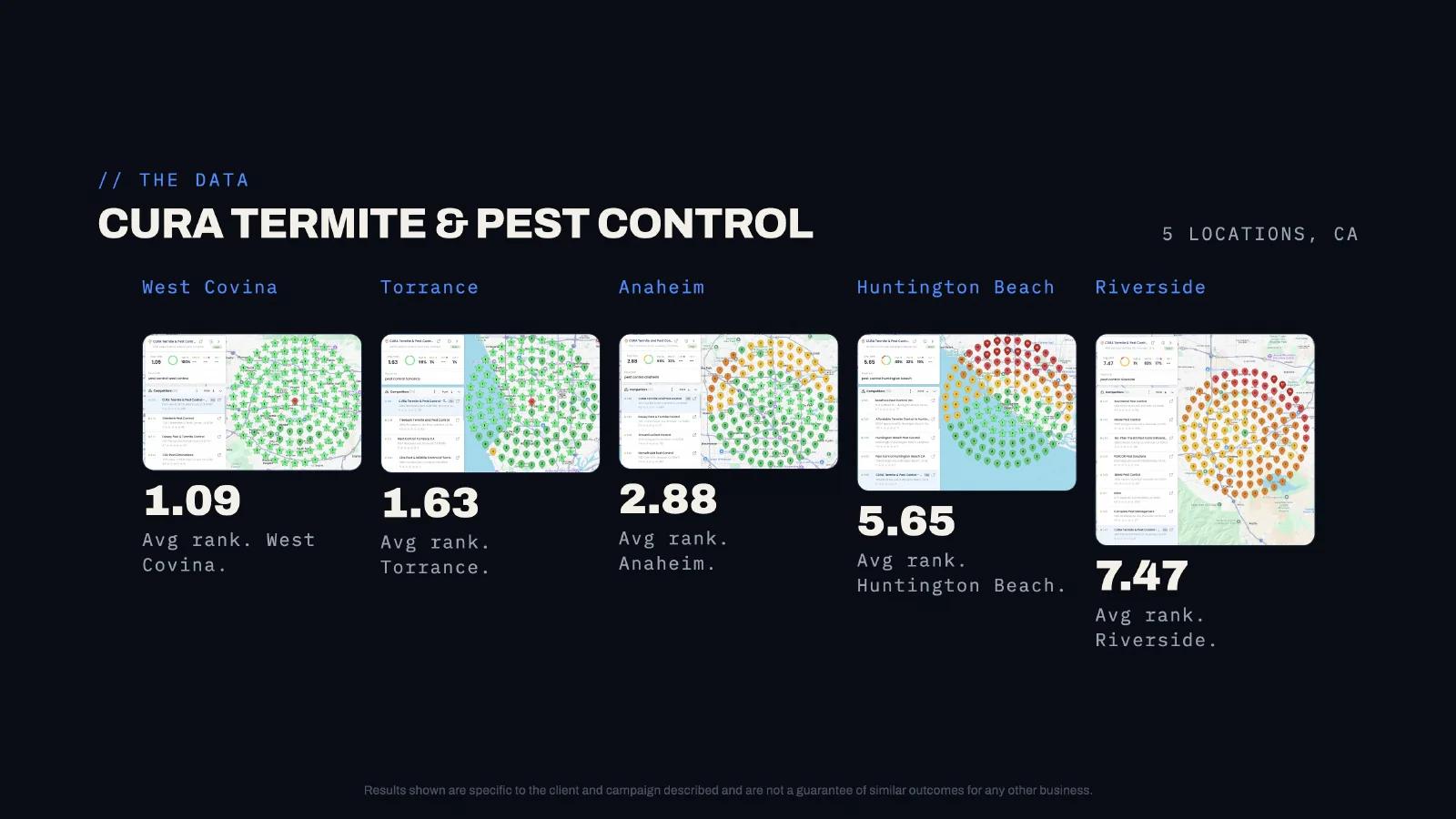
| Cura Termite & Pest Control | 2,627 (+77%) | Six profiles across Southern California |
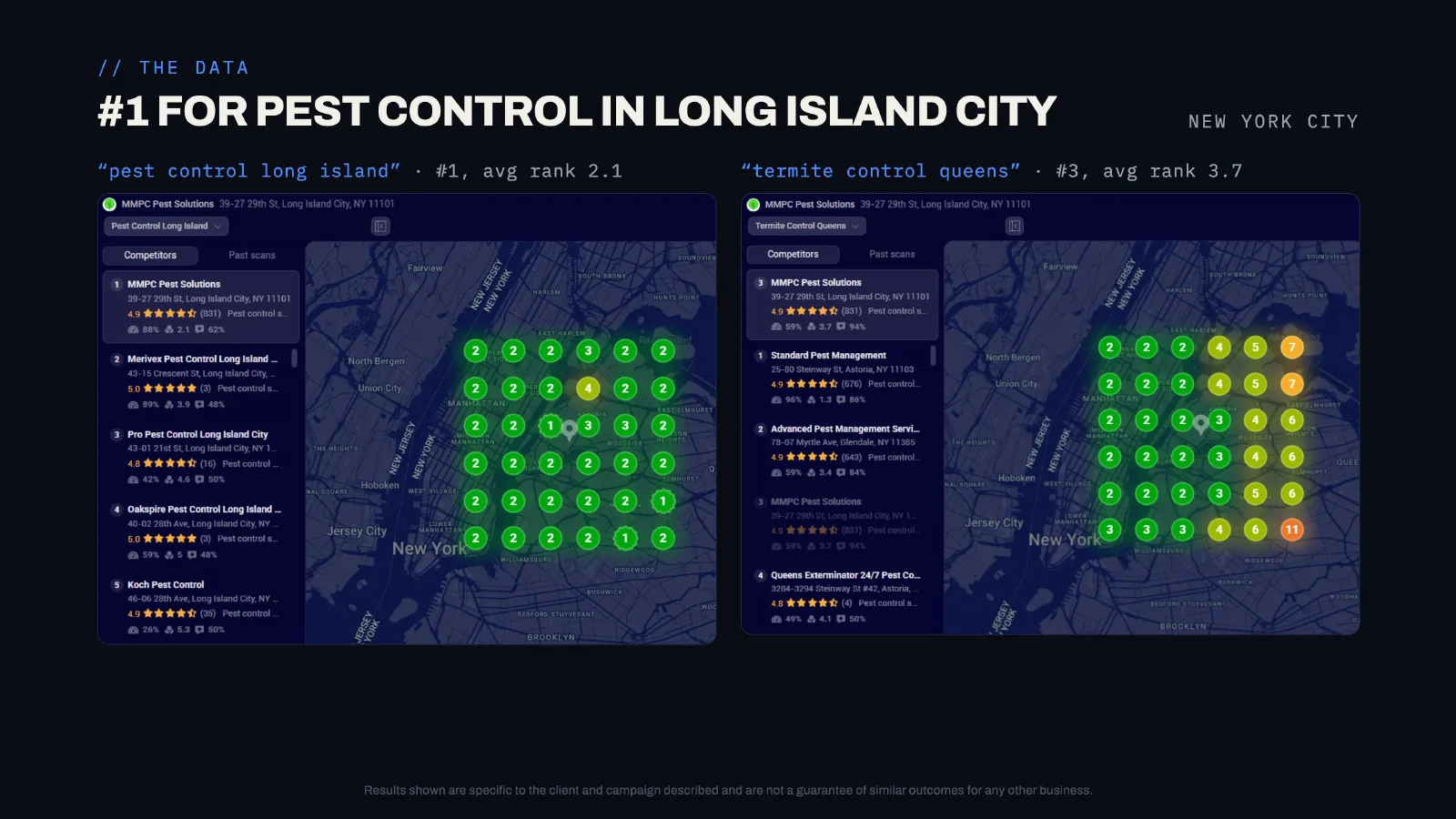
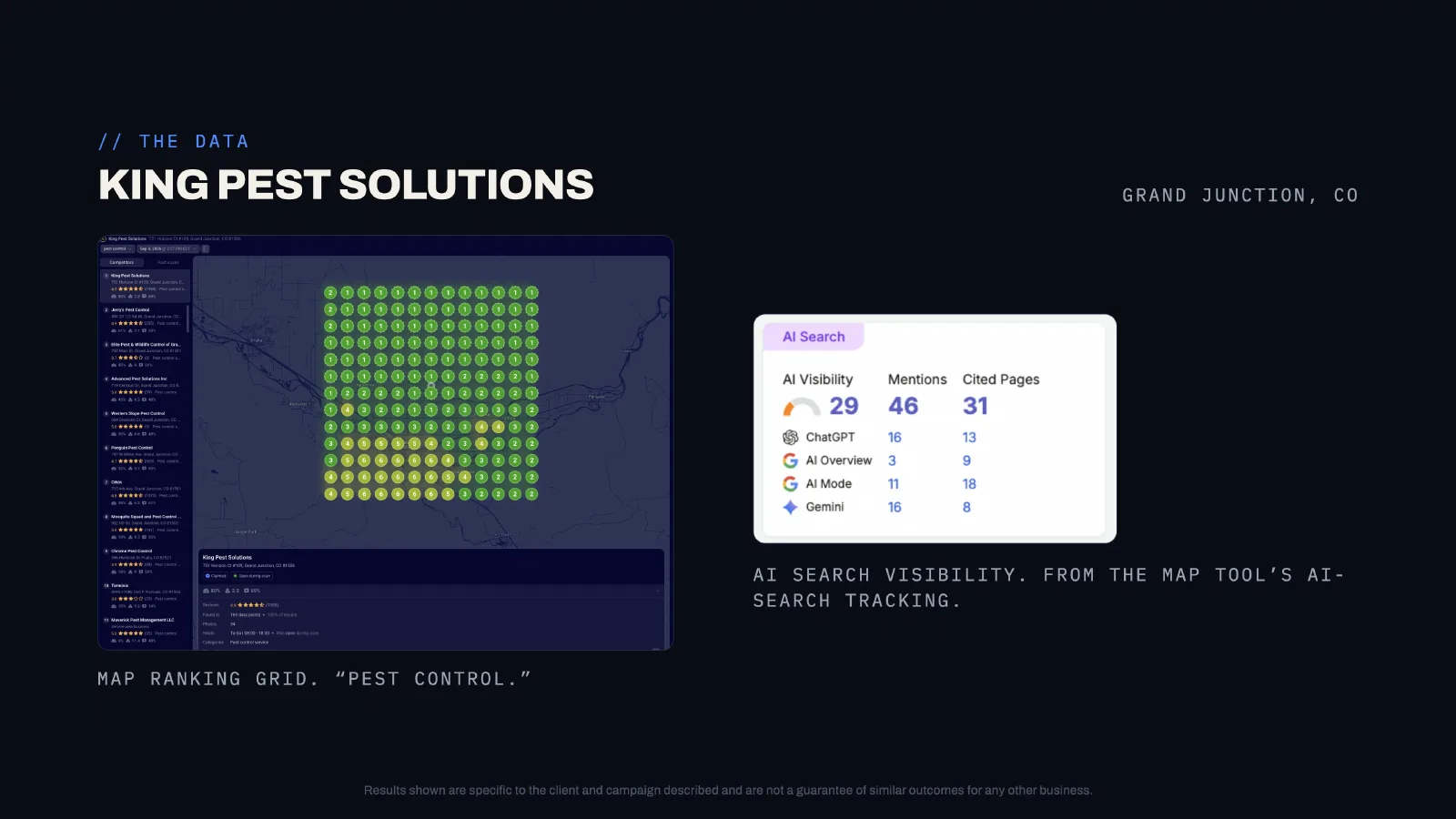
| King Pest Solutions | 1,789 (+47%) | #1 for "pest control" on Google Maps in Grand Junction |
| Scout Pest Control | 1,438 | Two profiles |
| MMPC Pest Solutions | 744 | #1 for "pest control long island" |
| Surge Pest Control | 415 | Two profiles, Georgetown and Leander, Texas |
Seth Fenn, owner of Cura, names "the SEO, our door knocking, and then obviously Yelp" as Cura's top channels. He's also candid that a previous agency's couple of years of blog posts didn't move the needle. Content alone isn't the answer for AI search either. Listings, reviews, locations and clear pages do the heavy lifting together.
A 90-day AI search plan for a pest control company
Spend the first month fixing listings and access, the second building the pages AI tools quote, and the third on reviews, mentions and a repeatable monthly check:
| When | Work |
|---|---|
| Weeks 1–2 | Audit the Google profile, Bing Places, Apple Business Connect, Yelp and BBB. Fix every mismatch. Check robots.txt and hosting for blocked crawlers. |
| Weeks 3–4 | Rewrite the first lines of the homepage, pest pages and location pages to answer the main question directly. Put services, towns and license details in text. |
| Weeks 5–8 | Add missing pest and town pages. Add real FAQs from office calls. Check structured data matches each page. |
| Weeks 5–12 | Run the review routine for every customer. Publish two or three identification or seasonal guides with real photos. |
| Weeks 9–12 | Pursue a few local mentions and links. Run the first monthly AI question check and record the baseline. |
| Ongoing | Monthly checks, corrections, new guides each season, and steady reviews. |
A simple monthly AI check
Keep it in a spreadsheet. One row per question, per platform, per month:
| Column | What to record |
|---|---|
| Question | The exact wording, such as "best termite company in Georgetown TX" |
| Platform | Google AI Overview, AI Mode, ChatGPT, Gemini, Perplexity or Copilot |
| Location | Where you checked from, since local answers change by place |
| Named? | Yes or no, and position if it's a list |
| Competitors named | Who else appears |
| What it said about you | Review themes, services, hours, any errors |
| Sources cited | Which sites the answer linked to, which shows you where it learned |
| Action | What you'll fix or build before the next check |
The "sources cited" column is the most useful one. If Perplexity keeps citing a directory where your listing is outdated, fixing that listing is the job. If competitors are named because local news covered them, that's a clue too.
AI search for commercial pest control
Facility managers, restaurant owners and property managers research differently from homeowners. They're more likely to ask an AI tool to compare providers, explain inspection requirements or describe what a commercial service plan usually includes before they ever call. To be useful in those answers:
- Build a page for each industry you serve, explaining the documentation, service schedule and reporting you provide.
- Explain how you help customers prepare for health inspections or audits, without promising outcomes.
- Describe your service area for commercial work, which is often wider than residential.
- Show certifications and training your technicians hold, in text.
- Earn mentions from local business associations and industry groups.
Commercial questions are often longer and more specific, which is exactly where AI Mode's query fan-out runs several searches. A company with clear industry pages has more chances to be part of the answer.
Common AI search mistakes
The most expensive mistakes are invisible ones, like blocking AI crawlers or letting listings disagree across Google, Bing and Apple:
- Blocking AI search crawlers by accident through a hosting or security setting.
- Paying for "AI optimization" that's only a special file or extra schema, with no work on listings, pages or reviews.
- Different business names, phone numbers or addresses across listings.
- Service areas only shown in a map image.
- Thin town pages that only swap the city name.
- Telling customers what to write in reviews to "feed" AI, which breaks Google's policy.
- Calling treatments "safe" or "harmless."
- Expecting AI to replace the map pack. For hiring questions, the map pack still does most of the work.
- Giving up on regular SEO, which AI answers are built on.
How does AI search affect Google Ads and Local Services Ads?
Ads still appear around AI answers, and Local Services Ads still sit at the top of many local searches. For urgent problems, many homeowners skip research entirely and call the first trustworthy company they see. That's why most of our clients run Local Services Ads alongside SEO. Google is also moving Local Services Ads into Google Ads in 2026; see our Google Ads and LSA guide for what's changing.
Using AI tools in your own marketing
AI tools are useful inside a pest control business too, as long as a person checks the work:
- Drafting outlines for pest guides, which a technician then corrects and adds real experience to.
- Summarizing call recordings to spot common questions for your FAQs.
- Drafting review replies that a person edits to match the actual review.
- Checking listings for inconsistencies.
Avoid publishing AI-written pages without review. Google's guidance targets content made mainly to manipulate rankings, however it's produced, and generic pages don't earn citations anyway. Never use AI to write fake reviews. The FTC's rule on fake reviews bans them explicitly, including AI-generated ones.
For the full system, see the pest control marketing guide, and for more channel ideas, 45 pest control marketing ideas.