
Most roofing companies should run Local Services Ads and Google Search ads together: LSA for pay-per-lead calls at the very top of local searches with the Google Verified badge, and Search ads for the specific jobs, towns and storm surges LSA can't target. Separate repair from replacement, block job seekers and DIY searches, send every ad to a matching page, answer every call, and judge it all by cost per signed job. Google is moving LSA into Google Ads in 2026, and roofing is in the first group.
This guide covers how Local Services Ads and Google Search ads work for roofers in 2026, what changed, where money gets wasted and how to tell whether ads are paying. The Google rules quoted here come from Google's own help pages, linked throughout. We don't publish ad budgets or prices for our clients, and we don't quote average lead costs, because they vary too much by market to be useful. We'll show you how to work out your own.
What's the difference between Local Services Ads and Google Search ads for roofers?
Local Services Ads charge per lead, show first on many local searches, and target by service type and area with no keywords. Search ads charge per click, show below LSA, and target by keyword, so you can choose exactly which searches and towns you pay for. They work best together.
| Local Services Ads | Google Search ads | |
|---|---|---|
| You pay for | Valid leads (calls, messages, bookings) | Clicks |
| Targeting | Service types and areas, no keywords | Keywords, locations, schedules, audiences |
| Where it shows | Top of Search and Google Maps | Top and bottom of search results |
| Trust signal | Google Verified badge, reviews | Your ad copy, assets and reviews |
| Landing page | Your LSA profile | Any page on your site |
| Setup time | Weeks, because of verification | Days |
| Best for | Urgent repair calls and inspections | Replacement, materials, storms, new towns |
Neither one improves your map ranking. Google says you can't pay for a better local rank. Ads are for calls now, while the map and SEO do the long-term work. See our guide to ranking on Google Maps.
How do Local Services Ads work for roofing companies?
A homeowner searches something like "roof repair near me." A row of LSA listings shows first, each with a company name, rating, review count, hours and the Google Verified badge. They tap one, see your services and reviews, then call or message you. You pay when that contact is a valid lead.
What is the Google Verified badge?
It's the badge LSA shows for businesses that passed Google's screening. Google replaced its older LSA badges with Google Verified in late 2025. If your trucks, website or estimates still show an older Google badge, update them to Google Verified.
What does Google check before a roofer can run LSA?
Google's screening and verification requirements vary by trade and state. For roofers they generally include a verified Google Business Profile, business and owner background checks for select users, proof of liability insurance, and contractor licenses where your state or city requires them. Google puts typical verification at three to four weeks from document submission, so start well before storm season.
The most common reason applications stall is a mismatch: the business name on your license, insurance certificate and Google profile don't match exactly. Fix that before you apply.
Which roofing jobs can you advertise in LSA?
LSA uses a fixed list of job types for each category. For roofers, it covers the core work, such as roof repair, roof installation and replacement, roof inspection and storm damage, plus related work like gutters and skylights. Check the current list in your account and turn on only the jobs you want. Each job type you leave on will bring calls for it.
What counts as a charged LSA lead?
Google's page on how leads work sets the rules:
| Contact | Charged? |
|---|---|
| An answered call, or a callback that reaches the homeowner | Yes, if Google counts it as a qualifying lead |
| A missed call during your business hours where the caller holds for longer than 20 seconds | Yes |
| A voicemail | Yes |
| A text or email message | Yes |
| A booking request | Yes |
| Someone who drops off your phone tree before choosing an option | No |
| A repeat contact from the same homeowner inside Google's 15-day window | No |
| Spam or duplicate leads that Google removes | No |
Two lessons for roofers. Missed calls cost money and hurt your responsiveness, so answer live during your posted hours. And Google keeps reassessing charged leads for 30 days and may credit poor ones. If a lead is a solicitor, a job seeker or someone outside your area, mark it in the lead feedback.
What decides how many LSA leads a roofer gets?
Google's page on LSA ad rankings says ads are ordered by an auction that weighs your bid and how likely your ad is to produce a lead. The factors it names are your bid, your responsiveness, the search itself, relevance (your services and business bio), whether you accept messages and bookings, and profile quality: "your rating, number of reviews, average response time, use of high-quality images, the verification checks you have completed." Google adds that higher-quality profiles "may rank higher and may also pay lower costs per lead."
The factor most roofers can move fastest is reviews. Our best-performing clients get 25 new reviews/month, and every one helps both the map and LSA. Our review system for roofers shows how.
How to build a strong LSA profile
Your LSA profile is the page a homeowner sees after tapping your ad, and Google counts its quality when ranking you. Write a short, plain bio: who you are, how long you've been roofing, what you install and repair, where you work, and your license and insurance. Upload real photos of crews in uniform, trucks with your name and finished roofs. Google's migration page says you can add up to 100 business photos after the move into Google Ads, and choose structured callouts such as specialties, hours and payment methods. Keep hours accurate, because they decide when missed calls are charged.
How to handle bad LSA leads
Mark them. Every lead has a feedback option. Use it for calls that weren't real leads: solicitors, job seekers, wrong numbers, people outside your area or asking for work you don't list. Google says it reassesses charged leads for 30 days and may credit poor ones automatically. Do this weekly, in one sitting, so it actually happens. It also teaches you which job types and areas bring junk, so you can turn them off.
What is changing with Local Services Ads in 2026?
Google is moving Local Services Ads into Google Ads as Performance Max campaigns with pay-per-lead goals. According to Google's migration page, roofing is in the first group of US home and storefront service advertisers, starting in August 2026, with service-area businesses and custom setups following in late 2026 and the rest in 2027.
| Not changing | Changing |
|---|---|
| Billing stays per qualifying lead, never per click | You manage it inside Google Ads, not the LSA dashboard |
| Ads still show only on Search and Maps, in the same places | Weekly budgets become daily averages (weekly divided by 7) |
| Still keywordless: targeting by service and area | Manual bidding and industry-level target CPA go away |
| Your Google Verified status carries over | Old performance reports don't carry over, so save them |
| Past leads and recordings carry over | Name, address and hours sync one way from your Google profile |
Google says the account admin gets an email 14 days before migration, and that performance can take up to two weeks to settle afterwards. Three things to do now:
- Download or screenshot your LSA reports before migration. Google says they won't move.
- Check your Google Business Profile. Name, address and hours will sync from it, and big changes to the name, address or primary category trigger a review that can pause the campaign for a day or two.
- Split campaigns if you want separate bids for roofing and other trades, such as gutters or siding, since a single campaign gets one target.
How should a roofing company structure Google Search campaigns for repair, replacement and storm jobs?
Build tight campaigns by job type and value, use exact and phrase match on searches that show real hiring intent, add a long negative keyword list, write ads that name the service and town, and send each ad group to a page about that exact job. Start narrow and expand only what produces signed jobs.
How to structure roofing ad campaigns
| Campaign | Example searches | Landing page |
|---|---|---|
| Roof repair | roof repair [city], roof leak repair, emergency roof repair | Roof repair page with a call button up top |
| Roof replacement | roof replacement [city], new roof cost [city], reroof | Replacement page with financing and warranty |
| Inspection and storm | roof inspection, hail damage roof, storm damage roof repair | Storm and inspection page |
| Materials | metal roofing contractor, flat roof repair, tile roof repair | Material pages |
| Brand | your company name | Homepage |
Repair and replacement should always be separate. A repair is worth less and is usually urgent. A replacement is worth much more and the homeowner shops around. They need different ads, different pages and, often, different bids.
Which negative keywords should roofers use?
Start with these groups and add more from your search terms report every week:
- Jobs: jobs, hiring, salary, careers, apprentice, training, license exam.
- DIY: how to, DIY, tutorial, YouTube, kit.
- Retail shopping: Home Depot, Lowe's, shingles for sale, supply, wholesale.
- Research only: pictures, types of, definition, lifespan (unless you have a page for it).
- Work you don't do: commercial, if you're residential only; car roof, RV roof, roof racks.
- Places you don't serve.
What should a roofing ad say?
The service, the town, a reason to trust you and a reason to call now. Headlines like "Roof Repair in Chandler, AZ," "Licensed & Insured Since [Year]," "Free Roof Inspections" or "Financing Available," if they're true. Add call assets with a tracked number, sitelinks to repair, replacement, financing and reviews, and location assets linked to your Google profile.
Google stopped allowing new call-only ads in February 2026, and existing ones stop showing in February 2027, according to Google's call ads notice. Use responsive search ads with call assets instead.
Roofing ad copy examples
Here's how we'd write headlines and descriptions for three ad groups. Swap in your own town, years and offers, and only claim what's true.
| Ad group | Headlines | Description |
|---|---|---|
| Roof repair | Roof Repair in [City] · Leak Fixed Fast · Licensed & Insured | Local roofing crew serving [City] since [year]. Call now to book an inspection, or request one online in a minute. |
| Roof replacement | Roof Replacement in [City] · [Brand] Certified Installer · Financing Available | Itemized written estimates, real warranty, and photos of roofs we've done in [City]. Get your free estimate. |
| Storm damage | Storm Damage Roof Inspection · Serving [City] · Local Crew, Not Storm Chasers | Hail or wind damage? We'll inspect, photograph what we find and explain your options. Licensed in [State]. |
Notice what's missing from the storm ad: any promise about insurance. That's deliberate, for the legal reasons covered below.
How should roofers set locations and schedules?
Target the towns you really serve, set location options to "presence" (people in or regularly in your area) rather than people merely interested in it, and run ads when someone can answer the phone. If calls go to voicemail after 6 p.m., either staff the phone or cut evening spend.
How should roofers use ads after a storm?
Turn up spend in the hit area fast, point ads at a storm damage and inspection page, and turn it back down when demand falls. Search ads are the best tool for this, because you can target specific towns and searches within hours. LSA will pick up some of the surge on its own if your budget allows.
Keep the copy legal. Several states restrict how contractors advertise roof damage insurance claims. Florida's Statute 489.147, for example, covers any electronic communication that encourages a homeowner to contact a contractor to make a roof damage claim, which can include ads, and requires specific disclaimers about deductibles and insurance fraud in a minimum font size. It also bans offering anything of value for an inspection or a claim. Before you run any "we'll handle your insurance claim" ad, check your state's rules.
What landing page should roofing ads go to?
A page about the exact job in the ad, with the phone number and an estimate button at the top, your license and reviews visible, real photos, and a short form. Sending every ad to the homepage is the most common way roofers waste ad spend. The homeowner has to hunt for what they searched for, and most won't.
The Neal Roofing & Waterproofing page Bodhi shows in his audit is a good model: a sticky header with the license number and an estimate button, a short quiz to qualify the lead and video testimonials. Our roofing website design guide covers the full layout.
Get ahead of the next storm season. On a free growth call we check where you rank for “roofer near me,” how your site sells inspections, and where calls slip through.
Book a Growth CallHow do roofers know if Google Ads are working?
Track every lead from the click or call through to inspection, estimate and signed job, by campaign. Cost per click and cost per lead only tell you whether ads bring contacts. Cost per signed job tells you whether they pay.
- Tracked phone numbers on ads, the website and LSA, with call recording.
- Form tracking as conversions in Google Ads.
- Every lead in your CRM with its source and campaign.
- Offline conversions: import signed jobs back into Google Ads, so its bidding learns which searches turn into roofs.
- Monthly review: spend, leads, inspections, signed jobs and revenue by campaign.
Vish Mazumder at Mighty Dog Roofing says it plainly: when an owner can't say where jobs came from, that's "a you problem." He's talking about owners who don't set up tracking and then blame the marketing. Set it up before you spend.
| Metric | Formula | What it tells you |
|---|---|---|
| Cost per lead | Spend ÷ leads | Whether ads bring contacts efficiently |
| Lead-to-inspection rate | Inspections ÷ leads | Lead quality and how well calls are handled |
| Close rate | Signed jobs ÷ inspections | Sales performance |
| Cost per signed job | Spend ÷ signed jobs | Whether the campaign is worth it |
| Return on ad spend | Revenue ÷ spend | The number that sets your budget |
Why are roofing clicks so expensive?
Because a single roofing job is worth a lot, so many companies are willing to pay for the same searches. Bought-lead companies and national brands bid on them too. The price of a click is set by that auction, which is why the same search can cost very different amounts in a small town and a big metro, and why it rises in storm season.
You can't control the auction, but you can control three things that decide whether expensive clicks pay off:
- Which clicks you buy. Exact and phrase match on hiring searches, with strong negatives, wastes far less than broad match.
- How many clicks become leads. A focused landing page with a visible phone number and short form can double your conversion rate compared with a homepage.
- How many leads become signed jobs. Fast answers, a booked inspection on the first call and a clear estimate.
Improve all three and the same click price produces far more roofs. That's also why Google ads and LSA work better for roofers with strong reviews and profiles: Google rewards them in the auction, and homeowners call them more often.
If you run more than one location, note one LSA rule from Google: when several of your locations serve the same area, only the highest-ranking one shows for a search. Set each location's service area to the towns it really serves, so they don't compete with each other.
How much should a roofer spend on Google Ads?
Work backwards from the jobs you want. Take your target number of signed jobs, divide by your close rate to get inspections, divide by your lead-to-inspection rate to get leads, and multiply by the cost per lead in your own account. That's the budget. Then put more behind the campaigns with the lowest cost per signed job.
Two practical notes. A budget too small to get a steady flow of leads won't teach you or Google's bidding anything, so concentrate a small budget on your best campaign rather than spreading it thin. And plan for seasons and storms: more in peak months and after events, less in the slow ones, while SEO keeps running all year.
Should roofers use standard Performance Max campaigns?
Be careful. Standard Performance Max, which is different from the pay-per-lead version replacing LSA, shows across Search, Maps, YouTube, Gmail and Google's display network, and charges per click. It can find leads, but it also spends on placements that rarely produce roofing jobs, and you get less control. Get Search ads and tracking right first. If you test standard Performance Max, give it its own budget and judge it on signed jobs in your CRM.
Should a roofer start with LSA or Search ads?
It depends on your reviews, your phones and your market. LSA rewards strong reviews and fast answers, and costs nothing until leads come in. Search ads give you control and speed, and suit replacement work, materials and new towns. Here's how we'd decide.
| Your situation | Start with | Why |
|---|---|---|
| Strong reviews, phones answered live all day | LSA | You'll rank well in LSA and pay only for leads |
| Few reviews, new company | Search ads, and build reviews | LSA ranks on reviews; you'll get few leads until you have them |
| Mostly replacement work | Search ads, plus LSA | You can target replacement and material searches by keyword |
| Mostly repair and leak calls | LSA, plus Search ads for repair | Urgent calls favor the top-of-page LSA row |
| Entering a new town | Search ads | Fast, targeted, while the map in that town is out of reach |
| Storm in your area | Search ads by town, plus LSA budget | Turn up fast, turn down when it passes |
How should roofers handle calls from ads?
Answer live, get the address and the problem, and book an inspection on that call. Ad leads are the most expensive you get, so the phone process matters more here than anywhere. A booked inspection on the first call is worth far more than a promise to call back.
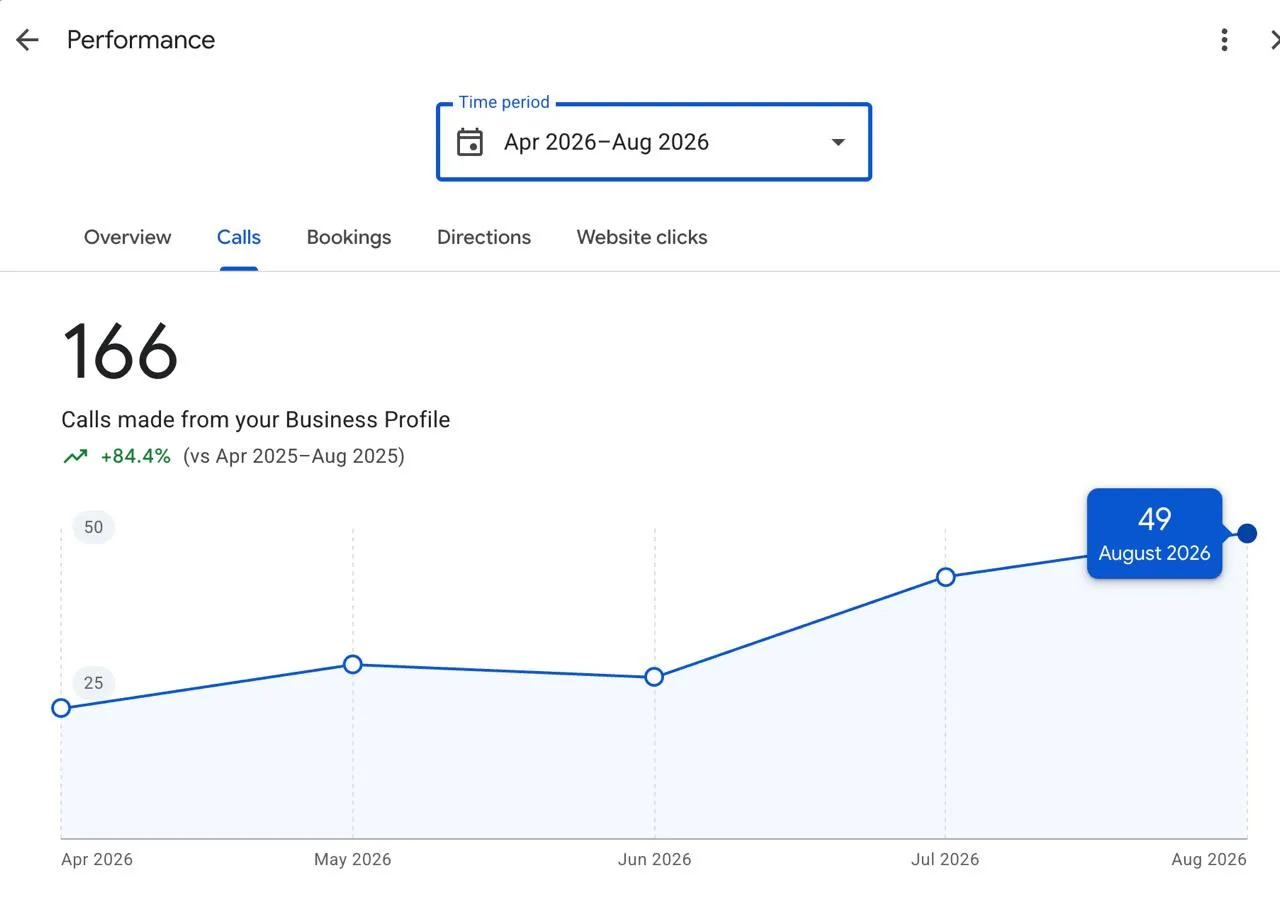
Paid clicks add to the calls your Google profile already brings in, so the phones have to cope with both. Gikas Roofing in Pearl River, New York got 166 calls from its Google Business Profile alone from April to August 2026, up 84.4% on the same months in 2025, and Real Roofing in Chandler, Arizona got 199, up 116.3%. Calls at that level, plus ad calls on top, can't go to voicemail.
- Answer by the third ring during posted hours, with a person, not a phone menu.
- Ask three things first: the address, what's going on (leak, storm, age of roof, selling the house), and how soon they need someone.
- Offer two inspection times instead of asking when they're free.
- Confirm by text with the inspector's name and photo.
- Return a missed call while the homeowner is still looking at the leak, and text if you can't reach them.
- Listen to recorded calls weekly. Most lost jobs are lost on the phone.
Tony Munoz at Martin Home Exteriors promises customers a callback within the hour and says "the quickness in responding" is what sets his company apart. That habit makes every lead source cheaper.
Which bidding strategy should roofing Search ads use?
Start with Maximize Conversions or Maximize Clicks with a bid cap while you collect data, then move to Target CPA once you have steady conversions and, ideally, signed jobs imported as offline conversions. Smart bidding learns from what you tell it is a conversion. If you count every short call as a conversion, it will chase short calls. If you import signed jobs, it learns which searches turn into roofs.
- Count only real conversions: calls over a minimum length, form submissions and booked inspections.
- Give replacement conversions more value than repair conversions if you can.
- Don't change bid strategies every week. Give each change a few weeks to settle.
What about Facebook, YouTube and other ads for roofers?
They can help, but they're a different job. Search ads catch people already looking for a roofer. Facebook, Instagram and YouTube ads reach people who aren't searching yet, so they work best for staying in front of past site visitors, promoting financing, showing project videos and reaching neighborhoods after a storm. Judge them the same way, by signed jobs, and expect them to cost more per lead than search.
Video testimonials from real customers are the strongest creative we see for these channels. The Neal page Bodhi shows in his audit uses them on the landing page too.
Should roofers use remarketing or bid on competitors' names?
Remarketing, yes. Bidding on competitors' names, usually not. Homeowners shopping for a replacement visit several sites and take weeks to decide, so reminding past visitors with display or video ads can pay off. Competitor name bidding tends to get poor click-through rates and expensive clicks, and it invites the same back. Bid on your own brand, though, so a competitor can't take that top spot.
- Remarketing audiences: visitors to your replacement and financing pages, for 30 to 90 days.
- Exclude converters: anyone who already booked or signed shouldn't keep seeing ads.
- Use real projects in the creative, with the town named.
- Brand campaign: cheap clicks, protects your name, sends people to the homepage.
Which keywords and negative keywords should roofing ads use?
Group keywords by the job the searcher needs, give each group its own ad and landing page, and block the searches that aren't customers. Roofing has a lot of those: job seekers, DIYers and people shopping for materials all type "roofing."
| Ad group | Example searches | Landing page |
|---|---|---|
| Emergency and leaks | roof leak repair near me, emergency roofer [city] | Repair page with the phone number up top |
| Storm damage | storm damage roof repair [city], hail damage roof | Storm page with inspection steps; no promises about claims |
| Replacement | roof replacement [city], new roof cost [city] | Replacement page with financing and project photos |
| Repair | roof repair [city], shingle repair | Repair page |
| Inspection | roof inspection [city] | Inspection page |
| Commercial | commercial roofing contractor [city], flat roof repair | Commercial page, only if you do that work |
Start the negative keyword list before launch and add to it every week from the search terms report:
- Jobs: jobs, hiring, salary, apprentice, careers.
- DIY: how to, DIY, YouTube, tutorial.
- Materials and stores: shingles for sale, roofing nails, Home Depot, Lowe's, wholesale, supply.
- Not your trade: roof rack, car roof, RV roof, if you don't do them; and any service you don't offer, such as gutters or solar.
- Outside your area: towns you don't serve, if the location settings let them through.
Use phrase and exact match for the expensive replacement and storm terms until you see which searches turn into inspections, then loosen carefully. Broad match without a strong negative list and good conversion data is how roofing budgets disappear in the first month. If someone else runs your ads, our guide on choosing a roofing marketing agency lists the questions that expose wasted spend.
Where do roofers waste the most money in Google Ads?
Sending clicks to the homepage, running broad match without negative keywords, counting form fills instead of signed jobs, and letting calls go to voicemail. Each one wastes money even when the ads themselves are fine.
| Mistake | The fix |
|---|---|
| Broad match with no negatives | Exact and phrase match, weekly search terms review |
| Repair and replacement in one campaign | Separate campaigns, pages and bids |
| All ads to the homepage | One landing page per job type |
| Ads running when no one answers | Ad schedule matched to staffed hours |
| Judging by clicks or cost per lead | Track to signed jobs |
| Old Google badges in ads and sites | Update to Google Verified |
| Insurance-claim copy without checking state rules | Legal review before storm campaigns |
| Ignoring LSA lead feedback | Mark junk leads within the reassessment window |
How to launch Google Ads for a roofing company
- Fix call handling and hours. A person picks up every call during the hours you list, and messages get fast replies.
- Build up the roofing profile and its reviews. LSA ranks on them, and Search ads show them.
- Apply for Local Services Ads. License, insurance and business name matching, then three to four weeks for verification.
- Set up tracking. Call tracking, form conversions and CRM sources before spending.
- Build landing pages. Repair, replacement and storm, each with a call button and form.
- Launch Search campaigns. Repair and replacement separate, exact and phrase match, full negative list.
- Review weekly. Search terms, lead feedback and calls. Cut what doesn't book.
- Judge monthly on signed jobs. Shift budget to the campaigns with the lowest cost per signed job.
Ads work best alongside the rest of the system: see our roofing marketing guide, the roofing lead generation guide, and our HVAC guide comparing Local Services Ads and Google Ads, which applies to roofers too.
FAQ
Are Local Services Ads worth it for roofers?
Often, if your reviews are strong and someone answers every call during business hours. You pay per valid lead and show at the top of local searches with the Google Verified badge. Judge them by cost per signed job, not cost per lead.
What does a Local Services Ads lead cost a roofer?
It varies by market, job type, lead type and competition, so there's no reliable national number. Check the estimates in your own account, then track what each lead turns into.
What is the Google Verified badge?
The badge Local Services Ads show for businesses that passed Google's screening. It replaced Google's older LSA badges in late 2025.
How long does LSA verification take for a roofer?
Google says three to four weeks on average after you submit documents. Make sure the business name on your license, insurance and Google profile match first.
Is roofing part of the 2026 LSA move into Google Ads?
Yes. Google lists roofing in the first group of US home service advertisers moving to Performance Max campaigns with pay-per-lead goals, starting in August 2026. Save your LSA reports first, because they don't carry over.
Do I pay for missed LSA calls?
Yes, if the call comes during your business hours and the caller holds for longer than 20 seconds. Missed calls can also hurt your responsiveness and ranking.
What negative keywords should roofers use in Google Ads?
Start with job terms (jobs, hiring, salary), DIY terms (how to, DIY), retail terms (Home Depot, shingles for sale, supply), and work you don't do (commercial, RV roof). Add more from your search terms report every week.
Should roofing ads go to my homepage?
No. Send each ad group to a page about that exact job, with the phone number and an estimate button at the top.
Can I advertise that I'll handle insurance claims?
Check your state's law first. Florida Statute 489.147, for example, restricts ads that encourage homeowners to contact a contractor to make a roof damage claim and bans contractors from adjusting claims without a public adjuster license.
Do Google Ads help my roofing company rank on Google Maps?
No. Google says you can't pay for better local rankings. Ads bring calls now while SEO and the map pack build.