
Roofing SEO is the work of getting your company to show up when homeowners search for roofing in the towns you serve, both in the Google map pack and in the regular results below it. It comes down to five things: a complete Google Business Profile for each real office, one strong page per service and per city, a steady flow of reviews, links and mentions from local and industry sites, and a site that's fast and clear on a phone. Map rankings can move in weeks. Pages usually take a few months.
This guide covers the whole roofing SEO system we use, including the Google Business Profile and reviews, which most guides treat separately. For roofers, they're the same job: the profile ranks in the map pack, the website feeds the profile, and reviews feed both. Every example comes from our own roofing clients and two videos: Andy Walker's roofing SEO walkthrough and Bodhi Gallo's live audit of an Omaha roofing company.

What does roofing SEO include?
It includes everything that decides where you appear for local roofing searches: your Google Business Profile, the pages on your website, the reviews customers leave, links and mentions on other sites, your business listings across directories and the technical health of your site. Paid ads aren't SEO, though they share a lot of the same groundwork.
| Part | What it does | Where it shows |
|---|---|---|
| Google Business Profile | Tells Google what you do, where and how well | Map pack, Google Maps, branded searches |
| Service pages | Ranks for "roof repair," "roof replacement," "metal roofing" and so on | Organic results, and feeds the map pack |
| Location pages | Ranks for "roofer [city]" in each town you serve | Organic results in that town |
| Reviews | Prominence signal and the main thing homeowners read | Map pack, profile, ads, AI answers |
| Links and citations | Prove you're a real, trusted local business | All of the above |
| Technical SEO | Lets Google crawl and understand the site, and keeps it fast | All organic results |
Most roofing searches are local. When someone types "roof repair" or "roofer near me," Google shows the map pack first, then the organic results. Being strong in both is what makes the difference between a few calls a week and a full calendar.
Which searches bring roofers repair, replacement and storm work?
The services you sell plus the places you sell them: "roof repair [city]," "roof replacement [city]," "roofing company [city]," "roofer near me" and the specific materials and problems you handle. Start with what makes you the most money, then check search volume and who ranks today.
In his video, Andy breaks keyword research into three steps:
- List every service and every town. Repair, replacement, inspection, storm damage, metal, flat, shingle, tile, gutters, skylights. Then every city, county and neighborhood you'd send a crew to.
- Check demand. Google's Keyword Planner gives rough monthly searches. Expect "roofing" and "roofer" terms in your main city to have the most, and long-tail terms like "flat roof repair [suburb]" to have little but convert well.
- Study the results. Search each term from inside the area and look at who ranks, what their pages look like and how many reviews they have. That's what you're competing with.
| Keyword type | Examples | Best page |
|---|---|---|
| Core local | roofing company [city], roofer [city], roofers near me | Homepage or main location page, plus the profile |
| Service | roof repair, roof replacement, roof inspection | One service page each |
| Material | metal roofing, flat roof, tile roof repair, shingle replacement | Service pages, or sections on them |
| Problem | roof leak, storm damage, hail damage, missing shingles | Repair and storm pages |
| Location + service | roof repair [suburb] | Location pages, and city-service pages where demand is real |
| Research | how long does a roof last, signs you need a new roof | Blog posts or FAQ sections that link to service pages |
One warning on research terms: they bring traffic, but few of those readers are ready to call. Build the service and location pages first, then add research content that links back to them.
How should a roofer set up a Google Business Profile?
Fill in every field with accurate information: real name, "Roofing contractor" as the primary category, real address, true service areas, every service, hours, photos, a description written for people, and a link to the matching page on your site. Then keep it active with photos, posts and replies to reviews.
| Field | What to do | Common mistake |
|---|---|---|
| Business name | Your real-world name, as on your signs and license | Adding "Best Roofer [City]" to it, which breaks Google's guidelines |
| Primary category | Roofing contractor | Picking "General contractor" or "Construction company" |
| Secondary categories | Only work you really do: gutter, siding, skylight | Adding every category that sounds close |
| Address | A real, staffed office | Virtual offices and mailboxes, which get suspended |
| Service areas | Towns you really cover, within about two hours' drive | Listing a whole state |
| Services | Every service, each with a short description | Leaving the defaults or nothing |
| Website link | The page for that office's city | Linking every profile to the homepage |
| Photos | Real crews, trucks and finished roofs, added regularly | Stock photos, or none since setup |
| Description | What you do, where, license, warranty, years in business | A wall of keywords |
Google's guidelines for representing your business are the rulebook here. Read them once. Nearly every suspended roofing profile we've seen broke one of them, usually the name rule or the address rule. If yours has been suspended, our guide to a suspended Google Business Profile covers how to get it back.
Andy makes a point in his video that a lot of owners don't know: products and services on the profile can link to pages on your site. Use that. A "Roof replacement" service on the profile that leads to your roof replacement page tells Google and the homeowner the same thing.
In the Omaha audit, Bodhi noticed the company's profile description started with the city and state. That's a good habit, as long as the rest reads naturally. Write it for the homeowner: what you do, where you do it and why they should trust you. Don't stuff it with keywords.
When does a roofer need a second Google Business Profile?
Yes, if you have a real, staffed office in each market. Each profile ranks best near its own address, so a second real office is the most reliable way to rank in a second city. Never create a profile for a place where you don't have a real office.
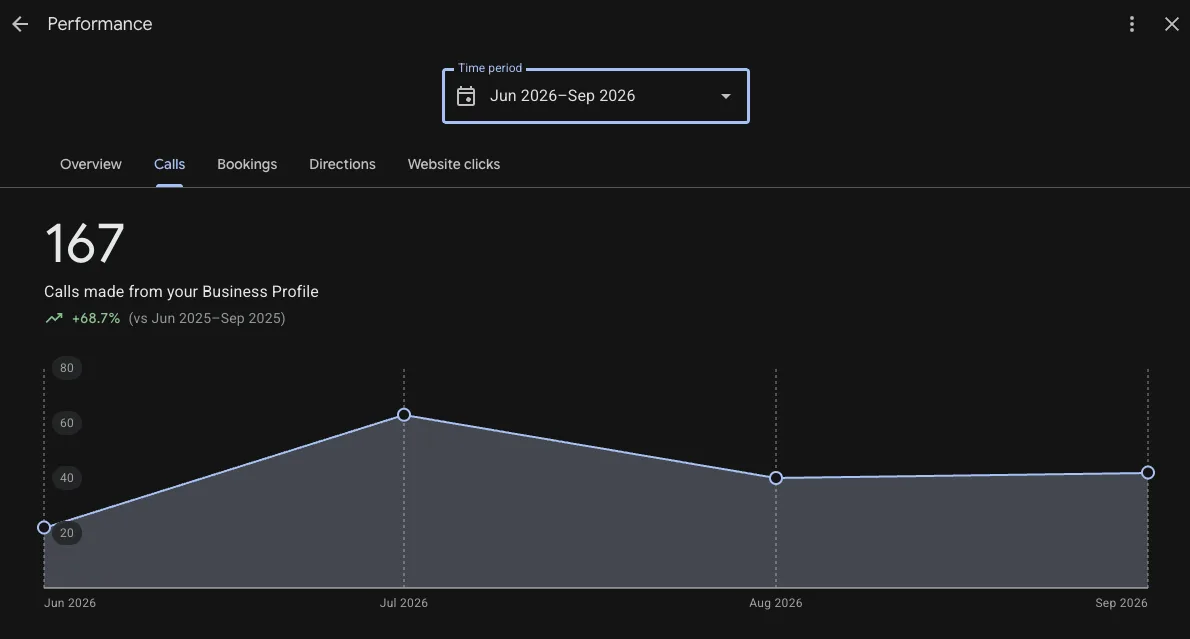
Our multi-location roofing clients show both sides of this. Original Roofing Co. runs three profiles. From June to September 2026, Rochester Hills produced 167 calls, up 68.7%. Grand Rapids produced 72, up 24.1%. Inverness, Illinois, a brand-new profile, produced 10. Ridge Runner Roofing in North Carolina runs three profiles that produced 84, 50 and 48 calls from April to September 2026, and its combined monthly calls rose from 20 in April to 46 in August. All-Side Roofing & Restoration in Ohio produced 141 calls in Dayton, 30 in Huber Heights and 2 in the new Middletown profile.
The pattern: new profiles start slow and take months to earn rank and reviews. If you open a second office, budget for that ramp and don't judge it in the first quarter.
Tony Munoz at Martin Home Exteriors is using a related idea for his rebrand. Instead of renaming his existing, well-reviewed profile, the plan is to run a second profile for the new brand and keep the old one. That's only allowed if both are real businesses with their own presence, so get advice before you try it.
What pages should a roofing website have for SEO?
A homepage for your main city, one page per service, one page per city you serve, and proof pages (projects, reviews, warranty, financing). Each page should target one main search and answer the questions that searcher has. That's the structure Andy lays out in his video, and it's what we build for every roofing client.
What goes on a roofing service page?
Andy calls these "money pages," and they all follow the same anatomy:
- A headline with the service and city, matching the title tag.
- The services: what this job includes, the materials and the options.
- How it works: inspection, estimate, scheduling, the work, cleanup, final walkthrough.
- About you: license, years in business, crews, certifications, warranty.
- Proof: photos of real jobs, reviews and a project or two in that town.
- An FAQ with five to seven real questions homeowners ask on the phone.
- Your name, address and phone in the footer, with a map embed.
- Calls to action throughout, not just at the bottom.
How should location pages be organized?
Nest them. A county page links to the city pages in that county. Each city page links to its city-and-service pages, like "roof repair in [city]," where there's real demand. Everything links back up to the county page and the homepage. That's the structure from Andy's video, and it gives Google a clear map of where you work.
| Level | Example URL | Links to |
|---|---|---|
| Homepage | / | Every service page and every county or main city page |
| Service | /roof-repair | The city versions of that service |
| County | /palm-beach-county | Every city page in the county |
| City | /palm-beach-county/lake-worth-beach | City-service pages, the county page |
| City + service | /palm-beach-county/lake-worth-beach/roof-repair | The city page and the main service page |
The rule that keeps this safe: every page has to be genuinely about that place. Name the neighborhoods, mention jobs you've done there, talk about local weather and building codes, and quote local reviews. Google's spam policies describe pages that swap only the city name as doorway pages. Those don't hold their rankings, and a site full of them can drag down the good pages too.
The results can be big when it's done right. Bodhi's audit video shows a landing page we built for Neal Roofing & Waterproofing in May 2025 that grew from zero to about 3,100 organic visits a month. Our website guide covers what that page does well: roofing website design.
How should roofers write title tags and headings?
Put the service and the city in the title tag and the H1, in plain words: "Roof Repair in Lake Worth Beach, FL | [Company]." Keep titles under about 60 characters so they don't get cut off, and make each page's title unique. These are still some of the strongest on-page signals you control.
- Title tag: service + city + brand. One page, one main search.
- H1: close to the title, written for a person.
- Meta description: what you offer and why to call, under about 155 characters. It doesn't rank you, but it gets the click.
- Subheadings: the questions homeowners ask, answered right below each one.
- Images: real job photos with descriptive alt text ("new standing seam metal roof in Chandler, AZ").
- Internal links: from the homepage and service pages to every city page, using plain anchor text.
In the Omaha audit, Bodhi checks the H1 and meta description first. It's a two-minute check that tells you whether a site was built with search in mind at all.
How do roofers get more Google reviews?
Ask every customer, every time, at the moment they're happiest: right after the job is finished and cleaned up. Send a text with a direct review link the same day, follow up by email a few days later, and reply to every review you get. A system beats a burst. Our best-performing clients get 25 new reviews/month.
That's the system Andy describes in his video: an automated text after the job, then an email, so nobody falls through the cracks. Tony Munoz shows what it can do. His Google reviews went from about 60 to about 160 in the first eight months of working with us, and he's now in the top three on the map in Jacksonville.
- Get your direct review link from your Google Business Profile and shorten it.
- Train crews and project managers to mention it at the final walkthrough, in person.
- Send the text the same day, from a name the customer knows, with the link.
- Follow up once by email two or three days later.
- Reply to every review within a few days. Thank people by name and mention the job.
- Track reviews by location and by person so you know who's asking.
What not to do: don't offer anything in exchange for a review, don't ask only happy customers, don't post reviews yourself and don't tell customers what to write. Google's policies on fake engagement forbid incentives and selective asking, and the FTC's final rule on fake reviews covers buying reviews and suppressing negative ones. In Florida, Statute 489.147 also bans giving homeowners gifts in exchange for a roof inspection, so be careful with any giveaway near the sales process.
How should a roofer reply to a bad review?
Quickly, calmly and briefly. Thank them, acknowledge the problem without arguing, and offer to fix it offline with a name and number. Future customers read the reply more than the complaint. If a review breaks Google's policies, such as a fake review from someone who was never a customer, report it through the profile, but don't count on it coming down.
What links and citations does a roofing company need?
Consistent listings on the main directories and a small number of real, relevant links: manufacturer and supplier contractor directories, local business groups, local news and community sites. Andy's advice in the video is to skip cheap bulk links from marketplaces. A handful of real local links beats hundreds of junk ones.
| Type | Examples | Why it helps |
|---|---|---|
| Core listings | Google, Bing Places, Apple Business Connect, Yelp, BBB, Facebook, Nextdoor | Consistency across the web, and what AI tools check |
| Industry directories | Shingle and metal manufacturers' contractor finders, supplier sites | Relevant, trusted, often local |
| Local organizations | Chamber of commerce, home builders association, sponsorships | Real local links |
| Local press | Storm recovery stories, community projects, hiring news | Strong prominence signals |
| Partners | Realtors, home inspectors, insurance agents, gutter or solar partners | Referrals and relevant links |
In the Omaha audit, Bodhi found the market leader, Innovative Roofing, getting about 4,100 visits a month and building links through local link-exchange posts with other businesses. He called it gray hat, and so would we. It can work for a while, but trading links at scale is the kind of thing Google's spam policies target. We'd rather earn the links.
The most common citation problem we see isn't missing listings. It's old ones: an old phone number, a previous address or a former business name still sitting on directories. Clean those up before you build anything new.
What technical SEO does a roofing website need?
A site that loads fast on a phone, can be crawled and indexed, has one clear URL per page, uses HTTPS, and has structured data that matches the page. Most roofing sites don't need anything exotic. They need the basics done right.
- Speed: compress photos, which are the usual culprit on roofing sites full of job pictures. Check with PageSpeed Insights.
- Mobile: tap-to-call buttons, readable text and forms that work with a thumb.
- Indexing: check Google Search Console for pages that aren't indexed and fix the reason.
- Structured data: LocalBusiness markup, using the more specific RoofingContractor type, with your real name, address and phone.
- Broken links: Bodhi found a broken YouTube link on the Omaha homepage. Small, but it's the kind of thing that adds up.
- Redirects: if you rebrand or move pages, redirect every old URL to its new one.
Why does branded traffic hide weak SEO?
Because people who already know your name will find you no matter what, so a site can look busy while ranking for almost nothing new. The test is how much of your organic traffic comes from searches that don't include your name. Those are the new customers.
The Omaha audit is a good example. The company's site got about 77 organic visits a month, and 93% of that came from branded searches. Branded search worked well, and the company even had a mention on Reddit. But for "roof replacement omaha," the map grid put it around 8th or 9th. Its leading competitor got about 4,100 visits a month. That gap is non-branded rankings: service pages, city pages and the profile work above.
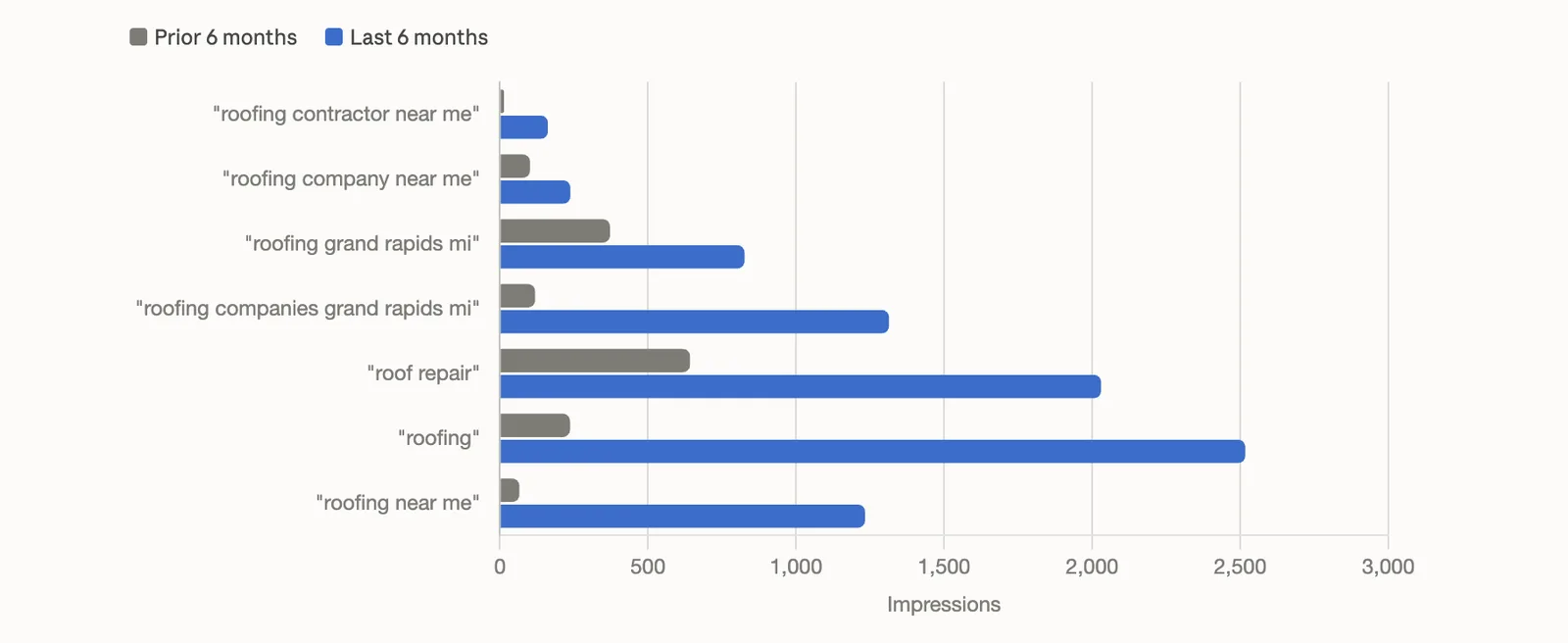
Giant Roofing & Exteriors in Ada, Michigan shows the other direction. Its organic traffic went from almost nothing to about 363 visits a month in SEO-tool estimates, and Google Search Console impressions for "roofing" grew about 12 times. All-Side Roofing & Restoration's traffic grew from about 1,500 to about 4,600 visits a month. Those are tool estimates, so read them as direction, not exact counts.
Should roofers build pages for certifications, insurance claims and storm damage?
Yes, if they match work you really do. Homeowners search "storm damage roof repair [city]," "hail damage roof inspection" and "insurance roof replacement," and a dedicated page answers those searches better than a line on the homepage.
- Storm and hail damage page. What damage looks like, what an inspection covers, how you document it, and what to do right after a storm. Keep it live all year, not just after an event.
- Insurance claims page. How the process works and where you help, written within your state's rules. Avoid promises about coverage or deductibles.
- Certification pages. If you hold a current manufacturer certification, explain what it means for the homeowner's warranty and link to the manufacturer's contractor locator listing, which is also a useful citation.
- Financing page. Replacement is a big purchase, and "roof financing [city]" is a real search.
Storm chasers often run thin, short-lived sites. Pages with your own job photos, local addresses and years of reviews are hard for them to copy.
Does roofing SEO help with ChatGPT and AI search?
Yes. The same work that helps you rank (consistent listings, reviews, clear answers on your pages and mentions on other sites) is what AI assistants use when they name local companies. There's not enough separate search demand for roofers to treat AI search as its own project yet, so we fold it into SEO and track it.
Pineapple Roofing in Lewisville, Texas is our clearest early case. Its AI visibility score went from 0 to 20 in December 2025, and tracked ChatGPT prompts mentioning it went from 0 to 3. That's early and small. In the Omaha audit, ChatGPT didn't name the company for its main searches at all. Our AI search guide covers the full method for home service companies.
When do roofing SEO changes start bringing calls?
Map rankings can move within weeks of fixing a profile. Service and city pages usually take three to six months to rank well, longer in crowded markets. New profiles and new locations take the longest. Anyone who promises page one in 30 days is guessing or cutting corners.
| Work | When you usually see it |
|---|---|
| Profile fixes (category, services, photos) | Weeks |
| Review system | Steady improvement over months |
| New service and city pages | Three to six months |
| Links and citations | Months, compounding |
| A new location's profile | Months, sometimes a year in tough markets |
Real Roofing in Chandler is a good example of the compounding. Its calls from Google from April to August 2026 were up 116.3% on the same months the year before, and it ranks #1 of 63 tracked competitors for "roofing company chandler."
What are the most common roofing SEO mistakes?
The same eight show up in almost every roofing audit we do: keyword-stuffed business names, one "Services" page for everything, copy-paste city pages, a profile linked to the homepage instead of the city page, no review system, old citations, a slow site full of uncompressed photos, and no tracking. Each one is fixable, and most are cheap to fix.
| Mistake | Why it hurts | The fix |
|---|---|---|
| Keywords added to the business name | Breaks Google's guidelines and risks suspension | Use your real name, or legally rebrand if you want a different one |
| One "Services" page | Can't rank for repair, replacement and materials at once | One page per service |
| Copy-paste city pages | Treated as doorway pages, and they don't convert | Real local content on each page, or fewer pages |
| Profile linked to the homepage | Misses the most relevant page for that office | Link each profile to its city page |
| Reviews in bursts | Competitors with steady reviews look more current | Ask after every job, every week |
| Old listings with old details | Mixed signals about who and where you are | Clean up before building new ones |
| Huge photo files | Slow pages on phones, where most searches happen | Compress and resize every image |
| No call tracking | You can't tell what's working | Tracked numbers on the site and the profile, tied to your CRM |
One more, specific to roofers: chasing every storm market at once with pages for towns you can't serve well. It spreads your effort thin and puts your name on reviews from jobs your crews couldn't get to on time. Build where you can deliver, then expand.
How should roofing SEO change with the seasons?
It shouldn't stop. The work you do in the slow months is what ranks in the busy ones, because pages and links take months to pay off. What changes by season is the content you add and the profile updates you post.
| Season | Demand in most markets | SEO focus |
|---|---|---|
| Late winter | Lower, except ice dams and wind damage in the north | Build new service and city pages, clean up citations |
| Spring | Rising, with leak calls and storm season starting | Storm and inspection pages, fresh photos, review push |
| Summer | High, plus hail in many regions | Storm damage posts on the profile, project galleries |
| Fall | Steady, with "before winter" replacements | Replacement and financing content, gutter pages |
Your region changes the calendar. Florida roofers like Garabar and Neal plan around hurricane season. Northern roofers like Mighty Dog and Original plan around snow and ice. Match your content to what homeowners in your area are actually worried about each month.
A roofing SEO checklist
Work through this in order. The early steps are free and fast, and everything later builds on them.
- Fix the Google Business Profile. Real name, Roofing contractor category, real address, true service areas, every service, photos and a page link.
- Set up tracking. Search Console, analytics, call tracking and a monthly map grid for your core searches.
- Start the review system. Text after every job, email follow-up, reply to every review.
- Clean up citations. One name, address and phone everywhere.
- Build service pages. Repair, replacement, inspection, storm damage and each material you sell.
- Build location pages. County and city pages with real local content, linked from the homepage.
- Earn local links. Manufacturer directories, suppliers, local groups and press.
- Review monthly. Grids, calls by profile, non-branded traffic and signed jobs by source.
Get ahead of the next storm season. On a free growth call we check where you rank for “roofer near me,” how your site sells inspections, and where calls slip through.
Book a Growth CallRoofing SEO results from our clients
These numbers come from our 2026 roofing results deck. Calls are calls from the Google Business Profile. Results are specific to each client and don't predict for anyone else.
| Client | Result |
|---|---|
| Garabar Roofing, Lake Worth Beach, FL | 656 calls Apr–Sep 2026; 1.13 avg rank for "roofer lake worth" |
| Neal Roofing & Waterproofing, West Palm Beach, FL | 661 calls Apr–Sep 2026; landing page from 0 to about 3,100 visits a month |
| Real Roofing, Chandler, AZ | Calls up 116.3% (Apr–Aug 2026); #1 of 63 |
| Raven Roofing, Beaverton, OR | Organic traffic up 84% to about 2,300 visits a month; 1.56 avg rank |
| All-Side Roofing & Restoration, Dayton, OH | Organic traffic from about 1,500 to 4,600 visits a month |
| Giant Roofing & Exteriors, Ada, MI | Organic traffic from near zero to 363 visits a month |
| Surge Exteriors, Quincy & Macomb, IL | Profile interactions up 431% to 1,631; Macomb calls up 205% |
Not all of it is finished. Giant ranks 1.16 for "siding" and 1.37 for "roof repair" but 8.71 for "roofing near me," which is still weak. See every client's results, good and bad, on our roofing case studies page.
How do you measure roofing SEO results?
By calls, forms and signed jobs from search, not by rankings alone. Rankings and traffic tell you whether the work is moving; calls and jobs tell you whether it's paying. Track both, in that order of importance.
| What to track | Where it comes from | How often |
|---|---|---|
| Calls from the Google profile | Business Profile performance report | Monthly |
| Map rank across your area | A ranking grid for your main searches | Monthly |
| Non-branded organic clicks | Google Search Console, with your company name filtered out | Monthly |
| Calls and forms from organic visits | Call tracking and form tracking on the site | Monthly |
| Inspections, estimates and signed jobs from search | Your CRM, with the lead source kept on every job | Quarterly |
The return math is simple once the source is tracked: revenue from jobs that came from search, minus what you spent on SEO, divided by what you spent. Expect the early months to show movement in rank and traffic before they show jobs, and judge the return over a year rather than a single month. Ridge Runner Roofing's three profiles, for example, went from 20 combined calls in April to 46 in August; that's the kind of trend that shows up in the monthly report long before it shows in a year-end total.
One trap: total organic traffic often rises because more people search your name, not because you rank for more. That's why we filter out branded searches; more on that above under branded traffic. To see how search leads compare with referrals, bought leads and door knocking, read our roofing lead generation guide.
Should you do roofing SEO yourself or hire someone?
You can do the profile, reviews and citations yourself if you have a few hours a week and the discipline to keep at it. Pages, links and technical work usually need a specialist. Whoever does it, insist on reports that show calls and rankings, not just "activity."
If you hire, ask to see real roofing results with the town named, ask who writes the pages and ask how they'll report calls by source. Our guide to choosing a roofing marketing agency has the full list of questions. Vish Mazumder's description of what he values is a good bar: "great team, super responsive."
For the rest of the system, see the roofing marketing guide, our Google Maps guide for roofers and our Google Ads and LSA guide.
FAQ
What is roofing SEO?
The work of getting a roofing company to show up when homeowners search for roofing in the towns it serves, in both the Google map pack and the regular results. It covers the Google Business Profile, service and city pages, reviews, links, listings and the technical health of the site.
How many months before roofing SEO pays off?
Profile fixes can move map rankings in weeks. New service and city pages usually take three to six months to rank, and new locations take longer. Crowded metro markets take the longest.
What's the best Google Business Profile category for a roofer?
"Roofing contractor" as the primary category. Add secondary categories, like gutter or siding services, only for work you really do.
Can a roofer add "roofing" or a city to its Google business name?
Only if it's genuinely part of your real business name. Google's guidelines say the name should match how the business appears in the real world, and adding keywords risks suspension.
How many city pages should a roofing website have?
One for each town or county you really serve and can write something specific about. A few strong pages beat dozens of copy-paste ones, which Google treats as doorway pages.
How do roofers get more Google reviews?
Ask every customer at the final walkthrough, send a text with a direct link the same day, follow up once by email, and reply to every review. Our best-performing clients get 25 new reviews/month.
Can I offer a discount for a Google review?
No. Google's policies forbid incentives for reviews, and the FTC's rule on fake reviews covers buying them. Ask every customer and let them write what they want.
Do backlinks still matter for roofing SEO?
Yes, but quality matters far more than quantity. Manufacturer and supplier directories, local organizations and local press help. Bulk links from marketplaces don't.
Does SEO help my roofing company show up in ChatGPT?
Yes. AI assistants lean on the same signals: consistent listings, reviews, clear answers on your site and mentions on other sites. Pineapple Roofing's AI visibility score went from 0 to 20 in a month in our tracking, an early but real sign.
Should a roofing company blog?
Only after the service and location pages are built. Research posts like how long a roof lasts can bring traffic and links, but they should link back to the pages that book inspections.