
Choose a roofing marketing agency that can show real results for other roofing companies, explains exactly what it will do each month, reports on calls and signed jobs rather than just traffic, lets you own your website, Google profiles and ad accounts, and is honest about what it can't promise. Ask for map grid reports, call data and client references, check how they get reviews and handle storm advertising, and walk away from anyone who guarantees rankings or won't let you leave with your own accounts.
Every roofing owner gets the calls and emails: "We'll get you to number one on Google." Some of those agencies are good. Many aren't. This guide explains how to tell the difference, what questions to ask, what good reporting looks like and which red flags to take seriously. We're an agency ourselves, so read it with that in mind; the questions here are the same ones we'd want any roofer to ask us.
What work should a roofer expect from a marketing agency?
A good roofing agency improves the things that bring calls: your Google Business Profiles and map rankings, your reviews, your website's service and location pages, your Local Services Ads and Google Ads, and your tracking. Then it reports on calls and jobs, not just rankings, and tells you plainly what's working and what isn't.
| Area | What good work looks like |
|---|---|
| Google Business Profile | Correct categories, services, service areas, regular photos and posts, map grid tracking across your area |
| Reviews | A simple, honest system to ask every customer, and replies to every review |
| Website | Fast mobile pages for each service and office city, real photos, clear contact options, schema |
| SEO | Content that answers homeowners' questions, local links and citations, technical fixes |
| Local Services Ads | Verification, budget and service settings, lead disputes, response tracking |
| Google Ads | Tight keywords by service, negative keywords, matching landing pages, conversion tracking |
| Tracking and reporting | Calls and forms by source, ideally connected to signed jobs in your CRM |
Not every roofer needs all of it at once. A good agency tells you where to start, based on your market and where your leads come from today.
Does an agency need roofing experience?
It helps a lot. Roofing has its own search patterns, seasons, storm cycles, insurance rules and Google categories. An agency that has worked with roofers knows that "roof repair" and "roof replacement" are different campaigns, that storm advertising has legal limits in some states, and that a new location's profile takes months to ramp up.
Ask to see results for roofing companies specifically, not just "home services." Look for map grid reports, call data from Google profiles and organic traffic trends. Then check that the companies are real: look them up on Google Maps and visit their websites.
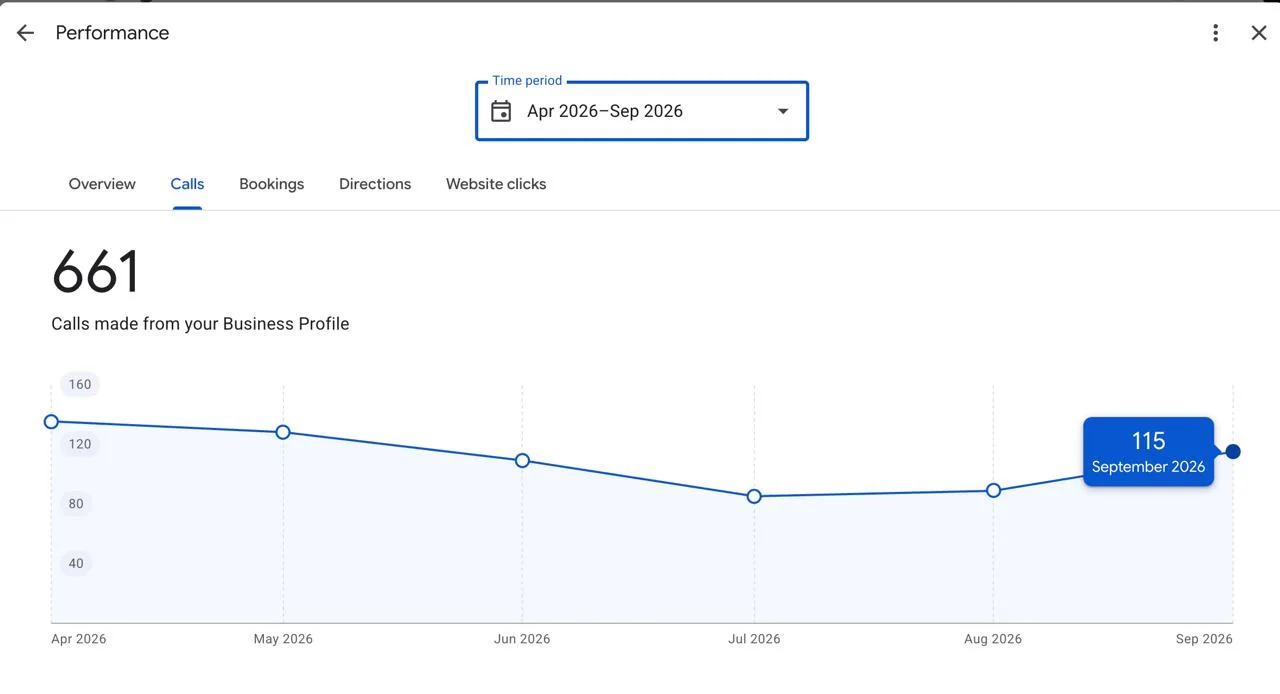
Our own roofing results are public. From April to September 2026, Neal Roofing & Waterproofing in West Palm Beach produced 661 calls from its Google profile, and Garabar Roofing produced 656. Our roofing case studies list all eighteen roofing clients in our 2026 results deck, including the ones whose numbers are weak or falling.
What should a roofer ask an agency before signing anything?
Ask questions that force specific answers. Vague answers to these are a warning sign.
- Which roofing companies do you work with now, and can I talk to one? Real references are the best proof.
- What will you do in the first 90 days, and each month after? You should get a clear plan, not "we'll optimize everything."
- How do you measure success? The answer should include calls and leads, ideally signed jobs, not just rankings or traffic.
- Can I see a sample report? Look for map grids, calls by source and plain explanations.
- Who owns the website, Google profiles, ad accounts and tracking numbers? You should.
- What happens if we stop working together? You should keep everything, including the content.
- How do you get reviews? The answer should be an honest ask-every-customer system, never fake or paid reviews.
- How do you handle storm and insurance advertising in my state? They should know the rules or know to check.
- Who will actually do the work, and who's my contact? Know whether it's in-house or outsourced.
- What can't you promise? An honest agency will tell you.
What should you ask about an agency's SEO and Google Maps work?
How they decide what to work on, what they'll change on your profile and website, and how they'll show progress across your whole service area. Good SEO for roofers is specific; vague answers usually mean templated work.
- How will you track my map rankings, and for which keywords and towns?
- Which pages will you create or improve first, and why?
- Who writes the content, and will it use my own photos and projects?
- How do you build local links and citations?
- How will you handle my service-area towns without creating doorway pages?
- What will you do about competitors with fake addresses or spammy names?
- How do you handle a profile suspension if one happens?
Our roofing SEO guide explains what this work involves, so you can judge the answers.
What should you ask about an agency's Google Ads and LSA management?
How they structure campaigns, control waste and connect spend to jobs. Paid ads can lose money quickly in roofing, where clicks are expensive and many searches aren't from homeowners ready to hire.
- How will campaigns be split by service: repair, replacement, storm, commercial?
- Which negative keywords will you use from day one?
- Which landing pages will each ad group use?
- How do you track calls and forms, and can you import signed jobs?
- Who disputes invalid Local Services Ads leads, and how often?
- How will you handle the 2026 move of Local Services Ads into Google Ads?
- Will the accounts be in my name, and will I see the same data you do?
See our Google Ads and LSA guide for roofers for what good management looks like.
What belongs in a monthly report for a roofing company?
Leads and where they came from, first. Then the measures that drive them: map rankings, organic traffic, ad performance and reviews. A report that's all rankings and impressions, with no calls, is hiding the most important number.
- Calls and forms by source: Google profile, organic, Local Services Ads, Google Ads, other.
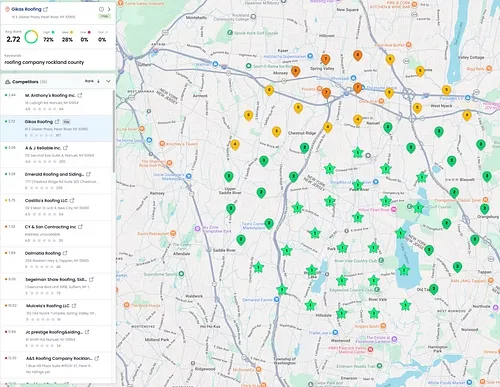
- Map grid reports for your main keywords in each market, showing ranks across the area, not just at your office.
- Google Business Profile performance: calls, direction requests, website clicks.
- Organic traffic to service and location pages, from Search Console and analytics.
- Ad results: spend, leads, cost per lead and, if connected, cost per signed job.
- Reviews: new reviews and average rating.
- What was done that month and what's next.
- Honest notes on what's not working.
The data should come from sources you can check yourself: your Google Business Profile, Search Console, analytics, ad accounts and call tracking. If you can't log in and see the same numbers, ask why.
Who should own your website, Google profiles and ad accounts?
You. Your company should own the domain, the website (or be able to move it), the Google Business Profiles, the Google Ads and Local Services Ads accounts, the analytics and Search Console properties and the tracking numbers. The agency should have access as a manager, not ownership.
This matters most when you leave. Agencies that own your ad account or your profile can make leaving painful: lost history, lost reviews or a website you have to rebuild. Some build sites on platforms they rent to you and take them down when you go.
- Google Business Profile: you're the primary owner; the agency is a manager.
- Google Ads and LSA: the account is in your company's name and billed to your card or invoice.
- Domain: registered to your company, with your login.
- Website: hosted in your account or easily transferred, with all content and photos yours.
- Call tracking: numbers that can be ported to you if you leave.
Which agency habits should make a roofer walk away?
Promises nobody can keep, unclear work, no proof and practices that put your Google profile at risk.
- "Guaranteed number one rankings." Google's own guidance on hiring an SEO says no one can promise a number one ranking.
- No roofing results they can show, or results they won't let you verify.
- Owning your accounts or refusing to give you access.
- Fake or paid reviews, or review "gating" that sends only happy customers to Google.
- Fake addresses or virtual offices to create extra Google profiles. They get suspended.
- Keyword-stuffed business names on your Google profile.
- Hundreds of copy-paste city pages that Google may treat as doorway pages.
- Reports with no calls, only impressions and rankings.
- Locking you in with long terms before they've shown results.
- Vague answers to what they'll actually do each month.
One red flag is easy to miss: an agency that won't talk about results it didn't get. Every agency has clients whose numbers stalled. Ask about one, and listen to how they explain it.
Google's help page on hiring an SEO is worth reading before any sales call. It covers what good SEOs do, what to ask and the warning signs.
How do you check an agency's roofing results?
Look up their clients yourself. Search the client's name and city on Google Maps, check where they show for "roofer" and "roof repair" in their area, read their reviews and look at their website. Then ask to talk to the owner.
- Search the company on Google Maps from their town. Do they show up in the top three?
- Check their review count and how recent the reviews are.
- Look at their website on your phone. Is it fast and clear?
- Ask the agency for screenshots from the client's Google profile and Search Console.
- Ask for a reference call with a roofing owner, and ask that owner what they'd change.
- Watch for results that are only rankings for odd keywords nobody searches.
Customer videos help, too, when they're unscripted. Vish Mazumder of Mighty Dog Roofing north of Boston talks in his own words about growing his franchise and working with us.

What types of marketing companies work with roofers?
Generalist agencies, home services agencies, roofing-only agencies, lead sellers, and freelancers or software tools. Each can work; each has trade-offs.
| Type | Strengths | Watch out for |
|---|---|---|
| Generalist agency | Broad skills, often strong design | Little roofing or local-search experience |
| Home services agency | Knows local search, LSA and the trades | Check roofing results specifically |
| Roofing-only agency | Deep roofing experience | May serve your competitors in the same market; ask how they handle that |
| Lead sellers | Fast leads | Leads often shared with other roofers; you build their brand, not yours |
| Freelancers and tools | Lower cost, flexible | Gaps in skills, your time to manage |
Ask any agency how many roofers it works with in your market and how it handles conflicts. There's no single right answer, but you deserve a straight one.
When does a roofing company need a marketing agency?
When marketing is costing you jobs because nobody has time to do it well, or when you've outgrown what one person in the office can run. If you're still doing most sales yourself and referrals keep the crews busy, you may not need one yet.
- Your calls are flat or falling while competitors with weaker work rank above you on the map.
- Your ads spend money but nobody can say which searches turned into signed jobs.
- You're opening a second office or a new service, and the website and profiles need to grow with it.
- Work is lumpy: busy after storms, quiet in between, with no steady base from search.
- The owner is the marketing department and it's getting done at 10 p.m. or not at all.
If two or more of those are true, the questions in this guide will help you pick well. If none are, put the time into reviews, your Google profile and following up on estimates first; an agency can't fix a sales process that loses the leads it brings. Our roofing lead generation guide covers call handling, qualifying and estimate follow-up.
Should a roofer hire a marketing manager or an agency?
It depends on your size and who you have. Many small roofers do the basics themselves: the Google profile, review requests, photos and neighbor marketing. Technical SEO, website builds and paid ads are where outside help usually earns its fee. Larger companies often hire an in-house marketing manager who works with an agency for specialist work.
| Task | Easy to do yourself | Often worth outside help |
|---|---|---|
| Review requests and replies | Yes | Setting up the system |
| Job photos and Google posts | Yes | Planning and consistency |
| Google profile setup | Mostly | Map grid tracking and multi-location strategy |
| Website and SEO | Basic edits | Builds, technical SEO, content and links |
| Local Services Ads | Basic setup | Optimization and the 2026 move into Google Ads |
| Google Ads | Rarely | Most roofers benefit from an expert |
Even with an agency, someone in your company needs to own the results: answering calls, following up, asking for reviews and checking the reports. Those stay with your office and crews.
Get ahead of the next storm season. On a free growth call we check where you rank for “roofer near me,” how your site sells inspections, and where calls slip through.
Book a Growth CallHow often should you meet with your roofing marketing agency?
Monthly is common, with a written report before each meeting and quicker contact when something urgent comes up, like a storm, a suspended profile or a sudden drop in calls. In the first 90 days, more frequent check-ins help both sides learn fast.
Use the meetings well. Bring what you're seeing on the ground: which calls turned into jobs, which towns you want more of, what crews are busy or idle. Ask the agency to explain anything in the report you don't understand, and agree on the two or three priorities for next month. A good agency relationship feels like working with a part of your team, not receiving a PDF.
If you go two months without being able to say what the agency did and what it produced, something is wrong. Raise it directly before deciding to leave.
What should a roofer see in the first three months with a new agency?
An audit, a clear plan, the foundation fixed and early signs of progress. Big ranking gains usually take longer, but you should see real work and better tracking within the first three months.
- Audit and baseline (weeks 1–2). Review Google profiles, website, rankings, ads and tracking. Record starting map grids, calls and traffic.
- Fix tracking (weeks 1–3). Call tracking, form tracking, Search Console and analytics, all in your accounts.
- Fix the Google profiles (weeks 2–4). Categories, services, areas, photos, and matching location pages.
- Start the review system (weeks 2–4). Ask every finished customer, reply to every review.
- Improve core pages (month 2). Homepage, replacement, repair, inspection, storm and office city pages.
- Launch or fix ads (months 2–3). Local Services Ads verification and Search campaigns by service line.
- Review results (month 3). Compare grids, calls and cost per lead with the baseline, and set the next quarter's plan.
How long before a roofing agency should show results?
Ads can bring leads within days or weeks. Google Maps and SEO usually take months, and the timeline depends on your competition, your starting point and how many reviews you get. New locations take longest.
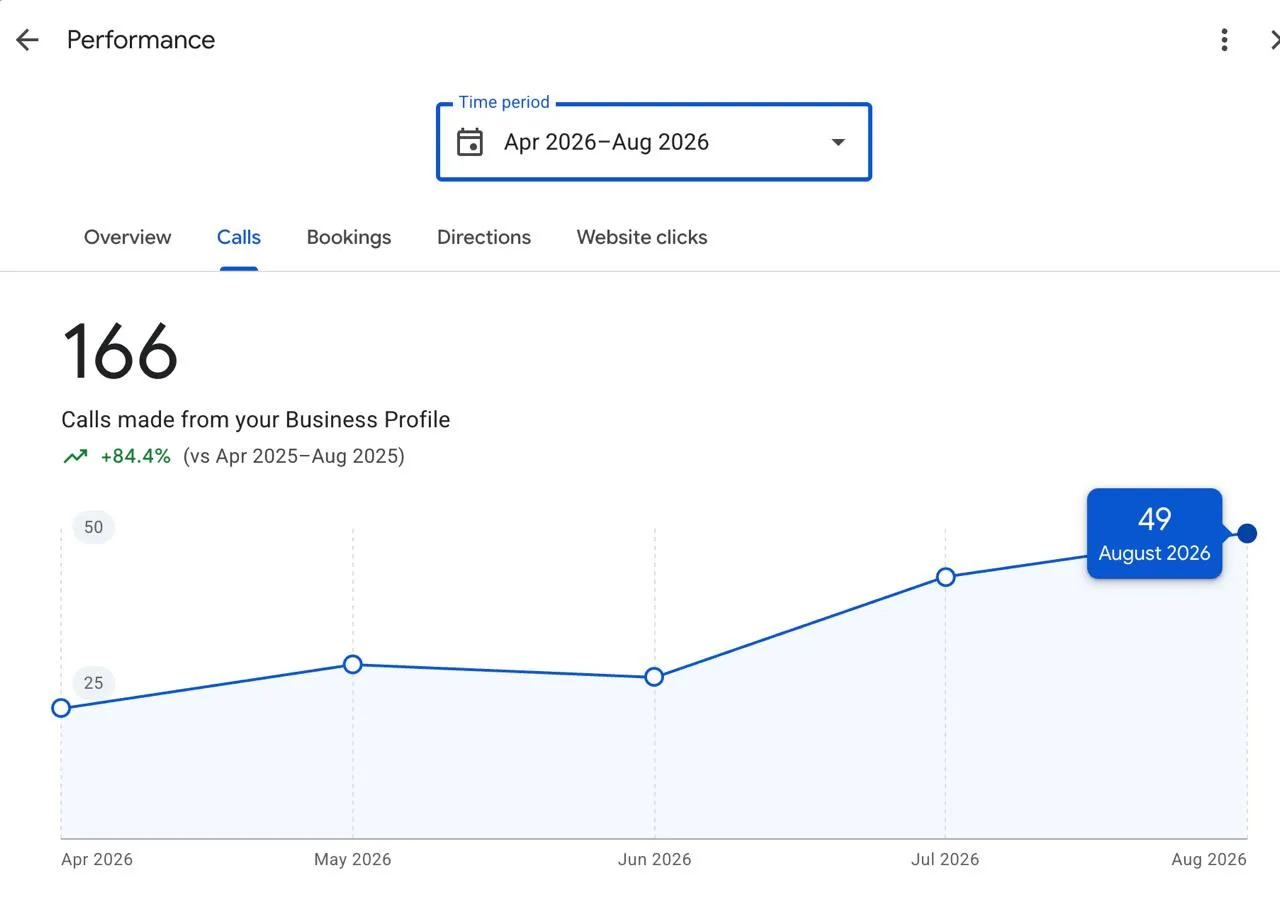
Our client data shows the range. Real Roofing's calls from Google rose 116.3% from April to August 2026 compared with the same months a year earlier, and Gikas Roofing's rose 84.4% over the same stretch. Mighty Dog Roofing's rose 24.4% from May to September. Bumble Roofing of Greater Kansas City's calls were trending down over the same period, with average ranks of 2.6, 2.8 and 7.2 on its tracked keywords. And new profiles start slow: Original Roofing Co.'s new Inverness, Illinois profile produced 10 calls from June to September 2026, while its established Rochester Hills profile produced 167.
An honest agency will show you numbers like Bumble's alongside the wins, and explain what it's doing about them.
What pricing models do roofing marketing agencies use?
Most charge a monthly retainer for ongoing work, a project fee for websites, and sometimes a percentage of ad spend or a fee per lead. Ad spend itself usually goes straight to Google and is separate from the agency's fee.
| Model | How it works | Watch out for |
|---|---|---|
| Monthly retainer | Fixed fee for defined work | Know exactly what's included |
| Project fee | One-time cost for a website or setup | Who owns it afterward |
| Percentage of ad spend | Fee grows with your budget | Incentive to raise spend |
| Pay per lead | Fee for each lead | Lead quality, who owns the lead source |
| Performance or revenue share | Fee tied to results | How results are counted |
Compare agencies on what's included and what it produces, not just the monthly number. A cheap agency that doesn't move calls costs more than a good one that does.
Should an agency know roofing advertising rules?
Yes. Roofing has more advertising rules than most trades, especially around storms and insurance. An agency that writes your ads, storm pages and review requests needs to know them or know to check.
- Insurance and storm advertising. Florida's statute 489.147, for example, bans offering gifts or incentives for an inspection or claim, bans interpreting insurance policies without a public adjuster license, requires disclosures on certain ads and sets fines up to $10,000 per violation. Other states have their own rules.
- Reviews. The FTC's rule on fake reviews bans fake and paid reviews and incentives for positive ones.
- Door-to-door sales. The FTC's Cooling-Off Rule gives buyers three days to cancel many sales made at their home.
- Google's policies. Real addresses only, no keyword stuffing in business names, Local Services Ads verification.
- Financing ads. Advertised terms must meet lender and legal requirements.
What should you prepare before talking to agencies?
Your numbers and your goals. Agencies can give better answers, and you can compare them more fairly, when you start with the same facts for each.
- Where your jobs come from today: referrals, Google, ads, lead sellers, door knocking. Rough percentages are fine.
- Your service area and the towns you most want more work in.
- Your services, and which ones you want more of: replacement, repair, storm, commercial, metal, gutters.
- Your capacity: how many more jobs a month your crews can handle.
- Your average job value and close rate, so you can judge cost per signed job.
- Access to your Google profiles, website, ad accounts and analytics, or a list of who has it.
- What you've tried before and what happened.
If an agency doesn't ask about most of these, it's probably selling a package rather than a plan.
How do you compare roofing agency proposals?
Put them side by side on the same points. Proposals are written to look good; a simple scorecard makes the differences clear.
| Question | What a strong proposal shows |
|---|---|
| Roofing proof | Named roofing clients, map grids, call data, references |
| Plan | Specific work in months 1–3 and ongoing, tied to your goals |
| Measurement | Calls and leads by source, with a path to signed jobs |
| Ownership | All accounts and content in your name |
| People | Who does the work and who you talk to |
| Communication | How often you meet and get reports |
| Leaving | How you exit, and what you keep |
| Honesty | What they won't promise, and why |
Score each from one to five. The highest score isn't always the right choice, but a low score on ownership or honesty should end the conversation.
What does a roofing company need to do for marketing to work?
Answer the phone, follow up, ask for reviews and share photos and information. An agency can bring calls; only your team can turn them into signed jobs.
- Answer calls live or have a service that does. Missed calls waste every marketing dollar.
- Follow up on every estimate more than once.
- Ask each homeowner for a review once the crew has cleaned up and the final walk-through is done.
- Send photos from jobs regularly so the agency can use them on your profile and website.
- Record lead sources in your CRM so you can see which marketing brings jobs.
- Tell the agency what's changing: new services, new locations, crews you've added, slow months.
- Read the reports and ask questions.
The roofing clients with the strongest results in our deck are the ones that do these well. Marketing and operations work together.
How does a roofer leave an agency without losing its profile or site?
Get your access and data first, then give notice. Leaving well protects your rankings and your ad history.
- Confirm ownership of your Google profiles, ad accounts, analytics, Search Console, domain and hosting. Fix anything that isn't in your name.
- Export data: ad reports, call recordings and logs, rankings and traffic history. Local Services Ads reports in particular don't carry over in Google's 2026 move into Google Ads, so save them.
- Get the website files or hosting transfer if the agency hosts it.
- Port tracking numbers if possible, or keep them running until directories are updated.
- Remove the old agency's access after the handover.
- Give the new agency a baseline so they can measure from day one.
Avoid changing your website, Google profile name or main phone number all at once during a switch. Change one thing at a time so you can see what affected rankings.
What should multi-location roofers look for in an agency?
Experience running several Google profiles and location pages, reporting by location and a plan for new markets. Multi-location roofing is harder than single-office marketing, and the mistakes are bigger: profiles suspended for address problems, locations competing with each other and new markets that never ramp up.
Ask for examples. Our multi-location roofing clients include Original Roofing Co. with three profiles in Michigan and Illinois, Ridge Runner Roofing with three in North Carolina that produced 84, 50 and 48 calls from April to September 2026, and All-Side Roofing & Restoration with three in Ohio. Each location's numbers are different, and a good report shows each one separately.
What roofing knowledge should an agency show in the first meeting?
Enough to talk about your jobs, not just your traffic. A good roofing agency should ask, without prompting, how your work splits between repair and replacement, how much is insurance work, what your average signed job is worth, how long replacements take to close, and how your calls change after hail or wind.
- Storm planning. How they would scale ads and pages for a storm in your area, and how they'd stay within your state's solicitation and claim rules.
- Inspections as the offer. Whether they build pages and ads around booking an inspection rather than quoting prices online.
- Long sales cycles. How they track a lead that takes weeks to sign, so a replacement isn't credited to the wrong source.
- Trust signals. How they would use your license, insurance, warranty and any manufacturer certifications on the site and profile.
- Regional seasons. When your busy months fall. In our results, most clients peaked in summer, but Neal Roofing in Florida peaked in April.
If the answers are generic, the work will be too.
Should a roofing agency handle AI search too?
It should at least have a plan for it. Homeowners are starting to ask ChatGPT, Google's AI Overviews and Perplexity for roofer recommendations. The work overlaps with good SEO: clear pages that answer questions directly, consistent business details everywhere, strong reviews and mentions on other sites. Ask how the agency measures AI visibility and what it has seen so far. For one of our clients, Pineapple Roofing, a tool that tracks AI mentions showed its score move from 0 to 20. It's an early measure, and an honest agency will say so.
What does Stryker Digital handle for a roofing company?
We focus on the parts that bring calls: Google Business Profiles and map rankings, reviews, websites and SEO, Local Services Ads and Google Ads, and AI search. Your accounts stay yours. We report on calls, map grids and traffic, and we show you the weak numbers along with the strong ones.
Andy Walker, our founder, walks through the SEO system we use for roofing companies in this video.

If you want to compare us with other agencies, use the questions on this page. For the full system, read our roofing marketing guide, and see every client's results, good and bad, on the case studies page.
Whoever you choose, start with clear goals, keep your accounts in your name and judge the work on calls and signed jobs. Those three habits protect you from most bad agencies and help you get the most from a good one.
FAQ
What's the fastest way to vet a roofing marketing agency?
Ask for verifiable roofing results and references, a clear monthly plan, reports that show calls by source, and confirmation that you own your website, Google profiles and ad accounts. Avoid anyone who guarantees rankings.
Can an agency guarantee first place on Google Maps?
No. Google says no one can promise a number one ranking. A good agency can show the work it will do and the results it has achieved for similar roofers.
Should I own my Google Ads and Google Business Profile?
Yes. Your company should be the owner, with the agency added as a manager, so you keep your history, reviews and data if you leave.
What numbers should a roofer expect in an agency's monthly report?
Calls and forms by source, map grid rankings, Google profile performance, organic traffic, ad spend and leads, new reviews, what was done and what's next.
How long should I give a new roofing marketing agency?
Expect better tracking and foundation work within the first 90 days, ad leads within weeks, and map and SEO gains over several months. New locations take longest.
Is it better to hire a roofing-only agency?
Roofing experience matters, but check results and ask how many roofers they serve in your market and how they handle that.
What are the biggest red flags in a roofing agency?
Guaranteed rankings, owning your accounts, fake or paid reviews, fake addresses for extra profiles, reports with no calls and vague plans.
Should I do roofing marketing in-house instead?
Many roofers handle reviews, photos and their Google profile themselves and hire help for websites, SEO and paid ads. Someone in your company should own the results either way.