
The pest control marketing ideas that bring in the most customers are the ones closest to the call: a complete Google Business Profile, a review request after every service, a page for every pest and town you serve, Local Services Ads with fast call handling, and a second real location when one market is full. After those come referrals, real estate and property partners, technician-sourced leads, past customer campaigns, door-to-door, seasonal offers and community work. Pick a few, track each one with its own number or source code, and keep only what produces recurring customers.
Most lists of pest control marketing ideas are long and flat: 100 ideas, all presented as equally useful. They aren't. Some ideas fill routes this month. Some build an engine that brings calls for years. Some are nice to have. A few waste money. This list groups 45 ideas by what they do, notes which ones our pest control clients lean on, and flags the ones that break Google's rules or tend to cost more than they bring in.
For context on scale, seven of our pest control clients got about 7,400 calls from Google in 2026, mostly May to September. Most of the ideas in the first two groups are what produced them.
How should you choose which ideas to try?
Choose by what the idea does for you: foundation ideas first, then growth, fast fills, referrals, retention and brand, in roughly that order:
| Group | What it does | When to start |
|---|---|---|
| Foundation | Gets you found and chosen when people search | Now, before anything else |
| Growth engines | Builds more calls in more towns over months | Once the foundation is solid |
| Fast fills | Brings calls in days or weeks | When you need jobs now, alongside the foundation |
| Relationships | Steady, high-quality referrals | Any time, slowly |
| Retention and upsell | Makes every customer worth more | As soon as you have recurring customers |
| Brand and community | Makes every other idea work a little better | Once the basics run |
| Usually skip | Popular but low return or risky | Rarely |
One rule for all of them: give each idea its own tracking phone number, web address or CRM source code before you start. If you can't tell whether it worked, you can't decide whether to keep it.
Foundation ideas: get found and chosen
- Complete your Google Business Profile. The right primary category, every pest as a service, real service areas, accurate hours, real photos and a link to a matching location page. For most of our pest control clients, this is where most calls start. Full setup in our Google reviews and Business Profile guide.
- Ask every customer for a Google review after every service. A plain ask from the technician, a QR code, and a same-day text with the link. Ask everyone, offer nothing in return and never suggest what to write. Our best-performing clients get 25 new reviews/month.
- Reply to every review. Thank people for what they actually said, and handle negative reviews calmly with a phone call. Future customers read your replies.
- Build a page for every pest you treat. People search for "mice in attic" or "termite inspection," not "pest control services." One well-written page per pest catches those searches. See our pest control SEO guide.
- Build a page for every town you serve, with real local details, not the same text with the name swapped.
- Put the phone number on every screen. Tap-to-call in the header on mobile, and a button that stays visible as people scroll.
- Use real photos. Technicians, trucks, your office and real work. Stock photos make you look like everyone else.
- Show your license. License numbers on the site, and plain answers about how treatments are applied. The EPA tells homeowners to check licensing before hiring.
- Answer every call live during business hours. Missed calls go to the next company. With Local Services Ads, missed calls can also be charged and hurt your ranking.
- Set up tracking. A required lead source field in your CRM and separate phone numbers for your Google profile, website, ads and print. It's what makes every other idea on this list measurable.
Growth engine ideas: more calls in more towns
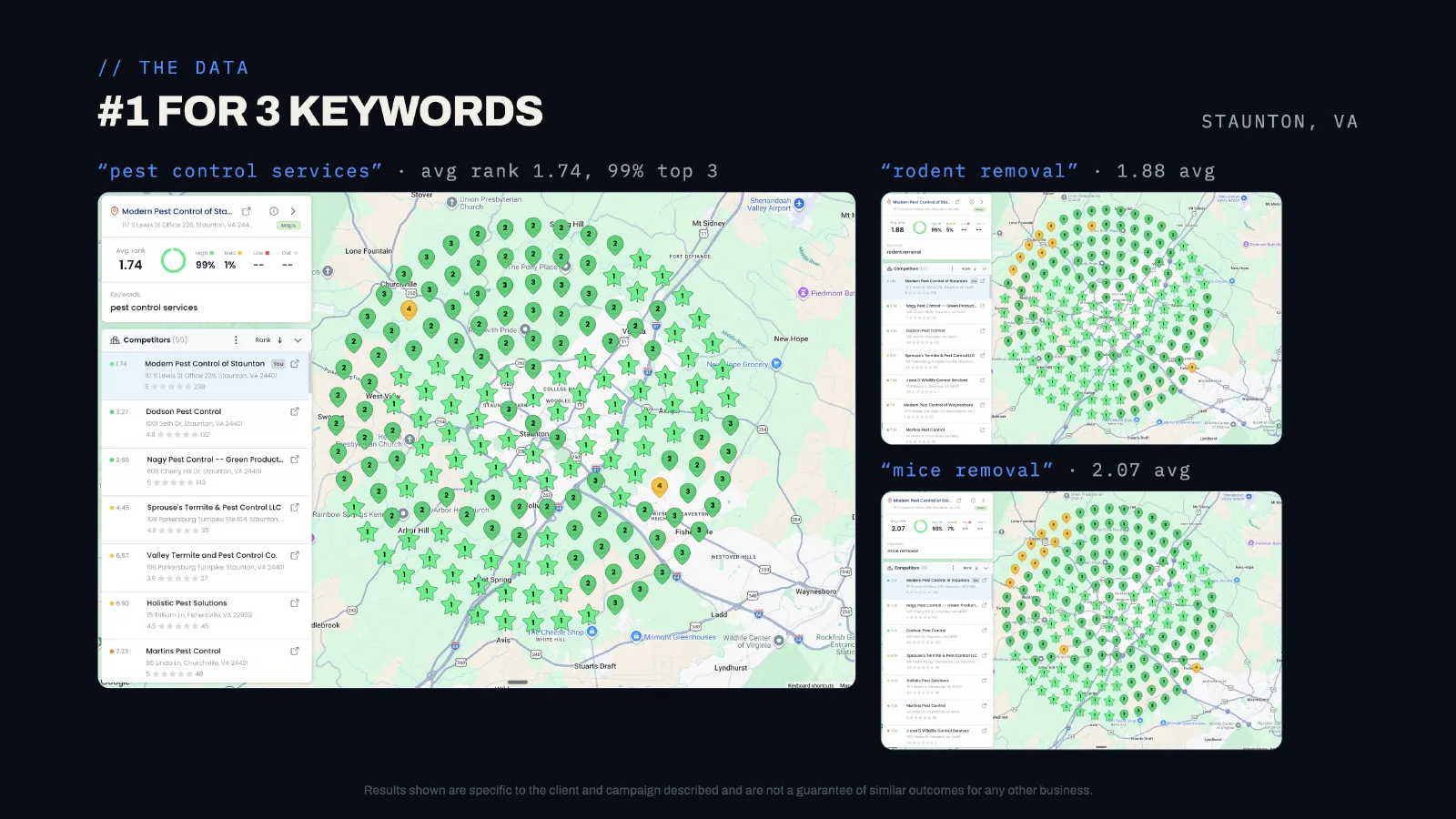
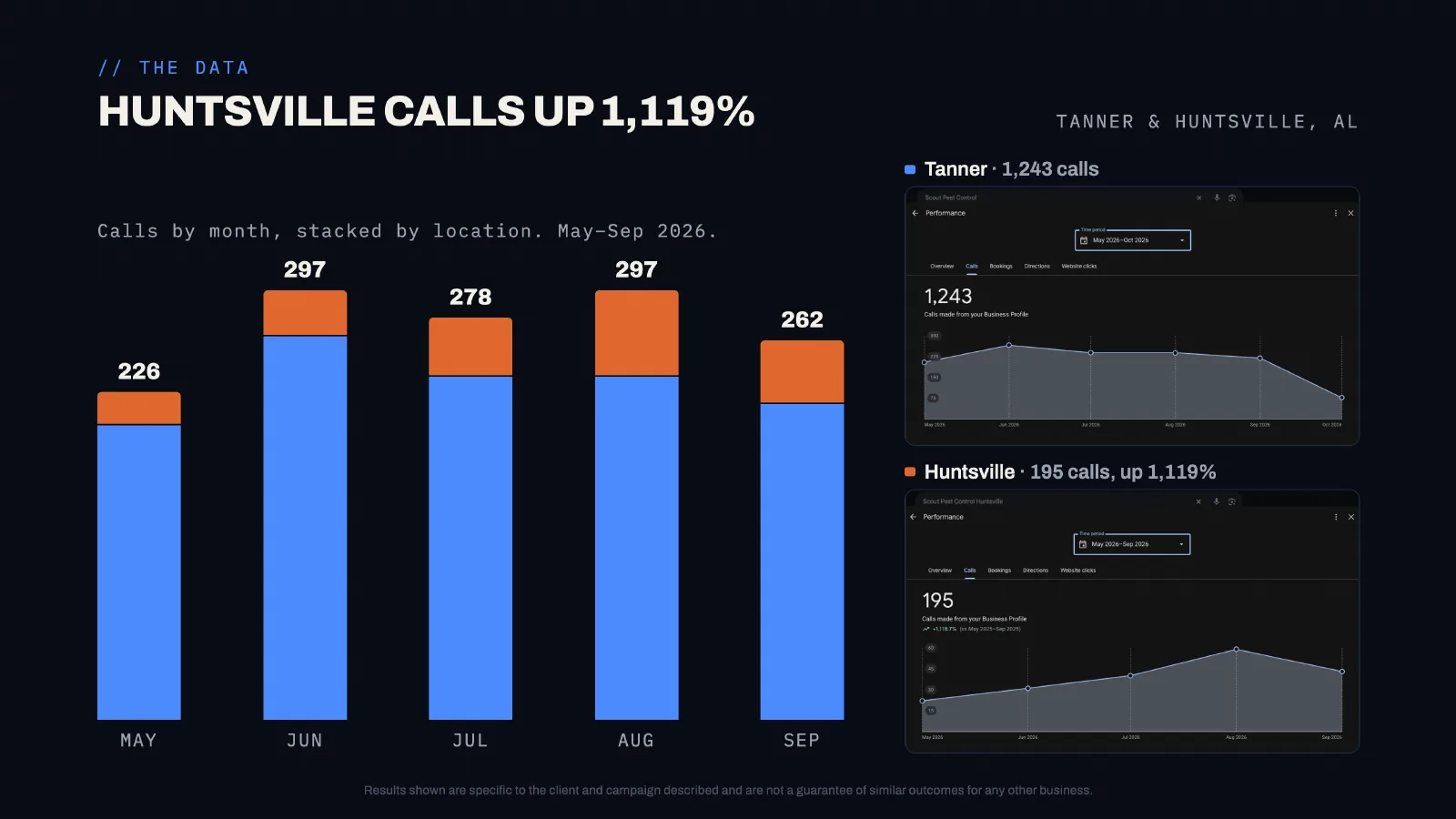
- Open a second real location. A Google profile ranks best around its own address, so a staffed office in a new market is how most of our clients win more of the map. Surge Pest Control's second profile in Leander, Texas, produced 140 calls in its first five months of tracking. Never use a virtual office. More in our Google Maps guide.
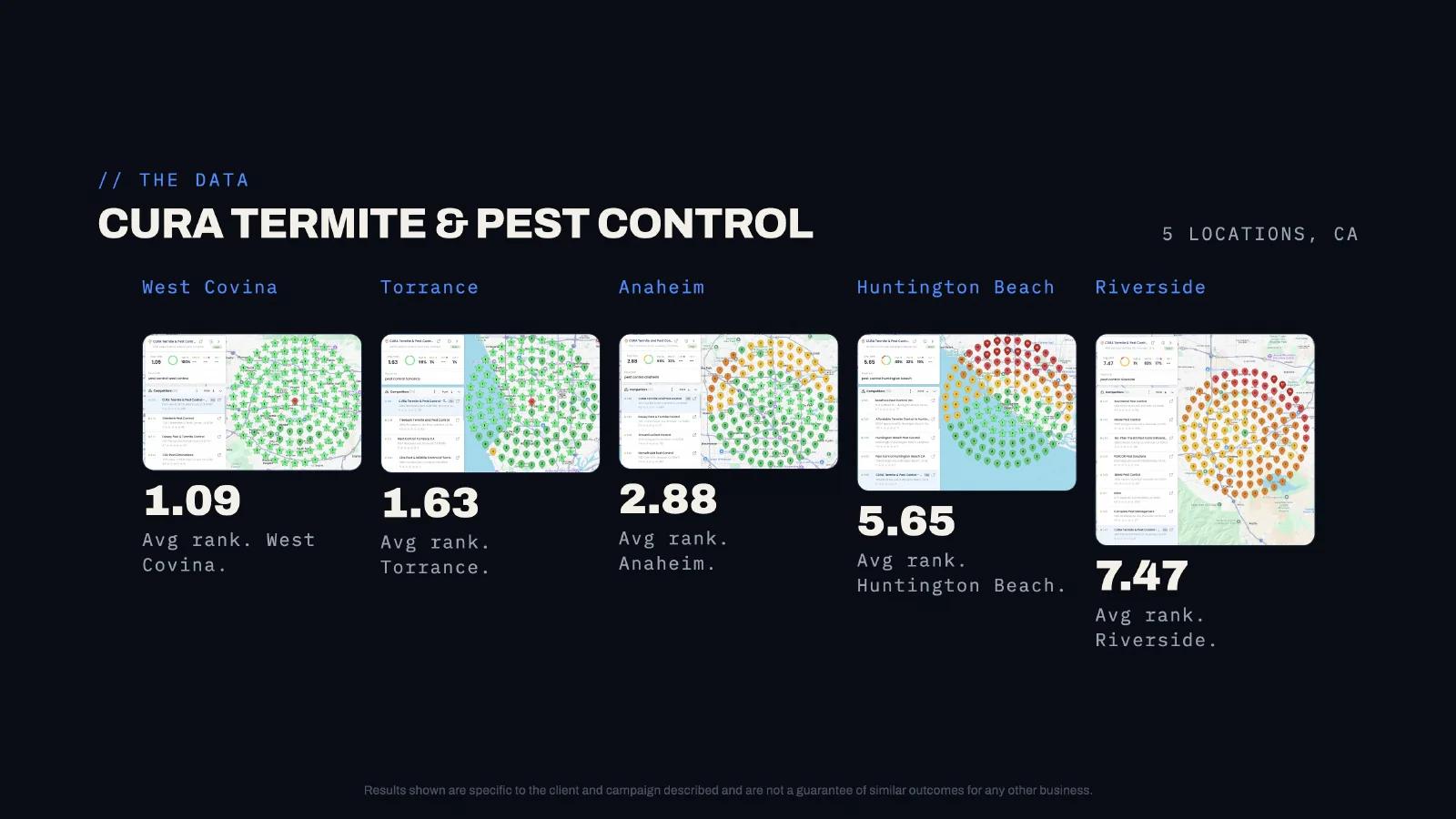
- Track your map rankings on a grid. A single rank check from your office tells you almost nothing. A grid shows where you're in the top three and where you disappear.
- Win pest-specific map searches. "Rodent removal" and "termite inspection" are often easier to win than "pest control," and they bring callers who know what they need.
- Earn local links. Your state pest control association, chamber of commerce, sponsored teams, real estate partners and local news. A handful of real local links helps both map and organic rankings.
- Clean up citations. Fix old addresses, duplicate listings and wrong phone numbers on Yelp, BBB, Apple Maps, Bing and industry directories.
- Write identification and seasonal guides. "Termites vs. flying ants," "signs of mice in walls," and guides published a few weeks before each pest season. Link each one to the matching pest page.
- Get your company into AI answers. Google's AI Overviews and tools like ChatGPT increasingly name local companies. Clear pest pages, consistent business details and steady reviews help. See our AI search guide for pest control.
- Refresh a dated website without losing what ranks. In Bodhi's audit of a $107K/month pest control company, the site looked "like it's from 2015," and the fix was a modern front end and local targeting, not a rebuild from scratch. See our website design guide.

Fast fill ideas: calls this month
- Run Local Services Ads. Pay per lead, with the Google Verified badge, at the top of local searches. Lead costs vary by market and service. Google is moving LSA into Google Ads in 2026, so check our Google Ads and LSA guide for what's changing.
- Split Google Search ads by pest and season. Separate campaigns for termites, rodents, bed bugs, mosquitoes and general pest, each landing on its own page, with budgets that follow the season.
- Add negative keywords from day one. DIY, jobs, product and research searches waste a lot of pest control ad budget.
- Text and email past customers before each season. One message about mosquito service in spring or rodent exclusion in fall, with a booking link, to people who already know you. Get consent for texts and honor opt-outs.
- Win back cancelled plans. A friendly call or message to customers who cancelled in the last year or two, explaining what's included now.
- Work the street you just serviced. After a rodent or termite job, the neighbors often have the same construction and the same risk. A door hanger next door, where local rules allow, reaches people who just watched your truck in the driveway.
- Lead with one seasonal offer. One clear seasonal program on your homepage, profile posts, ads and emails, instead of twelve services competing for attention.
- Add an after-hours missed-call text. An automatic text asking what pest they're dealing with keeps many callers from moving on to the next company.
Want this built for your pest control company? Book a free growth call and we'll review your Google profiles, site and rankings.
Book a Growth CallRelationship ideas: steady referrals
- Run a referral program. Reward customers when a neighbor they refer signs up. Rewarding referrals is common. Rewarding reviews is banned by Google, so keep the two separate.
- Partner with real estate agents and home inspectors. Termite inspections for home sales need fast scheduling and clean reports. Be the company that makes that easy.
- Partner with property managers and HOAs. One relationship can mean many homes or units, with scheduled service.
- Partner with other home service companies. Lawn care, roofing, HVAC, plumbing and handyman companies see pest problems they don't treat. Trade referrals with the ones you trust.
- Go after commercial accounts on purpose. Restaurants, warehouses, schools, medical offices and apartment communities. Build a page for each industry and reach out directly. More in our lead generation guide.
- Be active on Nextdoor. Neighbors ask for pest control recommendations there constantly. Keep a complete business page and respond when you're mentioned.
- Join your state pest control association. Training, credibility, and often a directory listing and a link.
Retention and upsell ideas: worth more per customer
- Offer the recurring plan on every first visit. Explain it on the call, again on site after the problem is handled, and in a follow-up a few days later.
- Cross-sell seasonal services. Termite protection for general pest customers, mosquito service before summer, rodent exclusion before fall.
- Leave a service note after every visit. What was treated, what the technician saw, and what to watch for. Customers who understand what they pay for cancel less.
- Handle callbacks fast. A quick re-service when pests come back between visits keeps customers. A slow one loses them.
- Reward technicians for service quality and leads. Bonuses for retention, low callback rates and leads they bring in from neighbors, not for review counts, which Google's policy doesn't allow staff to be asked for.
Brand and community ideas
- Wrap your trucks. Company name, main service and website, readable from the car behind. Wraps rarely make the phone ring alone, but they make people recognize your name when they search.
- Post real job photos and short videos. A quick clip of a problem and the fix, posted the same day on your Google profile and social pages, shows you're real and busy.
- Sponsor local teams and events. Schools, youth sports and community events in the towns you serve, which can also earn local links.
- Tell the owner's story. Family-owned, local roots, how you started. People want to know who's coming into their home, and AI tools and Google read that about-page content too.
- Use door-to-door sales if you can build the team. Forrest Jensen calls door-to-door the core of Surge Pest Control, which grew from zero at the end of 2023 to about $2M in 2026 (owner-reported). Seth Fenn names door knocking among Cura's top three channels. Check local permit rules and the FTC's Cooling-Off Rule first.

Which pest control marketing ideas do most lists miss?
The ones that make your existing marketing convert better. They cost little and they work in every season.
- Start each seasonal push four to six weeks early. Pages and posts need time to be found, and ad accounts need time to learn. Termite content goes up in late winter, mosquito offers in April, rodent exclusion in late summer.
- Market the re-service promise you already make. Many companies come back free if pests return between visits, and few say so in their ads, on the homepage or on the truck. Say it plainly, and only promise what you actually do.
- Show how your pricing works. A starting price, a price range or "free termite inspection" answers the first question a homeowner comparing four companies at night has. If you prefer quoting on site, explain what affects the price.
- Offer annual prepay. Some customers would rather pay once. A small prepay discount locks in a year of service and can reduce cancellations.
- Check what your paid leads were searching. Review Local Services Ads lead details and Google Ads search terms. If many charged leads searched your own company name, they found you because of your trucks, reviews and referrals, and that budget may do more on pest and town searches.
- Describe safety, don't promise it. Explain how you prepare the home and how long people and pets should stay off treated areas. Federal pesticide labeling rules treat claims like "safe" or "nontoxic" as misleading even with "when used as directed," and many states restrict similar ad claims.
- Put someone who knows pest control on the phone. A caller who hears in the first minute that you understand their problem books. Every idea on this page costs less per job when the booking rate goes up.
Ideas to usually skip
- Relying on shared lead marketplaces. Leads sold to several companies at once turn into a race on price, and the spend builds nothing you own. Fine to test, risky to depend on.
- Anything that games Google. Keywords in your business name, virtual office profiles, buying reviews, rewarding customers for reviews, asking only happy customers, or a burst of reviews from your whole list in a week. These get reviews removed and profiles suspended.
A few more to be careful with: paid placements on generic "best pest control in [city]" listicle sites, broad automated ad campaigns turned on without tracking, and safety claims like "safe" or "harmless" for treatments, which the EPA treats as false or misleading on pesticide labeling. Also skip Google Business Profile Q&A work: Google removed Q&A from Maps in December 2025.
How to run the ideas that matter most
A list only goes so far. Here's how to actually run the ideas that tend to make the biggest difference for pest control companies.
Running the review ask (ideas 2 and 3)
The review ask fails in most companies for one reason: it depends on someone remembering. Make it automatic and make it part of the visit.
- Script the moment, not the review. Train technicians to ask the same way at the same point, after explaining what they did. Something like: "Reviews really help a local company like ours. Would you be willing to leave us a Google review?" Never suggest what the customer should say.
- Carry the QR code. On a card and on the technician's phone, labeled by office if you have more than one.
- Send the text automatically when the service is marked complete, to every customer, with neutral wording and no mention of stars.
- Reply within two business days. Assign one person per location.
- Watch the pace. Steady weekly reviews look natural. Bursts get filtered. Check the date of the last review on each profile every week.
Google's review policy bans incentives, selective asking, pressure, requesting specific content, and review quotas for staff. Build the routine around those rules from day one so you never lose reviews to a filter.
Building a seasonal offer (idea 25)
A seasonal offer works when it's simple, timely and everywhere at once. Pick the one service that matches what's happening in your area, then use it consistently for six to eight weeks:
| Season | Offer theme | Where it goes |
|---|---|---|
| Late winter | Termite inspection before swarm season | Termite page, profile posts, Search ads, real estate partners |
| Spring | Mosquito season program | Past customer emails and texts, Meta ads, door-to-door |
| Summer | Recurring plan sign-up for one-time callers | Technician offer on site, follow-up texts |
| Fall | Rodent exclusion before winter | Homepage, profile posts, Search ads, door hangers |
Keep the offer accurate. If there's a price or discount, say exactly what it covers and when it ends, and make sure the office knows the details before the first call comes in.
Running a past customer campaign (ideas 22 and 23)
Your CRM is full of people who already trust you. A simple campaign:
- Pull a list of past one-time customers and cancelled plans from the last two years, within your current service area.
- Remove anyone who opted out, and only text people who gave consent for texts.
- Write one short, plain message tied to the season, with a way to book.
- Send it in small batches over a week or two so your office can handle the response.
- Track replies and bookings with a source code in your CRM.
- Follow up once with people who didn't respond, then stop.
An example message: "Hi Dana, it's [Company]. Mice start moving indoors this time of year. If you'd like us to seal up entry points before winter, reply here or book at [link]." No pressure, one clear reason, one clear next step.
Designing a referral program (idea 27)
- Make the reward worth talking about. A meaningful service credit for the referrer when the friend signs up for a plan tends to work better than a small gift card.
- Reward the sign-up, not the review. A referral reward is tied to a new customer. A review must never be rewarded.
- Make it easy to pass on. A link or code customers can text to a neighbor, and a line on invoices and service notes.
- Remind people at good moments, like right after a problem is solved or at a plan renewal.
- Track it in the CRM with the referring customer's name, so rewards go out on time.
- Thank people publicly where appropriate, such as in a customer newsletter, with permission.
Building a real estate partner program (idea 28)
Real estate termite and wood-destroying insect inspections are steady work in many states, and agents remember the company that made a closing easier.
- Offer a dedicated scheduling line or email for agents and inspectors.
- Commit to a turnaround time for inspections and reports, and meet it.
- Make the report clear enough for buyers and agents to understand.
- Visit brokerage offices with a short, useful talk on termite season or common inspection findings.
- Follow up with the new homeowner after closing about prevention and recurring service.
- Ask partners for a link from their websites to your inspection page, which also helps your SEO.
Turning technicians into a lead source (ideas 24 and 38)
Technicians see more homes than anyone else in the company. A simple program:
- Give every technician door hangers for the homes next to each service, where local rules allow.
- Train them to explain problems they find, like rodent entry points or moisture that attracts termites, and log them in the CRM for follow-up.
- Pay a bonus for leads that book, tracked by technician in the CRM.
- Have them take one good photo per day for your Google profile and website, with the homeowner's permission.
- Recognize the technicians whose customers stay the longest.
Opening a second location (idea 11)
This is the growth move we recommend most often, because a Google profile can only rank well around its own address. It's also the one that takes the most commitment, so do it in the right order:
- Pick the market from your own data. Towns where you already have customers and get calls, but rank poorly on the map because you're too far away.
- Open a real, staffed office with permanent signage and its own local phone number. Virtual offices and mailbox addresses get profiles suspended.
- Build the location page first, then create and verify the Google profile and link it to that page.
- Start reviews immediately from customers serviced out of the new office.
- Cover the gap with ads while the new profile builds rankings.
- Track it separately with its own numbers, so you can see what it adds.
Expect a slow start. State Termite's new Hartville, Ohio profile produced 22 calls in its first three months while it built reviews. Surge's Leander profile produced 140 in its first five months. On that second profile, Forrest Jensen told Bodhi, "I'm sure we'll get a third one."
Making door-to-door and digital work together (idea 43)
Owners who run door-to-door teams sometimes see digital marketing as a separate world. It isn't. A homeowner who meets a rep at the door usually looks the company up before signing, and what they find decides a lot of those sales.
- Make sure the company name the rep says matches the Google profile exactly, so homeowners find the right company.
- Keep reviews current in the neighborhoods the team is working. Recent reviews from nearby customers help close at the door.
- Give reps a simple link to your reviews and plan page to text to homeowners who want to think it over.
- Ask door-to-door customers for reviews after their first service, the same way as everyone else.
- Track door-to-door as its own lead source, and watch whether those customers stay as long as search customers.
Seth Fenn's list of Cura's best channels, "the SEO, our door knocking, and then obviously Yelp," is a good picture of how the two fit together.
Short video ideas that work for pest control (idea 40)
You don't need a production crew. A technician's phone and a minute of explanation is enough. Ideas that tend to hold attention:
- The problem and the fix: a rodent entry point found and sealed, a wasp nest removed, termite mud tubes on a foundation.
- "What we look for" walkthroughs of a crawl space, attic or garage inspection.
- Seasonal warnings: what to watch for this month in your area.
- Identification: termites vs. flying ants, mouse droppings vs. other droppings.
- Meet the technician: a short introduction, so customers know who's coming.
Post them on your Google profile, social pages and the matching pest page on your website. Get the homeowner's permission before filming at their home, and keep addresses and personal details out of the frame.
Getting more from your trucks (idea 39)
A branded truck is a moving sign in the exact neighborhoods you serve. Keep the design simple: company name, the main service and your website, large enough to read from a car behind. Many companies include a phone number, but a short, memorable website address is easier to recall later. Keep trucks clean, because a dirty or damaged truck says something too. If you want to measure the effect, watch searches for your company name in your Google profile performance report and Search Console as the fleet grows.
Which ideas fit a small budget?
Most foundation ideas cost time rather than money: the Google profile, reviews, pest pages and the recurring plan offer:
| Budget | Ideas that fit |
|---|---|
| Mostly time, little money | Google profile (1), review ask (2, 3), real photos (7), answering calls (9), past customers (22, 23), referrals (27), Nextdoor (32), service notes (36) |
| Some money, little time | Local Services Ads (19), call tracking (10), door hangers (24), truck wraps (39), outside help with pages and SEO (4, 5) |
| Growth budget | Second location (11), Search ads by pest (20), website refresh (18), link building (14), commercial outreach (31), door-to-door team (43) |
Whatever the budget, the foundation ideas come first. They make every paid idea cheaper.
Marketing ideas for commercial pest control
Commercial buyers need different marketing from homeowners. A few ideas that fit commercial work specifically:
- Industry pages for restaurants, food processing, healthcare, property management and warehouses, each explaining the documentation and service schedule you provide.
- Direct outreach to facility managers and owners, by phone, email and in person, with something useful to offer, such as a free assessment where you'd offer one anyway.
- Talks or short guides for local restaurant and property associations on preparing for health inspections.
- Case examples from existing commercial accounts, with their permission.
- Separate commercial Search ad campaigns with their own budget and landing pages.
- Fast response when a commercial customer calls, especially before an inspection.
Marketing ideas by pest
Different pests bring different callers. Matching the idea to the pest makes each one work harder.
| Pest | How people find help | Ideas that fit |
|---|---|---|
| Termites | Research first, compare a few companies, often tied to a home sale | Detailed termite page, identification guides, real estate partners, inspection-focused Search ads, swarm-season posts |
| Rodents | Urgent, often after hearing noises at night | "Mice in attic" and "rodent removal" pages, fall campaigns, fast call answering, after-hours text-back |
| Bed bugs | Urgent, private and stressful, many search at night | A calm, detailed bed bug page, discreet service messaging, property manager and hotel outreach |
| Mosquitoes and ticks | Seasonal and planned ahead | Spring pre-sales to past customers, neighborhood door hangers, recurring seasonal programs |
| Ants, roaches and general pests | Steady, price-aware, compare reviews | Strong Google profile, recurring plan messaging, referrals, door-to-door |
| Wasps and stinging insects | Urgent in summer | Same-day service messaging, Local Services Ads in season, profile posts |
| Wildlife (where you're licensed) | Urgent, often unsure who to call | Separate wildlife pages and services, clear explanations of local rules |
Look at your own call history by pest and month. It will tell you which of these deserve the most attention in your market.
Questions to ask before trying any new idea
- Who exactly will this reach, and are they in the area we serve?
- How will we know a lead came from it?
- Can our office handle the calls it brings?
- Does it follow Google's rules, the FTC's rules and local permit rules?
- Does it build something we own, like reviews, rankings or a customer list, or does it stop the day we stop paying?
- What would make us stop, and when will we decide?
If an idea can't answer those six questions, it isn't ready to start.
A seasonal marketing calendar for pest control
Pest pressure varies by region, so adjust to your own call history. Extension services like UC IPM and NC State Extension describe local pest timing. A typical year:
| Months | Pests | Marketing |
|---|---|---|
| January–February | Rodents, roaches, early termite prep | Publish spring guides, plan ads, push reviews and photos, partner outreach to real estate agents |
| March–May | Termite swarms in many regions, ants, early mosquitoes | Termite campaigns, mosquito pre-sales to past customers, door-to-door season starts |
| June–August | Peak insects: ants, wasps, mosquitoes, roaches, fleas and ticks | Full ad budgets, overflow call coverage, recurring plan push on every first visit |
| September–November | Rodents and overwintering pests moving in | Rodent exclusion offer, win-back campaigns, fall reminders to past customers |
| December | Rodents, bed bugs with travel | Commercial outreach, website and SEO work, new location planning |
Where should a pest control company start?
Start with the Google profile, reviews and call handling, then pick ideas by your stage:
| If you are... | Start with |
|---|---|
| Just starting out | Ideas 1, 2, 3, 6, 9, 10, 27 and door-to-door (43) if you can |
| Busy but stuck in one town | Ideas 4, 5, 11, 12, 14 and 20 |
| Busy in summer, slow in winter | Ideas 22, 23, 31, 35 and the seasonal calendar |
| Getting leads that don't close | Ideas 9, 10, 26 and 34 |
| Losing customers after the first year | Ideas 34 through 38 |
| Opening new locations | Ideas 11, 12, 19 and 5 |
For how much to put behind each one, see our pest control marketing budget guide. For the full system, see the pest control marketing guide.
What do our clients' results say about these ideas?
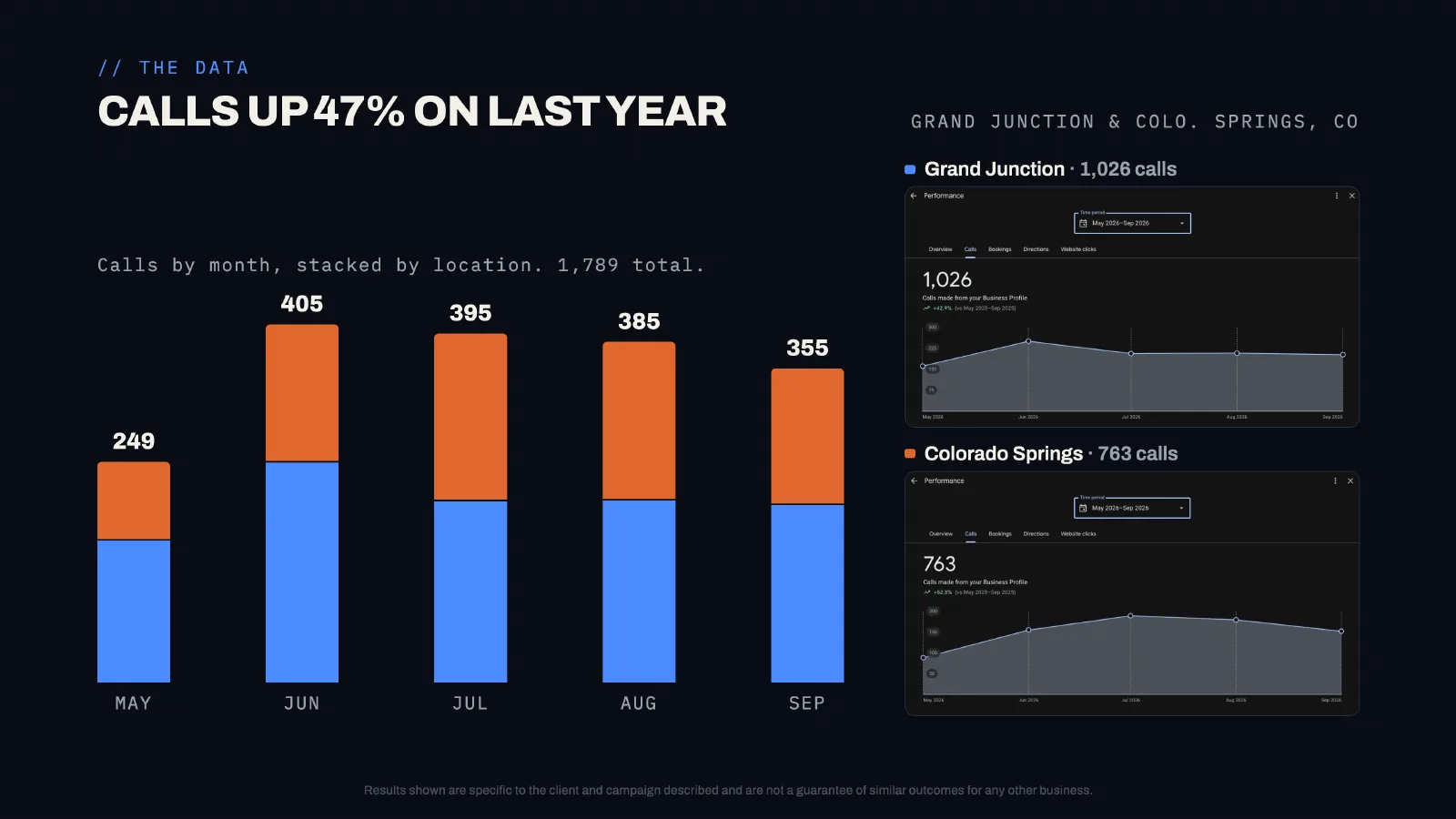
Across our pest control clients' 2026 reporting, the companies with the most calls from Google combine a few foundation and growth ideas and keep doing them. Cura Termite & Pest Control runs six Google profiles and produced 2,627 calls from Google from May to September 2026, up 77% on the year before. King Pest Solutions produced 1,789, up 47%. Scout Pest Control produced 1,438 across two profiles. MMPC Pest Solutions ranks #1 for "pest control long island," with 88% of its grid in the top three. None of that came from a single clever idea. It came from complete profiles, steady reviews, pest and city pages, links and real locations, done every month.
How do you test a marketing idea properly?
- Write down what success looks like before you start, in booked jobs or recurring plans.
- Give the idea its own tracking number, web address or CRM source code.
- Set a budget and a time limit long enough to get a real result, usually at least one full season month.
- Track every lead to an outcome in your CRM.
- Compare cost per recurring customer with your existing channels.
- Keep it, adjust it or drop it, and write down why.
Owners who test this way end up with a short list of channels they trust, instead of a long list of things they're paying for and hoping about.
Common mistakes with pest control marketing ideas
Trying too many ideas at once with no way to tell which one booked the job is the most common mistake:
- Trying ten ideas at once with one phone number, so nothing can be measured.
- Skipping the foundation and going straight to ads.
- Dropping an idea after two weeks in the off season.
- Copying national brands' marketing instead of using what a local company has: real people, real reviews and local knowledge.
- Rewarding reviews instead of referrals.
- Ignoring past customers while paying for new leads.
- Promising results a treatment can't deliver.