
Choose a pest control marketing agency that can show real results for pest control companies like yours, reports in calls and booked jobs instead of clicks, follows Google's rules on reviews and listings, leaves you owning your website, profiles, ad accounts and data, and explains exactly what it will do each month. Walk away from any agency that promises #1 rankings, offers to buy or filter reviews, wants to own your Google profile, or can't tell you where your calls come from.
Most pest control owners have worked with at least one marketing agency that didn't work out. The usual story: a monthly report full of impressions and keyword charts, a phone that didn't ring more, and a website or ad account the owner later found out they didn't control. This guide is a checklist for avoiding that. It covers what to look for, what to ask, the red flags that matter, and how to compare agencies fairly, including us.
We're a marketing agency for pest control companies, so read this knowing we have a stake. We've tried to write the guide we'd want a friend to read before hiring anyone, including the questions you should ask us.
What should a pest control marketing agency actually do?
Good agencies for pest control companies usually handle some or all of these:
| Area | What good work looks like |
|---|---|
| Google Business Profile and Maps | Complete, accurate profiles for each real location, review routines, photos, posts and grid rank tracking. See our Google Maps guide. |
| SEO | Pest and town pages with real local detail, technical fixes, local links and citations. See our SEO guide. |
| Website | Fast, mobile-first pages built to turn visitors into calls. See our website design guide. |
| Google Ads and LSA | Campaigns split by pest and season, negative keywords, lead disputes, call tracking. See our Google Ads and LSA guide. |
| AI search | Consistent listings, clear pages and monitoring of AI answers. See our AI search guide. |
| Tracking and reporting | Calls, forms and booked jobs by source and location, in plain language. |
Some agencies also run social media, email, direct mail or reputation software. Those can help, but they matter less than the first column for most pest control companies, where most calls start on Google.
What kinds of agencies work with pest control companies?
Four kinds: pest control specialists, home services agencies, general local SEO shops and big national firms. Each has different strengths:
| Type | Strengths | Watch for |
|---|---|---|
| Pest control specialist agency | Knows pest seasons, services, licensing and how pest customers search | Ask for real pest control results, not just a pest-themed website |
| Home services agency | Knows local search and service businesses well | May not know termite inspections, recurring plans or pest-specific seasons |
| General digital agency | Broad skills, often strong on design or ads | Local Maps work and service-area rules are often an afterthought |
| Software platform with "marketing included" | Convenient, tied to tools you may already use | Template websites, shared content and who owns the site if you leave |
| Lead seller or marketplace | Calls quickly with no setup | Leads may be shared with competitors, and you build nothing you own. See our lead generation guide. |
| Freelancer | Personal attention, often flexible | Coverage when they're busy or unavailable, and depth across channels |
None of these is automatically right or wrong. What matters is whether the people doing the work understand pest control and can show they've moved the numbers you care about.
What to look for in a pest control marketing agency
Real results for real pest control companies
Ask for case studies with company names, locations and numbers you could check: calls, map rankings, reviews. Look for agencies that show results from more than one client and are open about what didn't work. Be skeptical of results described only as percentages with no starting point, or screenshots with names hidden and no way to verify. Our own pest control results are on our pest control case studies page, with client names and the reports behind them.
Reporting in calls and booked jobs
Impressions, clicks and keyword rankings are useful to the agency. What you need to know is how many calls and form leads came in, from which source and which location, and how many turned into jobs and recurring customers. A good agency sets up call tracking and asks you for booked-job data from your CRM. If an agency can't tell you how many calls your Google profile produced last month, that's a problem.
You own everything
Before you start, confirm in writing that you'll own:
- Your domain name, registered in your company's name.
- Your website and its content, with a way to move it if you leave.
- Your Google Business Profiles, with you as primary owner and the agency as a manager.
- Your Google Ads and Local Services Ads accounts, billed to your payment method.
- Your Google Analytics, Search Console and tracking accounts.
- Your call tracking numbers, or a clear process to port them.
- Your photos, videos and reviews.
Google itself recommends that business owners stay as owners of their profiles and add agencies as managers. If an agency resists any of these, it's a sign they're building leverage, not results.
They follow Google's rules
Shortcuts can get reviews removed, profiles suspended or ad accounts banned. A good agency will refuse to:
- Add keywords or city names to your business name on Google.
- Create profiles at virtual offices or addresses where you don't have staff.
- Buy reviews, reward customers for reviews, ask only happy customers, or tell customers what to write. All of these break Google's review policy, and fake reviews are banned by the FTC's rule.
- Publish near-duplicate city pages that only swap the town name.
- Describe treatments as "safe" or "harmless," which the EPA treats as misleading for pesticides.
Ask a prospective agency how they get reviews for clients. If the answer includes filters, incentives, scripts telling customers what to say, or "review packages," keep looking. See our Google reviews guide for how a compliant review routine works.
They understand pest control
An agency doesn't need to have run a pest control company, but it should understand:
- That termite, rodent, bed bug, mosquito and general pest customers search and decide differently.
- Your seasons, and how budgets and content should follow them.
- Recurring plans and why a recurring customer is worth more than a one-time job.
- Commercial vs. residential work.
- Licensing and why it belongs on your site.
- That many pest companies are service-area businesses and how Google treats them.
- How Local Services Ads work for pest control, including Google Verified and lead disputes.
A good test: ask them how they'd market rodent exclusion in the fall vs. mosquito service in the spring. Specific answers mean they've done it.
A clear plan and a named person
You should know what the agency will do in the first 90 days, who's doing it, and who you'll talk to. Agencies that can only describe their work as "SEO" or "optimization" without specifics usually don't have a plan for you yet.

Red flags when hiring a pest control marketing agency
The biggest red flags are promised #1 rankings, accounts the agency owns instead of you, and reports with no calls in them:
| Red flag | Why it matters |
|---|---|
| Promising #1 rankings or a set number of calls | No one controls Google's rankings. Google's own guidance on hiring an SEO warns about anyone who claims a #1 spot. |
| Offering review packages or "reputation filters" | Buying, rewarding or filtering reviews breaks Google's policy and the FTC's rule |
| Wanting to own your Google profile, website or ad account | Leaves you stuck if you leave |
| Reports with no calls or leads | You can't tell if marketing is working |
| Adding keywords to your business name | Can get your profile suspended |
| A profile at an address you don't staff | Virtual offices are a common cause of suspensions |
| Same template site and content used for many clients | Duplicate content and nothing that sets you apart |
| Won't share ad account access or spend details | You should see exactly where your ad budget goes |
| Pushing a "secret system" or proprietary trick | Real local marketing isn't secret. It's consistent work. |
| No pest control results to show | You'll be paying for them to learn |
| Can't explain what they'll do this month | No plan, or the plan is thin |
25 questions to ask a pest control marketing agency
Results and proof
- Which pest control companies do you work with, and can I see their results with names?
- Can I speak to one or two of them?
- What results have you had in a market like mine, by size and competition?
- What's a client result that disappointed you, and what did you learn?
- How long did it take your clients to see more calls?
The work
- What will you do in the first 30, 60 and 90 days?
- Who will actually do the work, and who will I talk to?
- How do you decide which pest and town pages to build, and will you target towns where our routes are already dense?
- How do you handle a service-area business on Google Maps?
- How do you help us get more reviews without breaking Google's rules?
- When would you recommend a new location, and how do you set one up?
- How do you handle Local Services Ads, lead disputes and the 2026 move into Google Ads?
- How do you approach AI search?
- What's your plan for termite swarm season, mosquito season and the fall rodent push, and what happens in winter?
Reporting
- What will your monthly report include?
- How do you track calls and forms by source, location and pest, so we can see termite calls separately from general pest?
- Will you match calls to new recurring plans in FieldRoutes, PestPac, GorillaDesk or whatever we use, and report cancellations next to new sign-ups?
- How do you show map rankings across our service area, not just from our office?
- How often will we meet, and who attends?
Ownership and access
- Will we own our domain, website, Google profiles and ad accounts?
- Will we have admin access to everything from day one?
- If we leave, what do we take with us and how does the handover work?
- Who owns the call tracking numbers?
- Will you be added as a manager on our Google profiles, not the owner?
- Where does our ad spend go, and can we see it in our own account?
Three of these matter more in pest control than in most trades. Reporting in new recurring plans, not leads, matters because plan revenue is about 74% of the average pest control company's income (NPMA and PCO Bookkeepers, 2025), so a one-time wasp call and a quarterly plan are very different results. Targeting towns next to your existing stops matters because a cheap lead 30 minutes off-route can cost more in drive time than it earns. And net customer growth matters because a strong spring can be quietly erased by fall cancellations nobody counted against it.
What good answers sound like
Good answers are specific, name real work and real numbers, and admit what an agency can't control. Weak ones are vague:
| Question | A weak answer | A strong answer |
|---|---|---|
| How do you get reviews? | "We have a reputation system that sends happy customers to Google and unhappy ones to a feedback form." | "We help you ask every customer the same way, through the technician and a text, and you reply to every review. No incentives, no filters, no telling people what to say." |
| How will we know it's working? | "You'll see your keyword rankings going up." | "We'll report calls and forms by source and location each month, and compare them with your booked jobs." |
| How fast will we rank #1? | "Usually within 60 days." | "No one controls Google. Here's what we've seen with similar clients and how we'll measure progress." |
| Who owns the website? | "It's on our platform." | "You do. It's on your domain and hosting, and you have full access." |
| Can we add our next town? | "We'll make a page and a profile for it." | "If you have a real, staffed office there, yes. Otherwise we'll build a strong town page and use ads while you decide." |
How to check an agency's work yourself
You don't have to take an agency's word for anything. Twenty minutes of your own research tells you a lot:
- Look up their clients on Google Maps. Search each client's main service and town. Are they in the map pack? Is the profile complete, with recent reviews and real photos?
- Read the clients' reviews. Do they look natural and spread out over time, or do they arrive in bursts with similar wording?
- Check the business names. If clients' Google names are stuffed with keywords, like "Best Pest Control Exterminator Austin," the agency is taking risks with them.
- Visit the clients' websites on your phone. Are they fast? Is the phone number easy to tap? Do the pest and town pages say something real?
- Compare two client sites. If the text is nearly identical apart from the names, the agency is reusing content.
- Look at the agency's own reviews and how they reply to criticism.
- Call a reference without the agency on the line. Ask what changed, what didn't, and whether they'd hire them again.
How do pest control marketing agencies charge?
Agencies price their work in a few common ways. Each has trade-offs, and none is automatically better:
| Model | How it works | Questions to ask |
|---|---|---|
| Flat monthly fee | A set fee for a defined scope of work | Exactly what's included, and what costs extra? |
| Percentage of ad spend | The fee rises with your ad budget | Does the agency gain from you spending more, even when it isn't working? |
| Per lead or per call | You pay for each lead delivered | Are leads shared? Who owns the website and numbers they come through? |
| Setup or project fee | A one-time fee for a website or setup | Who owns the result, and what's needed afterward? |
| Software plus service | A platform fee with marketing bundled in | What happens to your site and data if you stop using the platform? |
Whatever the model, keep your ad spend separate and visible in your own accounts, and make sure the scope is written down. The cheapest option is often expensive if it builds nothing you own, and the most expensive option is only worth it if the calls follow.
Questions a good agency should ask you
The questions an agency asks in the first meeting tell you how they think. A good agency wants to know:
- Which services make you the most money, and which you want more of.
- Which towns you want to grow in, and where you have real offices.
- How many calls you get now, where they come from, and how many you book.
- Who answers the phone, and what happens after hours.
- Your seasonal pattern, and when you're short on work.
- How you ask for reviews today.
- What you've tried before, and what happened.
- Whether you run door-to-door, commercial or real estate programs.
- How many customers stay on recurring plans.
If an agency pitches a package before asking about any of this, they're selling what they have, not planning what you need.
Choosing an agency for a multi-location pest control company
With several offices, the stakes go up and so do the requirements:
- Location-level reporting. Calls, rankings and reviews for each office, so you can see which markets are growing and which need attention.
- Experience with multiple profiles. Setting up and verifying new locations, avoiding duplicate listings, and keeping details consistent.
- A plan for new markets. How they'd support a new office before its profile ranks, usually with ads and a strong location page.
- Consistent brand, local detail. Pages that share a look and structure but say something real about each town.
- Review routines at every office, not just the original one.
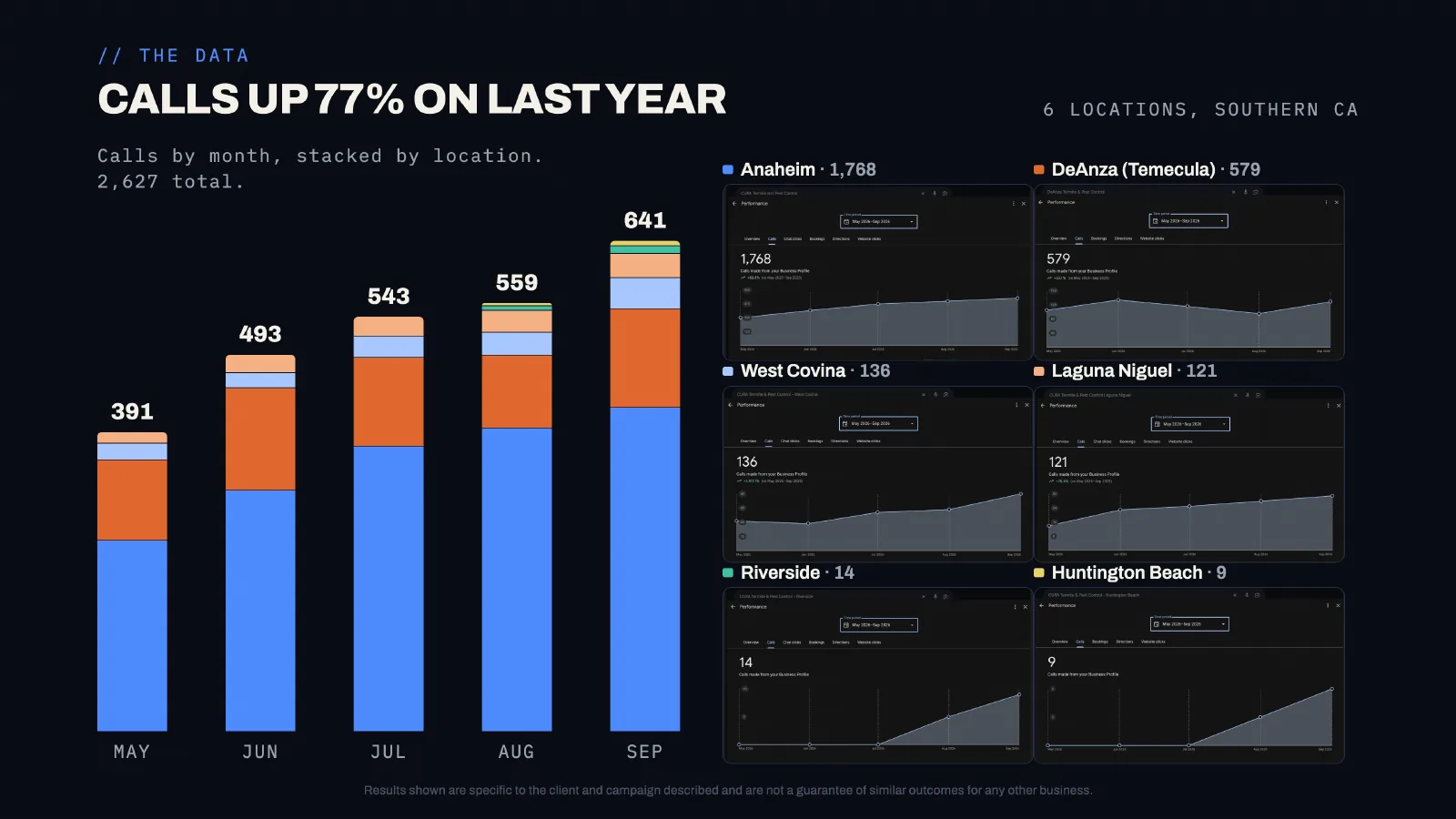
Cura runs six Google profiles across Southern California, and its reporting breaks calls and average map rank out by location. That's the level of detail to expect from any agency handling several offices.
Do you need one agency for everything?
Not necessarily. Some pest control companies use one agency for SEO, web and Maps, and another for ads. Others hire a specialist only for Local Services Ads. Splitting work can make sense if each partner is strong in its area, but it adds coordination:
- Make sure tracking is shared, so both partners see the same call data.
- Agree on who owns the Google profile work, since it affects both SEO and ads.
- Make sure ad landing pages match what the website team builds.
- Hold a joint review at least once a quarter.
For most small and mid-size pest control companies, one partner handling Google profiles, SEO, website and ads together is simpler, because those channels affect each other so much.
Common mistakes when hiring a marketing agency
Most owners regret the same thing: hiring on a sales call without checking work, access terms or real client results:
- Choosing the lowest price without comparing the actual work included.
- Hiring on a sales call without checking real client results.
- Handing over ownership of profiles or accounts to "make it easier."
- Not setting up call tracking before starting, so there's no baseline.
- Expecting map rankings to change in two weeks.
- Staying with an agency for years without asking what's changed.
- Letting the agency handle reviews entirely, instead of building the ask into every service visit.
- Not telling the agency about seasonal changes, new services or new offices.
How to compare agencies fairly
Agencies structure their work and pricing differently, which makes side-by-side comparison hard. Compare them on what they'll actually deliver:
- List the work. For each agency, write down exactly what's included: profiles, pages per month, link building, ads management, reporting and meetings.
- Separate ad spend from fees. Know what goes to Google and what goes to the agency.
- Compare proof. Named pest control clients, real numbers and references.
- Compare reporting. Ask each for a sample report and see if it shows calls and booked jobs.
- Compare ownership terms. What you keep if you leave.
- Compare people. Who you'd work with and how much pest control experience they have.
- Ask about your market specifically. A good agency will look at your profile, site and competitors before proposing anything.
For guidance on how much pest control companies typically put into marketing overall, see our pest control marketing budget guide.
Should you hire an agency, a person in-house, or do it yourself?
Do it yourself when you're small and have time, hire in-house once you have several locations and steady work for one person, and use an agency when you need specialist skills across maps, pages and ads at once:
| Option | Best when | Trade-offs |
|---|---|---|
| Do it yourself | You're small, have time, and one market | Your time goes to marketing instead of the business. Easy to fall behind in busy season. |
| In-house marketer | You have several locations and enough work for a full-time role | One person rarely covers SEO, ads, web and tracking all at expert level |
| Agency | You want specialists across channels and steady execution | You have to choose well and stay involved |
| Hybrid | An in-house person handles reviews, photos and posts, and an agency does SEO, web and ads | Needs clear division of work |
Whatever you choose, some things should stay in-house: answering calls, asking every customer for a review, taking real photos and knowing your numbers. No agency can do those for you.
What should happen in the first 90 days with a new agency?
By day 90 you should have full access in your name, a baseline, fixed profiles, tracked calls and a report in calls and new plan customers:
| When | What you should see |
|---|---|
| Week 1–2 | Access set up with you as owner, tracking installed, an audit of your profiles, site, ads and competitors |
| Week 3–4 | A written plan with priorities, quick fixes made to profiles and site |
| Month 2 | New or improved pest and town pages, review routine running, ads restructured if needed |
| Month 3 | First full report with calls by source and location, map grid baseline vs. now, next quarter's plan |
Map rankings and SEO usually take months to move, especially in competitive markets. Ads can move within weeks. If nothing has changed at all after 90 days, including the plan, profiles and tracking, ask why.
A simple scorecard for comparing agencies
Score each agency from 1 to 5 on each line after your calls and your own research. The totals matter less than the gaps. A 1 on ownership or rule-following should rule an agency out no matter what else it scores.
| Area | What a 5 looks like |
|---|---|
| Pest control proof | Named pest clients with call and ranking reports you can verify |
| References | Clients who'll talk to you without the agency present |
| Plan | A written 90-day plan specific to your profiles, site and market |
| Reporting | Calls and leads by source and location, tied to booked jobs |
| Ownership | You own the domain, site, profiles, ad accounts and tracking |
| Rules | Clear, compliant review routine and no shortcuts on listings |
| Pest knowledge | Specific answers about your services, seasons and recurring plans |
| People | A named contact who knows your account |
| Fit | Experience with companies your size and in markets like yours |
What a good monthly report looks like
Ask every agency for a sample report before you hire them. A useful one for a pest control company includes:
- Calls and form leads by source (Google profile, website, LSA, Search ads, other) and by location.
- The same numbers last month and last year, so seasonality doesn't fool anyone.
- Booked jobs and recurring plans from those leads, using your CRM data.
- Map grid rankings for your main services in each market, compared with the last report.
- Reviews: new reviews per location, average rating and response rate.
- Ads: spend, leads, cost per lead and disputed or credited LSA leads.
- Work completed this month in plain language.
- Next month's priorities, and anything the agency needs from you.
The report should be short enough to read in ten minutes. If you need the agency on a call to explain what it means, it's built for them, not you.
How to get the most from an agency once you've hired one
The best results we see come from owners who stay involved. A few habits that help any agency do better work:
- Share booked-job data from your CRM monthly, so results are measured in revenue, not just calls.
- Tell them what's changing: new services, new offices, staffing gaps, price changes and seasonal pushes.
- Keep the review ask going on every service visit. It's the one thing no agency can do for you.
- Send real photos from technicians every week.
- Listen to call recordings together now and then. Missed or poorly handled calls waste marketing.
- Meet monthly or quarterly and ask the same three questions: what did we do, what changed, what's next?
- Give feedback early when something isn't working, instead of quietly losing patience.
Marketing works best as a partnership. The agency brings the specialist work. You bring the service, the phones and the knowledge of your market. Together, that's what produces the call numbers on our pest control case studies page.
What pest control owners say about agencies
The most useful lessons we've heard come from owners who switched. Seth Fenn at Cura Termite & Pest Control paid a previous agency for "a couple years" of blog posts and said, "I don't think our domain authority, I don't think anything increased." Activity isn't the same as results. Ask what the work is supposed to change, and check that it does.

Forrest Jensen at Surge Pest Control built a door-to-door company first and added search marketing on top. His second Google profile in Leander produced 140 calls in its first five months. That's the other lesson: a good agency fits around how your business already wins customers, instead of replacing it. Read more in the Surge case study.

Choosing help when you're a new pest control company
If you're in your first year or two, your needs are different from a company with five offices. You need the foundation built correctly, not a big monthly program. Priorities:
- A verified Google Business Profile set up correctly from day one, with the right category and service areas, and you as owner.
- A simple, fast website on your own domain, with pages for your main pests and towns.
- Call tracking so you know what's working from the start.
- A review routine your technicians follow on every job.
- Local Services Ads, if you can meet the requirements and answer calls fast, to bring calls while the profile builds.
Be wary of anyone selling a new company a large, long program before any of these are in place. Surge Pest Control started at zero at the end of 2023 and reached about $2M in 2026 (owner-reported), mostly through door knocking, with search marketing built on top as it grew. The order matters.
Recovering after a bad agency experience
If you're coming off an agency that didn't work out, start by finding out what you have and what's broken:
- Recover ownership. Confirm you're primary owner on every Google profile, admin on your ad accounts, and in control of your domain and hosting.
- Check your Google profiles for keyword-stuffed names, wrong categories, duplicate listings or addresses you don't staff, and fix them carefully.
- Look at your review history for anything that could be flagged, like bursts or suspicious reviews, and stop any practice that broke Google's rules.
- Audit your website for thin or duplicated town pages, broken tracking, slow speed and pages with no real content.
- Review your ad accounts for wasted spend: missing negative keywords, broad campaigns and old LSA disputes you never filed.
- Set a baseline of calls by source and map grid rankings before the next partner starts, so you can measure real change.
The good news is that most damage is fixable. Profiles can be cleaned up, sites can be refreshed without losing what ranks, and ad accounts can be rebuilt. In Bodhi's audit of a $107K/month pest control company, the website looked "like it's from 2015," and the path forward was a modern front end and better local targeting, not starting over. See our website design guide for how that works.
How to leave an agency cleanly
Leave cleanly by confirming you own every profile, ad account, domain and tracking number before you give notice:
- Confirm you're primary owner on every Google profile, and remove agency users after the handover.
- Make sure your Google Ads and Local Services Ads accounts are billed to you and you're an admin.
- Get full access to your domain registrar, hosting and website.
- Take ownership of Google Analytics, Search Console and Tag Manager.
- Port or replace call tracking numbers, and update them on your site and listings.
- Download reports and keep a copy of historical data.
- Collect your photos, videos and content files.
- Check that no review platform, form tool or software is tied to the agency's accounts.
A good agency makes this easy. If you're worried about leaving before you've even started, that's worth paying attention to.
How to evaluate Stryker Digital
Ask us every question on this page. Here's what we can show you before you decide:
- Named pest control clients and their call reports, including Cura (2,627 calls from Google, May to September 2026, up 77%), King Pest Solutions (1,789, up 47%), Scout Pest Control (1,438) and MMPC Pest Solutions (744).
- Map grid reports across clients' service areas, not single rank checks.
- Video conversations with clients like Seth Fenn and Forrest Jensen, in their own words.
- A review routine that follows Google's policy: ask everyone, no incentives, no filters, no telling customers what to write.
- Your ownership of your profiles, website and ad accounts.
If we're not the right fit for your market or stage, we'll tell you.