
The best pest control leads come from sources where the homeowner found you and called you directly: your Google Business Profile and map rankings, your website's pest and city pages, Local Services Ads, referrals and repeat customers. Door-to-door sales are the other big engine for many fast-growing companies. Shared lead services and broad social ads can fill gaps, but the leads usually cost more per customer and close at lower rates. Whatever the source, the numbers that matter are how fast you answer, how many leads book, and how many become recurring customers who stay for years.
Pest control lead generation is really two jobs. The first is getting the phone to ring when someone finds mice in the garage or termite wings on the windowsill. The second is turning that first call into a customer on a recurring plan, because that's where the revenue in pest control comes from. A company that wins the first call and loses the customer after one treatment has to buy that customer again next year.
This guide compares every major pest control lead source, what each one costs and how it behaves, and how to measure them against each other. It uses data from our eight pest control clients, who got about 7,400 calls from their Google profiles and Google search between May and September 2026, and from two owners who've built their companies on a mix of search and door knocking.
What are the main pest control lead sources?
For most of our pest control clients, Google (map listings, SEO and ads) is the largest source of calls, alongside door-to-door, referrals and partners. Here's how they compare:
| Source | How you pay | Speed | Lead quality | Who owns it |
|---|---|---|---|---|
| Google Business Profile and Maps | Your time or an agency | Months to build, then steady | High. They called you | You |
| Website SEO (pest and city pages) | Your time or an agency | Months to build, then steady | High | You |
| Local Services Ads | Per lead | Weeks (after verification) | High intent, often urgent | Google sets the rules |
| Google Search ads | Per click | Days | Depends on keywords and landing pages | You, while you pay |
| Door-to-door sales | Sales team pay | Fast in season | Varies by rep and route | You |
| Referrals and neighbors | Low, sometimes a referral reward | Steady | Very high | You |
| Real estate and home inspection partners | Relationship time | Slow to start | High for termite inspections | You |
| Commercial outreach | Sales time | Slow | High value per account | You |
| Lead services and marketplaces | Per lead or subscription | Days | Often shared with other companies | The platform |
| Meta (Facebook and Instagram) ads | Per impression or click | Days | Lower intent, better for seasonal offers | You, while you pay |
| Direct mail and door hangers | Printing and postage | Weeks | Low response rate, but local | You |
| Email and text to past customers | Low | Immediate | High | You |
The pattern: sources you own get cheaper over time, and sources you rent cost the same or more every year. Most healthy pest control companies use both, with owned sources carrying more of the load as they grow.
What is a pest control lead worth?
Before you can say whether a lead source is expensive, you need to know what a customer is worth to you. The math is simple, and every owner should do it with their own numbers. Here's how it works, with example numbers only to show the steps:
| Step | Example |
|---|---|
| Average revenue per recurring service visit | Your average price per visit |
| Visits per year on the plan | 4 for a quarterly plan |
| Average years a plan customer stays | From your CRM's cancellation history |
| Gross margin on that service | After technician time, product and vehicle cost |
| Lifetime gross profit per plan customer | Visit revenue × visits per year × years × margin |
| Leads needed per plan customer | From your close rate and plan sign-up rate by source |
| Most you can pay per lead and still profit | Lifetime gross profit ÷ leads needed, minus a safety margin |
Most owners who do this for the first time find that a recurring customer is worth much more than they assumed, and that the source with the cheapest leads isn't always the cheapest source. It also shows why retention matters: a customer who stays twice as long makes every lead source twice as profitable.
Do leads behave differently by pest?
Yes, and it changes which channels work best for each service.
| Service | How customers buy | Best channels |
|---|---|---|
| General pest (ants, spiders, roaches) | Often urgent, often price-aware, good fit for recurring plans | Google profile, LSA, door-to-door, referrals |
| Rodents | Urgent and stressful, especially indoors. Exclusion work is higher value | Google profile, LSA, Search ads for "mice exterminator" type searches |
| Termites | Slower, higher-value decisions, often triggered by a home sale or a swarm | Real estate partners, termite pages, Search ads in swarm season |
| Bed bugs | Very urgent and private. People want fast answers and discretion | Search ads, LSA, a strong bed bug page |
| Mosquitoes | Seasonal and planned. Good fit for seasonal plans | Meta ads, door-to-door, past customer emails before summer |
| Wildlife | Urgent, specialized, often licensed separately | Google profile with the right category, Search ads |
| Commercial | Slow, documented, recurring | Direct outreach, referrals, commercial pages |
Building a page for each pest is how organic search catches all of these. Termite and bed bug pages often produce the highest-value leads per visit. For page structure, see our pest control SEO guide.
Why is Google the biggest lead source for most pest control companies?
Because people with a pest problem search for help, usually on their phone, and usually call one of the first companies they see. For our pest control clients, the Google Business Profile is where most calls start.
| Client | Market | Calls from Google, May–Sep 2026 |
|---|---|---|
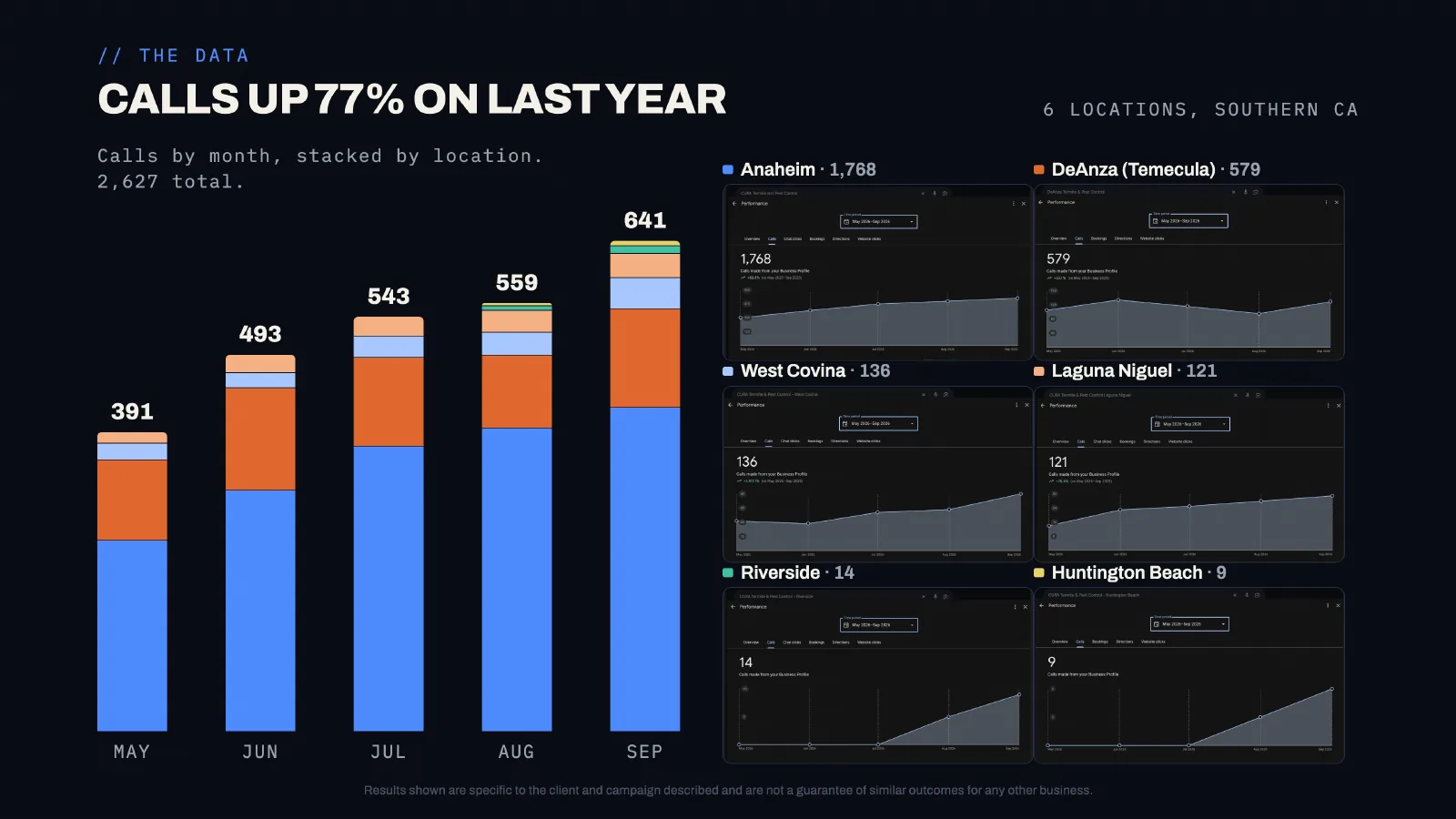
| Cura Termite & Pest Control | Southern California, 6 locations | 2,627, up 77% year over year |
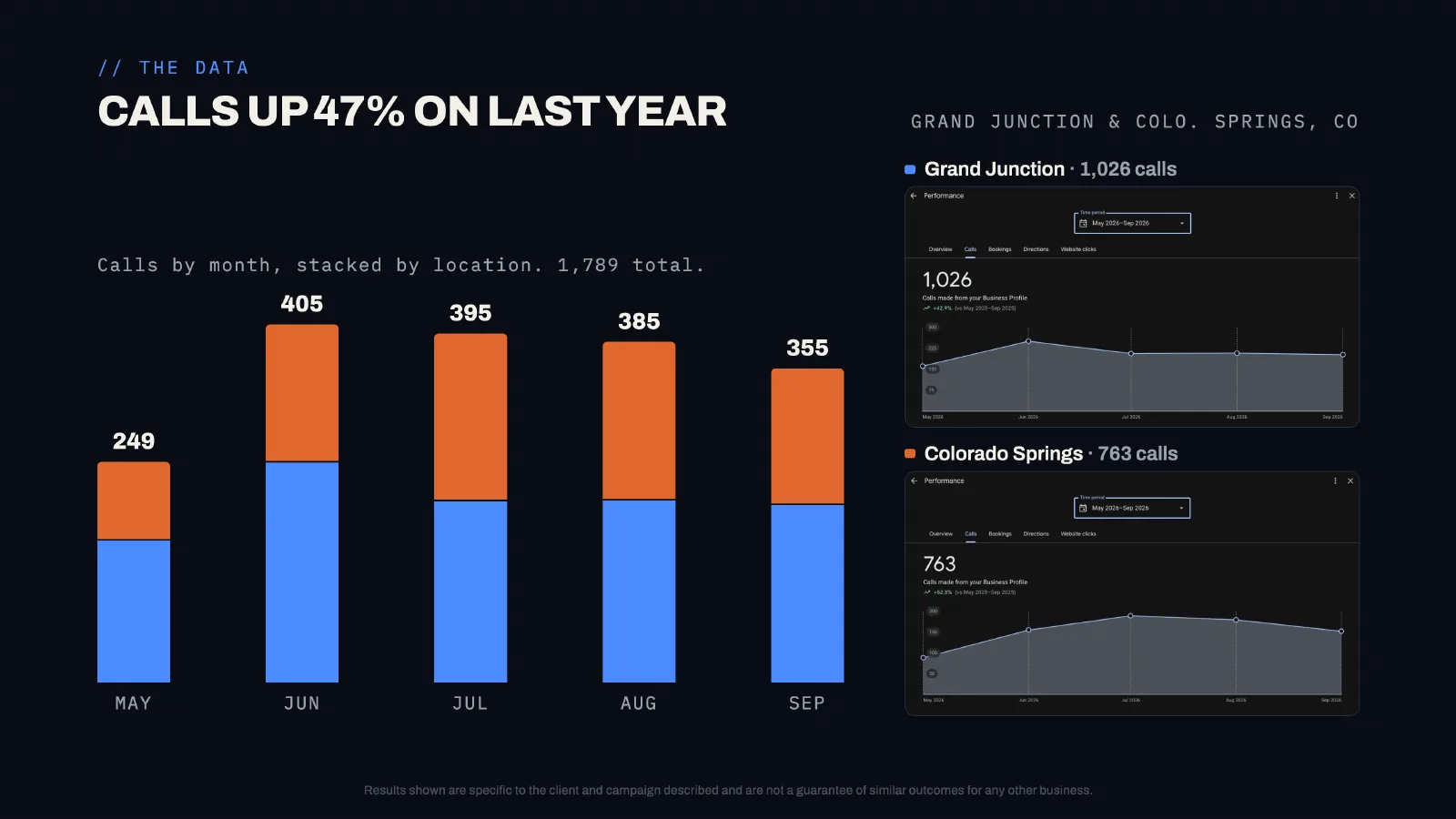
| King Pest Solutions | Grand Junction and Colorado Springs, CO | 1,789, up 47% year over year |
| Scout Pest Control | Tanner and Huntsville, AL | 1,438 |
| MMPC Pest Solutions | Long Island City, Queens, NY | 744 |
| Surge Pest Control | Georgetown and Leander, TX | 415 |
| Bad Termite | Granada Hills, CA | 159, up year over year |
Those calls come from three things working together: a complete Google Business Profile with steady reviews, map rankings across the service area, and pest and city pages on the website. Each has its own guide: Google reviews and Business Profile, Google Maps and pest control SEO.
Where do paid Google leads fit?
Local Services Ads and Search ads put you at the top of the page right away. LSA charges per valid lead and shows the Google Verified badge. Search ads charge per click and let you target specific pests and towns. Both work best on top of a strong profile, because LSA ranks partly on your reviews and both convert better when the customer can see a good rating. Costs vary a lot by market, service and competition. The full setup, including Google's 2026 move of LSA into Google Ads, is in our Google Ads and LSA guide for pest control.
How does door-to-door fit with digital marketing?
Door-to-door sales are a major growth engine in pest control, and two of our clients say so directly. Forrest Jensen calls door-to-door the core of Surge Pest Control, which he started from zero at the end of 2023, grew to about $500K in its first year, and is taking to about $2M in 2026 (owner-reported). Seth Fenn names Cura's three best channels as "the SEO, our door knocking, and then obviously Yelp."
Door knocking and search reach different people. A sales rep finds homeowners who weren't looking yet and signs them up for prevention. Search catches people who have a problem today and are looking right now. The two support each other:
- Homeowners who meet a rep often search the company name before signing. A strong Google profile with recent reviews helps close that sale.
- Door-to-door customers become reviewers, which helps the profile rank for the urgent searches.
- Dense routes from door knocking make every truck more efficient, which makes paid leads in the same neighborhoods more profitable.
Door-to-door has rules. Many cities and counties require solicitation permits, so check locally before a team goes out. The FTC's Cooling-Off Rule generally gives buyers three business days to cancel qualifying sales made at their home, and requires sellers to give a written cancellation notice. Some states have their own additional rules.

We're honest about what we drive at Surge. Most of its growth comes from Forrest's door-to-door team. We run the SEO and Google profiles, and we're one part of the growth, not the cause of it. Forrest's second Google profile, in Leander, produced 140 calls in its first five months of tracking. Read more in the Surge Pest Control case study.
How do you get more referrals?
Referrals are usually the cheapest and best-closing pest control leads. Recurring customers see your technicians every few months and talk to neighbors. You can encourage that:
- Ask at the right time. Right after a problem is solved, a technician can mention that most new customers come from neighbors.
- Offer a referral reward for customers who send a neighbor who signs up, such as a credit on their next service. This is different from reviews: rewarding a referral is common, but Google bans any reward for a review.
- Use yard signs where local rules and homeowners allow, especially during treatments for visible problems like mosquitoes.
- Be on Nextdoor. Neighbors ask for recommendations there constantly. Keep your business page complete and respond when you're tagged.
- Track referrals as their own lead source in your CRM, with the referring customer's name.
Can real estate agents and home inspectors send you leads?
Yes, especially for termite work. In many states, wood-destroying insect inspections are common during home sales, and lenders sometimes require them. Agents, home inspectors and title companies need a company that can schedule quickly and deliver clear reports on time.
- Offer fast scheduling for real estate inspections and stick to it.
- Deliver clean, readable reports the agent can share.
- Follow up after the sale. A new homeowner who just learned about termite risk is a good candidate for a prevention plan.
- Build relationships in person: brokerage meetings, inspector associations and local real estate events.
Links from real estate partners' websites also help your SEO, a bonus covered in our pest control SEO guide.
How do you get commercial pest control leads?
Commercial accounts like restaurants, property management companies, warehouses, schools and medical offices bring scheduled recurring service and fewer cancellations. They're also slower to win. Commercial leads usually come from:
- Direct outreach to businesses in your area, by phone, email and in person.
- A commercial page on your website that explains inspections, documentation and service schedules for each industry.
- Search ads for commercial terms, run in their own campaign.
- Referrals from property managers, facility managers and other vendors who serve the same businesses.
- Business associations and chambers of commerce.
Commercial buyers want documentation, consistent service and someone who answers when an inspector is coming. Make that easy and the accounts tend to stay.
Want this built for your pest control company? Book a free growth call and we'll review your Google profiles, site and rankings.
Book a Growth CallCan other home service companies send you leads?
Yes. Lawn care companies, landscapers, roofers, HVAC companies, plumbers, handymen and home inspectors all see pest problems they don't treat: mice in the attic, wasps in the soffits, termite damage behind a wall, ants along the foundation. A referral relationship with a few trusted companies in your area can send steady, pre-qualified leads, and you can return the favor when your technicians spot a roof leak or a failing AC unit.
- Pick partners whose customers overlap with yours and whose service quality you'd vouch for.
- Agree on how referrals are passed, by text, a shared form or a simple card.
- Track partner referrals in your CRM by partner name, and thank them often.
- Property managers and HOAs are partners too, often with many homes or units under one decision maker.
What do our clients' numbers say about lead sources?
A few patterns show up across our eight pest control clients' 2026 reporting:
- More real locations, more calls. The companies with the most calls from Google run more than one Google Business Profile. Cura has six, and King, Scout, Surge and State Termite each have two.
- Established profiles carry the load. Newer profiles start slow and take months of reviews, pages and links to catch up.
- Growth compounds. Cura's calls from Google rose every month from May to September 2026, from 391 to 641, and were up 77% on the year before. King's were up 47%.
- Owned search and sales work together. The two owners who talk about door knocking, Forrest Jensen and Seth Fenn, also put SEO and Google at the center of their marketing.
Every client and market is different, and these are results from specific companies, not a promise. They do show what the owned channels can produce once they're built. More detail is in our pest control case studies.
How do you test a new lead source?
New lead sources pitch pest control owners constantly. Test them the same way every time, so you can compare fairly:
- Set a fixed test budget and length, long enough to get a real sample, such as one full season month.
- Give it its own tracking number or lead source code in your CRM.
- Track every lead to an outcome: booked, not booked and why, and plan signed or not.
- Calculate cost per booked job and cost per recurring plan at the end of the test.
- Compare against your existing sources using the same math.
- Decide on numbers, not on the platform's dashboard. Platforms report their own results, and they tend to look good.
Watch for red flags while you test: leads outside your area, services you don't offer, the same lead sold to several companies, contacts who don't remember asking for a quote, and pressure to sign a long commitment before you've seen results.
Are lead services like Angi and Thumbtack worth it?
Lead marketplaces and directories sell leads or advertising to service businesses. For pest control, they can fill a schedule in a slow week or test a new town. Before relying on them, understand how they work:
| Question | Why it matters |
|---|---|
| Is the lead shared with other companies? | Shared leads mean you're racing several competitors, often on price |
| Do you pay for leads you can't use? | Wrong service, wrong area, and duplicates add up |
| Can you get credits for bad leads? | Some platforms credit them, some don't |
| Who owns the customer relationship? | Some platforms keep messaging inside their app |
| What do they close at for you? | Track it in your CRM, not on the platform's dashboard |
Yelp is a special case. It's a review site and an ad platform, and in some markets, especially in California, it's a real source of calls, which is why Seth Fenn names it among Cura's top three. Keep your Yelp profile complete and reply to reviews. Yelp's rules don't allow businesses to ask customers for Yelp reviews, so let those come on their own.

Lead services work best as a supplement. If they're your main source, every customer costs the same next year as this year.
Do Facebook and Instagram ads work for pest control?
They work differently from Google. On Google, people are searching for help. On Facebook and Instagram, you're interrupting people who weren't thinking about pests. That makes Meta ads better for:
- Seasonal prevention offers, like mosquito service before summer or rodent exclusion before fall.
- Brand awareness in neighborhoods where your door-to-door team or trucks are active.
- Remarketing to people who visited your website but didn't call.
- Recruiting technicians, which is a different goal but often the biggest bottleneck to growth.
Meta ads are weaker for urgent problems. Someone with bed bugs tonight searches Google. Judge Meta campaigns on booked customers, and expect a lower close rate than search leads.
Is direct mail still worth it for pest control?
It can be, in the right neighborhoods. USPS Every Door Direct Mail lets you mail every address on chosen carrier routes without buying a mailing list, which fits pest control's route-based business. Door hangers do the same job around active customers' homes. Response rates are low, so mail works best when it's:
- Targeted to neighborhoods where you already have customers and dense routes.
- Timed to the season for that pest.
- Tracked with its own phone number or web address.
- Paired with your Google reviews, since people search your name before calling.
What about past customers and cancelled plans?
Your cheapest leads are people who already know you. Past one-time customers, cancelled plans and customers who moved within your area are all worth contacting:
- Seasonal reminders to past customers before their pest season, by email and text.
- Win-back offers to cancelled plans, with a plain explanation of what's included.
- Cross-sell to current customers: termite protection for general pest customers, mosquito service for summer, rodent exclusion for fall.
- Movers: customers who move within your area are easy to keep if you ask.
For texts, get consent and follow the rules. Federal rules under the Telephone Consumer Protection Act require consent for many marketing texts, and recipients must be able to opt out. Your CRM or texting provider should handle opt-in records and opt-outs.
Can technicians generate leads?
Technicians are in customers' homes and neighborhoods every day, which makes them one of the most overlooked lead sources in pest control. Many companies pay technicians a small bonus for leads they bring in, like a neighbor who asks about service or an add-on the customer signs up for.
- Add-on services: a general pest customer with termite risk factors, or a yard that needs mosquito service.
- Neighbors: people who stop the technician to ask about a problem. Leave a door hanger next door after each service.
- Problems found on site: rodent entry points, moisture problems or wood damage that need follow-up work.
Train technicians to explain what they found plainly and leave the sales pressure out. A homeowner who trusts the technician is far more likely to say yes. Track technician-sourced leads in your CRM so you can see who's bringing them in.
Do truck wraps and community events bring leads?
They're slower and harder to measure, but they help. A clean, branded truck parked in a driveway every week tells the neighbors who services that house. Community events like school sponsorships, local festivals and youth sports put your name in front of families in your service area. Neither one makes the phone ring by itself. Both make the next search, door knock or mailer more likely to work, because the homeowner already recognizes the name. If you track them, use a dedicated web address or phone number on the wrap or event material.
Is AI search becoming a lead source?
It's starting to be. Google's AI Overviews and tools like ChatGPT now answer questions like "best pest control company near me" or "how do I get rid of termites" directly, sometimes naming local companies. Those answers draw on your website, your Google profile, your reviews and what other sites say about you. It's still a small share of calls for most pest control companies, but it's growing, and the same work that wins on Google today helps there. More in our AI search guide for pest control.
How does lead generation change with more locations?
Each location needs its own lead engine. A Google profile can only rank well around its own address, so a second office with its own profile is how most of our clients win calls in a new market. Cura's six locations produced 2,627 calls from Google from May to September 2026. Its Anaheim office alone produced 1,768. Newer profiles start slower, so plan on paid ads and partner outreach to fill the months before a new profile ranks.
- Give each location its own tracked phone numbers, Google profile, location page and LSA setup.
- Report leads and recurring customers by location, not just company-wide.
- Route leads to the location that will service them, so nothing falls between offices.
- Expect each new location to need months of reviews, pages and links before it pulls its weight.
How should lead generation change through the year?
Build in late winter, push termites and ants in spring, mosquitoes and stinging insects in summer, rodents in fall, and spend winter on retention and reviews:
| Time of year | Lead focus |
|---|---|
| Late winter | Prepare: reviews, pages and ad campaigns ready before spring. Termite pages and partner outreach ahead of swarm season |
| Spring | Door-to-door teams out, LSA and Search ad budgets up, mosquito pre-sales to past customers |
| Summer | Peak demand: call handling, overflow coverage and full budgets. Push recurring plan sign-ups |
| Fall | Rodent and exclusion campaigns, win-back emails to cancelled plans |
| Winter | Commercial outreach, new location setup, website and SEO work for next season |
Timing varies by region. In warmer parts of the country, pest pressure runs much longer, and some pests stay active year round. Use your own call history by month to set the calendar.
How fast do you need to answer pest control leads?
As fast as possible. Pest problems are stressful. People with mice in the kitchen or bed bugs in the bedroom usually call the next company if the first one doesn't answer. Missed calls also cost you directly: Google can charge for missed Local Services Ads calls during business hours and counts them against your responsiveness.
- Answer live during business hours, with overflow coverage in peak season.
- Send an automatic text to missed callers asking what pest they're dealing with.
- Reply to forms and messages within minutes during business hours.
- Make sure the person answering can book on the first call.
- Review call recordings weekly, including calls that didn't book.
How do you turn leads into recurring customers?
The first service is where you win the customer. The plan is where you keep them.
- Explain the recurring plan on the first call: what's included, how often you visit, and what happens if pests come back between visits.
- Have the technician offer it again on site, after the problem is handled and the customer has seen the result.
- Follow up a few days after one-time services with the plan option.
- Make signing up easy: on the technician's tablet, by text link or by phone.
- Track the share of first-time customers who sign up for a plan, by lead source.
That last number changes how you judge lead sources. A source with cheap leads that rarely sign up for plans can be more expensive than one with pricey leads that usually do.
Why is retention part of lead generation?
Every customer who cancels has to be replaced by a new lead. Cutting cancellations is often the cheapest way to grow, because it makes every lead source more profitable at once. The most common reasons recurring pest control customers cancel are predictable: they stop seeing pests and decide they don't need service, they don't understand what they're paying for, a technician misses an appointment, or a competitor knocks on the door with a lower price.
- Explain every visit. Leave a short service note or send a text summary: what was treated, what the technician saw, and what to watch for.
- Remind before each visit, so customers expect the technician and know when they're coming.
- Handle callbacks fast. A customer who sees pests between visits and gets a quick re-service usually stays. One who waits a week often leaves.
- Call before cancellations go through. Many cancellations are about price or a misunderstanding that a short conversation can fix.
- Track retention by lead source and by technician. If customers from one source or one route cancel faster, that's worth knowing.
Retention also feeds your review flow and referrals. Long-term customers see your technicians the most, and they're the ones neighbors ask.
How do you compare lead sources fairly?
Cost per lead is the wrong number. The right one is cost per recurring customer, and ideally what each source's customers are worth over time.
| Metric | How to get it |
|---|---|
| Leads by source | Required lead source field in your CRM, separate tracking numbers for each channel |
| Booked jobs by source | CRM job records linked to the lead |
| Recurring plans by source | CRM plan sign-ups linked to the lead source |
| Cost per recurring customer | Spend on the source divided by plans signed from it |
| Retention by source | Share of each source's customers still active after 12 months |
Separate tracking numbers matter. Give your Google Business Profile, website, Local Services Ads, Search ads, mail and door hangers each their own number, so the CRM can tell them apart. Local Services Ads calls use Google's own number and never touch your website, so Google Analytics won't see them.
A lead generation plan by company stage
Start with the Google profile and referrals, add paid Google ads and pages as you grow, and add locations, partners and commercial once routes are full:
| Stage | Focus |
|---|---|
| Starting out | Google Business Profile and reviews, referrals, door-to-door if you have the team, Local Services Ads once reviews build |
| Growing in one market | Pest and city pages, map rankings across the service area, Search ads for high-value pests, real estate partners |
| Adding locations | A real office and Google profile in each market, ads to cover the months a new profile takes to rank |
| Established | Commercial outreach, retention and cross-sell, AI search visibility, testing new channels with their own tracking |
For how much to spend at each stage, see our pest control marketing budget guide. For fresh ideas within each channel, see pest control marketing ideas.

Step-by-step: building a pest control lead generation system
- Set up tracking first. A required lead source field in the CRM and separate tracking numbers for each channel.
- Fix call handling. Live answers, missed-call texts and booking on the first call.
- Build the Google profile and reviews. Complete every field and ask every customer for a review.
- Add pest and city pages. One page for each pest you treat and each town you serve.
- Turn on Local Services Ads. Once you have reviews and reliable call handling.
- Build referral and partner sources. Referral rewards, Nextdoor, real estate agents and inspectors.
- Offer the recurring plan every time. On the call, on site and in follow-up.
- Compare sources monthly by cost per recurring customer. Move money toward what produces customers who stay.
Common pest control lead generation mistakes
The most common is judging a channel by cost per lead instead of cost per recurring customer:
- Judging channels by cost per lead instead of cost per recurring customer.
- Sending every channel to one phone number, so nobody knows what works.
- Relying on rented lead sources with nothing owned underneath.
- Missing calls during the busiest hours of peak season.
- Never offering a recurring plan after one-time services.
- Ignoring past customers and cancelled plans.
- Running Meta ads for urgent problems that people search for on Google.
- Rewarding customers for reviews instead of referrals.